
LoNE: Liquid on Neural Engine



LFM3 and LFM2.5 on the Apple Neural Engine, via Core ML. Decode is bandwidth-bound on the ANE, so LoNE targets MLX-class throughput at a lower power envelope; it also works around the ANE's fp16 arithmetic failures, which are the precision rules below.
Install
Apple Silicon, macOS 15+, Python 3.11+. The distribution is lone-ane on
PyPI; it installs the lone command.
pip install lone-ane                  # run / serve / chat
pip install 'lone-ane[convert,chat]'  # conversion + HF chat templates
For a development checkout: uv venv && source .venv/bin/activate && uv pip install -e '.[convert,chat]'.
convert adds torch 2.7.0 and scikit-learn (coremltools' k-means palettizer); chat adds
transformers for exact chat-template rendering — lone chat works without it, using the bundled
Jinja template.
Homebrew
brew tap aj-gonzalez/lone https://github.com/AJ-Gonzalez/LoNE
brew trust aj-gonzalez/lone
brew install lone-ane
Builds the released source tag (v0.1.1) into an isolated Python 3.12 venv with runtime
dependencies from PyPI. Conversion extras are opt-in:
"$(brew --prefix lone-ane)/libexec/bin/pip" install "torch==2.7.0" "scikit-learn>=1.4,<1.6" "transformers>=5.0"
Quick start
lone convert --model /path/to/LFM3-1.7B --out bundles/lfm3-1.7b --ctx 2048 --prefill 64
lone run --bundle bundles/lfm3-1.7b --chat --prompt "Explain RoPE in two sentences" --max-new-tokens 128
lone chat --bundle bundles/lfm3-1.7b
lone serve --bundle bundles/lfm3-1.7b --port 8082
lone inspect --bundle bundles/lfm3-1.7b
lone verify --bundle bundles/lfm3-1.7b --model /path/to/LFM3-1.7B \
    --prompt "Explain in one sentence why the sky is blue."
Convert flags: --precision fp16|lut4|lut6|lut8, --layers-per-model 4, --head-chunks (0 sizes
each head graph to ~128 MB), --decode-only/--prefill-only, --ring/--no-ring, --no-plan,
--spec-drafts N (adds the verify shape; see below).
Weights are stored once per sequence shape, so a full bundle is ~2x the fp16 checkpoint;
--decode-only halves it. --no-ring keeps a full-ctx cache for sliding layers.
lone verify runs the HF checkpoint in a subprocess, then the bundle's decode path in the parent,
printing logits cosine, argmax, per-layer hidden drift and (with --max-new-tokens) the first greedy
divergence. It exits 1 below --min-cos (default 0.999). Run it before trusting a conversion.
Chat
lone chat --bundle bundles/lfm3-1.7b --system "Be terse."
One process, one stats block per turn (measured on the 230M bundle):
you> Hi
lone> Hello! How can I help you today
  prefill 11 tok 0.10 s 104.8 tok/s 0.97 W · decode 5 tok 0.08 s 66.6 tok/s 0.73 W
  ctx 17/128 (13.3%) · mem 0.59 GB rss · 0.07 GB free · ane io 11.15 GB
Prefill is measured until the first sampled token (the /metrics convention), decode after it.
ctx counts the tokens held; mem is process RSS and system free memory; the watts are the ANE rail
from the PMP group — cumulative, system-wide counters, so short turns are noisy; ane io is ANE
read+write traffic. History is fed incrementally — each turn prefills only the tokens the template
added — and /reset clears the conversation while keeping the weights loaded, which is the point of
a REPL here: a fresh process re-specialises every graph (8 s measured for the 230M bundle).
Speculative decoding
lone convert --model /path/to/LFM3-1.7B --out bundles/lfm3-1.7b-spec \
    --ctx 512 --precision lut8 --spec-drafts 16
lone run --bundle bundles/lfm3-1.7b-spec --spec-ngram --max-new-tokens 128 --prompt "..."
Decode is bandwidth-bound here: one token re-reads the whole stack, so 16 tokens cost about the
same as one when they go through a single graph. --spec-drafts 16 converts that graph — the
prefill shape becomes 17 tokens (one pending token plus 16 drafts) and the LM head is traced at the
same length, so a verify pass returns one logits row per position from one weight read.
The proposer is llama.cpp's ngram-simple, reimplemented verbatim (src/lone/spec.py): rescans the
token history for the most recent earlier occurrence of the last --spec-n (12) tokens and drafts
the following --spec-m (16) tokens, with llama.cpp's quirks — needs n + m + 1 tokens of history,
ignores a match at position 0, drops drafts shorter than n. It is a copy engine, so it only pays
on repeated text (editing, refactoring, copying a file); on prose it drafts nothing and costs
nothing.
Acceptance is exact, not greedy-only: a draft token is accepted with the target's own probability
for it and a rejected position draws from the target minus that token, so --temperature/--top-k/
--top-p keep their distribution. At temperature 0 the accepted sequence is what plain greedy
decode produces, except where the two graph shapes disagree on a near-tie: measured 0.9999 logits
cosine between them, 96/96 identical tokens on a 230M copy test, 124/128 (96.9%) on the LUT8 1.7B.
Quality is unchanged: speculation only changes which graph shape computes the logits, and the accept rule is exact rejection sampling, so sampled output keeps the target distribution. Greedy, 128 new tokens, LUT8 coder on the NE, both arms on the same prompt: identical on a chat copy request, a code task and prose; 124/128 on the repeated-text workload, where the one divergence sits on a 0.09-logit top-2 margin (a tie in fp16) and everything after it differs.
Measured (this M1, one process, both arms interleaved after a warmup; rates exclude prefill):
| Bundle, engine | Workload | No spec | Spec | Acceptance | Tokens/pass |
|---|---|---|---|---|---|
| LFM2.5-230M fp16, ctx 256, 4 drafts, CPU | copy, temp 0 | 64.0 tok/s | 124.1 tok/s (1.94×) | 93.8% | 1.88 |
| LFM3-1.7B LUT8 coder, ctx 512, 16 drafts, NE | repeat, temp 0 | 23.2 tok/s | 84.4 tok/s (3.64×) | 91.1% | 5.08 |
| same | copy (chat turn), temp 0.1 | 19.1 tok/s | 23.3 tok/s (1.22×) | 79.0% | 1.56 |
| same | novel prose (control) | 22.8 tok/s | 24.0 tok/s (1.05×) | 43.8% | — |
One verify pass costs 1.40 decode passes on the NE (1.45 on Metal), so break-even is 1.40 tokens/pass and the speedup tracks how much verbatim text the model emits. On the ANE the repeat workload also drops from 64.8 to 23.2 mJ/token on the engine rail; a workload the proposer cannot exploit costs about 5%, and energy per token there was 63.0 → 60.5 mJ.
Partial acceptance rewinds the caches to the accepted prefix. K/V rows are written at absolute
positions and the mask admits nothing at or past pos, so stale rows are overwritten by the next
pass; conv layers get their window from an extra graph output (conv_<i>_window, the previous
window concatenated with this pass's inputs), which makes any prefix of the pass addressable.
Serve
curl -s localhost:8082/v1/chat/completions -H 'Content-Type: application/json' -d '{
  "model": "lfm3-1.7b",
  "messages": [{"role": "user", "content": "Hi"}],
  "max_tokens": 64
}'
| Endpoint | Notes |
|---|---|
POST /v1/chat/completions |
OpenAI chat schema, SSE when stream: true |
POST /v1/completions |
raw prompt, SSE when stream: true |
GET /v1/models, /health |
harness probes |
GET /metrics |
prefill/decode seconds and rates, last-request ANE bytes (IOReport; streams included) |
One request at a time; Core ML serialises predictions anyway. --cpu-only and
--compute-units {cpu_and_ne,cpu_and_gpu,cpu_only,all} select the engine. Point EvalPlus
(--backend openai), lm-eval (local-chat-completions) or Harbor at the OpenAI endpoint.
Precision rules
The ANE's arithmetic differs from torch's fp16 in three measurable ways; torch_model implements
all three, and lone verify exists because per-op conversion parity does not catch them.
| Rule | Why (measured) |
|---|---|
| Wide reductions split (FFN > 4096, head hidden > 1024) | one 6656-wide projection 0.9972; two 3328-wide 0.999994 |
| Wide reductions scaled by 2^4 (any k > 1024; weights ×16, output ×1/16) | products otherwise fall subnormal: LFM3 conv out_proj 0.99916 → 0.9999998 |
SiLU as x / (1 + exp(-x)) |
Core ML's fused silu/sigmoid is an NE approximation ~1e-3 off; gate 0.99935 → 0.999991 |
Power-of-two scaling is exact in fp16 unless it overflows; 2^4 stays far below the maximum. Norm
reductions need none of this — mean over 2048 measured exact on the ANE.
Chunk size is not a precision knob once those rules are in place: 230M measures 0.99981 (1 layer), 0.99976 (2) and 0.99990 (4) at ctx 128; LFM3-1.7B measures 0.99977 at 4. The old 0.9968 / 0.9969 readings predate the scaled reductions and exact SiLU. Fewer graphs are also cheaper — each pays a start-up ramp — worth 1.58× on 230M (17.6 → 11.1 ms/token) and inside noise on LFM3.
Measured (M1, 8 GB)
Parity (lone verify, decode path):
| Model | Placement | Logits cosine | Notes |
|---|---|---|---|
| LFM2.5-230M (ctx 128) | CPU | 0.99987 | greedy 2 tokens identical, then EOS differs |
| LFM2.5-350M (ctx 128) | CPU | 0.99989 | greedy 12/12 identical |
| LFM3-1.7B (ctx 512, 4 layers/graph) | NE | 0.99977 | hidden min 0.99958; argmax match |
Placement is MLComputePlan over every chunk. The M1 planner declines the small LFM2.5 graphs, so
only LFM3 runs on the NE here; those rows are CPU-path parity.
Speeds and power by engine. Power is the engine's PMP rail, idle-subtracted, via IOReport without root; rate and power come from the same window.
| Engine | Weights | Prefill tok/s | Decode tok/s | Prefill power | Decode power | J/token (decode) |
|---|---|---|---|---|---|---|
ANE (CPU_AND_NE) |
fp16, 4.0 GB | 50.9 (32 tok) | 8.5 | 0.25 W | 0.59 W | 0.070 |
CPU (CPU_ONLY) |
fp16, 4.0 GB | 2.73 (32 tok) | 0.20 | 0.45 W | 1.64 W | 8.2 |
| GPU (MLX 4-bit, Metal) | 4-bit, 0.95 GB | 385.9 (512 tok) | 53.3 | 9.12 W | 6.04 W | 0.113 |
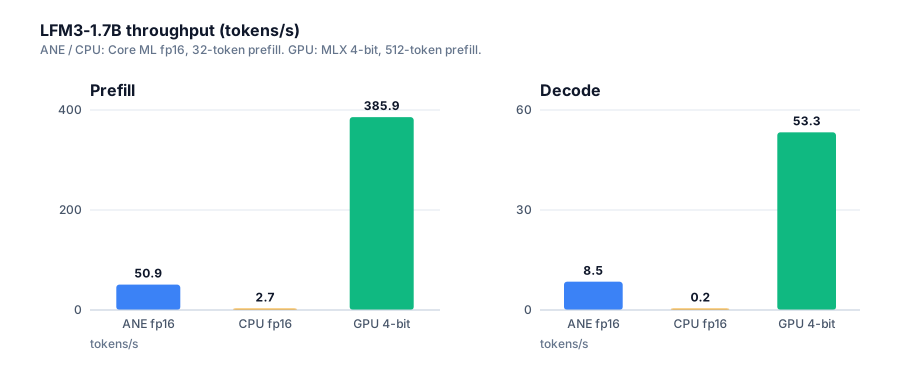
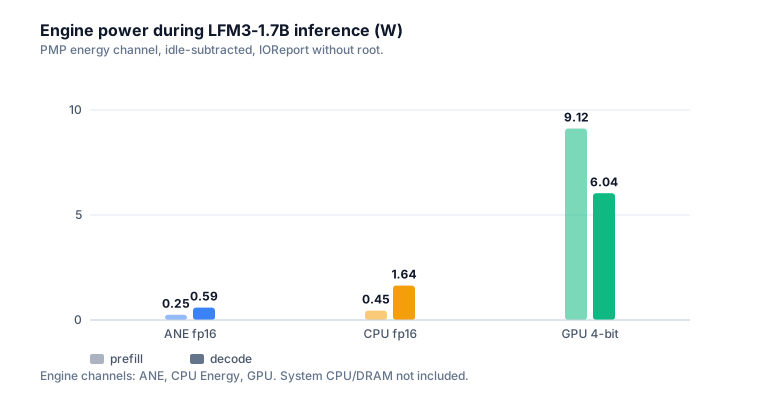
Engine numbers, not wall power: decode adds ~1.7 W of CPU orchestration and ~0.9 W of DRAM; the CPU
row's work power is 2.82 W. The GPU row is 4-bit while ANE/CPU are fp16, so it is not
quantization-controlled. LFM3 ANE decode varies 2–13 tok/s with weight residency (8.5 in the
instrumented window, 13.2 warm, ~2 when 4 GB stream from SSD), so pair rate and power from one run.
CPU_AND_GPU is not a GPU path: 0.51 tok/s at 0.07 W.
Quantized ANE (LFM3-1.7B) — all place every op on the NE; none meets the fp16 parity bar:
| Weights | Bundle | Decode | ANE power | Energy/token | Logits cosine |
|---|---|---|---|---|---|
| fp16 | 4.0 GB | 13.2 tok/s | 0.59 W | 0.070 J | 0.99977 |
| LUT8 | 2.2 GB | 23.1 tok/s | — | — | 0.9985 |
| LUT6 | 1.8 GB | 20.5 tok/s | 0.87 W | 0.039 J | 0.9526 |
| LUT4 | 1.4 GB | 30.7 tok/s | 0.88 W | 0.037 J | 0.786 |
* LUT8's parity is from a 57-token code prompt (LUT6 measures 0.9616 there); other rows use an earlier, shorter prompt. Power for 8-bit weights is not measured.
Each extra LUT bit buys ~0.04 logits cosine in the 6–8 range; 8-bit is the only format near the
bar, and 6-bit parity needs QAT. Those power figures are 1–2.5 s window averages; a 60 s sustained
LUT6 run measured 23.7 tok/s at 1.04 W (43.9 mJ/token) with no throttling, and ~3.7 W system-wide
with CPU and DRAM. A wall/package figure needs powermetrics (root) or a meter.
Limits
- Static shapes.
ctxand prefill length are frozen at conversion; prompt remainders decode one token at a time. Caches are allocated at load:ctxrows for full-attention layers, the window for sliding ones. LFM3 costs 22.5 KB per context token before the ring, so 32k allocates 0.40 GB of cache instead of 0.74 (64k: 0.81 vs 1.5; 128k: 1.6 vs 2.9). 32k fits on 8 GB; 128k is swap-bound[INFERENCE]— the longest measured run is a 401-token verification at ctx 512.--wire-caches(run, chat, serve) pins caches withmlock(2)so pressure evicts the mmap-backed weights instead. - fp16 / palettized only. No fp32 ANE path; palettized weights trade accuracy (above).
- Speculation stores a second copy of the weights.
--spec-drafts Nsets the prefill shape to N+1, and LoNE stores weights once per sequence shape, so the chunks double. A 1.7B LUT8 bundle with a verify shape is 4.4 GB (loads on 8 GB); the fp16 equivalent is 8 GB and does not. - One request, no batching; no left-padded prompts.
- Prefill models load lazily, decode models at startup; a full bundle stores both shapes.
- Not implemented: tools/structured output,
logit_bias,n,logprobs;stopstrings apply to the decoded text after generation. Sharded checkpoints are unsupported. - Depth costs accuracy. LFM3's hidden cosine falls 0.999995 → 0.99958 over 24 layers; at 1 layer per graph, greedy output diverged from HF after 6 tokens (ctx 256) despite 0.99977 logits cosine.
How it works
The stack is split into contiguous chunks, one mlprogram per sequence shape (prefill and decode).
Caches are ordinary tensors owned by the runtime — K/V per attention layer and the
conv_kernel-1 window per conv layer — concatenated as past || new inside the graph with an
additive mask keyed by absolute position. No Core ML state buffers, so conversion stays on
TorchScript. The LM head is vocabulary slices on the ANE; the embedding gather runs on the CPU.
Sliding layers keep a ring buffer sized to their window (256 for LFM3) instead of ctx: row
p % window holds absolute position p, the runtime writes new keys there, and the mask resolves
rows back to positions, so the graph reads 256 keys where it used to read ctx. Same attention,
only the rotation changes; --no-ring restores the full-ctx cache. Verified through the wrap
(401-token prompt, ctx 512): 0.99991 logits cosine, argmax match.
Notes and unverified ideas
External suggestions not yet measured — LUT4 + pruning + retraining, and emitting the MIL graph
directly in Swift: docs/notes.md.
1 maintainer

Metadata
1 maintainer
Release files for lone-ane 0.1.1
For a detailed explanation of source distributions (sdists) and built distributions (wheels), please see the package formats documentation.
Source distribution (sdist)
| File | Size | Uploaded | Provenance | Actions |
|---|---|---|---|---|
| lone_ane-0.1.1.tar.gz | 58.9 kB | With provenance | Details for lone_ane-0.1.1.tar.gz |
Built distribution (wheel)
| File | Interpreter | ABI | Platform | Actions Reset |
|---|---|---|---|---|
| lone_ane-0.1.1-py3-none-any.whl | Python 3 | none | any | Details for lone_ane-0.1.1-py3-none-any.whl |
Total release size: 110.4 kB
Release files / lone_ane-0.1.1.tar.gz
| Download URL | lone_ane-0.1.1.tar.gz |
|---|---|
| Size | 58.9 kB |
| Tags | Source |
|
SHA-256 checksum How to use checksums |
1654b561bd249f6a403ee78496554c2ea450e73f0a4bcb4c8a0e56c6a4204d8b
|
|
BLAKE2b-256 checksum How to use checksums |
d569fa5cd43035a3dc092b5d4546e3ec98fb2c498d01f4f212e3b8465a1c9be9
|
| Upload date | |
|
Uploaded using Trusted Publishing? What is trusted publishing? |
Yes |
| Uploaded via |
twine/7.0.0 CPython/3.13.16
|
Provenance
Provenance describes where a file came from. On PyPI, provenance is shared via attestations, which provide a verifiable record of the build or publishing details. View details, limitations and caveats.


PyPI Publish Attestation
PyPI verified that this artifact, at this checksum, originated from the publisher listed below.
Signed by GitHub Actions, verified by PyPI on Nov 13, 2026.
Transparency logRelease files / lone_ane-0.1.1-py3-none-any.whl
| Download URL | lone_ane-0.1.1-py3-none-any.whl |
|---|---|
| Size | 51.5 kB |
| Tags | Python 3 |
|
SHA-256 checksum How to use checksums |
7266a76a53e7411269badc8a8ef3fe9080a37d0a7fa0c4e6291fe45aa60fb9d6
|
|
BLAKE2b-256 checksum How to use checksums |
c893f8752c946459d1b7219e14101206afb9aba83b90ad985d4114975eec1764
|
| Upload date | |
|
Uploaded using Trusted Publishing? What is trusted publishing? |
Yes |
| Uploaded via |
twine/7.0.0 CPython/3.13.16
|
Provenance
Provenance describes where a file came from. On PyPI, provenance is shared via attestations, which provide a verifiable record of the build or publishing details. View details, limitations and caveats.
PyPI Publish Attestation
PyPI verified that this artifact, at this checksum, originated from the publisher listed below.
Signed by GitHub Actions, verified by PyPI on Nov 13, 2026.
Transparency logSecurity for lone-ane 0.1.1
Provenance
Provenance describes where a file came from. On PyPI, provenance is shared via attestations, which provide a verifiable record of the build or publishing details. View details, limitations and caveats.
Full provenance
Both files in this release have been uploaded with provenance metadata.
Attestation for lone_ane-0.1.1.tar.gz
PyPI Publish Attestation
PyPI verified that this artifact, at this checksum, originated from the publisher listed below.
Signed by GitHub Actions, verified by PyPI on Nov 13, 2026.
Transparency logA note on package security
PyPI is a repository for distributing packages, not a service for auditing them. While third-party security researchers and our staff do their best to detect and remove malicious packages, PyPI cannot guarantee the quality, security or suitability of any given package.
To learn more about protecting yourself from malicious actors, visit our package security documentation.














