
A diffusion-driven procedural noise library.

Project description
Longdin Noise
What is it?
Longdin Noise is a noise type that uses per-pixel vectors to propagate pixel values.
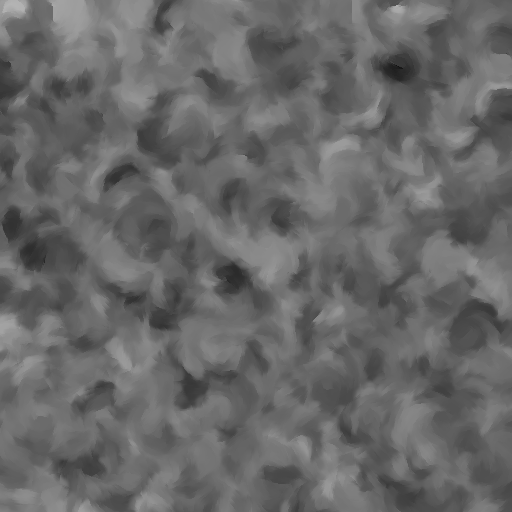
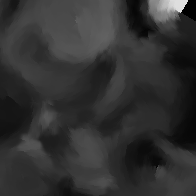
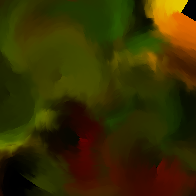
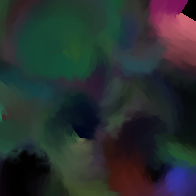
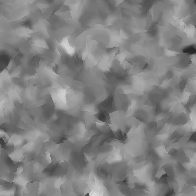
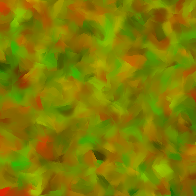
It is interesting in the fact that two different configurations can produce wildly different results. A high density with low iterations can produce a blocky, glitchy looking noise. A low density with high iterations can produce a sort of bubbly or brush-like noise.
Why was it made?
For no particular reason really. It's strange pattern makes it impractical for common examples in games (like landscapes for video game with Perlin Noise). It's definitely an example of more artistic noise - although, if you can find a genuinely practical use for this thing, please do let me know via my email!
It started off as a desperate wrestle with the boney hands of boredom. It's strange to think the wonders one's mind can produce when one is desperately in need of something to do - or, indeed, type. If you ever find yourself desperately bored with nothing to do, create a new python file and type the following:
class Universe:
    pass
There's something about the openness of an unimplemented class that allows the mind to wonder. It doesn't have to be Universe. It can really be anything - in my case it gradually morphed into _Noise. Although, the broad topic that is the entirety of existence is definitely effective.
The Inner-Workings
All three of the generator functions first instantiates a _Noise object. _Noise is an internal class and is not intended for use outside of the API.
Initialisation
When _Noise instantiates, it generates a 2D numpy array that takes on the shape (height, width, channels) where channels is either 1, 2, or 3. (more on that later!) These are the cell 'values'. It generates another array of the shape (height, width, 2) to store each cell's influence vector.
The density (a float bigger than 0 up to 1) is just the percentage of 'cells' that are active. The generator decides which cells should be inactive using this value and zeros out each of these inactive cells.
The Algorithm
Each iteration runs the same algorithm on the data that either the initialisation or last iterative pass produced.
First things first, it gets all active cells and shuffles that data's order. A cell is active if it has an influence vector and a value associated. The shuffle helps to mitigate undesired and unpleasant row artifacts produced by the parallelism used to speed up the algorithm.
The algorithm then loops through all active cells. For each cell, it does the following:
- Get all cells within the radius of the active cell (excludes cells if the active cell is not pointing towards them within 90°)
- Computes the distance from the origin (active cell) to each cell within its range (radius)
- Uses the distance to compute the influence the active cell has on each cell
- Each cell is then lerped towards the active cell's data using the calculated influence as the factor.
To finish off the iteration, the list of active cells is updated ready for the next iteration.
Installation
pip install longdin-noise
How to use it?
Here's a quick example of how one may use this library using PIL:
from longdin_noise import generate_mono
from PIL import Image
import numpy as np

result = generate_mono((512, 512), 42, 0.05, 10)

# result is a (512, 512) array of floats in the range 0..1
# multiply by 255 and convert to uint8 for PIL
image_data = (result * 255).astype(np.uint8)
img = Image.fromarray(image_data, mode="L")
img.save("mono_noise.png")
This will create you a lovely greyscale image using the longdin_noise python library:
Parameters
| Parameter | Type | Default | Valid Range | Description |
|---|---|---|---|---|
| size | tuple[int, int] | — | Any positive ints | Width and height of the output |
| seed | int | — | Any int | Random seed |
| density | float | — | 0 < x ≤ 1 | Proportion of initially active pixels |
| iterations | int | — | ≥ 1 | Number of diffusion passes |
| radius | int | 8 | ≥ 1 | Influence reach in pixels |
Tweaking the Values
The effect the values have on the resulting noise can be obscure and difficult to figure out at first. Hopefully this short guide can help you to understand how to craft your desired effect.
The number of iterations — in short — just increases the amount of smearing in the noise. As the vectors' influences propagate outwards every iteration, the colours mix more and boundaries become less clear.
The density will basically dictate how noisy the image is. A really, really low density like 0.0005 - especially on a low number of iterations like 1 - 4 - scatters 'searchlights' across the image. I have yet to find a use for this but it's pretty cool. A high density creates a more tightly packed image where blending between colours occurs much sooner in the iterative process.
The radius is quite simple. It just affects how far each active cell can influence. I haven't had an opportunity to experiment with this much, but it should have an 'octaves' effect where higher values create simpler noise.
Example Images
Low density, high iterations (0.005 Density, 20 Iterations)
| Mono | Bi | Tri |
|---|---|---|
 |
 |
 |
High density, low iterations (0.6 Density, 4 Iterations)
| Mono | Bi | Tri |
|---|---|---|
 |
 |
 |
Dependencies
This module requires numpy and numba.
License
This is under the MIT license. Truly do whatever you want with this code and what it produces.
Release history Release notifications | RSS feed


Download files
Download the file for your platform. If you're not sure which to choose, learn more about installing packages.
Source Distribution
Built Distribution
Filter files by name, interpreter, ABI, and platform.
If you're not sure about the file name format, learn more about wheel file names.
Copy a direct link to the current filters
File details
Details for the file longdin_noise-0.1.1.tar.gz.
File metadata
- Download URL: longdin_noise-0.1.1.tar.gz
- Upload date:
- Size: 333.7 kB
- Tags: Source
- Uploaded using Trusted Publishing? No
- Uploaded via: twine/6.2.0 CPython/3.14.3
File hashes
| Algorithm | Hash digest | |
|---|---|---|
| SHA256 |
310c6a483d90d0a73f96705228e6900f627d167bd9c762182f33c0ff8af5e768
|
|
| MD5 |
6ba1aeee2b32d4f395ddb57b397e61be
|
|
| BLAKE2b-256 |
bad4eab8b53f9b69b74811d56f4e7ccf135bde1881dd27ceed9357f15a188dfc
|
File details
Details for the file longdin_noise-0.1.1-py3-none-any.whl.
File metadata
- Download URL: longdin_noise-0.1.1-py3-none-any.whl
- Upload date:
- Size: 6.7 kB
- Tags: Python 3
- Uploaded using Trusted Publishing? No
- Uploaded via: twine/6.2.0 CPython/3.14.3
File hashes
| Algorithm | Hash digest | |
|---|---|---|
| SHA256 |
7de4d09035c3c86655da45fb85708b5fa7d333cc1b2471fc0e126ddea2161d2e
|
|
| MD5 |
fc8b95c4b7bf95f90fe8f5589df6a5f5
|
|
| BLAKE2b-256 |
75822ffc120a5242e00e2e2061400c6012f762229fb7784c8bf8cfb08eaeacf1
|






