

In-flight circuit breaker & reasoning loop recovery for LangGraph & LangChain agents









⚡ Quick Start · 📖 Documentation · Why LongGuard? · 🌐 Part of Long Suite · Loop Detectors · CI/CD Ready
Overview
"Why did my agent just burn $14 repeating the exact same search 20 times?" — now you have an in-flight circuit breaker that detects loops and recovers gracefully.
When autonomous LLM agents hit an unexpected hurdle, they often get trapped in repetitive reasoning loops: calling identical tools with the same parameters, oscillating between two conflicting thoughts, or drifting aimlessly while burning thousands of tokens.
LangGraph's built-in recursion_limit is a hard crash (GraphRecursionError). It drops state, discards user context, and provides zero opportunity for recovery.
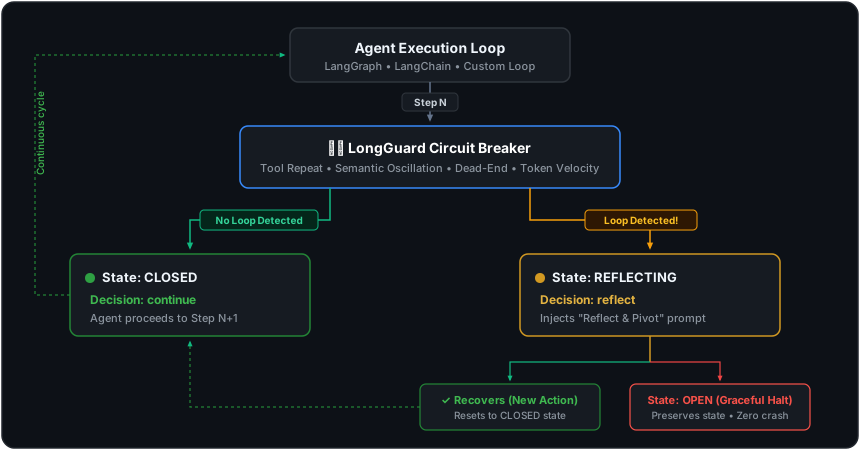
LongGuard is an intelligent circuit breaker middleware. It monitors your agent's chain-of-thought in real time, catches loops early, injects a "Reflect & Pivot" prompt to guide the agent back on track, and only halts (kill) gracefully if recovery fails—preserving complete state and token analytics.
🌐 Part of the Long Suite
LongGuard is part of the EnDevSols Long Suite of open-source production AI tools:
- LongParser — High-speed, privacy-first local document ingestion & chunking (PDF, DOCX, PPTX, XLSX)
- LongTrainer — Production multi-tenant RAG chatbot and agent framework
- LongTracer — Post-generation hallucination detection via hybrid STS + NLI claim verification
- LongProbe — Sub-second RAG retrieval regression testing with pytest
- LongGuard — In-flight runtime agent circuit breaker & reasoning loop recovery ← You are here
Together, the Long Suite covers the full AI lifecycle from data ingestion and retrieval CI regression to runtime agent safety and post-generation verification.
💡 Why LongGuard?
- ⚡ Sub-millisecond overhead: Evaluates in-flight agent steps without slowing down LLM inference.
- 🔄 4 loop detectors: Catches tool repetition, semantic oscillation, dead-end drift, and token velocity spikes.
- 🧭 Reflect & Pivot prompt injection: Guides stuck agents back on track before giving up.
- 🛡️ Zero unhandled crashes: Gracefully terminates and preserves conversation state if recovery fails.
- 🔌 1-line integration: Drop-in wrapper for LangGraph 1.0+ (
add_guard_to_graph) and LangChain (GuardedAgentExecutor). - 🐍 Raw client support (v0.1.3): Use LongGuard directly with
openaioranthropicSDK — no LangGraph needed. - 💵 Dollar cost tracking (v0.1.3): Built-in pricing for 40+ models. Set
max_cost_usdto hard-kill on budget overrun. - 📊 Full observability: Detailed
GuardReportwith per-step telemetry. Save to JSON/YAML. Load for offline analysis. - 🧪 255 passing tests: Strict MyPy typing and Ruff linted across Python 3.10–3.12.
🏗️ Architecture
⚡ Quick Start
Installation
# Core package (standalone, zero heavy dependencies)
pip install longguard

# With LangGraph integration (LangGraph 1.0+)
pip install longguard[langgraph]

# With LangChain integration
pip install longguard[langchain]

# With high-quality sentence embeddings
pip install longguard[embeddings]

# Everything
pip install longguard[all]
1. LangGraph Integration (1 Line)
Compatible with LangGraph 1.0+ and modern multimodal models (Claude 3.7, Gemini 2.5, GPT-4o):
from langgraph.graph import StateGraph
from longguard.integrations.langgraph import add_guard_to_graph
from longguard import GuardConfig

# 1. Build your LangGraph workflow as usual
workflow = StateGraph(AgentState)
workflow.add_node("agent", agent_node)
workflow.add_node("tools", tool_node)
workflow.add_edge("agent", "tools")
workflow.add_conditional_edges("tools", should_continue)

# 2. Add LongGuard in one line!
workflow = add_guard_to_graph(workflow, GuardConfig())
app = workflow.compile()

# 3. Read execution telemetry after run
guard = workflow.__longguard__
print(guard.get_report().summary())
2. Raw OpenAI / Anthropic Client (No LangChain needed)
Call LongGuard directly from any while loop — works with plain openai or anthropic SDK:
import openai
from longguard import AgentStep, CircuitBreaker, GuardConfig

client = openai.OpenAI()
breaker = CircuitBreaker(GuardConfig(
    model="gpt-4o",        # enables dollar-cost tracking
    max_cost_usd=0.50,     # hard-kill if run exceeds $0.50
    max_steps=30,
))

observation = None
for i in range(1, 31):
    response = client.chat.completions.create(model="gpt-4o", messages=messages)

    # One-line conversion from SDK response → AgentStep
    step = AgentStep.from_openai_response(response, step_number=i, observation=observation)
    decision = breaker.check(step)

    if decision.action == "kill":
        print(f"⛔ Halted: {decision.reason}")
        break
    elif decision.action == "reflect":
        messages.append({"role": "system", "content": decision.inject_prompt})

    if step.action is None:
        break  # final answer
    observation = run_tool(step.action, step.action_input)

# Full run report including estimated cost
print(breaker.report.summary())
# → Estimated Cost: $0.0143 USD (gpt-4o)
For Anthropic: use
AgentStep.from_anthropic_response(response, step_number=i)— same API, zero dependencies.
3. Standalone / Custom Agent Loop
If you run a custom while loop or proprietary agent orchestrator:
from longguard import CircuitBreaker, GuardConfig, AgentStep

breaker = CircuitBreaker(GuardConfig(
    tool_repeat_threshold=3,    # 3 identical tool calls = trigger
    max_tokens_per_run=50_000,  # Hard token cap
))

for step in run_agent():
    decision = breaker.check(AgentStep(
        step_number=step.index,
        thought=step.thought,
        action=step.tool_name,
        action_input=step.arguments,
        observation=step.tool_output,
        tokens_used=step.tokens,
    ))

    if decision.action == "reflect":
        # Inject the recovery advice into your agent's context
        messages.append({"role": "user", "content": decision.inject_prompt})
    elif decision.action == "kill":
        print(f"Halted safely: {decision.reason}")
        break

# View summary report
print(breaker.report.summary())
🔍 The 4 Loop Detectors
| Detector | What It Catches | Real-World Example |
|---|---|---|
| 🔄 Tool Repeat | Calling the same tool with identical inputs $\ge N$ times | Agent calls search("revenue 2025") 4 times with zero parameter changes |
| 🌀 Semantic Oscillation | Cycling between the same concepts in reasoning | Agent reasons "Option A", then "No, B", then "Actually A", then "No, B" |
| 📉 Dead-End Drift | Zero new information or observations for 5+ steps | Queries return empty results or repetitive error strings |
| ⚡ Token Velocity | Sudden exponential token spikes per step | Agent injects giant raw HTML payloads into context, blowing budget |
📊 LongGuard vs. LangGraph recursion_limit
| Capability | LangGraph recursion_limit |
LongGuard 🛡️ |
|---|---|---|
| Detects Tool-Repeat Loops | ❌ No | ✅ Yes |
| Detects Semantic Reasoning Loops | ❌ No | ✅ Yes |
| Detects Sudden Cost / Token Spikes | ❌ No | ✅ Yes |
| Auto-Injects Recovery Prompts | ❌ No | ✅ Yes |
| Exit Behavior | 💥 Unhandled Exception (Crash) |
🛡️ Graceful State Preservation |
| Run Reporting & Telemetry | ❌ No | ✅ JSON & Summary Reports |
| Configurable Thresholds | ❌ Single integer | ✅ Granular GuardConfig |
⚙️ Configuration at a Glance
All behavior is customizable through GuardConfig:
from longguard import GuardConfig

config = GuardConfig(
    # Loop Detection Sensitivity
    tool_repeat_threshold=3,          # Repeated tool calls before reflection
    tool_repeat_window=6,             # History window to examine
    dead_end_threshold=5,             # Steps with no progress before triggering
    token_velocity_multiplier=3.0,    # Spike multiplier vs rolling baseline

    # Hard Safety Guardrails
    max_tokens_per_run=50_000,        # Hard stop if agent burns > 50k tokens
    max_steps=30,                     # Maximum steps permitted
    max_reflections=2,                # Maximum recovery attempts before kill

    # Dollar Cost Tracking (v0.1.3)
    model="gpt-4o",                   # Enables built-in cost estimation
    max_cost_usd=0.50,                # Hard-kill if run exceeds $0.50
    # cost_per_input_token=2.5e-6,    # Override for unlisted models (USD/token)
    # cost_per_output_token=10e-6,
)
👉 For detailed documentation on custom detectors, embedding backends, and LangSmith telemetry, see the Full Documentation.
🧪 CI/CD Ready
Run the test suite locally with uv or pytest:
# Run all 255 unit & integration tests
uv run pytest tests/ -v

# Run with coverage report
uv run pytest tests/ --cov=longguard --cov-report=term-missing

# Run code style & type checks
uv run ruff check src/ tests/
uv run mypy src/
Every push and pull request is automatically tested across Python 3.10, 3.11, and 3.12 on both Ubuntu and macOS via GitHub Actions.
🤝 Contributing
Contributions are welcome! Please see CONTRIBUTING.md for guidelines on code formatting, running tests, and opening pull requests.
🛡️ Security
For vulnerability disclosures, please review SECURITY.md or contact technology@endevsols.com.
📄 License
LongGuard is open-source software released under the MIT License.
1 maintainer

Download files
Download the file for your platform. If you're not sure which to choose, learn more about installing packages.
Source Distribution
Built Distribution
Filter files by name, interpreter, ABI, and platform.
If you're not sure about the file name format, learn more about wheel file names.
Copy a direct link to the current filters
File details
Details for the file longguard-0.1.3.tar.gz.
File metadata
- Download URL: longguard-0.1.3.tar.gz
- Upload date:
- Size: 284.3 kB
- Tags: Source
- Uploaded using Trusted Publishing? No
- Uploaded via:
uv/0.9.22 {"installer":{"name":"uv","version":"0.9.22","subcommand":["publish"]},"python":null,"implementation":{"name":null,"version":null},"distro":{"name":"macOS","version":null,"id":null,"libc":null},"system":{"name":null,"release":null},"cpu":null,"openssl_version":null,"setuptools_version":null,"rustc_version":null,"ci":null}
File hashes
| Algorithm | Hash digest | |
|---|---|---|
| SHA256 |
71bdabee5d91715f3e5829e1a1ebdda0a15b1e610257d196e7030b46b19ea614
|
|
| MD5 |
9b902680694203dc64fa22a9df69f9e2
|
|
| BLAKE2b-256 |
6932aa2a7846e46b6101a2b359a087629bb63b7825dd06cf4ae3ec9ae0df1cee
|
File details
Details for the file longguard-0.1.3-py3-none-any.whl.
File metadata
- Download URL: longguard-0.1.3-py3-none-any.whl
- Upload date:
- Size: 49.5 kB
- Tags: Python 3
- Uploaded using Trusted Publishing? No
- Uploaded via:
uv/0.9.22 {"installer":{"name":"uv","version":"0.9.22","subcommand":["publish"]},"python":null,"implementation":{"name":null,"version":null},"distro":{"name":"macOS","version":null,"id":null,"libc":null},"system":{"name":null,"release":null},"cpu":null,"openssl_version":null,"setuptools_version":null,"rustc_version":null,"ci":null}
File hashes
| Algorithm | Hash digest | |
|---|---|---|
| SHA256 |
5ee5f0275018c27401e94432a356d58ff6d029a7651e46ca75f26c9ba96851eb
|
|
| MD5 |
f92d28c95d4bc573d0361a59c4d344b7
|
|
| BLAKE2b-256 |
d06895ded966a7c0d4f7df6f3807113170cca259533f8217991fa729bb168d3a
|














