
loss-landscapes


Project status: Originally developed in 2019, this project is now back in active development. Significant changes to the API and implementation are coming soon.
loss-landscapes is a PyTorch library for approximating neural network loss functions, and other related metrics,
in low-dimensional subspaces of the model's parameter space. The library makes the production of visualizations
such as those seen in Visualizing the Loss Landscape of Neural Nets much
easier, aiding the analysis of the geometry of neural network loss landscapes.
This library does not provide plotting facilities, letting the user define how the data should be plotted.
Known limitations: Some normalisation routines produce incorrect results, gradient evaluation has known defects, and the
contribmodules cannot be imported. See the strictxfailtests for details before relying on affected functionality.
Quickstart
Install from PyPI:
python -m pip install loss-landscapes
The following example evaluates loss along the line between two small models. It uses untrained models and synthetic data so you can run it immediately; replace them with your checkpoints and evaluation data for your own experiments.
import torch

from loss_landscapes import linear_interpolation
from loss_landscapes.metrics import Loss

torch.manual_seed(0)
model = torch.nn.Sequential(torch.nn.Linear(2, 4), torch.nn.Tanh(), torch.nn.Linear(4, 1))
other_model = torch.nn.Sequential(torch.nn.Linear(2, 4), torch.nn.Tanh(), torch.nn.Linear(4, 1))
inputs = torch.randn(16, 2)
targets = inputs.sum(dim=1, keepdim=True)
metric = Loss(torch.nn.MSELoss(), inputs, targets)

loss_values = linear_interpolation(model, other_model, metric, steps=20, deepcopy_model=True)
print(loss_values.shape)  # (20,)
Sampling modifies the supplied model's parameters and disables its parameter gradients by default.
Use deepcopy_model=True, as above, to evaluate a copy and preserve the supplied model.
1. What is a Loss Landscape?
For a neural network with n parameters, let L : R^n -> R map its parameter vector to a loss
value. The loss landscape is the graph of this function: the set of points (θ, L(θ)) in
R^(n+1), for all parameter vectors θ.
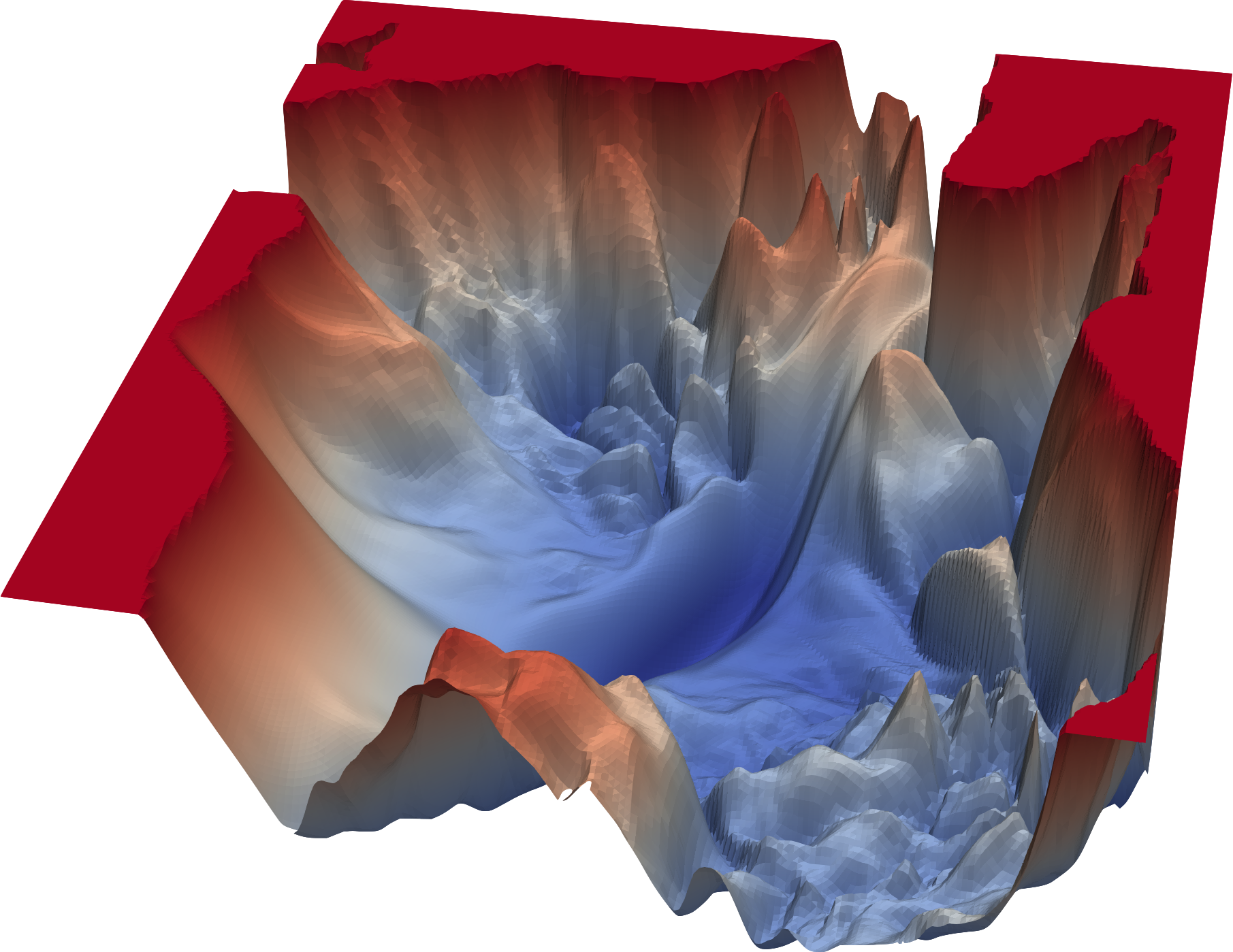
Since the full parameter space is too high-dimensional to visualise, the loss is usually evaluated on one- or two-dimensional subspaces. The figure below, reproduced from Li et al., illustrates a loss function over a two-dimensional parameter space. See Visualizing the Loss Landscape of Neural Nets for the visualisation methods that inspired this library.
2. Base Example: Supervised Loss in Parameter Subspaces
A common use case is to evaluate a supervised loss function in a low-dimensional subspace of a
neural network's parameter space. Given a trained torch.nn.Module named model, a loss function
loss_function, inputs X and targets y, the following evaluates the loss on a random plane:
from loss_landscapes import random_plane
from loss_landscapes.metrics import Loss

metric = Loss(loss_function, X, y)
landscape = random_plane(model, metric, normalization="filter", deepcopy_model=True)
The two core concepts are metrics and parameter subspaces. The subspace defines the parameter
vectors at which to evaluate the model; the metric defines the quantity to compute at each vector.
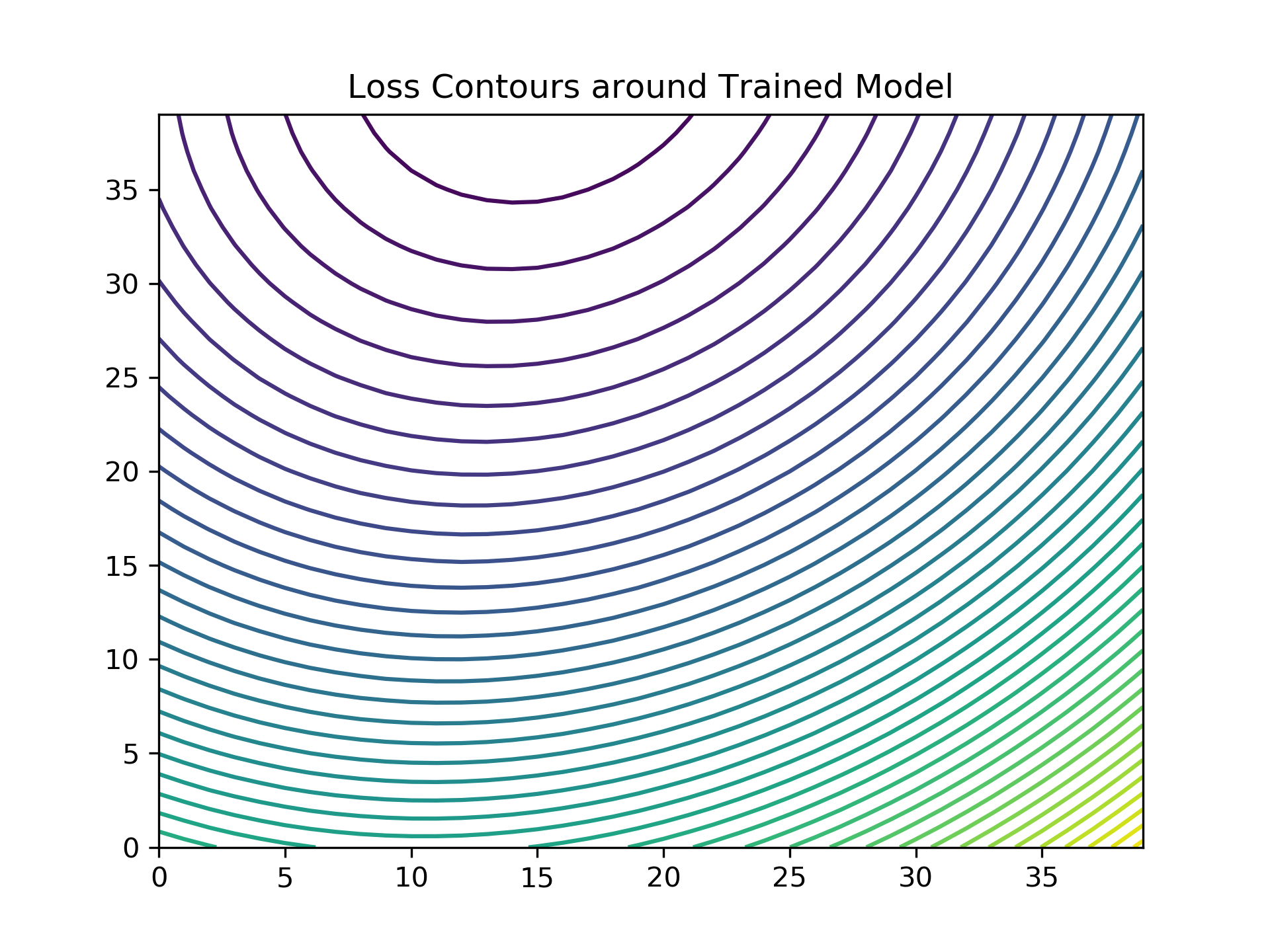
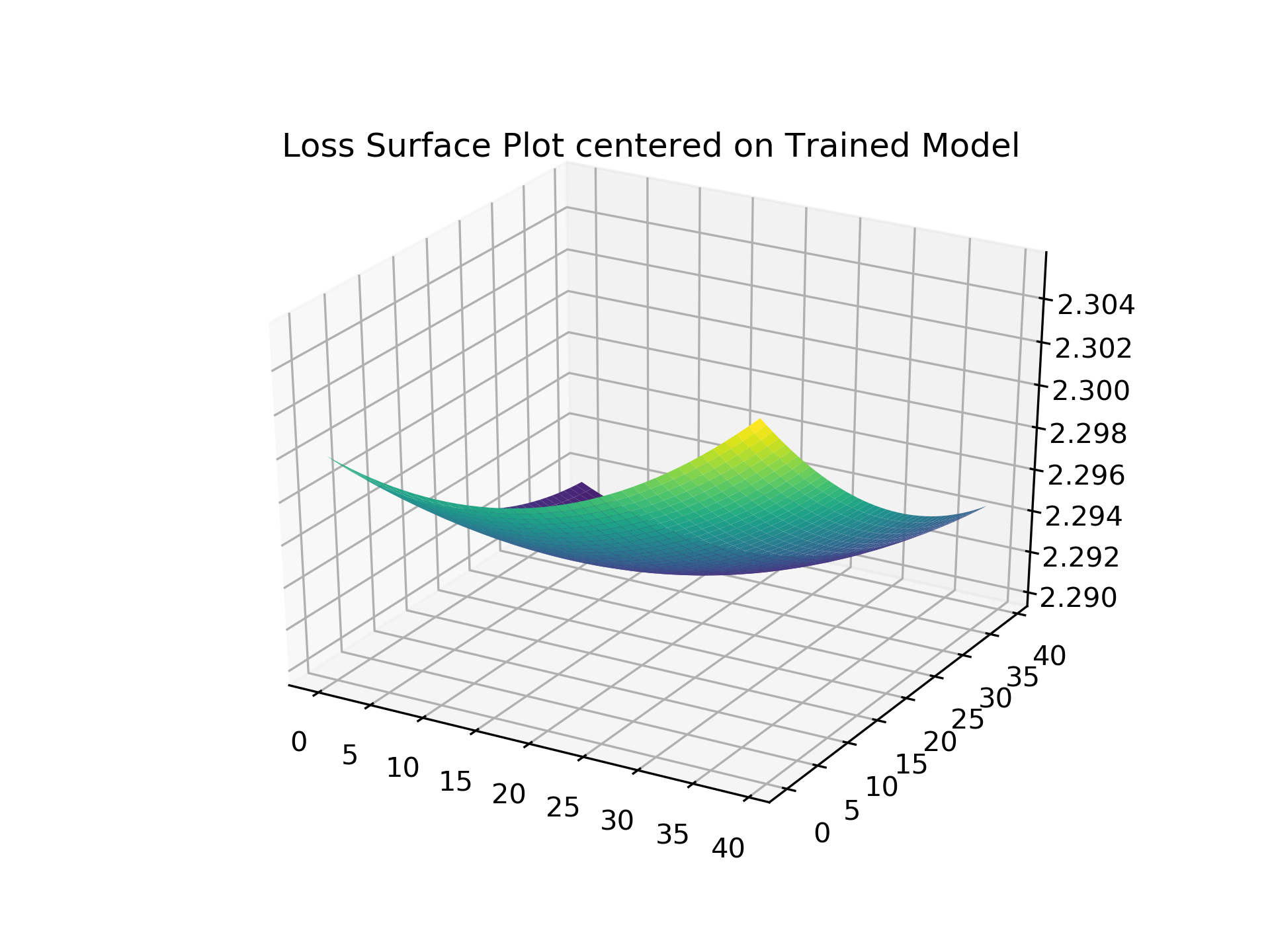
Here, Loss evaluates the supervised loss over X and y, and random_plane returns a
two-dimensional array of its values. This array can be plotted as a contour map or a surface:
See the core-features notebook for a training and plotting example.
It additionally uses torchvision, matplotlib and tqdm; install these separately.
3. Metrics and Custom Metrics
The loss-landscapes library can compute any quantity of interest at a collection of points in a parameter subspace,
not just loss. This is accomplished using a Metric: a callable object which applies a pre-determined function,
such as a cross entropy loss with a specific set of inputs and outputs, to the model. The loss_landscapes.metrics
package provides Loss, LossPerturbations and MetricPipeline. LossGradient is also exported,
but currently has the defects noted above.
Custom metrics can be defined by subclassing Metric and implementing __call__. The library
implementation of Loss illustrates this contract:
import torch

from loss_landscapes import ModelWrapper
from loss_landscapes.metrics import Metric


class Loss(Metric):
    """Computes a specified loss function over specified input-output pairs."""

    def __init__(self, loss_fn, inputs: torch.Tensor, target: torch.Tensor):
        super().__init__()
        self.loss_fn = loss_fn
        self.inputs = inputs
        self.target = target

    def __call__(self, model_wrapper: ModelWrapper) -> float:
        return self.loss_fn(model_wrapper.forward(self.inputs), self.target).item()
Custom metrics receive a ModelWrapper. Call model_wrapper.forward(inputs) to evaluate
the wrapped model and model_wrapper.get_modules() to access the selected PyTorch modules.
A GeneralModelWrapper also exposes the underlying model through its model attribute.
The wrapper itself is not callable.
4. More Complex Models
For a simple supervised model, functions such as linear_interpolation accept a torch.nn.Module
directly. More complex cases, such as evaluating a subset of a model's parameters or an RL agent's
expected return, require an explicit interface between the model and the library.
ModelWrapper defines this interface. The supplied GeneralModelWrapper accepts the model,
the modules whose parameters define the subspace, and a function for forward evaluation.
For example, to vary only the final module of a torch.nn.Sequential model while evaluating
the complete model, reuse the loss metric from the supervised example:
from loss_landscapes import GeneralModelWrapper

model_wrapper = GeneralModelWrapper(
    model=model,
    modules=[model[-1]],
    forward_fn=lambda model, inputs: model(inputs),
)
landscape = random_plane(model_wrapper, metric, normalization="filter", deepcopy_model=True)
modules selects the parameters to vary; the forward function defines how the complete model
is evaluated. This example assumes the final module has parameters to sample.
5. Supported Environments
The library supports the following combinations:
| PyTorch minor series | CPython minor versions |
|---|---|
| 2.15 | 3.11, 3.12, 3.13, 3.14, 3.15 |
Compatibility is tested on Linux x86-64 CPU with standard, GIL-enabled CPython, using the latest compatible stable patches in these series. GPU execution, free-threaded builds and alternative interpreters are not covered by these checks.
See CONTRIBUTING.md for compatibility checks and platform prerequisites.
Development
See CONTRIBUTING.md for checkout setup, tests and release instructions, and CHANGELOG.md for release notes.
1 maintainer

Metadata
1 maintainer
Release files for loss-landscapes 4.0.1
For a detailed explanation of source distributions (sdists) and built distributions (wheels), please see the package formats documentation.
Source distribution (sdist)
| File | Size | Uploaded | Provenance | Actions |
|---|---|---|---|---|
| loss_landscapes-4.0.1.tar.gz | 3.5 MB | With provenance | Details for loss_landscapes-4.0.1.tar.gz |
Built distribution (wheel)
| File | Interpreter | ABI | Platform | Actions Reset |
|---|---|---|---|---|
| loss_landscapes-4.0.1-py3-none-any.whl | Python 3 | none | any | Details for loss_landscapes-4.0.1-py3-none-any.whl |
Total release size: 3.5 MB
Release files / loss_landscapes-4.0.1.tar.gz
| Download URL | loss_landscapes-4.0.1.tar.gz |
|---|---|
| Size | 3.5 MB |
| Tags | Source |
|
SHA-256 checksum How to use checksums |
d69f77416c3a20753827a478ae0d19c5f195711dd7a4c50f5193abe4732bcf3e
|
|
BLAKE2b-256 checksum How to use checksums |
cc097bf78433f0f98d4411c305c5d6a70de6399e095c78f7f8422208ff0de658
|
| Upload date | |
|
Uploaded using Trusted Publishing? What is trusted publishing? |
Yes |
| Uploaded via |
twine/7.0.0 CPython/3.13.16
|
Provenance
Provenance describes where a file came from. On PyPI, provenance is shared via attestations, which provide a verifiable record of the build or publishing details. View details, limitations and caveats.


PyPI Publish Attestation
PyPI verified that this artifact, at this checksum, originated from the publisher listed below.
Signed by GitHub Actions, verified by PyPI on Oct 31, 2026.
Transparency logRelease files / loss_landscapes-4.0.1-py3-none-any.whl
| Download URL | loss_landscapes-4.0.1-py3-none-any.whl |
|---|---|
| Size | 20.4 kB |
| Tags | Python 3 |
|
SHA-256 checksum How to use checksums |
0db51b362a8e8495611b748fafce596eabf73316ddcd6dae1278c04c5b008c2e
|
|
BLAKE2b-256 checksum How to use checksums |
c68b57951ce6f8a44b4c6c2c966f48e1707716dca96f254b098a372bfefbb8e6
|
| Upload date | |
|
Uploaded using Trusted Publishing? What is trusted publishing? |
Yes |
| Uploaded via |
twine/7.0.0 CPython/3.13.16
|
Provenance
Provenance describes where a file came from. On PyPI, provenance is shared via attestations, which provide a verifiable record of the build or publishing details. View details, limitations and caveats.
PyPI Publish Attestation
PyPI verified that this artifact, at this checksum, originated from the publisher listed below.
Signed by GitHub Actions, verified by PyPI on Oct 31, 2026.
Transparency logSecurity for loss-landscapes 4.0.1
Provenance
Provenance describes where a file came from. On PyPI, provenance is shared via attestations, which provide a verifiable record of the build or publishing details. View details, limitations and caveats.
Full provenance
All 2 files in this release have been uploaded with provenance metadata.
Attestation for loss_landscapes-4.0.1.tar.gz
PyPI Publish Attestation
PyPI verified that this artifact, at this checksum, originated from the publisher listed below.
Signed by GitHub Actions, verified by PyPI on Oct 31, 2026.
Transparency logA note on package security
PyPI is a repository for distributing packages, not a service for auditing them. While third-party security researchers and our staff do their best to detect and remove malicious packages, PyPI cannot guarantee the quality, security or suitability of any given package.
To learn more about protecting yourself from malicious actors, visit our package security documentation.














