

lothc




Lord Of The Http Clients — a typed HTTP client for Python, built on pyreqwest (an awesome Rust-backed HTTP client), with first-class optional support for pydantic and msgspec as both decode and encode targets.
Installing
uv add 'lothc[pydantic,msgspec]'
(Any subset of the extras works — the base package alone gets you bytes/dict support.)
Quickstart
from lothc import HTTPClient
from pydantic import BaseModel


class Pokemon(BaseModel):
    id: int
    name: str


async with HTTPClient(base_url="https://pokeapi.co/api/v2/") as client:
    response = await client.get("pokemon/pikachu", into=Pokemon)
    print(response.status, response.data)  # 200 id=25 name='pikachu'
Why?
Why was lothc built, and why should you use it?
pyreqwest is a genuinely excellent HTTP client for Python, fast because the heavy lifting happens
in Rust, not pure Python. But its API is a builder pattern (client.get(path).build() before you
can even .send() it), unfamiliar to anyone coming from requests/httpx/niquests, where a
call is just client.get(url, params=..., headers=...). lothc wraps pyreqwest with exactly that
familiar shape, so you get pyreqwest's speed without giving up the ergonomics Python HTTP users
already expect.
The other reason: Python's most popular third-party HTTP clients (httpx, aiohttp, niquests) all
have first-class JSON support: call .json() and get back a dict. But in order for a Python
project to be end-to-end type-safe, data crossing I/O boundaries must be validated, and if
invalid, handled accordingly (raise an error) — a plain dict does neither. Closing that gap is
exactly what lothc is designed for.
The original idea was to make lothc backend-agnostic: httpx, aiohttp, niquests, and pyreqwest all interchangeable underneath the same typed lothc interface, so switching backends never meant switching your call sites. However, in the author's opinion there's currently no compelling reason not to just use pyreqwest, so pyreqwest is the only backend implemented today, but, if there's demand for an httpx/aiohttp/niquests backend, the author is happy to consider adding one.
Fast
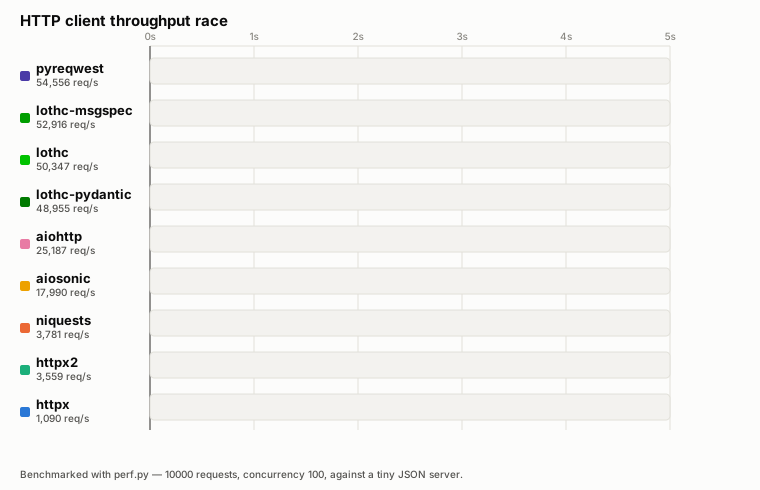
Benchmarked with perf.py against a tiny Rust-based static JSON server, 10,000 requests at
concurrency 100 — including lothc's fully-typed decode targets (into= a msgspec
Struct or a pydantic BaseModel), not just raw bytes or an untyped dict. The object handed back
from those runs isn't just parsed JSON — it's a real, constructed, field-validated instance of
your own type, and that validation cost is included in the numbers, not benchmarked around.
Decoding into a real msgspec Struct even edged out the unvalidated dict path in this run. Full
numbers: docs/benchmarks.md.
Highlights
Pass into to any lothc call and get back a real, constructed, field-validated
pydantic BaseModel or msgspec Struct, instead of the plain dict .json() leaves you to
validate yourself. Any type expression works, so into=list[Pokemon] decodes a top-level array. See Benchmarks for what that costs (usually nothing).
| Two clients, one API | HTTPClient (async) and SyncHTTPClient (sync) — identical surface, both backed by pyreqwest. |
| Every verb | get, post, put, patch, delete, head, download (each returning a Response: .data, .status, .headers) — see Verbs. |
| Typed params, headers & forms | A BaseModel/Struct for query params or headers (with None-field omission), or a body sent urlencoded (data=) or as a real multipart form (form=). |
| Precise static types | Every verb is paired @overloads, not a cast-laden generic — your editor knows the exact return type. |
| SSE & streaming | Spec-compliant SSE — automatic reconnect with Last-Event-ID, server retry: honored, typed decode (discriminated unions included) — plus raw or NDJSON-typed stream_get/stream_post — see SSE / Streaming. |
| Retries with real backoff | max_retries/retry_methods, a genuine pyreqwest middleware hook, Retry-After-aware — see Retries. |
| Authentication | Static bearer_token, a per-request-refreshed bearer_auth, basic_auth, or default_headers for anything else — plus a ready-made OAuth 2 client-credentials provider (OAuthProvider: mint, leeway-based renewal, refresh-then-mint fallback, optional on-disk token cache) — see Authentication. |
| Cookies, redirects, proxy | cookie_store, follow_redirects/max_redirects, proxy= — see Networking. |
| A real error hierarchy | HTTPTransportError/HTTPTimeoutError/HTTPConnectionError for no response, HTTPResponseError for 4xx/5xx — see Error handling. |
| Everything optional | pydantic, msgspec — works with neither, either, or both installed. |
Development
See CLAUDE.md and style-guide.md for architecture notes and the (non-obvious in places) design
conventions this codebase relies on.
task deps-sync    # install
task test         # run tests
task check        # lint + format-check + typecheck (what CI runs)
License
lothc is MIT. It's built on pyreqwest (Apache-2.0), which is built on the Rust crate reqwest (MIT or Apache-2.0). Thanks to both.
1 maintainer

Metadata
1 maintainer
Release files for lothc 0.2.1
For a detailed explanation of source distributions (sdists) and built distributions (wheels), please see the package formats documentation.
Source distribution (sdist)
| File | Size | Uploaded | Provenance | |
|---|---|---|---|---|
| lothc-0.2.1.tar.gz | 85.3 kB | Without provenance | Details |
Built distribution (wheel)
| File | Interpreter | ABI | Platform | Reset |
|---|---|---|---|---|
| lothc-0.2.1-py3-none-any.whl | Python 3 | none | any | Details |
Total release size: 168.7 kB
Release files / lothc-0.2.1.tar.gz
| Download URL | lothc-0.2.1.tar.gz |
|---|---|
| Size | 85.3 kB |
| Tags | Source |
|
SHA-256 checksum How to use checksums |
da7f0f1f61802cd51c4057df249b5f5e6c9c7c81520e63703c98b0f6a5be4f58
|
|
BLAKE2b-256 checksum How to use checksums |
3fe57717fa500bc75bef97526ac231f117a20cce0b504b984acd008576dbb06d
|
| Upload date | |
|
Uploaded using Trusted Publishing? What is trusted publishing? |
Yes |
| Uploaded via |
uv/0.13.5 {"installer":{"name":"uv","version":"0.13.5","subcommand":["publish"]},"python":null,"implementation":{"name":null,"version":null},"distro":{"name":"Ubuntu","version":"24.04","id":"noble","libc":null},"system":{"name":null,"release":null},"cpu":null,"openssl_version":null,"setuptools_version":null,"rustc_version":null,"ci":true}
|
Release files / lothc-0.2.1-py3-none-any.whl
| Download URL | lothc-0.2.1-py3-none-any.whl |
|---|---|
| Size | 83.4 kB |
| Tags | Python 3 |
|
SHA-256 checksum How to use checksums |
8717a9b097b5d22c4ca2b829c4b1fed36f7027eb5da5469648ec25936ddf7c8d
|
|
BLAKE2b-256 checksum How to use checksums |
c9c09300155ad0cbfed5fd10409559c28adfcfcaa481a33ef6caf1789e6836a8
|
| Upload date | |
|
Uploaded using Trusted Publishing? What is trusted publishing? |
Yes |
| Uploaded via |
uv/0.13.5 {"installer":{"name":"uv","version":"0.13.5","subcommand":["publish"]},"python":null,"implementation":{"name":null,"version":null},"distro":{"name":"Ubuntu","version":"24.04","id":"noble","libc":null},"system":{"name":null,"release":null},"cpu":null,"openssl_version":null,"setuptools_version":null,"rustc_version":null,"ci":true}
|
Security for lothc 0.2.1
Provenance
Provenance describes where a file came from. On PyPI, provenance is shared via attestations, which provide a verifiable record of the build or publishing details. View details, limitations and caveats.
No provenance found
None of the files in this release were uploaded with provenance metadata.
A note on package security
PyPI is a repository for distributing packages, not a service for auditing them. While third-party security researchers and our staff do their best to detect and remove malicious packages, PyPI cannot guarantee the quality, security or suitability of any given package.
To learn more about protecting yourself from malicious actors, visit our package security documentation.














