
LUNA
LUNA is a differentiable astrophysical hydrodynamics code written in JAX, with hand-written Pallas kernels as a fast path on GPUs. It solves the Euler equations in one, two and three dimensions with an unsplit, second-order MUSCL-Hancock scheme and HLLC or HLL Riemann solvers, and runs on CPUs and on many NVIDIA or AMD GPUs, with the domain split over devices. Self-gravity is solved with periodic or isolated boundaries and couples to the gas conserving energy; comoving cosmology evolves gas together with dark-matter particles; radiative cooling, driven turbulence and starburst energy and mass injection are built in. Examples of what it does: shock tubes, blast waves and Kelvin-Helmholtz, Rayleigh-Taylor and Richtmyer-Meshkov instabilities; Jeans collapse and collapsing self-gravitating clouds; the cosmic web of gas and dark matter from cosmological initial conditions; driven supersonic turbulence; galactic winds blown out of a starburst disk; and inverse problems, such as optimising initial conditions with gradients taken through the solver. Non-equilibrium chemistry and cooling networks, radiation transport, sink particles and star formation with stellar dynamics and feedback through Torch/AMUSE, and block-based adaptive mesh refinement are included as experimental modules. Validated capabilities are tested against exact solutions or other codes (AthenaK, Arepo, RAMSES), whose reference solutions are published with the code.
Defaults on main: FP32
(enable_x64=False), minmod limiter, HLLC, CFL 0.8, and the XLA kernel
(hydro_kernel="xla"), which is the reference path. A Pallas kernel is an opt-in path
for GPUs (hydro_kernel="pallas"); it refuses configurations it cannot run.
The reference solutions the tests compare against (AthenaK, Arepo, RAMSES, the Pencil Code, AMReX Microphysics and others, with their sources) are public in luna-reference-solutions.
What LUNA can do
Status: validated = asserted by a test against an independent reference; shown = real runs, shown in figures, not yet asserted by a test; experimental = under development, not finalised. Each row's tests and details are in docs/CLAIMS.md.
| capability | status |
|---|---|
| Euler hydrodynamics in 1D, 2D, 3D: unsplit MUSCL-Hancock, PLM (minmod, MC, van Leer), HLLC | validated |
riemann_solver="hll": the robust fallback where HLLC carbuncles at grid-aligned strong shocks; chosen by the user, never switched automatically |
validated |
| Multi-GPU domain decomposition; a sharded run reproduces the single-device run | validated |
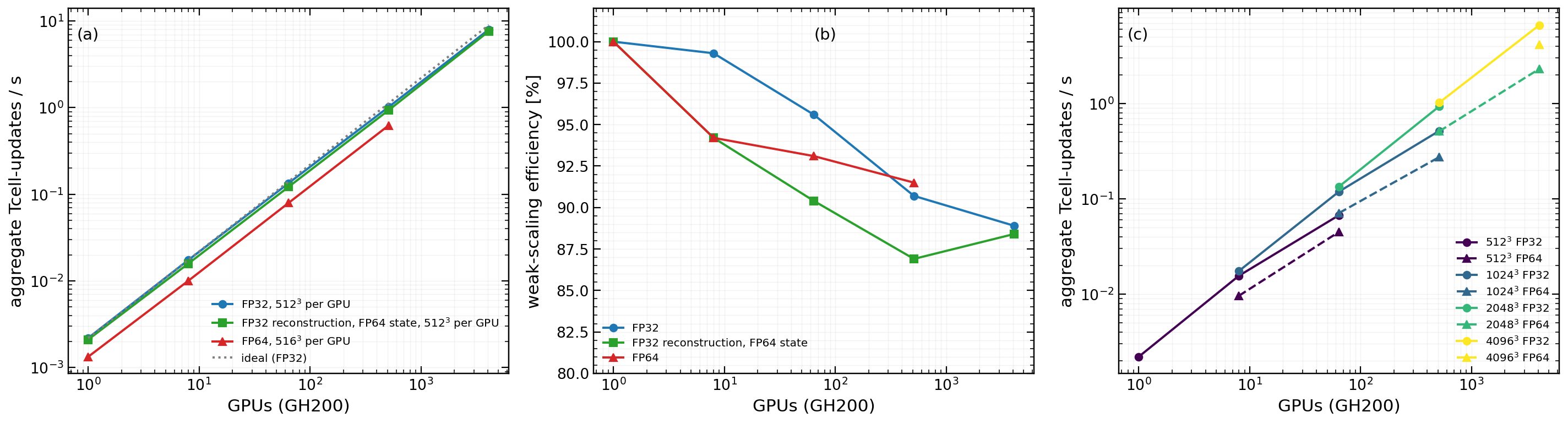
| Weak scaling to 4096 NVIDIA GH200 GPUs on JUPITER (FP32, 88.9 % efficiency) | shown (measurement) |
| NVIDIA and AMD GPUs (runs on A100, GH200, MI300A; public CI is CPU only) | shown |
Pallas GPU kernels (hydro_kernel="pallas", opt-in), bitwise equal to the XLA kernel on A100 |
validated |
| Self-gravity, periodic and isolated boundaries; energy-conserving coupling | validated |
| Comoving cosmology: adiabatic expansion, top-hat collapse | validated |
| Cosmic web with dark-matter particles and gas; DM power spectrum compared with Arepo | shown |
| Radiative cooling (tables validated against published equilibria; cooling in the step not yet asserted) | shown |
| Chemistry networks | experimental |
| Radiation transport, M1 and M2 closures | experimental |
| Sink particles and star formation coupled to Torch/AMUSE | experimental |
| Block AMR | experimental |
| Starburst-driven wind (M82 disk, CC85 injection) | shown |
| Driven turbulence | shown |
| Differentiation through the solver (gradients checked against finite differences; known gaps in docs/AUTODIFF.md) | shown |
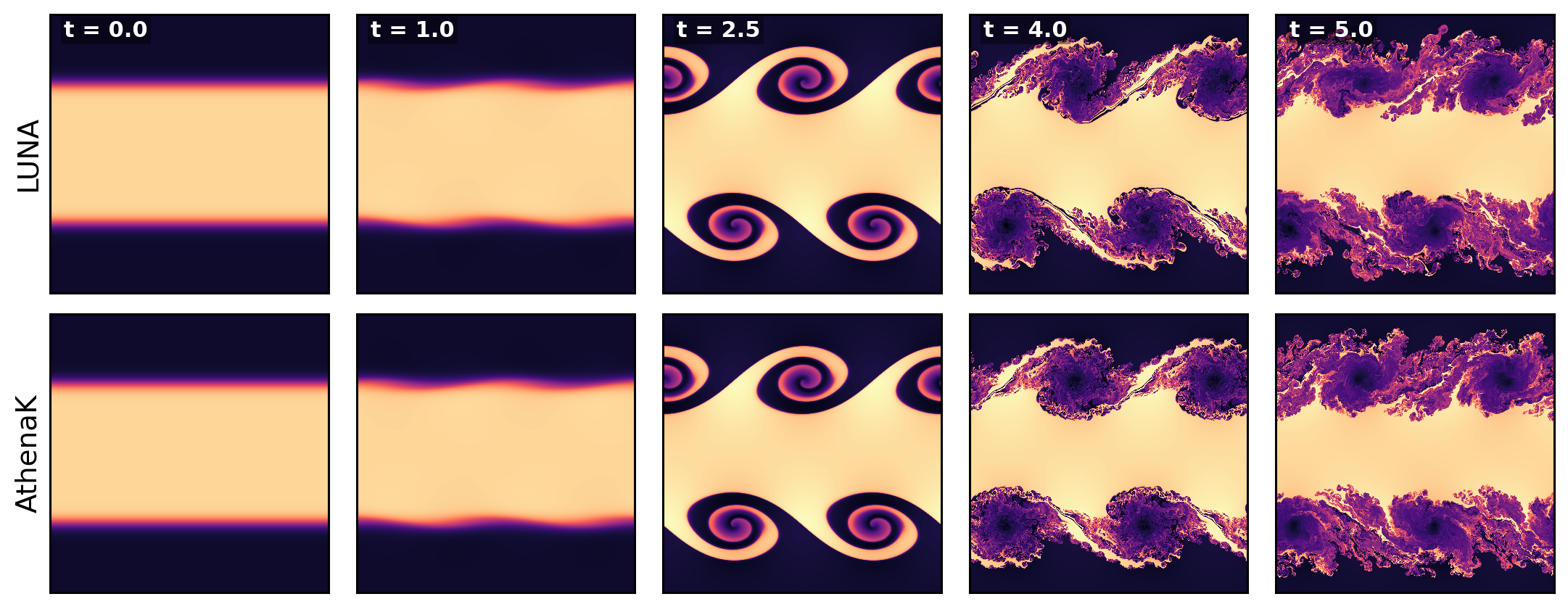 Kelvin-Helmholtz at 8192², density at t = 0 to 5: LUNA (top, second order) and AthenaK (bottom, fourth-order WENOZ) as the reference. Shown: an accuracy comparison by eye, not an asserted test. |
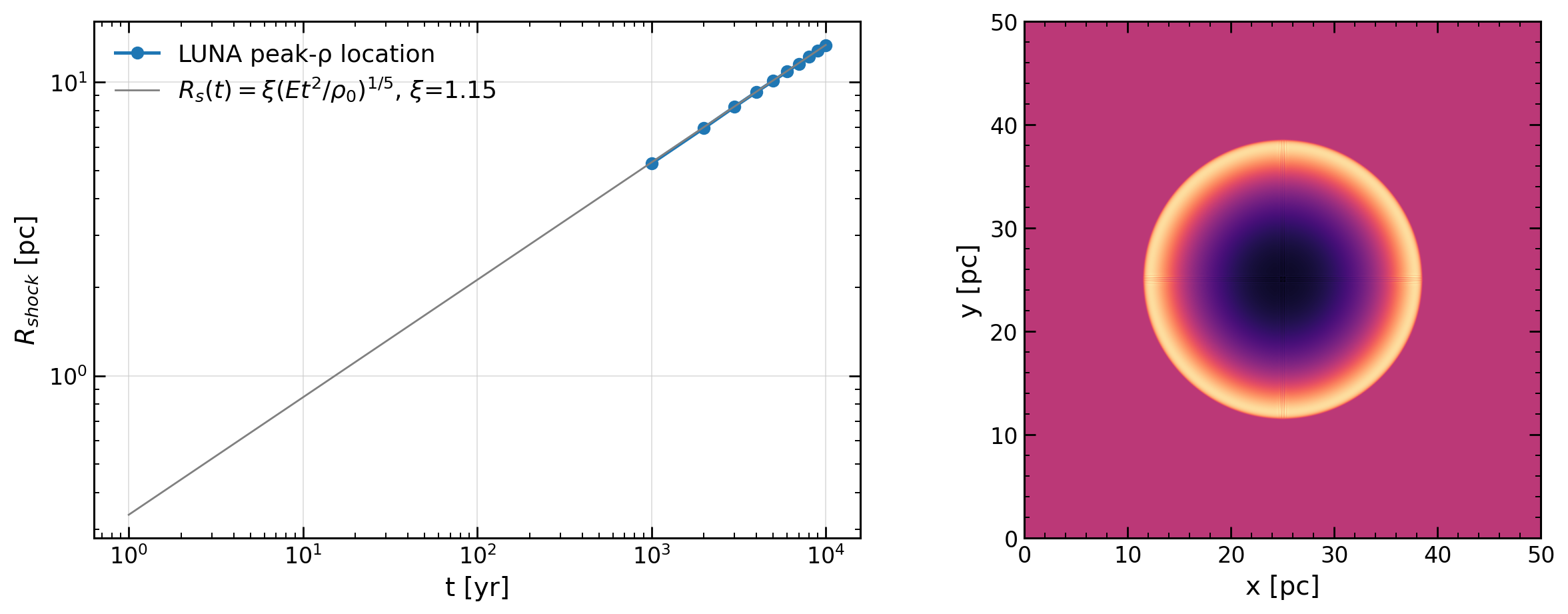 3D Sedov-Taylor blast in an ISM-like medium: shock radius against the self-similar solution, and column density. The Sedov solution is asserted in the 2D off-axis tests (validated); this 3D run is shown. |
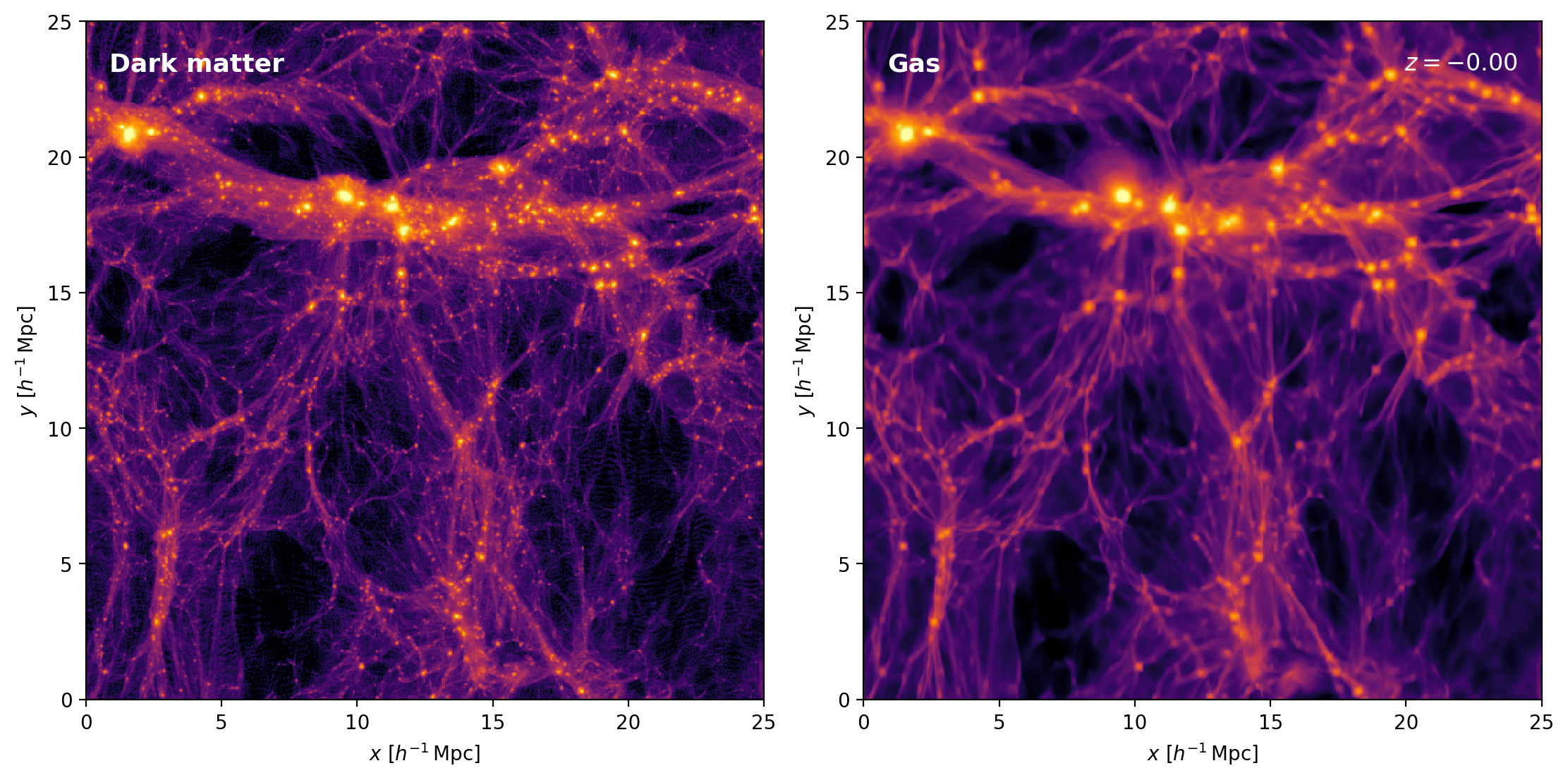 Cosmic web at z = 0: 512³ gas cells and 512³ dark-matter particles, 25 Mpc/h box; dark matter (left), gas (right). Shown. |
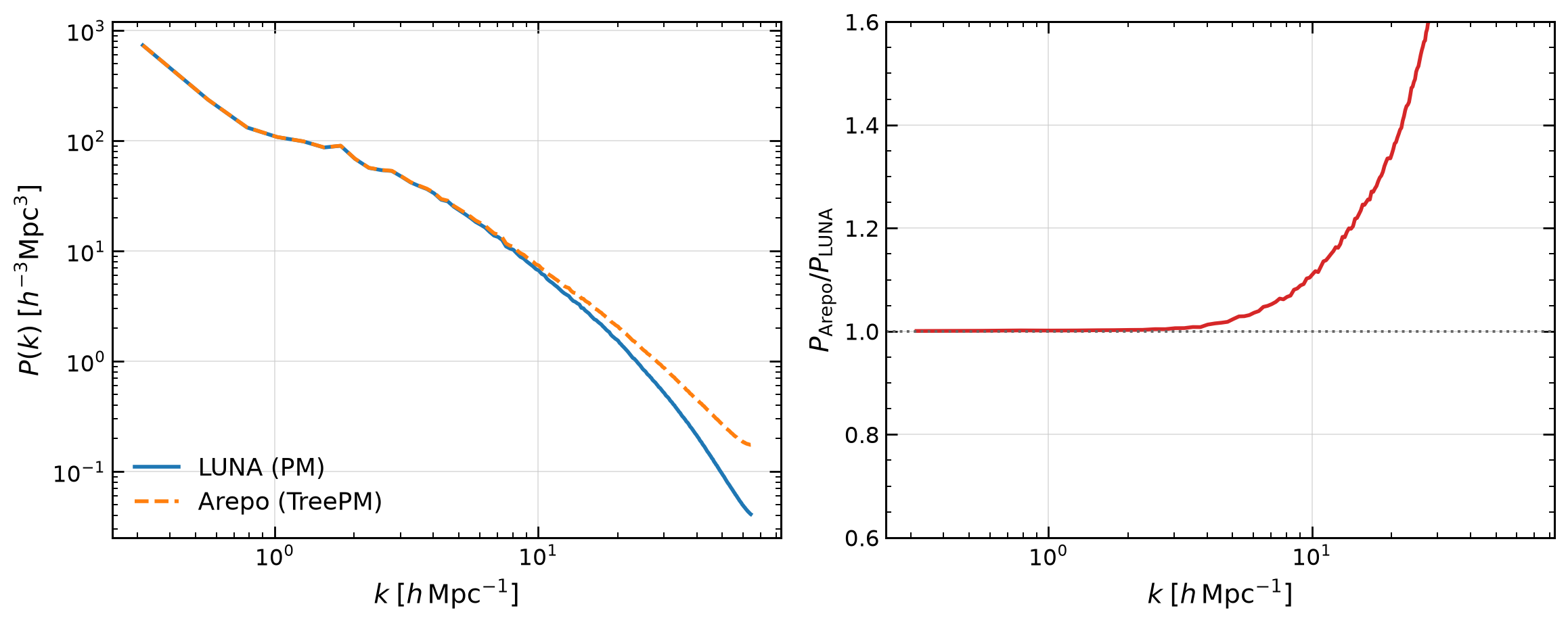 Dark-matter power spectrum, LUNA (particle-mesh) and Arepo (TreePM) from identical 512³ initial conditions: equal on large scales, LUNA lower above k ≈ 5 h/Mpc where the grid softens the force. Shown: compared in a figure; no test gates it yet. |
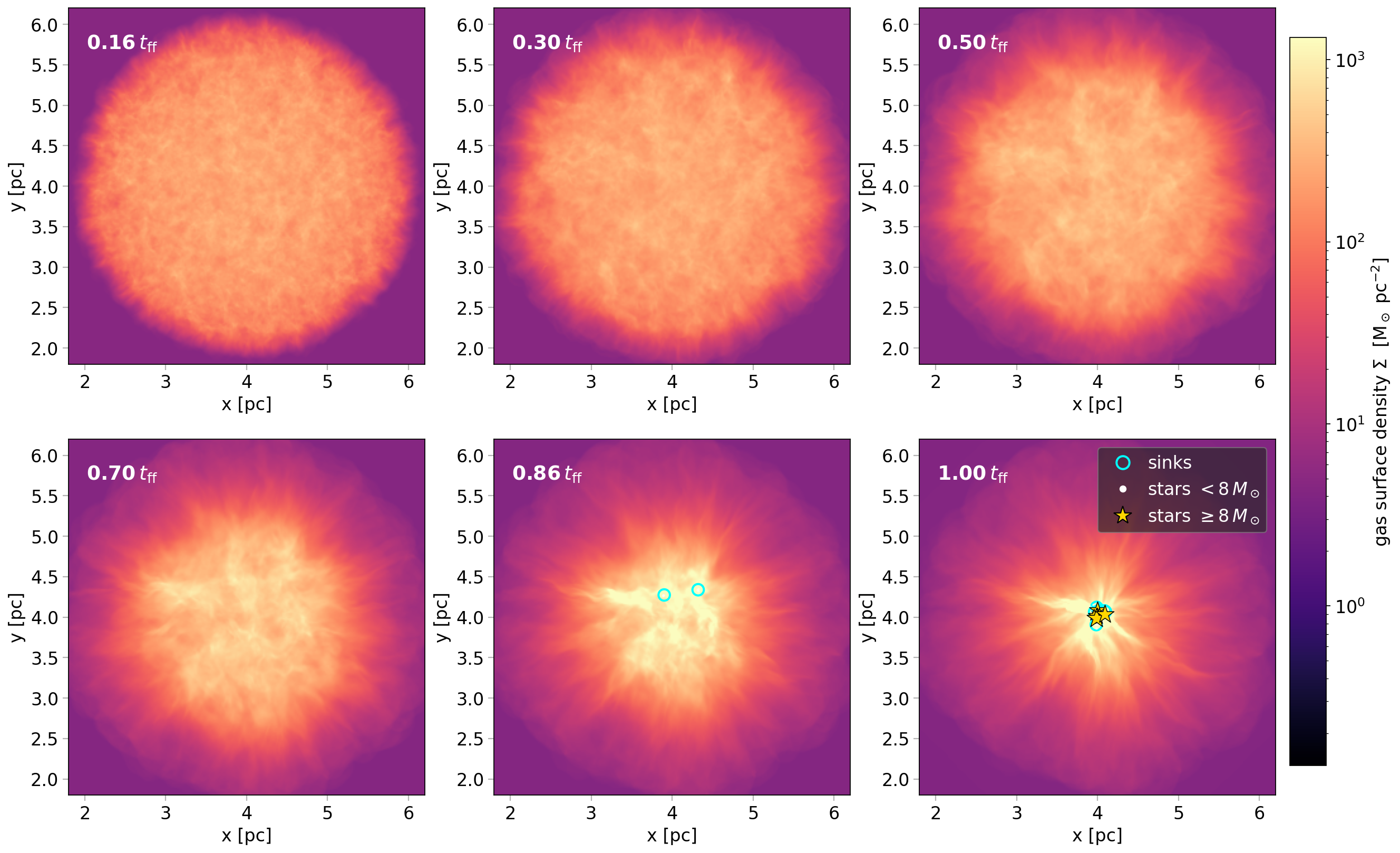 Collapsing molecular cloud (2000 M⊙, 512³) to one free-fall time, with sink particles; stars and their N-body dynamics through Torch/AMUSE. Experimental. |
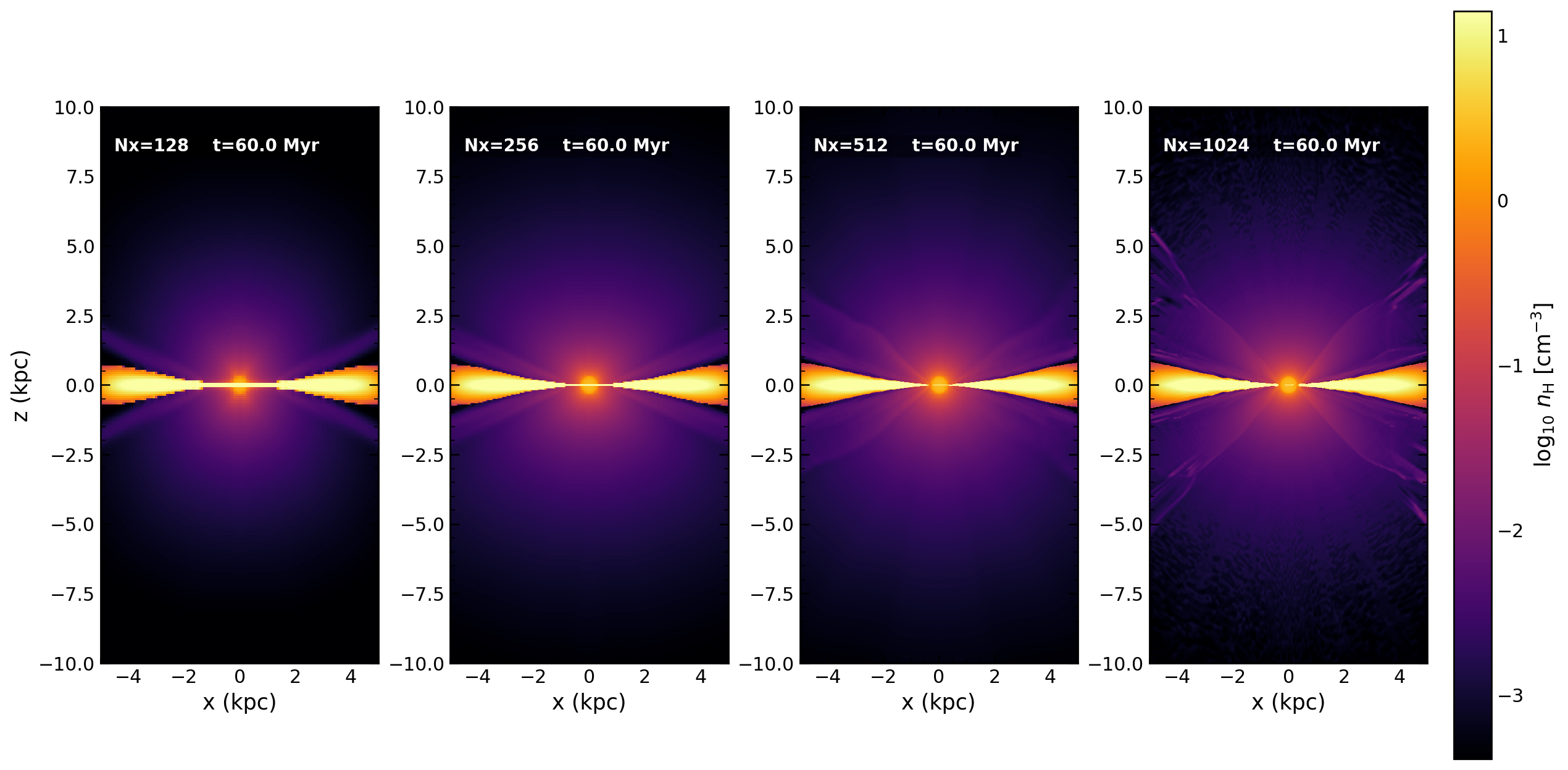 M82-like starburst wind leaving a rotating disk (CC85 injection, Schneider et al. 2018 setup), log n_H at 60 Myr. Shown. |
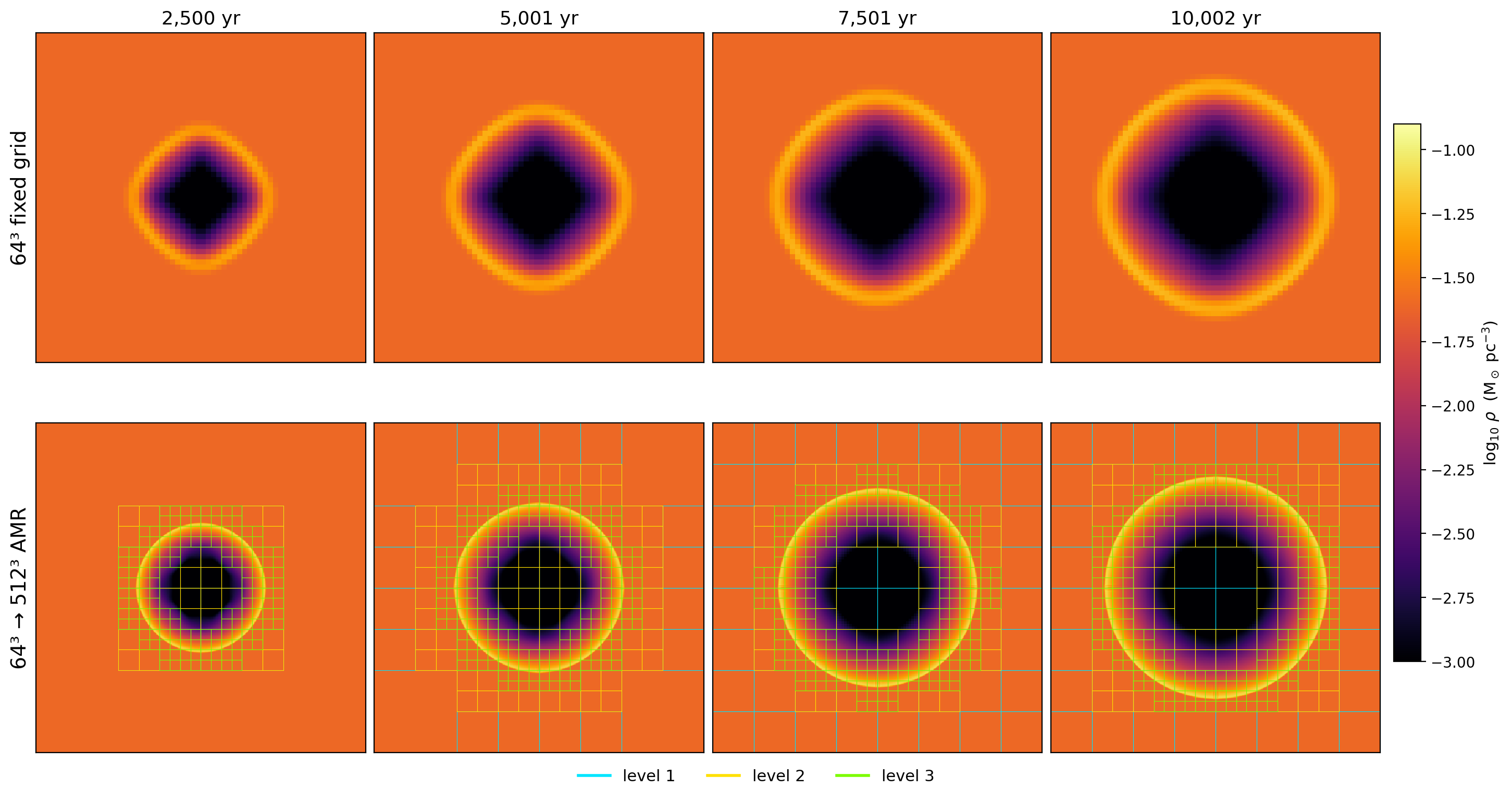 Block AMR: 3D Sedov on a fixed 64³ grid and with block refinement, refinement mesh overlaid. Experimental. |
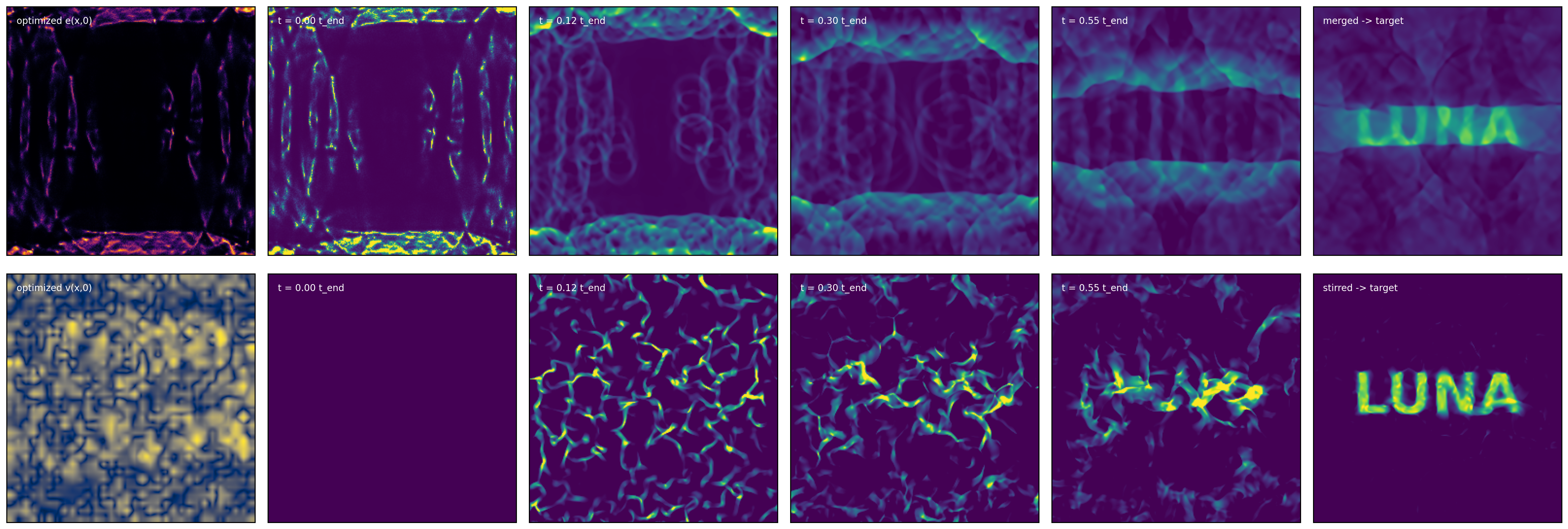 Differentiating through the solver: initial conditions optimised with reverse-mode gradients so that the word LUNA emerges from an explosion (top) and from turbulence (bottom). A demonstration, shown. |
More figures: docs/GALLERY.md.
What is validated
Only results that a test asserts against an independent reference (exact or analytic solution, published data, or another code's output) with a stated bound; the test for each is in docs/CLAIMS.md, and the other codes' outputs are in luna-reference-solutions.
- Second-order convergence on smooth flows and linear waves; HLLC and HLL fluxes against Toro's tests; shock tubes against the exact Riemann solution.
- Sedov-Taylor, Noh and Guderley against exact solutions; linear growth of Kelvin-Helmholtz, Rayleigh-Taylor and Richtmyer-Meshkov against linear theory; nonlinear Kelvin-Helmholtz against McNally et al. (2012).
- HLL keeps grid-aligned strong shocks planar where HLLC carbuncles (the HLLC case is a known open bug, kept as a strict xfail test).
- A run split over several devices reproduces the single-device run (bitwise in the Sedov and Kelvin-Helmholtz tests, to 1e-12 in the shard-seam test); the Pallas hydro kernel equals the XLA kernel bitwise on an A100.
- Self-gravity with periodic and isolated boundaries (Jeans waves, direct sums, energy conservation in the Evrard collapse); comoving expansion and the spherical top-hat collapse against exact solutions; cooling tables against published equilibria.
White-dwarf detonations are in development and not on main.
Install
Python 3.11, 3.12 or 3.13. The package is luna-hydro; it installs the library luna
and the command luna (the same as python main.py in a clone), and pins
jax>=0.10.0,<0.11. Until LUNA is on PyPI, install from a clone; the commands in
brackets are the PyPI form for once it is published.
CPU (laptop, workstation, login node):
git clone https://github.com/Ulli1991/LUNA.git
pip install "./LUNA[plot]"              # (once published: pip install "luna-hydro[plot]")
NVIDIA GPUs: the [cuda12] extra installs JAX's CUDA 12 build of the same version,
with the CUDA libraries as pip wheels; the machine needs only an NVIDIA driver, no CUDA
module.
pip install "./LUNA[cuda12,plot]"       # (once published: pip install "luna-hydro[cuda12,plot]")
python -c "import jax; print(jax.devices())"     # [CudaDevice(id=0), ...]
AMD GPUs: pip install "./LUNA[rocm,plot]" installs JAX's ROCm 7 plugin of the
same version (jax[rocm7-local]), which needs ROCm 7 installed on the machine (module
or system). This route is not tested by LUNA's CI.
No JAX 0.10 wheel for your platform (for example an Intel Mac): use the CPU image in tools/docker/Dockerfile; its header has the build and run commands.
For development, install the clone editable with the test tools:
cd LUNA
pip install -e ".[plot,test]"
Extras: plot (matplotlib; the default run plots its result at the end,
PLOT_AFTER_SIM=True, and fails there without it, so set PLOT_AFTER_SIM=False if you
leave it out), test (pytest), notebooks (Jupyter and matplotlib), cuda12, rocm.
The installed package is the library and the luna command. The run scripts in
scripts/, the autodiff example tasks (scripts/examples/autodiff/), the tests and
tools/, the SLURM templates in submit/ and the Torch/AMUSE coupling (src/amuse_luna)
need the clone.
Quick start
A run is a config file (a copy of the template, which holds every setting) plus
field=value overrides on the command line:
cp LUNA/src/luna/template_config.py my_run.py     # every setting; docs/CONFIG.md explains them
luna my_run.py Nx=256                             # Sod shock tube, 1D (the template's problem)
luna my_run.py test_problem=Kelvin-Helmholtz SPATIAL_DIMENSION=2 BOUNDARY=0 \
    Nx=128 Ny=128 Lx=2 Ly=2 t_end=1.0 output_dir=snapshots/kh128
luna my_run.py test_problem=Sedov-Blast-3D SPATIAL_DIMENSION=3 \
    Nx=32 Ny=32 Nz=32 output_dir=snapshots/sedov32
Without a clone, copy the template from the installed package:
python -c "import luna.template_config as t, shutil; shutil.copy(t.__file__, 'my_run.py')".
In a clone, python main.py is the same command as luna.
On four cores of a shared login node (JAX_PLATFORMS=cpu) each took under three
minutes. The first one ends with
[gas] done: 195 steps, t=2.45000e-01, 14.5s

============================================================
SIMULATION COMPLETED
============================================================
✓ Total runtime: 14.50 seconds
✓ Total steps: 195
✓ Final time: 0.24500
Snapshots are written to output_dir (default snapshots/) as snapdir_NNN/ HDF5
directories, together with history.csv and run.json (the settings, the command line
and the code revision). An unknown field name is an error, not a warning. Problem
parameters are set as problem.<name>=value. docs/TUTORIAL.md walks
through a first run, and docs/RUNNING.md covers production runs.
Clusters and GPUs
Start one process per GPU with srun; JAX's distributed runtime picks up the SLURM
environment, and MESH_SHAPE chooses how the grid is split across the processes:
srun luna my_run.py test_problem=Sedov-Blast-3D SPATIAL_DIMENSION=3 \
    Nx=1024 Ny=1024 Nz=1024 MESH_SHAPE=2,4,4
SLURM templates for NVIDIA and AMD nodes are in submit/examples/.
Measured weak scaling (not a test; method, job ids and the strong-scaling data are in docs/GALLERY.md): 3D Sedov blast, 512³ cells per GPU, FP32, on JUPITER's NVIDIA GH200 nodes, from 2.19 Gcell-updates/s on one GPU to 7.99 Tcell-updates/s on 4096 GPUs (8192³ cells), 88.9 % weak-scaling efficiency. No FP64 run was made at 4096 GPUs.
Interactive use (Jupyter)
examples/notebooks/ has small CPU notebooks that go through the same
path as main.py (luna.launch(Config), which starts JAX and calls luna.main.run). Each runs
in a few minutes on four CPU cores, FP64, on grids far smaller than the tests' (the test file is
named in each), and compares with an exact or published solution:
| notebook | what it compares | status (docs/CLAIMS.md) |
|---|---|---|
| 01_sod_shock_tube | Sod tube against the exact Riemann solution | validated |
| 02_kelvin_helmholtz | 2D KH run (a demonstration, no reference) | - |
| 03_shock_tubes | Toro tests 1-5, HLLC and HLL, against the exact Riemann solution | validated |
| 04_sedov_taylor | 2D off-axis and 3D Sedov-Taylor against the exact solution | 2D validated, 3D shown |
| 05_noh | planar and cylindrical Noh against Noh (1987) | validated |
| 06_linear_waves | sound, entropy and shear waves: convergence order | validated |
| 07_gresho_vortex | Gresho vortex: velocity error and kinetic-energy loss vs resolution | validated |
| 08_kelvin_helmholtz_validation | KH linear growth vs linear theory; McNally et al. (2012) vs the Pencil Code | validated |
| 09_jeans_waves | Jeans waves against the linear dispersion relation | validated |
| 10_cosmology_tophat | comoving top-hat collapse against the closed-FRW solution | validated |
| 11_autodiff_gradients | gradients of a Sedov run: forward-mode AD vs finite differences and Sedov scaling | validated (AD vs FD), shown (whole runs) |
| 12_custom_problem | your own initial state through launch(cfg, ic=...) (a demonstration) |
- |
They need pip install -e ".[plot,notebooks]"; 08 also needs the reference solutions
(below). How to add a problem of your own, from a run file to a registered, tested problem:
docs/ADDING_A_PROBLEM.md. From Python:
from dataclasses import replace
from luna import Config, launch

res = launch(replace(Config(), test_problem="Sedov-Blast-3D", SPATIAL_DIMENSION=3,
                     Nx=32, Ny=32, Nz=32, output_dir="snapshots/sedov32"))
print(res.t, res.n_steps)    # final state in res.extra["U"]
Tests and reference data
pip install -e ".[plot,test]"  # in the clone
python tools/run_tests.py      # the fast tier on CPU, as CI runs it
The tests need the clone and the reference solutions below; how to run them and the rules for new tests are in CONTRIBUTING.md.
Reference solutions (outputs of AthenaK, Arepo, RAMSES, the Pencil Code and AMReX
Microphysics, spectral solutions, and LUNA's own high-resolution runs for the
regression-only tests) live in a separate repository,
luna-reference-solutions. Tests
look for it in $LUNA_REFERENCE_SOLUTIONS, then next to the LUNA checkout
(../luna-reference-solutions), then in ~/luna-reference-solutions, and check every
file's sha256 against its MANIFEST.json; a missing or altered file is an error, not a
skip. Other codes are used only as accuracy references.
git clone https://github.com/Ulli1991/luna-reference-solutions.git ../luna-reference-solutions
Public CI runs the fast tier on CPU, once on one device and once on two virtual devices
(--devices 2, which exercises the halo exchange), plus ruff check. The GPU and
multi-node tiers run on the author's clusters (docs/TESTING.md).
Documentation
| docs/CLAIMS.md | every claim, the test that asserts it, its status |
| docs/TUTORIAL.md | a first run, step by step |
| docs/RUNNING.md | configuration, multi-GPU and production runs |
| docs/CONFIG.md | every field of Config |
| docs/ARCHITECTURE.md | how the code fits together |
| docs/TESTING.md | the test suite and its tiers |
| docs/GALLERY.md | figures and the scaling measurements |
Citation
Please cite LUNA through CITATION.cff (GitHub shows it under "Cite this
repository").
License
BSD 3-Clause; see LICENSE. The AMR layer derives from JAX-AMR (MIT; src/luna/amr/LICENSE-JAX-AMR).
Contributing
Bug reports and questions: GitHub issues. Pull requests are welcome; see CONTRIBUTING.md and the Code of Conduct. Changes are listed in CHANGELOG.md; third-party code and data, with their licences, in THIRD_PARTY.md.
1 maintainer

Metadata
1 maintainer
Release files for luna-hydro 0.1.0
For a detailed explanation of source distributions (sdists) and built distributions (wheels), please see the package formats documentation.
Source distribution (sdist)
| File | Size | Uploaded | Provenance | Actions |
|---|---|---|---|---|
| luna_hydro-0.1.0.tar.gz | 585.4 kB | With provenance | Details for luna_hydro-0.1.0.tar.gz |
Built distribution (wheel)
| File | Interpreter | ABI | Platform | Actions Reset |
|---|---|---|---|---|
| luna_hydro-0.1.0-py3-none-any.whl | Python 3 | none | any | Details for luna_hydro-0.1.0-py3-none-any.whl |
Total release size: 1.3 MB
Release files / luna_hydro-0.1.0.tar.gz
| Download URL | luna_hydro-0.1.0.tar.gz |
|---|---|
| Size | 585.4 kB |
| Tags | Source |
|
SHA-256 checksum How to use checksums |
07ef13e3fb023519aae949e35fd1c2e81be1d28ee516aceedbddf09bf1a9738f
|
|
BLAKE2b-256 checksum How to use checksums |
677a2d6d45cb4cc5041b559d49adb66d55b3a257b91695bb658219c41e3d1117
|
| Upload date | |
|
Uploaded using Trusted Publishing? What is trusted publishing? |
Yes |
| Uploaded via |
twine/7.0.0 CPython/3.13.16
|
Provenance
Provenance describes where a file came from. On PyPI, provenance is shared via attestations, which provide a verifiable record of the build or publishing details. View details, limitations and caveats.


PyPI Publish Attestation
PyPI verified that this artifact, at this checksum, originated from the publisher listed below.
Signed by GitHub Actions, verified by PyPI on Nov 2, 2026.
Transparency logRelease files / luna_hydro-0.1.0-py3-none-any.whl
| Download URL | luna_hydro-0.1.0-py3-none-any.whl |
|---|---|
| Size | 666.9 kB |
| Tags | Python 3 |
|
SHA-256 checksum How to use checksums |
bc653dc5935f8662f59b5bfd5add76651521e2df2d4a7dfe897537baf3288759
|
|
BLAKE2b-256 checksum How to use checksums |
e36c7e9a1f6d421668108e2d6fe361026d5eab52f31a831265a29883d19f9cdd
|
| Upload date | |
|
Uploaded using Trusted Publishing? What is trusted publishing? |
Yes |
| Uploaded via |
twine/7.0.0 CPython/3.13.16
|
Provenance
Provenance describes where a file came from. On PyPI, provenance is shared via attestations, which provide a verifiable record of the build or publishing details. View details, limitations and caveats.
PyPI Publish Attestation
PyPI verified that this artifact, at this checksum, originated from the publisher listed below.
Signed by GitHub Actions, verified by PyPI on Nov 2, 2026.
Transparency logSecurity for luna-hydro 0.1.0
Provenance
Provenance describes where a file came from. On PyPI, provenance is shared via attestations, which provide a verifiable record of the build or publishing details. View details, limitations and caveats.
Full provenance
Both files in this release have been uploaded with provenance metadata.
Attestation for luna_hydro-0.1.0.tar.gz
PyPI Publish Attestation
PyPI verified that this artifact, at this checksum, originated from the publisher listed below.
Signed by GitHub Actions, verified by PyPI on Nov 2, 2026.
Transparency logA note on package security
PyPI is a repository for distributing packages, not a service for auditing them. While third-party security researchers and our staff do their best to detect and remove malicious packages, PyPI cannot guarantee the quality, security or suitability of any given package.
To learn more about protecting yourself from malicious actors, visit our package security documentation.













