lustr


lustr is a fast, drop-in replacement of the built-in asyncio event loop. lustr is implemented in PyO3 and uses PhotonLibOS under the hood.
The project documentation can be found
here <http://uvloop.readthedocs.org/>. Please also check out the
wiki <https://github.com/MagicStack/uvloop/wiki>.
Performance
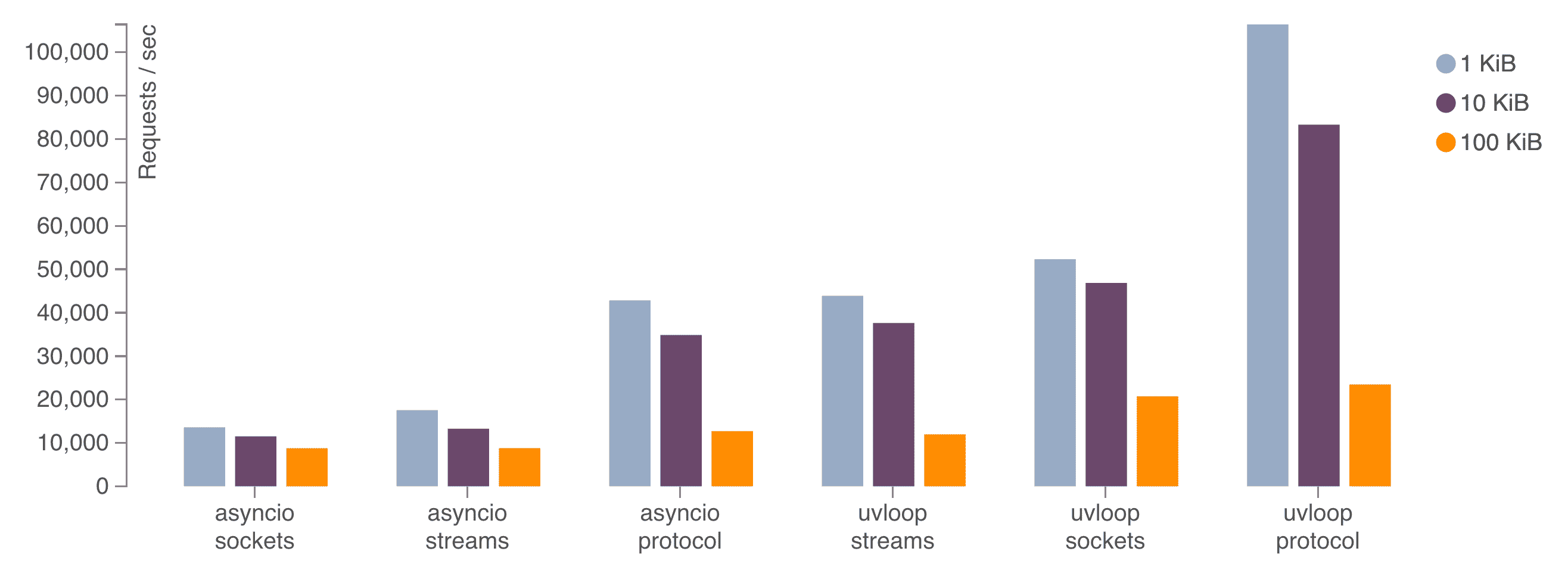
uvloop makes asyncio 2-4x faster.
.. image:: https://raw.githubusercontent.com/MagicStack/uvloop/master/performance.png :target: http://magic.io/blog/uvloop-blazing-fast-python-networking/
The above chart shows the performance of an echo server with different
message sizes. The sockets benchmark uses loop.sock_recv() and
loop.sock_sendall() methods; the streams benchmark uses asyncio
high-level streams, created by the asyncio.start_server() function;
and the protocol benchmark uses loop.create_server() with a simple
echo protocol. Read more about uvloop in a
blog post <http://magic.io/blog/uvloop-blazing-fast-python-networking/>_
about it.
Installation
uvloop requires Python 3.8 or greater and is available on PyPI. Use pip to install it::
$ pip install uvloop
Note that it is highly recommended to upgrade pip before installing uvloop with::
$ pip install -U pip
Using uvloop
As of uvloop 0.18, the preferred way of using it is via the
uvloop.run() helper function:
.. code:: python
import uvloop

async def main():
    # Main entry-point.
    ...

uvloop.run(main())
uvloop.run() works by simply configuring asyncio.run()
to use uvloop, passing all of the arguments to it, such as debug,
e.g. uvloop.run(main(), debug=True).
With Python 3.11 and earlier the following alternative snippet can be used:
.. code:: python
import asyncio
import sys

import uvloop

async def main():
    # Main entry-point.
    ...

if sys.version_info >= (3, 11):
    with asyncio.Runner(loop_factory=uvloop.new_event_loop) as runner:
        runner.run(main())
else:
    uvloop.install()
    asyncio.run(main())
Building From Source
To build uvloop, you'll need Python 3.8 or greater:
-
Clone the repository:
.. code::
$ git clone --recursive git@github.com:MagicStack/uvloop.git $ cd uvloop
-
Create a virtual environment and activate it:
.. code::
$ python3 -m venv uvloop-dev $ source uvloop-dev/bin/activate
-
Install development dependencies:
.. code::
$ pip install -e .[dev]
-
Build and run tests:
.. code::
$ make $ make test
License
uvloop is dual-licensed under MIT and Apache 2.0 licenses.
1 maintainer

Metadata
1 maintainer
Release files for lustr 0.1.0
For a detailed explanation of source distributions (sdists) and built distributions (wheels), please see the package formats documentation.
Source distribution (sdist)
| File | Size | Uploaded | Provenance | Actions |
|---|---|---|---|---|
| lustr-0.1.0.tar.gz | 4.0 MB | Without provenance | Details for lustr-0.1.0.tar.gz |
Built distribution (wheel)
| File | Interpreter | ABI | Platform | Actions Reset |
|---|---|---|---|---|
| lustr-0.1.0-cp313-cp313-macosx_11_0_arm64.whl | CPython 3.13 | CPython 3.13 | macOS 11.0+ ARM64 | Details for lustr-0.1.0-cp313-cp313-macosx_11_0_arm64.whl |
Total release size: 4.3 MB
Release files / lustr-0.1.0.tar.gz
| Download URL | lustr-0.1.0.tar.gz |
|---|---|
| Size | 4.0 MB |
| Tags | Source |
|
SHA-256 checksum How to use checksums |
92c94451008afa5b465b01acfaf79d853fa5cdf5c5701793304be7fe30d58da6
|
|
BLAKE2b-256 checksum How to use checksums |
fab781b3dd1b4c9be774cd81583bc41d6a8255b7c35ea676471c6428111b684c
|
| Upload date | |
|
Uploaded using Trusted Publishing? What is trusted publishing? |
No |
| Uploaded via |
uv/0.7.20
|
Release files / lustr-0.1.0-cp313-cp313-macosx_11_0_arm64.whl
| Download URL | lustr-0.1.0-cp313-cp313-macosx_11_0_arm64.whl |
|---|---|
| Size | 301.7 kB |
| Tags | CPython 3.13 macOS 11.0+ ARM64 |
|
SHA-256 checksum How to use checksums |
d3996e00c4cd7759446951ca6ce53a5f9e646c8f948e18f83833435b82e4e14c
|
|
BLAKE2b-256 checksum How to use checksums |
7d4d5d20bbc77d26afbdbdf1d09ebd2e65848a530f137d1624f9e2458147c67f
|
| Upload date | |
|
Uploaded using Trusted Publishing? What is trusted publishing? |
No |
| Uploaded via |
uv/0.7.20
|
Security for lustr 0.1.0
Provenance
Provenance describes where a file came from. On PyPI, provenance is shared via attestations, which provide a verifiable record of the build or publishing details. View details, limitations and caveats.
No provenance found
None of the files in this release were uploaded with provenance metadata.
A note on package security
PyPI is a repository for distributing packages, not a service for auditing them. While third-party security researchers and our staff do their best to detect and remove malicious packages, PyPI cannot guarantee the quality, security or suitability of any given package.
To learn more about protecting yourself from malicious actors, visit our package security documentation.