
100% local MCP server for semantic + lexical code search: AST-aware chunking (tree-sitter), hybrid BM25+dense retrieval, optional code knowledge graph.

Project description
Lynx
A 100% local MCP server for semantic code search — AST-aware chunking, hybrid BM25 + dense retrieval, and an optional code knowledge graph. Works with any MCP client (Claude Code, Cursor, Windsurf, Antigravity, ...).



Your AI assistant greps file names and guesses. Lynx gives it real retrieval over your code, your library docs, and your PDFs — without a single byte leaving your machine.
- AST-aware indexing — tree-sitter parses 13+ languages and indexes whole functions/classes, not arbitrary text windows.
- Hybrid retrieval — dense embeddings + code-tokenized BM25, fused with RRF; optional cross-encoder reranker.
- Code knowledge graph (opt-in) — who-calls-what, inheritance, imports: ask "what breaks if I change this?" and get the actual blast radius.
- Multi-source — index codebases, public docs sites (fetched once, on demand; JS-rendered SPAs supported via optional headless Chromium), and PDFs side by side.
- Live index — a file watcher re-indexes saves in ~2s. No manual rebuild ritual.
- Web manager UI —
lynx manager uigives you guided setup, a query playground, diagnostics, and client config snippets.
(Named after Lynceus, the Argonaut whose sharp eyes could find anything hidden.)
Quickstart
# 1. Install the CLI (isolated, no venv ritual)
pipx install lynx-mcp
#    or: uv tool install lynx-mcp

# 2. Create a config pointing at your project
lynx manager init

# 3. Build the index (downloads the ~130MB embedding model on first run)
lynx build
Then register Lynx in your MCP client (Claude Code shown; see the full guide for Cursor, Antigravity, and generic stdio clients — or let lynx manager ui generate the snippet for you):
{
  "mcpServers": {
    "lynx": {
      "command": "lynx",
      "args": ["serve", "--config", "/absolute/path/to/config.json"]
    }
  }
}
Prefer zero terminal? There are double-click installers for macOS and Windows.
The tools your AI gets
The tool set is fixed — it does not grow with the number of sources, so your client's tool list (and context window) stays small. Tools take a source argument where relevant.
| Tool | What it answers |
|---|---|
search(query, source?) |
Primary hybrid search. Omit source to search every source at once (RRF-fused). |
deep_search(queries, source?) |
Escalation: tries multiple query phrasings until one passes a quality threshold. |
graph_query(operation, symbol?) |
callers, callees, subclasses, superclasses, imports, neighbors, shortest_path, overview, surprising_connections, status. |
find_definition(symbol) |
Where is X defined? (AST-precise when the graph is on, BM25 fallback otherwise.) |
find_usages(symbol) |
Every use of X — calls and non-call references (generics, decorators, docs). |
find_tests_for(symbol) |
Are there tests for X? |
find_similar(snippet) |
Does code like this already exist? |
search_diff(query, base?) |
Search only the files changed vs a base branch — built for code review. |
feedback(trying_to_do, tried, stuck) |
The agent files a report when the index couldn't answer — stored 100% locally, your signal for tuning sources. |
list_sources / get_rag_status / update_source_index |
Introspection and maintenance. |
All retrieval tools carry MCP readOnlyHint annotations (clients can auto-approve them), and the server ships its usage playbook in the MCP handshake (instructions + a lynx://guide resource) — your agent knows how to query well without any rules-file setup.
How it works
your code ──► tree-sitter AST chunker ──► bge-small embeddings ──► ChromaDB
                                     └──► code-tokenized BM25 ─┐
query ───────────────────────────────────► RRF fusion ◄────────┘ ──► (optional reranker) ──► results
Everything runs locally: HuggingFace models are downloaded once, then Lynx switches to offline mode. No telemetry, no cloud index, no code upload. The only network access is the model download and the explicit webdoc fetch step you trigger yourself.
Why not just let the agent grep?
Grep is great when you know the identifier. It fails when you (or the agent) know the behavior: "where do we clamp the camera zoom?" matches nothing literal. Agentic grep also burns tokens — every wrong file the agent opens is context spent. Lynx answers behavioral queries in one tool call with file + line + symbol citations, and the graph layer answers structural questions (callers, inheritance) that grep fundamentally cannot — polymorphic dispatch leaves no textual trace.
Honest counterpoint: on a small repo that fits in the agent's context, built-in tools are fine. Lynx pays off on large codebases, on framework docs your model's training data has gone stale on, and on repeated sessions where re-exploring from scratch is waste.
Benchmarks (reproducible)
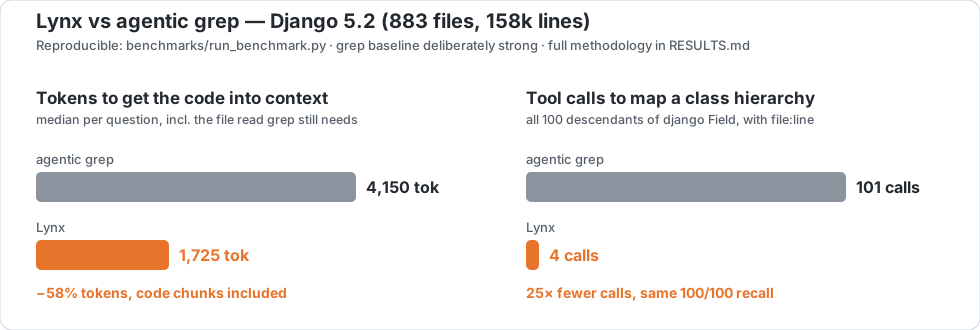
On the django/ package of Django 5.2 (883 files, ~158k lines), 20 behavioral questions with known ground-truth files — full methodology, per-task results, and an intentionally strong grep baseline in benchmarks/RESULTS.md:
| Agentic grep | Lynx | |
|---|---|---|
| median tokens to answer (tool output + required follow-up read) | 4,150 | 1,725 |
| tool round-trips before the code is in context | 2+ | 1 (chunks included, with symbol + file:line + score) |
| hit@1 / MRR | 45% / 0.64 | 55% / 0.67 |
"what inherits from Field?" — full descendant tree (100 classes) |
101 grep rounds | 4 graph calls, same recall, file:line per edge |
The ranking quality is comparable (Django's docstring-rich code is grep's best case — we say so in the report). The structural difference is not: every tool round-trip is a full model inference over the growing context, and class-relation questions force grep into one round per discovered class while graph_query reads resolved inheritance edges.
# reproduce
git clone --depth 1 --branch 5.2 https://github.com/django/django.git benchmarks/_target/django
python benchmarks/run_benchmark.py && python benchmarks/structural_demo.py
Documentation
| Full guide | Configuration, all source types (codebase / webdoc / PDF), retrieval internals, troubleshooting |
| Manager UI | Guided setup, playground, diagnostics |
| config.example.json | Annotated example configuration |
Status
Actively developed by one author; APIs may still move before 1.x stabilizes. Issues and PRs welcome — the test suite runs with pytest and CI must stay green.
License


Download files
Download the file for your platform. If you're not sure which to choose, learn more about installing packages.
Source Distribution
Built Distribution
Filter files by name, interpreter, ABI, and platform.
If you're not sure about the file name format, learn more about wheel file names.
Copy a direct link to the current filters
File details
Details for the file lynx_mcp-1.3.0.tar.gz.
File metadata
- Download URL: lynx_mcp-1.3.0.tar.gz
- Upload date:
- Size: 409.8 kB
- Tags: Source
- Uploaded using Trusted Publishing? No
- Uploaded via: twine/6.2.0 CPython/3.14.3
File hashes
| Algorithm | Hash digest | |
|---|---|---|
| SHA256 |
468731542bd491b28d013e3de77742e7b817d627abe83c15266b64be5f3a2eb5
|
|
| MD5 |
289e18cf1564798d28e0a147a6d95fc5
|
|
| BLAKE2b-256 |
df6d4ecbf469e8b0e7a78df117e6cd440e1b5b04b9437ee08f26d3e5fded7afa
|
File details
Details for the file lynx_mcp-1.3.0-py3-none-any.whl.
File metadata
- Download URL: lynx_mcp-1.3.0-py3-none-any.whl
- Upload date:
- Size: 353.9 kB
- Tags: Python 3
- Uploaded using Trusted Publishing? No
- Uploaded via: twine/6.2.0 CPython/3.14.3
File hashes
| Algorithm | Hash digest | |
|---|---|---|
| SHA256 |
2f0790ba63a1b2e35a3746126d2b4c2049893a6163798af0e6dbf90ed9a628ec
|
|
| MD5 |
3c68eade18d890f30c2b5c7dfcc5ac35
|
|
| BLAKE2b-256 |
074ecb749cf03fa72adbc751702cb2306c0b529db26ae1efec1839b83fe30f76
|






