
English | Türkçe
Lythos Settle

Settlement analysis of shallow foundations and embankments, driven from your browser. A rectangular, strip or circular foundation — or an embankment given by its crest width, height and slope angles — on a layered soil profile is analysed for how much it settles and how fast:
- Stresses — in-situ σv0, u0, σ'v0 and σ'p; the stress increase beneath the foundation by Boussinesq (Newmark's rectangle, the strip and the circle solutions) or by the 2:1 spread, at the centre, the characteristic point, the middle of the long edge and the corner; under an embankment, exactly for its trapezoidal load, at the crest centre, the crest edge, the middle of the slope and the toe.
- Immediate settlement — layered elastic (Steinbrenner) in every layer, or Schmertmann (1978) in the granular layers.
- Consolidation — primary settlement of the clay layers from Cc, Cr, e0 and σ'p, and secondary compression from Cα up to the design life.
- Time — Terzaghi's one-dimensional consolidation, each clay layer draining on its own; t50, t90 and the time–settlement curve.
- Checks — total settlement and angular distortion against their allowable values.
On top of it, a parametric or reliability study sweeps any input — a range, or a distribution — and reports sensitivities and the probability of exceeding the allowable settlement or distortion, with a confidence interval and the reliability index β.
The whole program — every label, result text, figure and report — is bilingual in English and Turkish, switchable while it runs.
The interface is a small HTTP server on your own machine, driven from a browser. That keeps the program usable over a remote session or inside a container, where a desktop toolkit would need a display it does not have, and it costs no dependency beyond the standard library.
This is the sibling of LythosFEA, Lythos Kinematic, Lythos SPWA and LythosLE, and follows the same architecture.
Screenshots
| Results summary | Time–settlement |
|---|---|
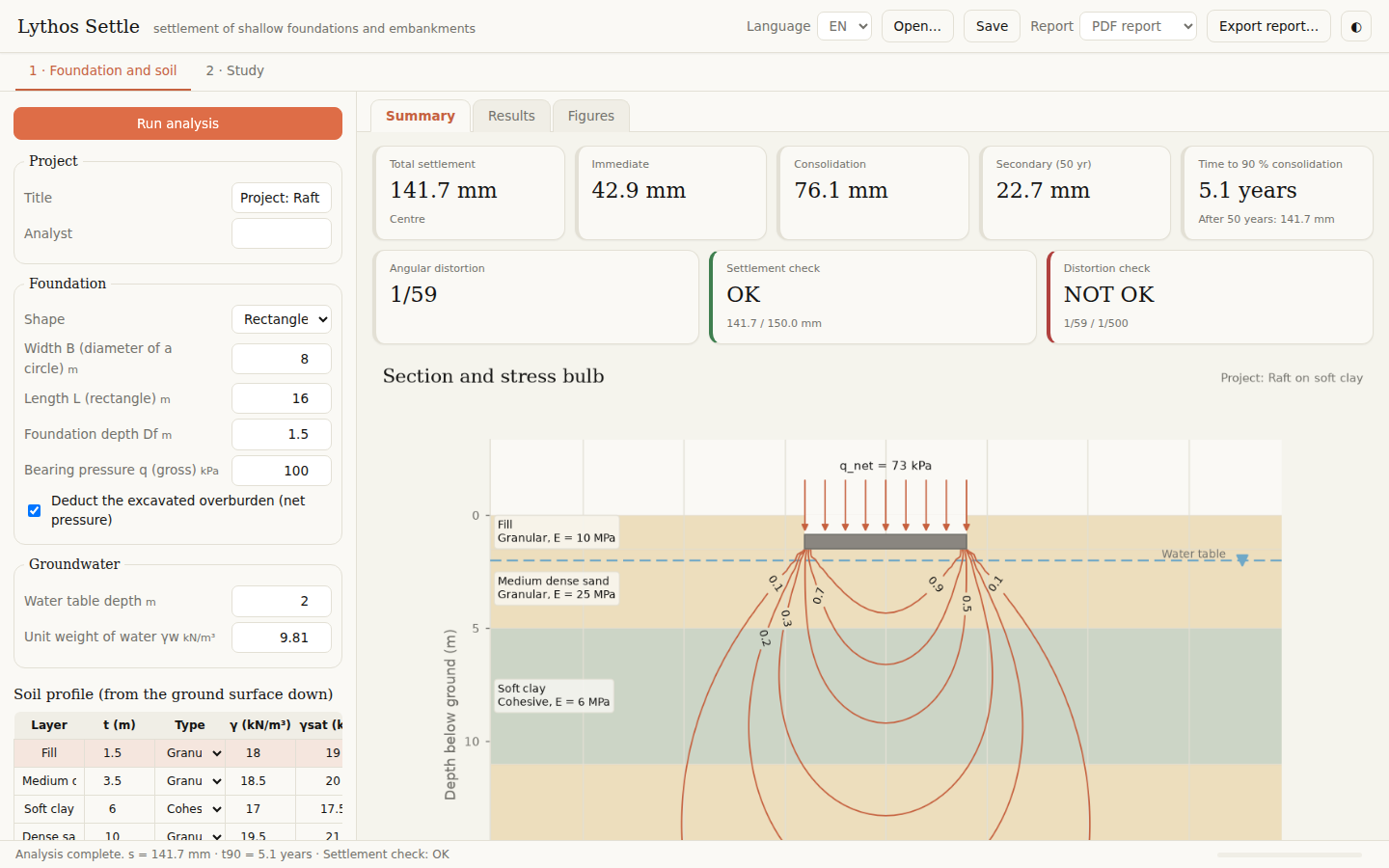 |
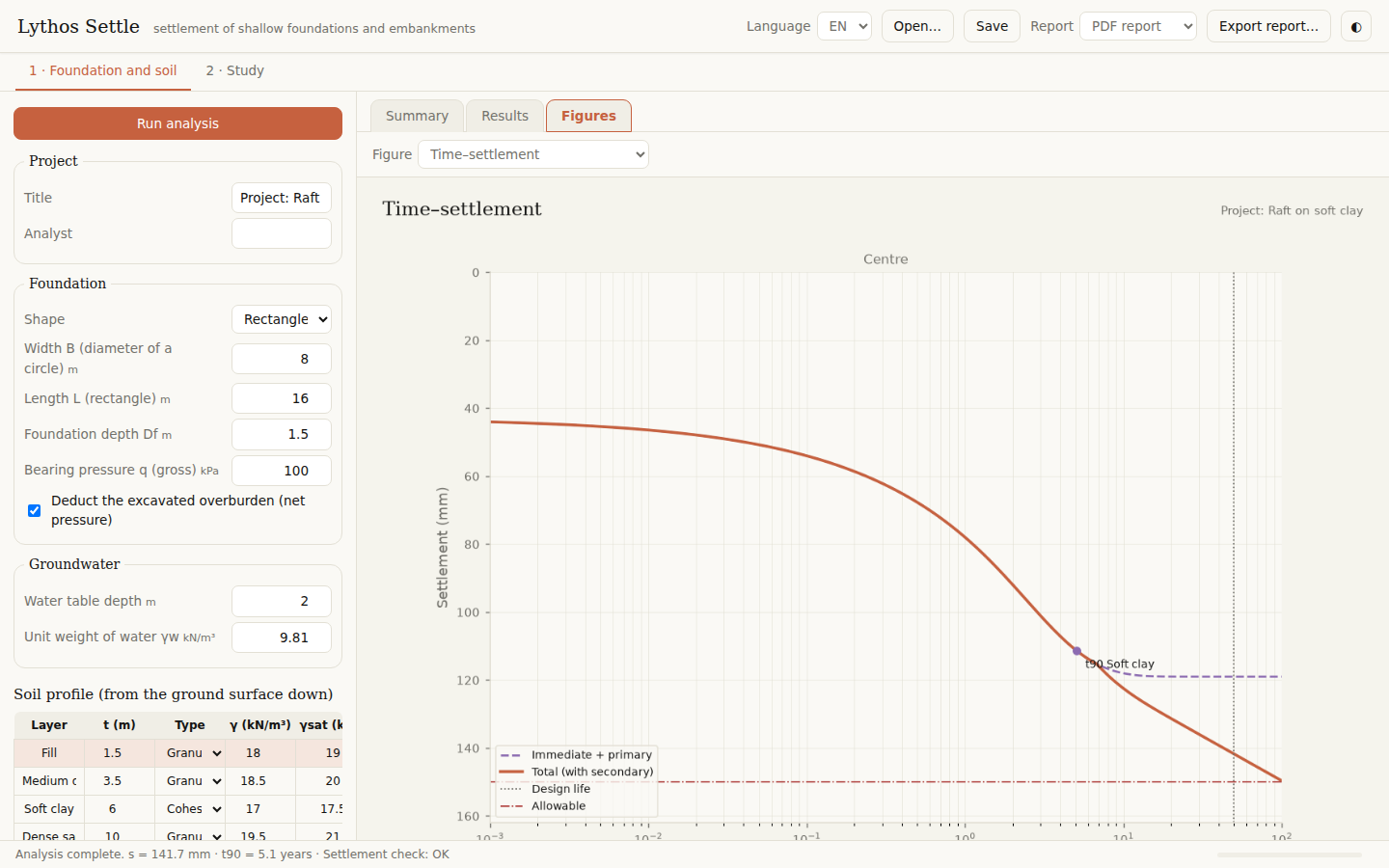 |
| Reliability study | Settlement with depth, dark theme, Turkish |
|---|---|
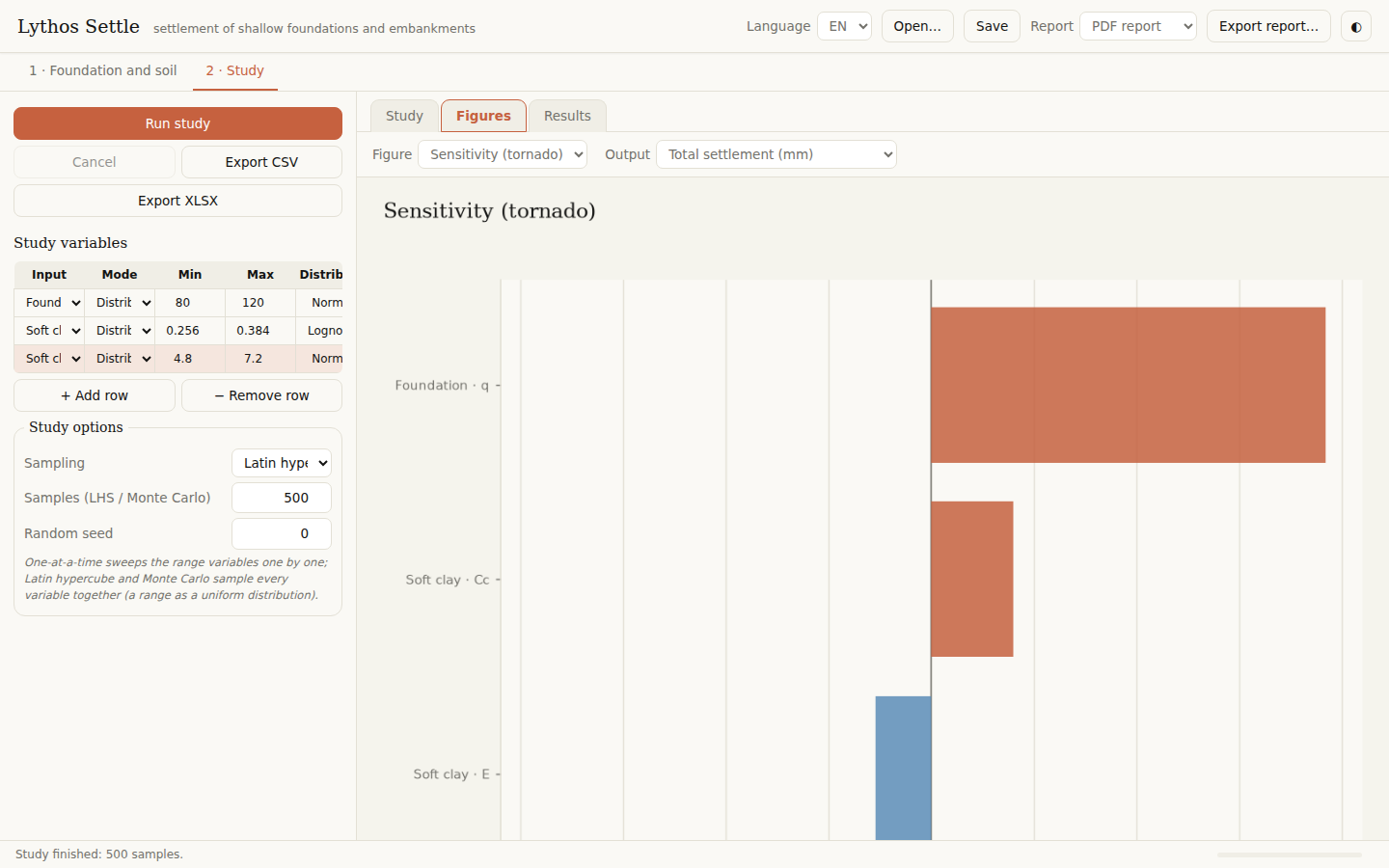 |
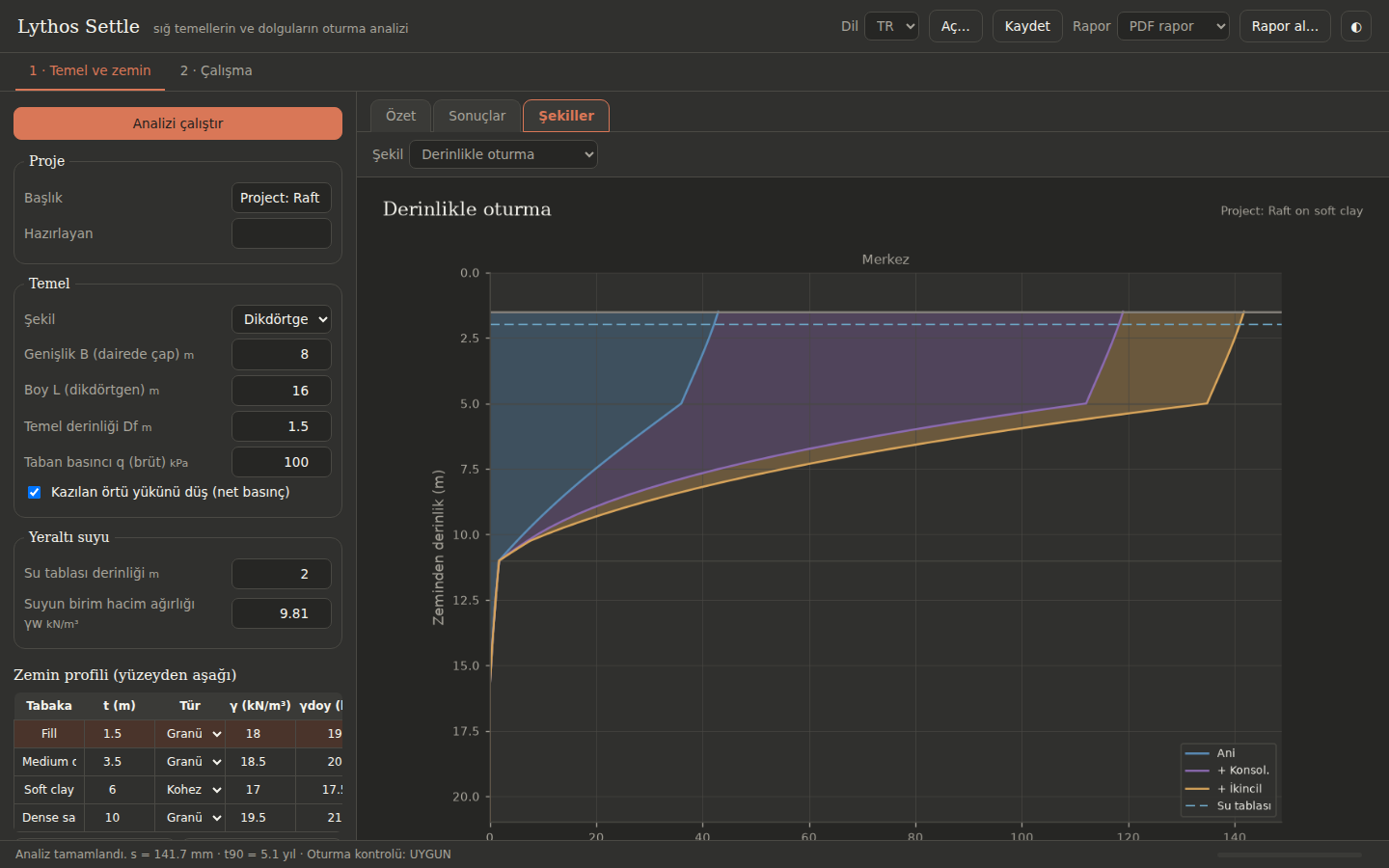 |
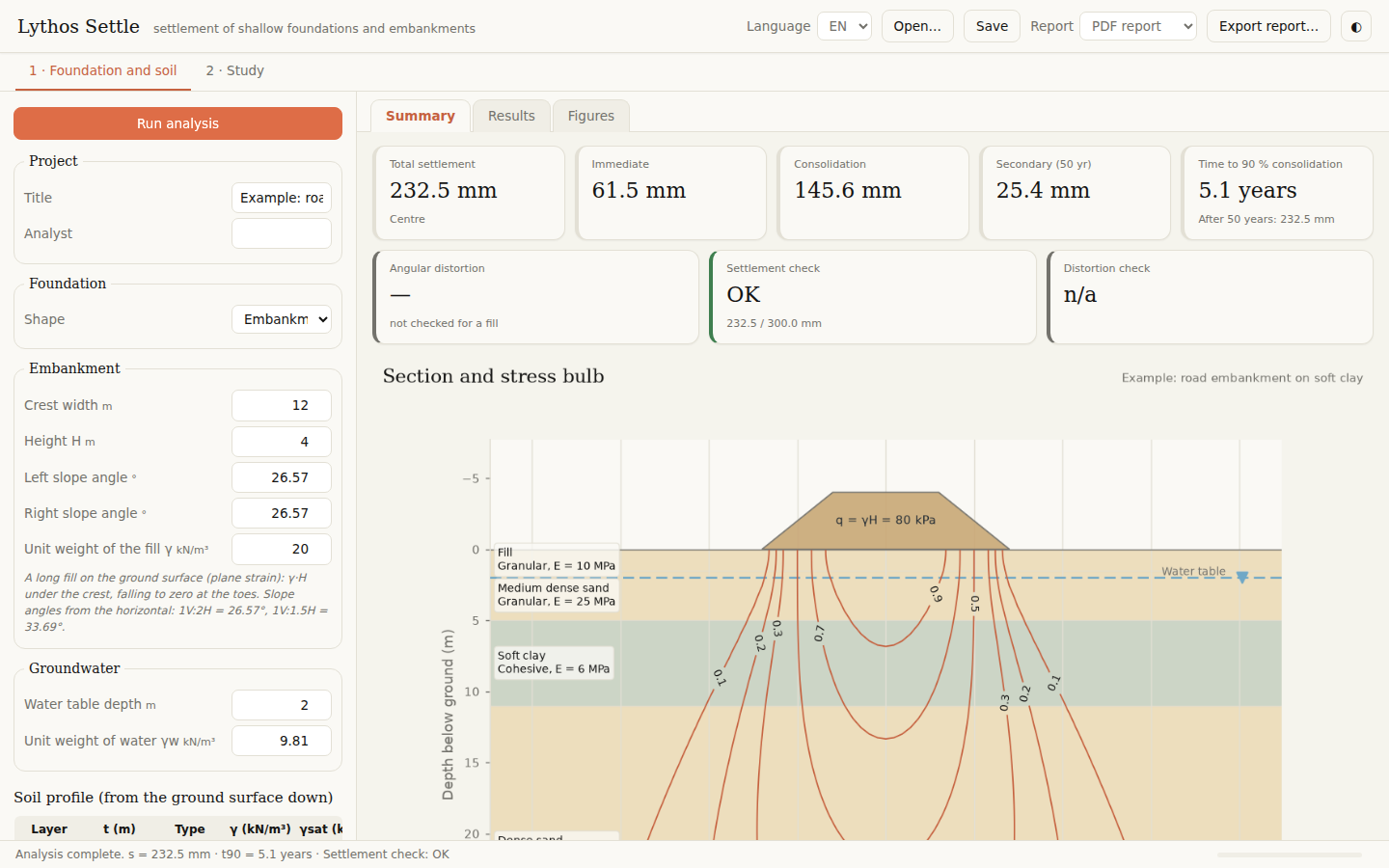
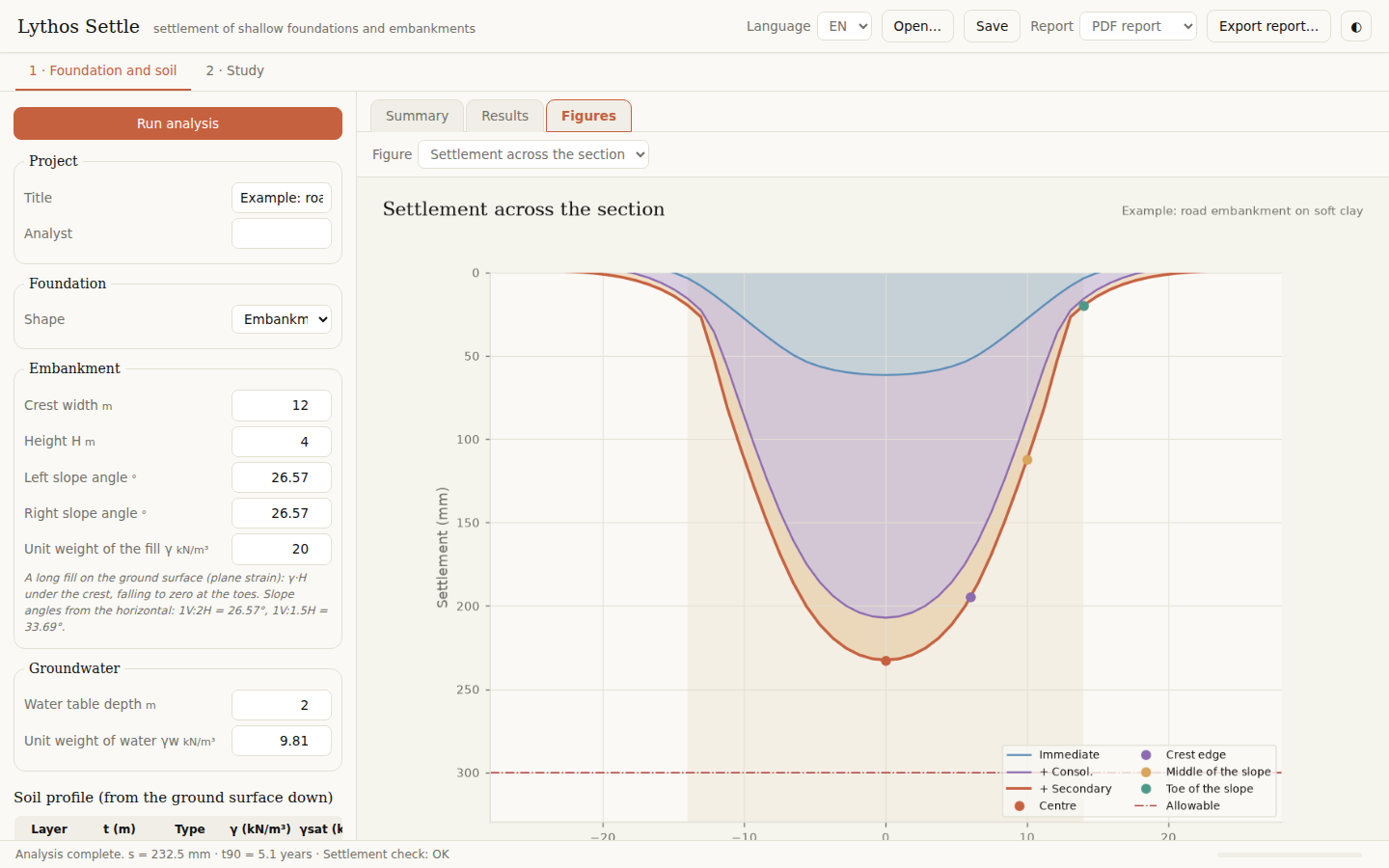
| Embankment on soft clay | Settlement across the embankment |
|---|---|
 |
 |
Install & run
From a clone, with nothing installed but the scientific stack:
pip install numpy matplotlib reportlab
python main.py
or install it and use the command:
pip install .
lythos-settle                      # opens the interface in your browser
main.py puts its own directory first on the import path, so the clone's code is what
runs even when lythossettle is also installed.
Python 3.10+ is required. Word reports need python-docx and the spreadsheet export of a
study needs openpyxl; both are extras (pip install ".[docx,xlsx]").
Command line
lythos-settle                                  # web interface (the default)
lythos-settle web --port 9000 --lang tr --no-browser
lythos-settle example -o project.settle        # a starter project file
lythos-settle run project.settle -o report.pdf # analyse, print the results, write a report
lythos-settle study project.settle -o samples.csv
run and study read the same .settle file the interface saves, so a case set up in
the browser can be re-run unattended.
Inputs
- Foundation: shape (rectangle, strip, circle), B (diameter of a circle), L, depth Df, gross bearing pressure q; optionally the excavated overburden is deducted (q_net = q − σv0(Df)).
- Embankment (shape "embankment"): crest width, height H, left and right slope angles from the horizontal, unit weight of the fill γ; the load is γ·H under the crest, falling linearly to zero at the toes.
- Groundwater: depth of the water table, γw.
- Soil profile, from the surface down, one row per layer: thickness, granular or cohesive, γ, γsat, E, ν, and for the clays Cc, Cr, e0, OCR, cv, Cα and single / double drainage. E is the drained modulus of a sand and the undrained modulus of a clay.
- Options: stress distribution, immediate-settlement method, flexible or rigid foundation, sublayer thickness, influence-depth ratio Δσ/σ'v0, design life, Schmertmann's creep factor.
- Criteria: allowable total settlement and angular distortion (1/x).
What it computes
| quantity | method |
|---|---|
| Δσ under a rectangle | Newmark's integration of Boussinesq, superposed for any point |
| Δσ under a strip / circle | closed form / exact one-dimensional integral over the polar angle |
| Δσ under an embankment | exact: Flamant's line load integrated over the piecewise-linear (trapezoidal) load |
| Δσ, approximate | 2:1 spread |
| embankment, immediate | Steinbrenner in plane strain, the crest as one strip and each slope as 16 slices |
| immediate settlement | Steinbrenner F1, F2 on each layer (layered elastic), or Schmertmann (1978) with C1, C2 and the L/B-interpolated influence diagram |
| primary consolidation | Cr up to σ'p = OCR·σ'v0, Cc beyond it, sublayer by sublayer at each point |
| secondary compression | Cα/(1+e0)·H·log(t/t_p) from U = 95 % to the design life; Cα·Cr/Cc where the clay stays over-consolidated |
| time | Terzaghi U(Tv), per clay layer, H_dr = H/2 or H |
| rigid foundation | settlement of the characteristic point (0.74·B/2, 0.74·L/2; 0.845·R) |
| angular distortion | (s_centre − s_edge) / (B/2) |
The derivations and their limits are in docs/theory.md.
Figures
Section with the Boussinesq stress bulb · stresses with depth (σ'v0, σ'v0 + Δσ, σ'p and the influence-depth criterion) · influence factors at each point with Schmertmann's Iz · cumulative settlement with depth · time–settlement curve · settlement components at each point · settlement across the section (the settlement trough under a footing or a fill). Study figures: one-at-a-time sweep, histogram, scatter, tornado.
Reports
Choose PDF, self-contained HTML or Word in the header and press Export report…. The report carries the inputs, the stresses, the settlement at each point and in each layer, the Schmertmann factors, the consolidation times, the checks, the figures, the warnings, the method notes and — if one was run — the study, in whichever language the interface is in. All three formats are assembled from one place, so they say the same thing.
Project files (.settle)
JSON. Save writes the inputs and the study definition; Open… reads them back. Missing entries keep their defaults.
Modules
| file | content |
|---|---|
lythossettle/stress.py |
Boussinesq (rectangle, strip, circle), 2:1, Steinbrenner |
lythossettle/consolidation.py |
Terzaghi U(Tv) and its inverse, compression of clay, secondary compression |
lythossettle/engine.py |
The settlement analysis: profile, sublayers, points, checks, time curve |
lythossettle/study.py, study_plots.py |
Parametric (one at a time) and reliability (LHS / Monte Carlo) studies, statistics, P of exceedance with 95 % CI and β, Spearman sensitivities, CSV / XLSX |
lythossettle/plotting.py, plot_style.py, render.py |
Matplotlib figures, theme-aware, off-screen |
lythossettle/report.py, pdf.py |
Calculation report: one HTML assembly, exported as PDF (reportlab), HTML or DOCX |
lythossettle/forms.py |
Input schema and readers; converts between the interface's flat values and the engine's configuration |
lythossettle/summary.py |
The results as cards and as text, for the browser and the command line alike |
lythossettle/i18n.py |
Every text, English and Turkish, written side by side |
lythossettle/web/ |
The local HTTP server, the session, and the browser interface |
Development
pip install -e ".[dev]"
pytest -q                 # engine against hand calculations, stresses against tables, study, report, web, packaging
ruff check .
The tests check the stress solutions against published values and brute-force integrals, the engine against closed-form cases (a square on an elastic half-space, a one-dimensional clay layer, Schmertmann by hand), the report in all three formats, the input schema and its file round-trips, and the interface itself — the session and the HTTP layer both, so the browser is exercised without a browser.
Releasing to PyPI is described in docs/releasing.md;
tools/upload_to_pypi.py does it from an editor, without a terminal.
License
MIT © 2026 Hasan Deniz Altuntaş
1 maintainer

Release files for lythossettle 0.1.0
For a detailed explanation of source distributions (sdists) and built distributions (wheels), please see the package formats documentation.
Source distribution (sdist)
| File | Size | Uploaded | |
|---|---|---|---|
| lythossettle-0.1.0.tar.gz | 106.8 kB | Details |
Built distribution (wheel)
| File | Interpreter | ABI | Platform | Reset |
|---|---|---|---|---|
| lythossettle-0.1.0-py3-none-any.whl | Python 3 | none | any | Details |
Total release size: 201.1 kB
Release files / lythossettle-0.1.0.tar.gz
| Download URL | lythossettle-0.1.0.tar.gz |
|---|---|
| Size | 106.8 kB |
| Tags | Source |
|
SHA-256 checksum How to use checksums |
e4445d8460b81bb9ab509d194af8429ae3fe33865dbb17c7d434ab5773b3ad15
|
|
BLAKE2b-256 checksum How to use checksums |
ddfebe7d22489ab83bd259c20d6117c1269e7a27fa5bb2c26438e1b50170d189
|
| Upload date | |
|
Uploaded using Trusted Publishing? What is trusted publishing? |
No |
| Uploaded via |
twine/7.0.0 CPython/3.14.4
|
Release files / lythossettle-0.1.0-py3-none-any.whl
| Download URL | lythossettle-0.1.0-py3-none-any.whl |
|---|---|
| Size | 94.3 kB |
| Tags | Python 3 |
|
SHA-256 checksum How to use checksums |
44b8676eb58b7a04bb9bb3d6a7af1ca7e3f21bc95da0ee4b0e1313d6a0958b3d
|
|
BLAKE2b-256 checksum How to use checksums |
8e5d5d0cdb69993a66f80127d6bdc7e689c48d280a703cbbce46401a5ca274c7
|
| Upload date | |
|
Uploaded using Trusted Publishing? What is trusted publishing? |
No |
| Uploaded via |
twine/7.0.0 CPython/3.14.4
|













