
Multi-Mission Multi-Messenger Observation Planning Toolkit

Project description
Multi-Mission Multi-Messenger Observation Planning Toolkit




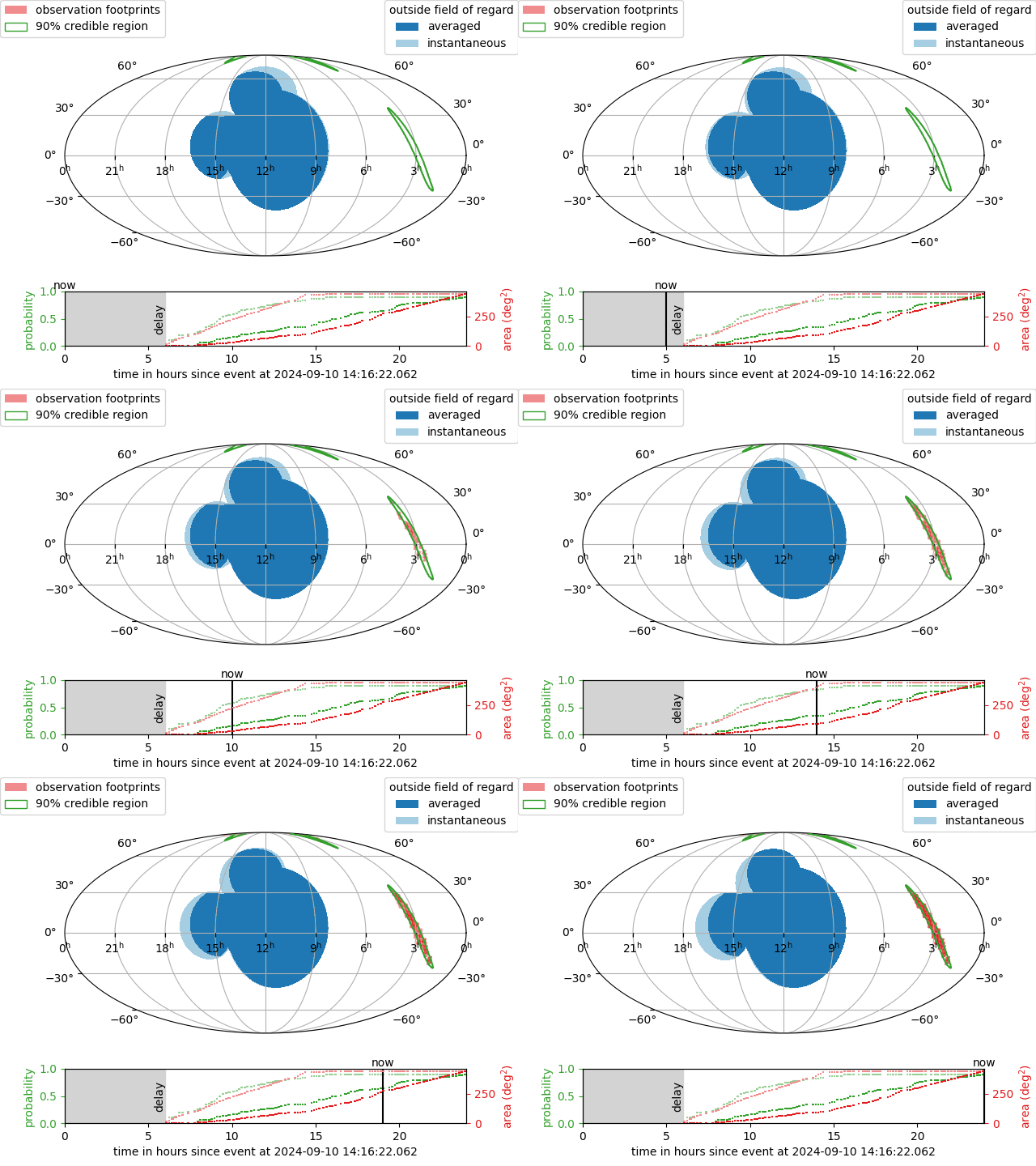
M4OPT is an open-source toolkit for multi-facility scheduling of astrophysics observing campaigns. It focuses on extremely rapid follow-up of gravitational wave (GW) and neutrino events with heterogeneous networks of space and ground-based observatories.
M4OPT uses the versatile mathematical framework of mixed integer programming to model and solve complex observation scheduling problems. Although M4OPT is open source, for the largest problems it can leverage two industrial-strength commercial MIP solvers: CPLEX or Gurobi. Both solvers are available for free for academic users.
M4OPT is designed from the Astropy affiliated package template, and is meant to follow those standards, including interoperability with the Astropy ecosystem. It also complies with NASA Procedural Requirements (NPR) 7150 for Class C software and is suitable for non-safety-critical ground software applications for Class D NASA payloads.
Features
Global: jointly and globally solves the problems of tiling (the set of telescope boresight orientations and roll angles) and the scheduling (which tile is observed at what time), rather than solving each sub-problem one at a time
Optimal: generally solves all the way to optimality, rather than finding merely a “good enough” solution
Fast: solve an entire orbit in about 5 minutes
General: does not depend on heuristics of any kind
Flexible: problem is formulated in the versatile framework of mixed integer programming
License
This project is Copyright (c) M4OPT Developers and licensed under the terms of the BSD 3-Clause license. This package is based upon the Astropy package template which is licensed under the BSD 3-clause license. See the licenses folder for more information.
How to Cite
If you use M4OPT in your research, then please cite the following paper:
Singer, L. P., Criswell, A. W., Leggio, S. C., et al. (2025). Optimal Follow-Up of Gravitational-Wave Events with the UltraViolet EXplorer (UVEX) (Version 1). https://doi.org/10.48550/ARXIV.2502.17560
Contributing
We love contributions! m4opt is open source, built on open source, and we’d love to have you hang out in our community.
Imposter syndrome disclaimer: We want your help. No, really.
There may be a little voice inside your head that is telling you that you’re not ready to be an open source contributor; that your skills aren’t nearly good enough to contribute. What could you possibly offer a project like this one?
We assure you - the little voice in your head is wrong. If you can write code at all, you can contribute code to open source. Contributing to open source projects is a fantastic way to advance one’s coding skills. Writing perfect code isn’t the measure of a good developer (that would disqualify all of us!); it’s trying to create something, making mistakes, and learning from those mistakes. That’s how we all improve, and we are happy to help others learn.
Being an open source contributor doesn’t just mean writing code, either. You can help out by writing documentation, tests, or even giving feedback about the project (and yes - that includes giving feedback about the contribution process). Some of these contributions may be the most valuable to the project as a whole, because you’re coming to the project with fresh eyes, so you can see the errors and assumptions that seasoned contributors have glossed over.
Note: This disclaimer was originally written by Adrienne Lowe for a PyCon talk, and was adapted by m4opt based on its use in the README file for the MetPy project.
Release history Release notifications | RSS feed


Download files
Download the file for your platform. If you're not sure which to choose, learn more about installing packages.
Source Distribution
Built Distribution
Filter files by name, interpreter, ABI, and platform.
If you're not sure about the file name format, learn more about wheel file names.
Copy a direct link to the current filters
File details
Details for the file m4opt-2.1.0.tar.gz.
File metadata
- Download URL: m4opt-2.1.0.tar.gz
- Upload date:
- Size: 1.3 MB
- Tags: Source
- Uploaded using Trusted Publishing? No
- Uploaded via: twine/6.1.0 CPython/3.13.7
File hashes
| Algorithm | Hash digest | |
|---|---|---|
| SHA256 |
5bc40b5f8e7f7c1a0643152f9386cdbcb030b0c160c60db95074f6f2f854d495
|
|
| MD5 |
ed9b9ef260f36accf41ca1529d96f918
|
|
| BLAKE2b-256 |
5993f55070dddbc02bf7ebf60ccfb7100060fd0d7f178d786f3967f20cda8ae0
|
File details
Details for the file m4opt-2.1.0-py3-none-any.whl.
File metadata
- Download URL: m4opt-2.1.0-py3-none-any.whl
- Upload date:
- Size: 1.3 MB
- Tags: Python 3
- Uploaded using Trusted Publishing? No
- Uploaded via: twine/6.1.0 CPython/3.13.7
File hashes
| Algorithm | Hash digest | |
|---|---|---|
| SHA256 |
1d7c58a0a9f07e7031a739f55dd8afd769e8875c5703c98816c1ae17891e1c40
|
|
| MD5 |
1ea02af29314143cda25c6fd8e3291f4
|
|
| BLAKE2b-256 |
b0cfa5162864a21545b511f778c8b7186fb53b325c7bf0b534497e05cac52b51
|






