MA-PMO — Multi-Agent Project Management Office
Seven little AI agents that run your PMO — and always ask a human before the big decisions.
English | 한국어




An LLM-backed supervisor–worker multi-agent system for portfolio and project management. Seven agents (A1–A7) plan schedules, allocate resources, detect risks early, review stage gates, search lessons learned and write executive reports. They talk to each other through versioned, schema-validated messages, and a human approves every high-risk decision.
MA-PMO turns the proof-of-concept simulation of the MA-PMO paper into a real, measurable system: every action is instrumented on five efficiency axes so hypotheses H1–H5 can be tested on real telemetry.
🇰🇷 한국어 요약 — LLM 기반 감독자–작업자 멀티 에이전트(A1~A7)로 PMO 업무(일정·자원·리스크·게이트·지식·보고)를 자동화하는 오픈소스입니다. 대시보드와 생성 결과는 영어/한국어를 모두 지원합니다(화면 우측 상단
EN | 한국어). 오픈소스(AGPL-3.0)로 무료 사용 가능하며, 상업적 사용(소스 비공개 SaaS·자사 제품 탑재 등)과 각종 문의는 mjinttt@gmail.com 으로 연락주세요. 전체 한국어 문서: README.ko.md
Highlights
- Seven cooperating agents — A1 orchestrator routes goals to A2 Planning (CPM), A3 Resources, A4 Risk, A5 Reporting, A6 Governance and A7 Knowledge (RAG with mandatory citations).
- Runs offline — with no API key, every agent falls back to deterministic logic, so the whole pipeline works end to end. Add an Anthropic key or a local Ollama model to switch on the LLM path.
- Structured, auditable communication — Pydantic
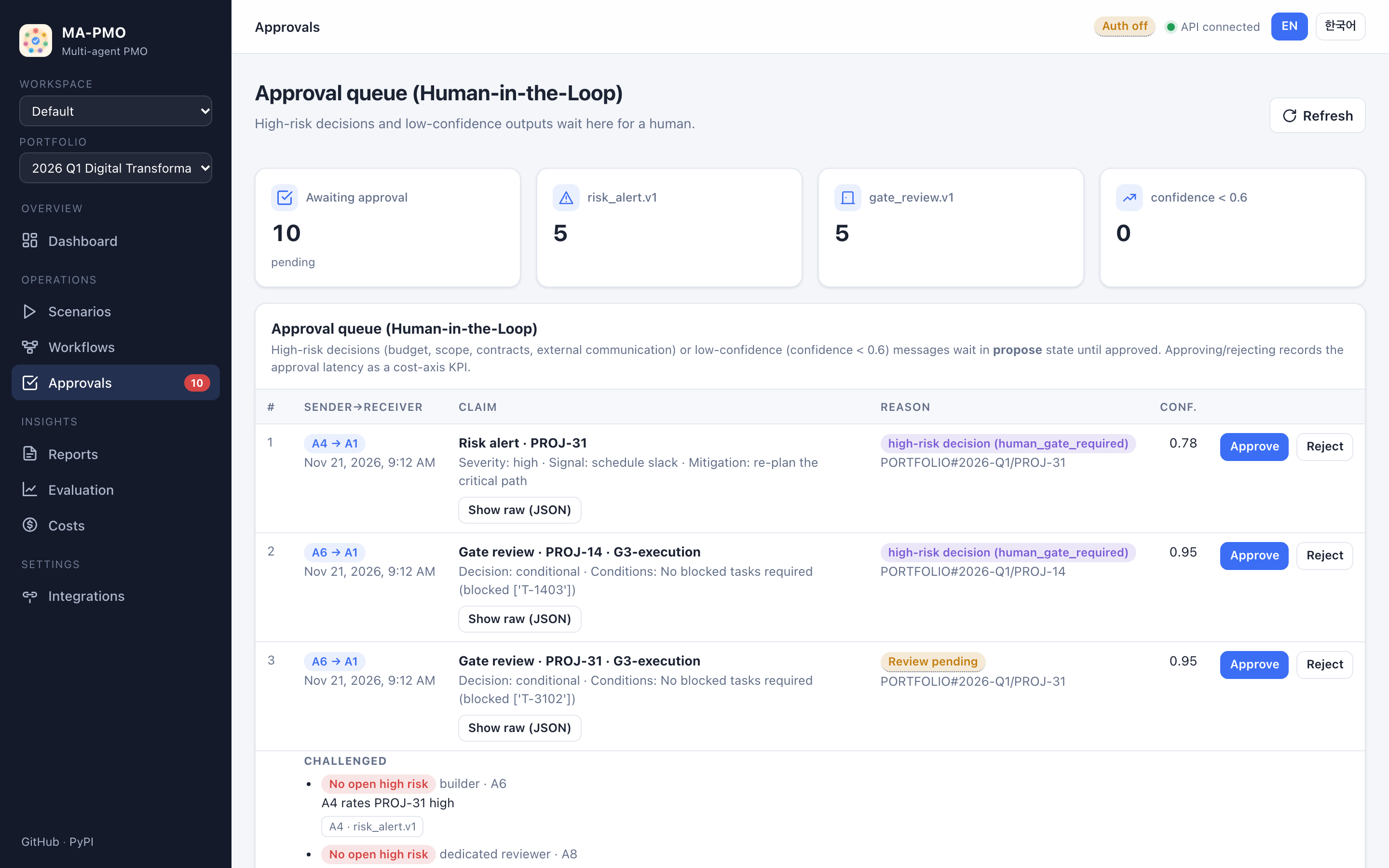
.v1message schemas instead of free-form chat, stored in an append-only log. - Human-in-the-loop — high-severity risks, failed gates and low-confidence messages wait in an approval queue.
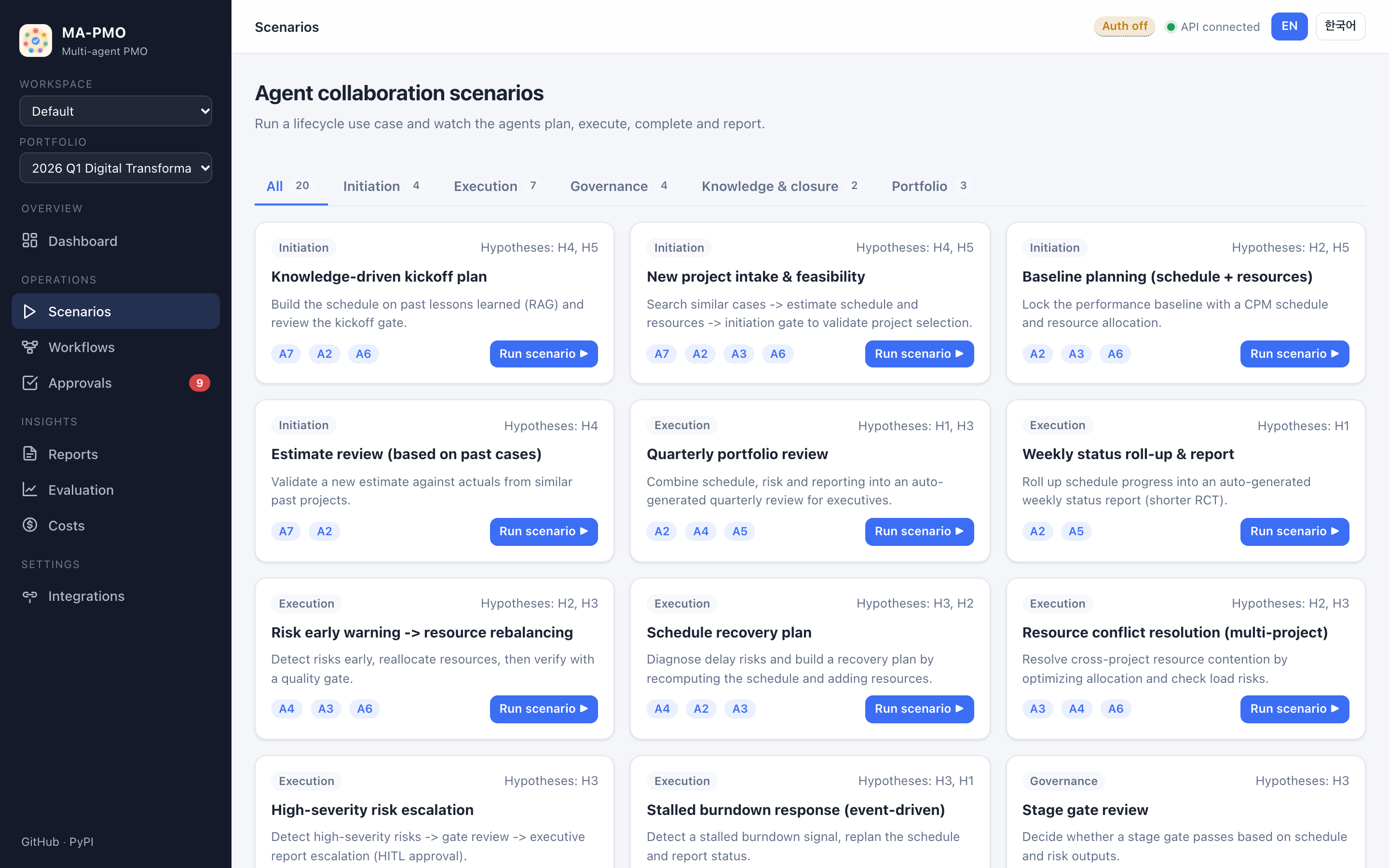
- Measurable — five-axis KPIs (time, resource, delivery, risk, cost), 20 lifecycle scenarios and an experiment harness that exports paper-ready Markdown.
- Bilingual — dashboard, API responses, reports and LLM output in English or Korean (
?lang=ko,Accept-Language, orMA_PMO_LANG). - Pluggable integrations — Slack and webhook notifications, Jira Cloud as the data source, and a plugin entry point for your own.
- Evaluate on your own data — fill-in data templates with line-by-line validation, H1–H5 reports with verdicts (Markdown/HTML), and an experiment scaffold (
ma-pmo harness new). - Admin dashboard — sidebar navigation with a pending-approvals badge, Evaluation and Integrations pages, light/dark themes and a mobile layout.
Screenshots
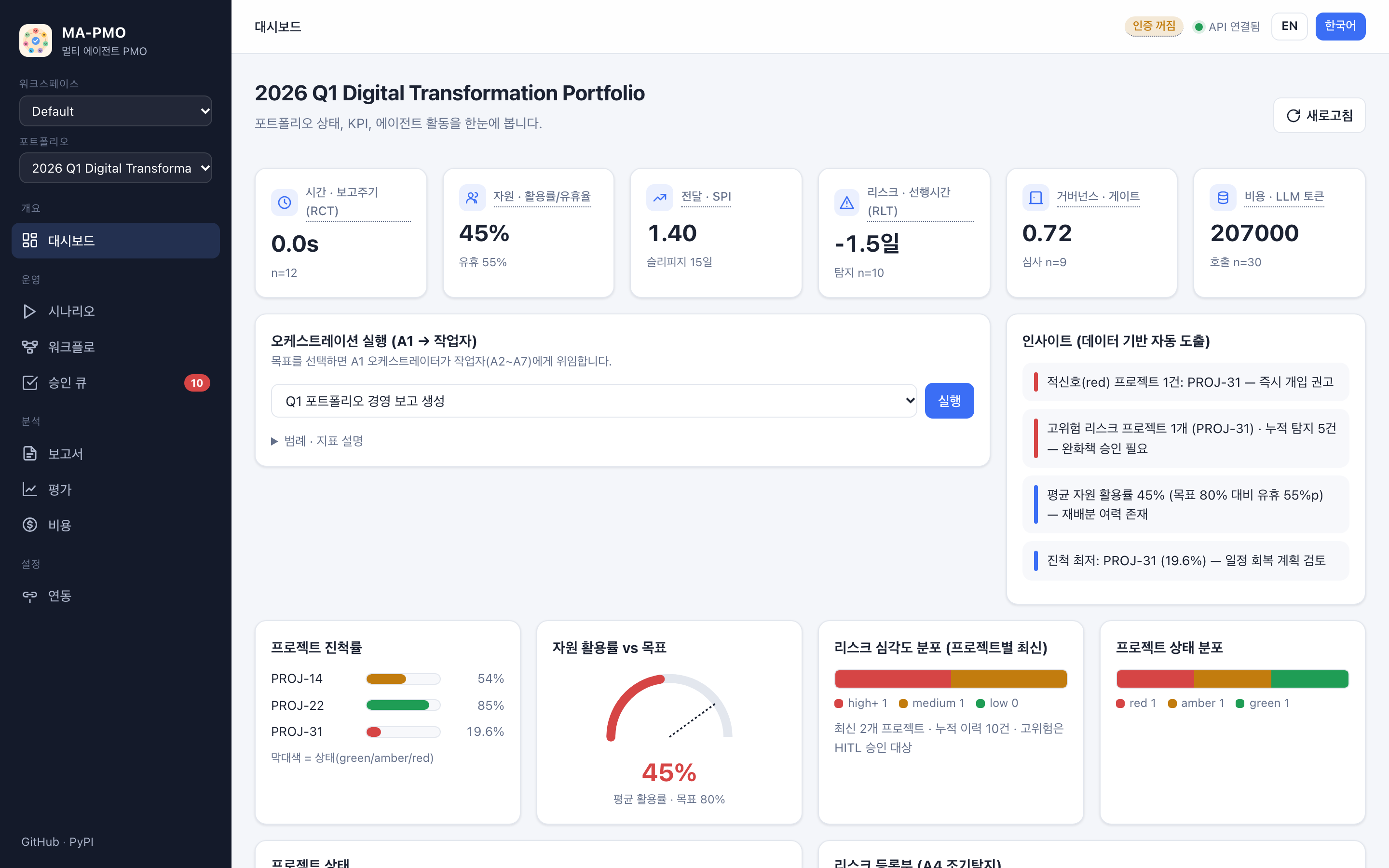
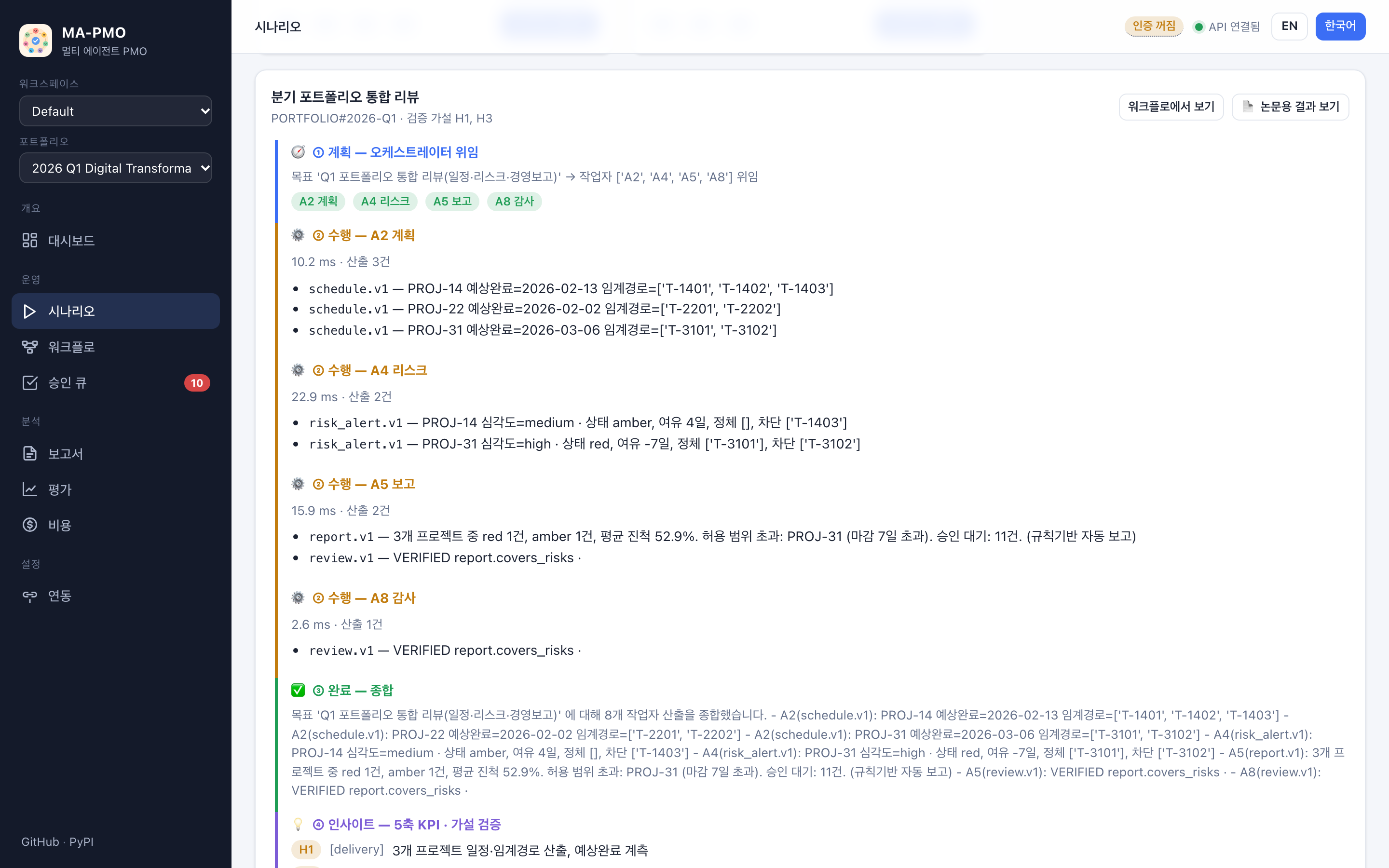
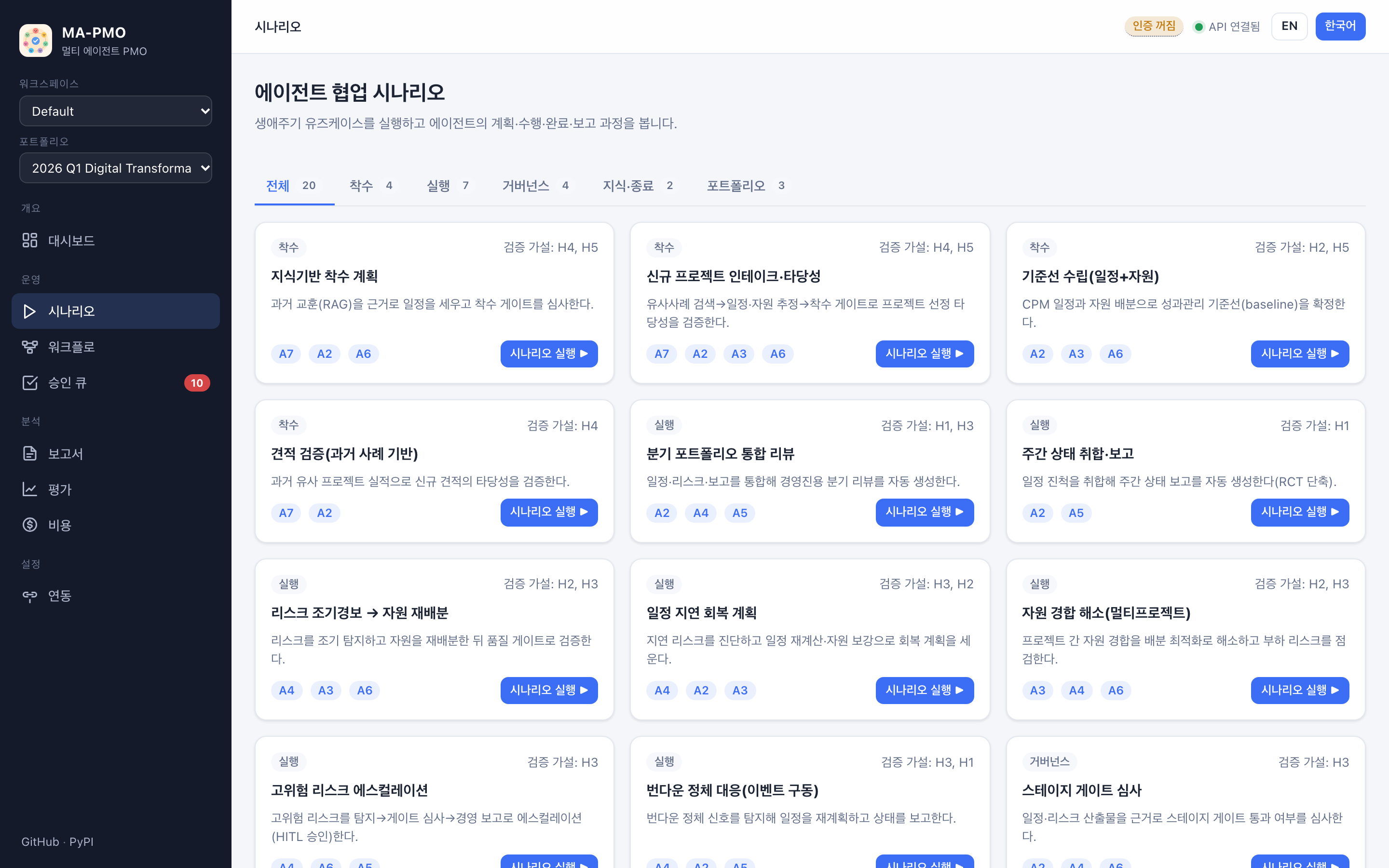
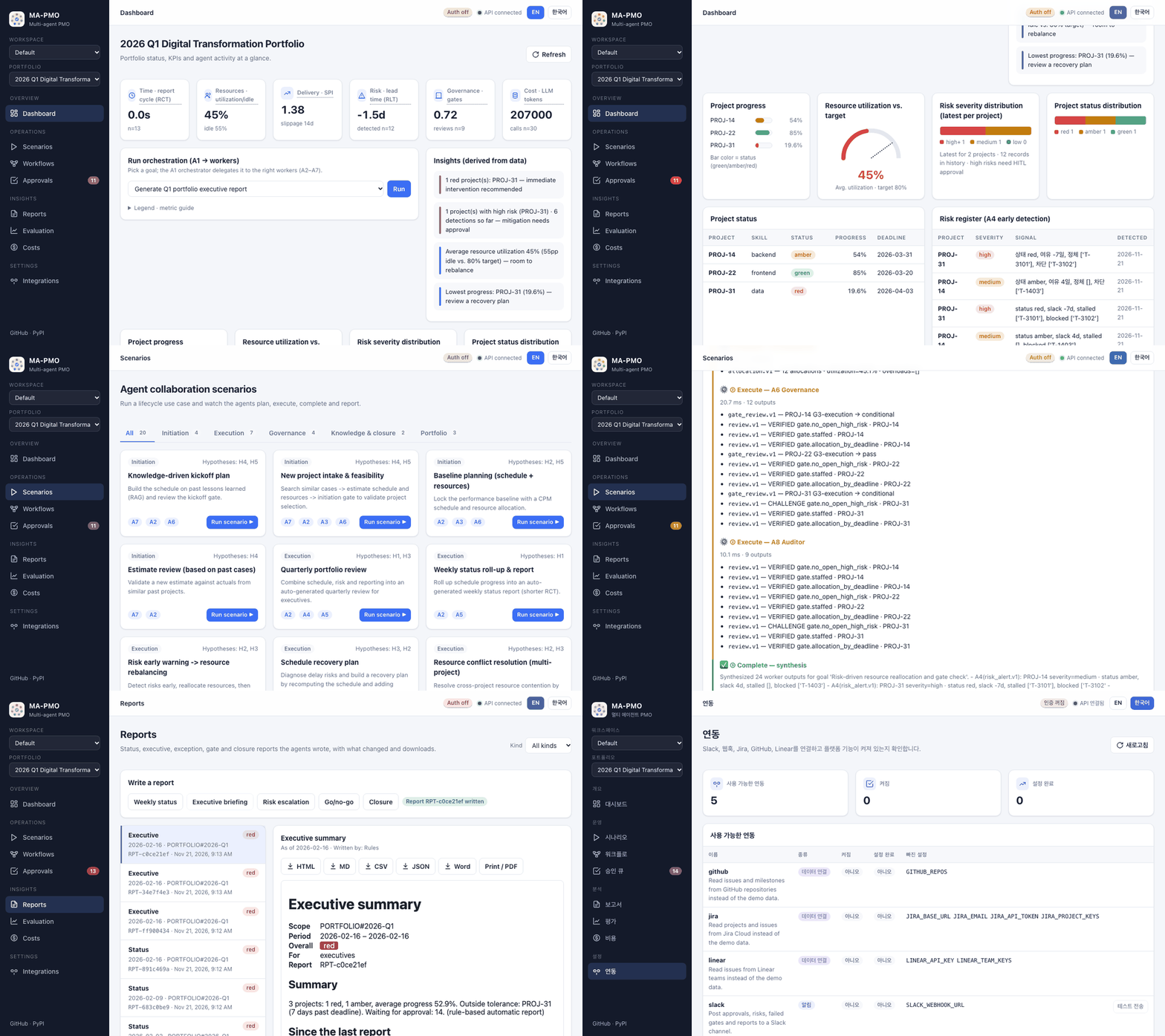
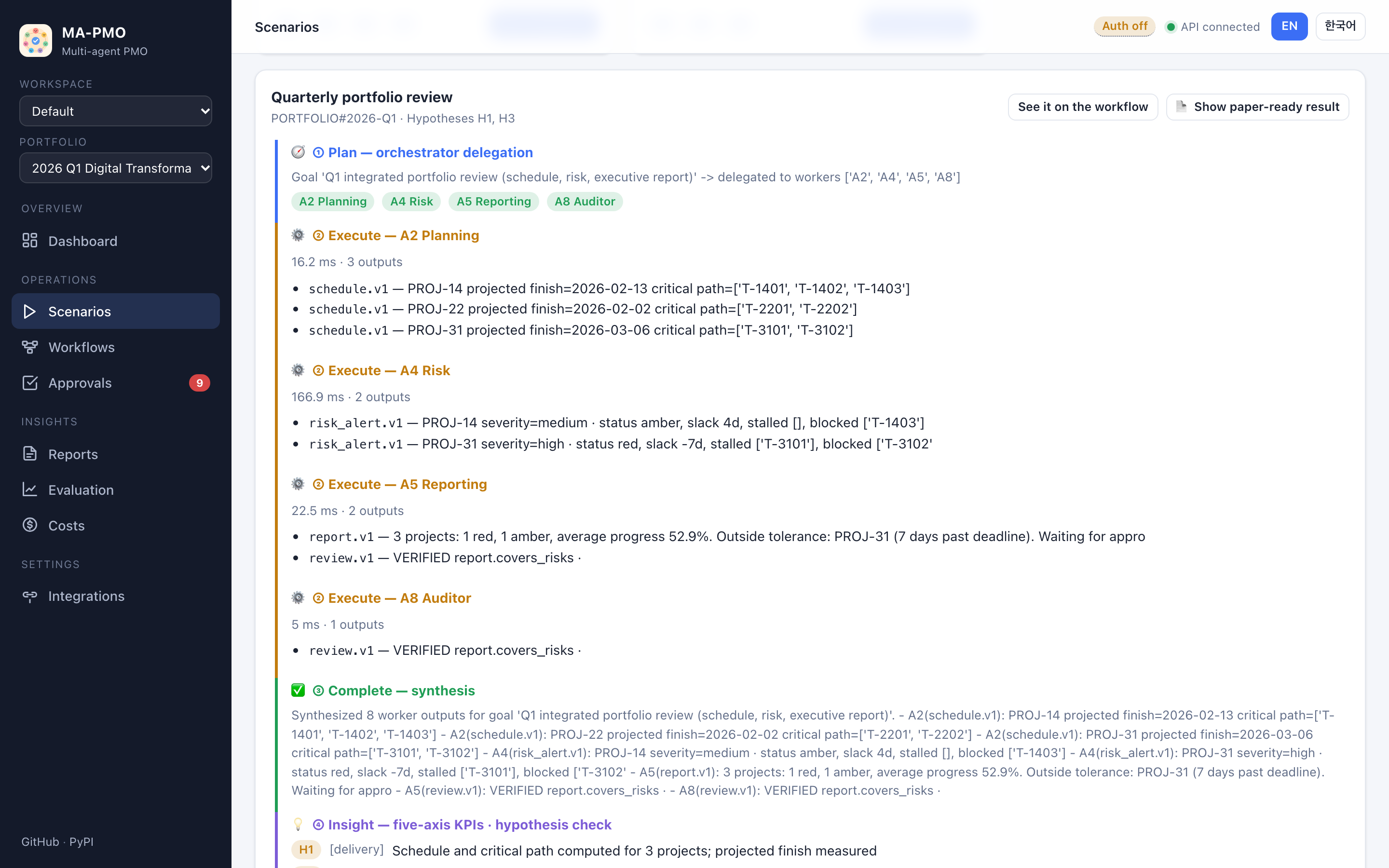
| Dashboard | Agent collaboration trace |
|---|---|
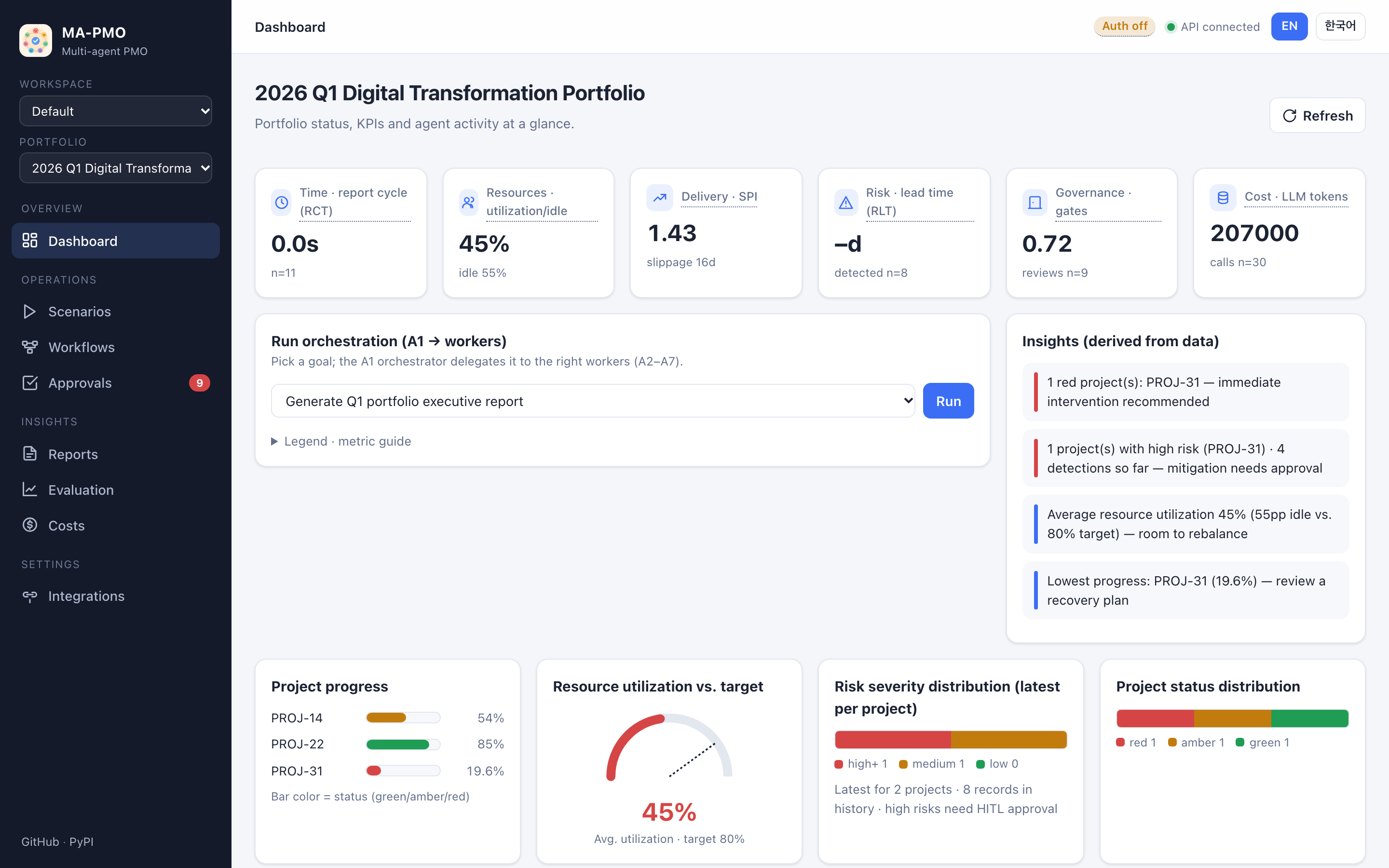 |
 |
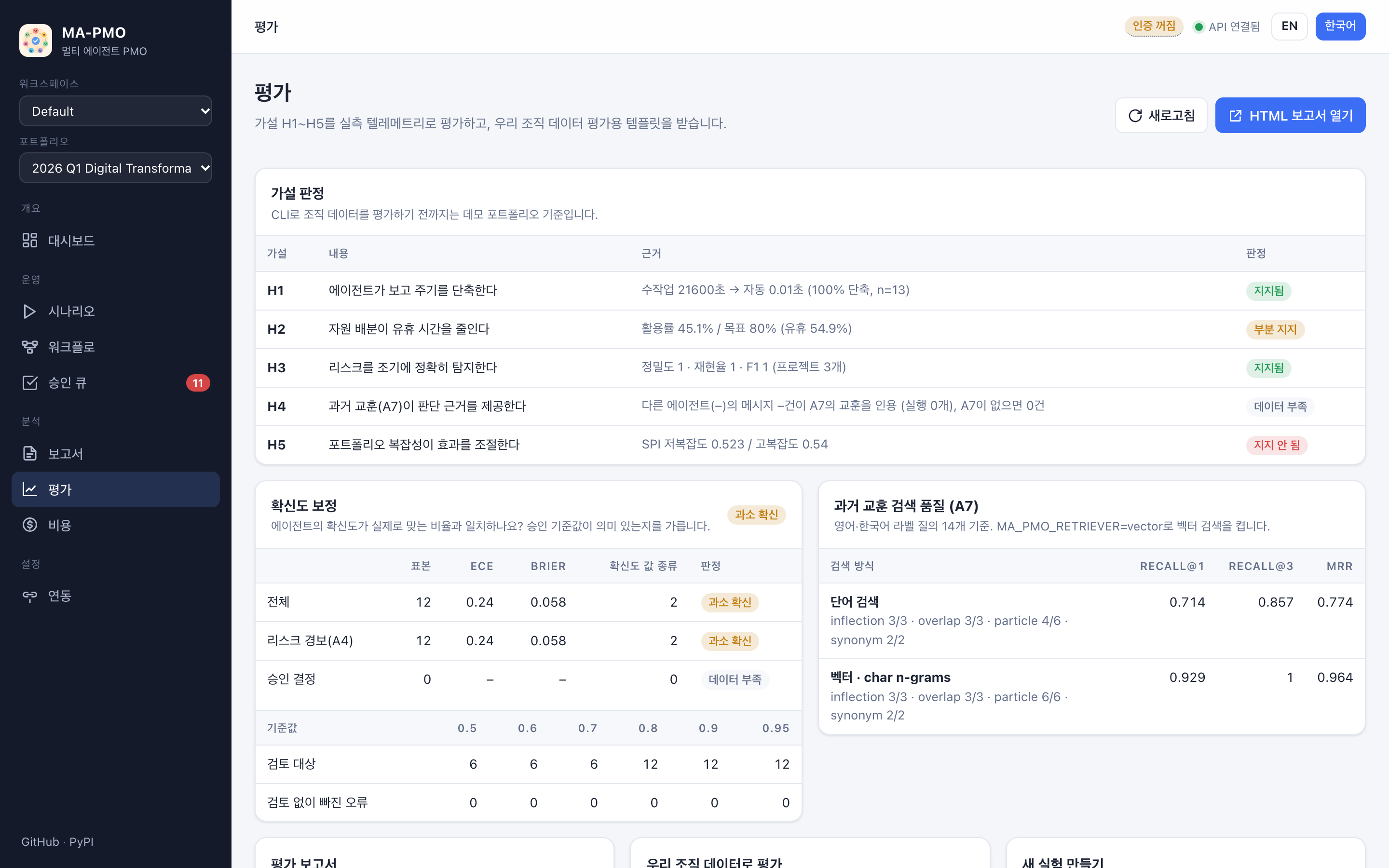
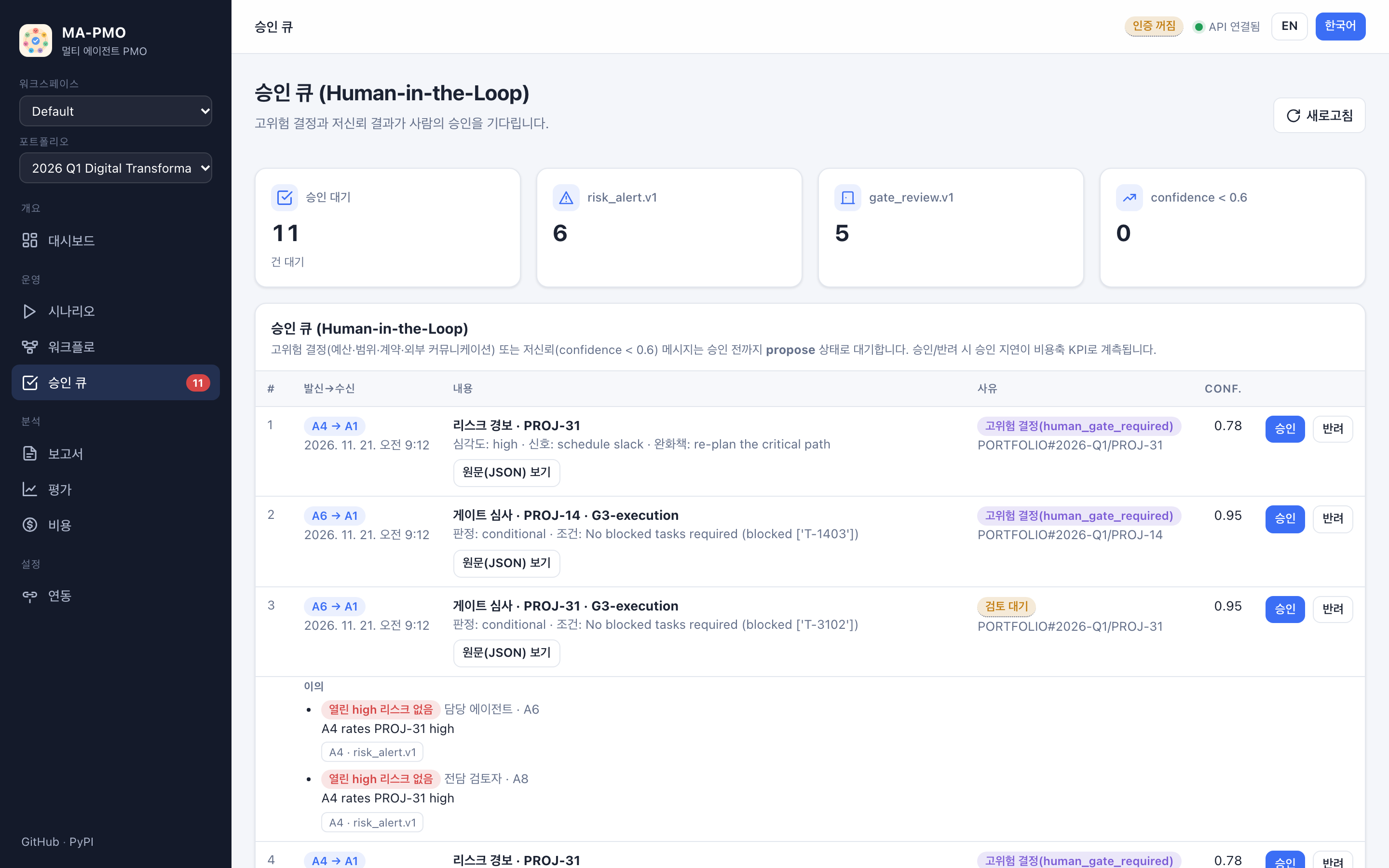
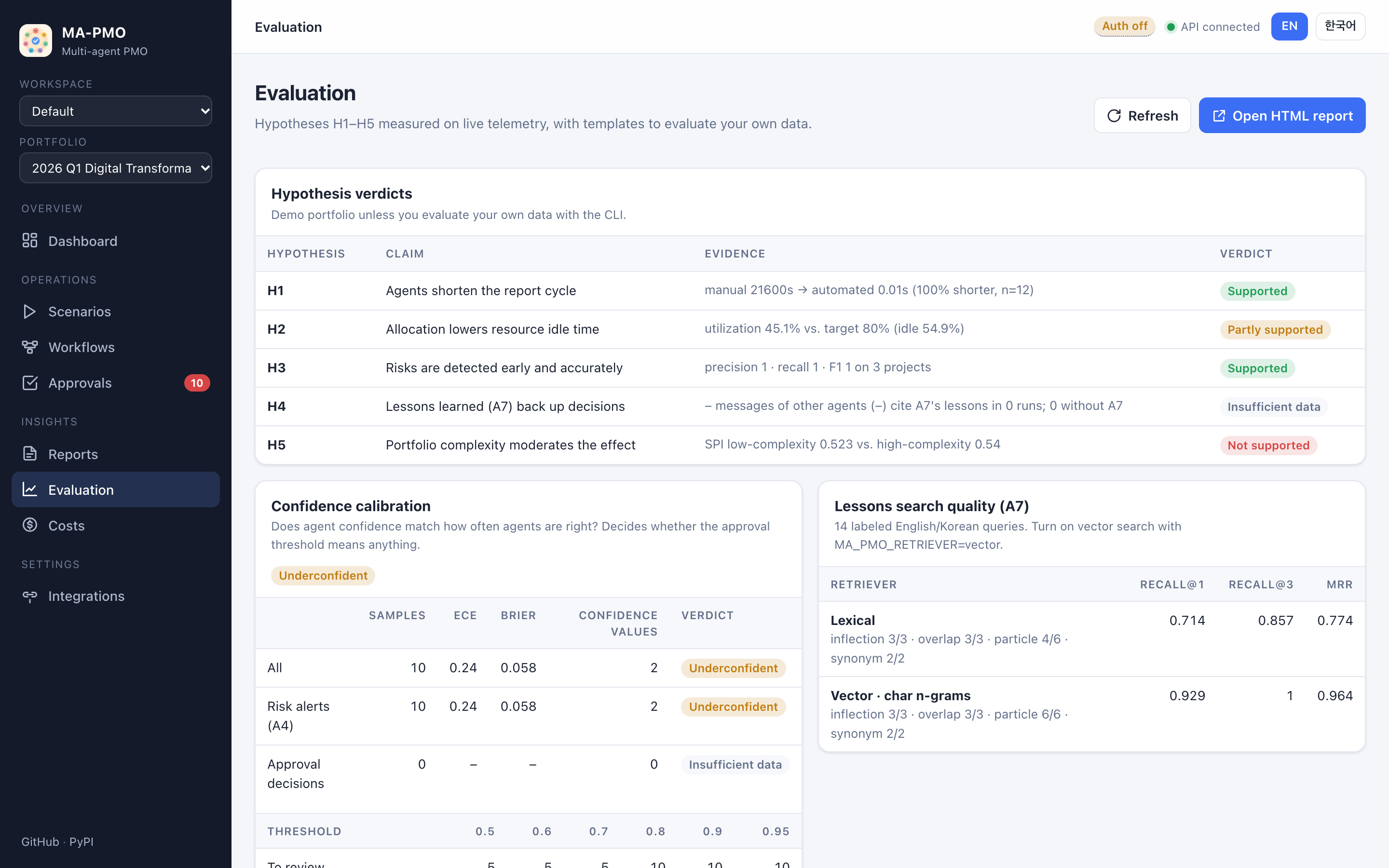
| Evaluation (H1–H5 verdicts, templates) | Human-in-the-loop approvals |
 |
 |
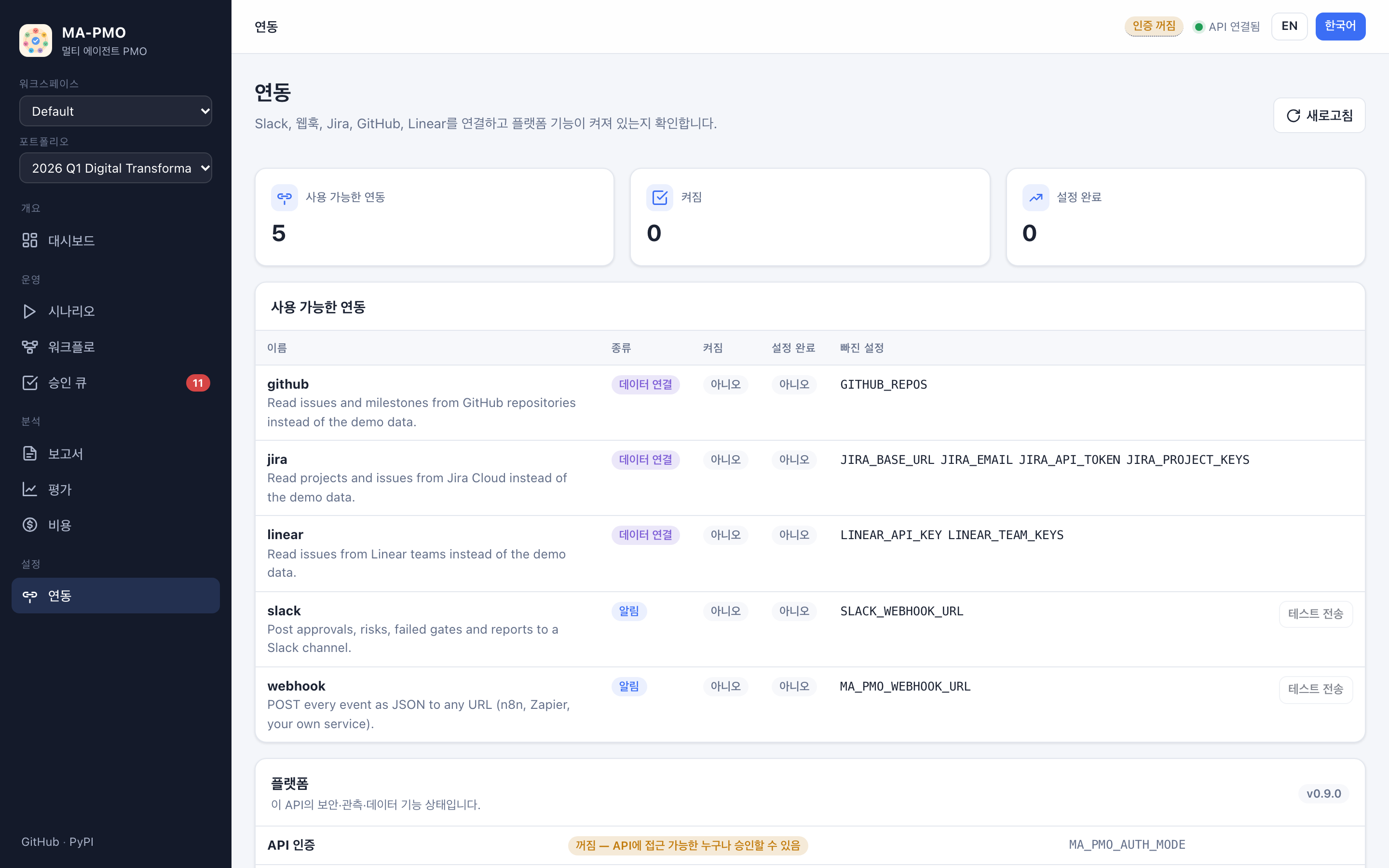
| 20 lifecycle scenarios | Integrations (Slack, webhook, Jira) |
 |
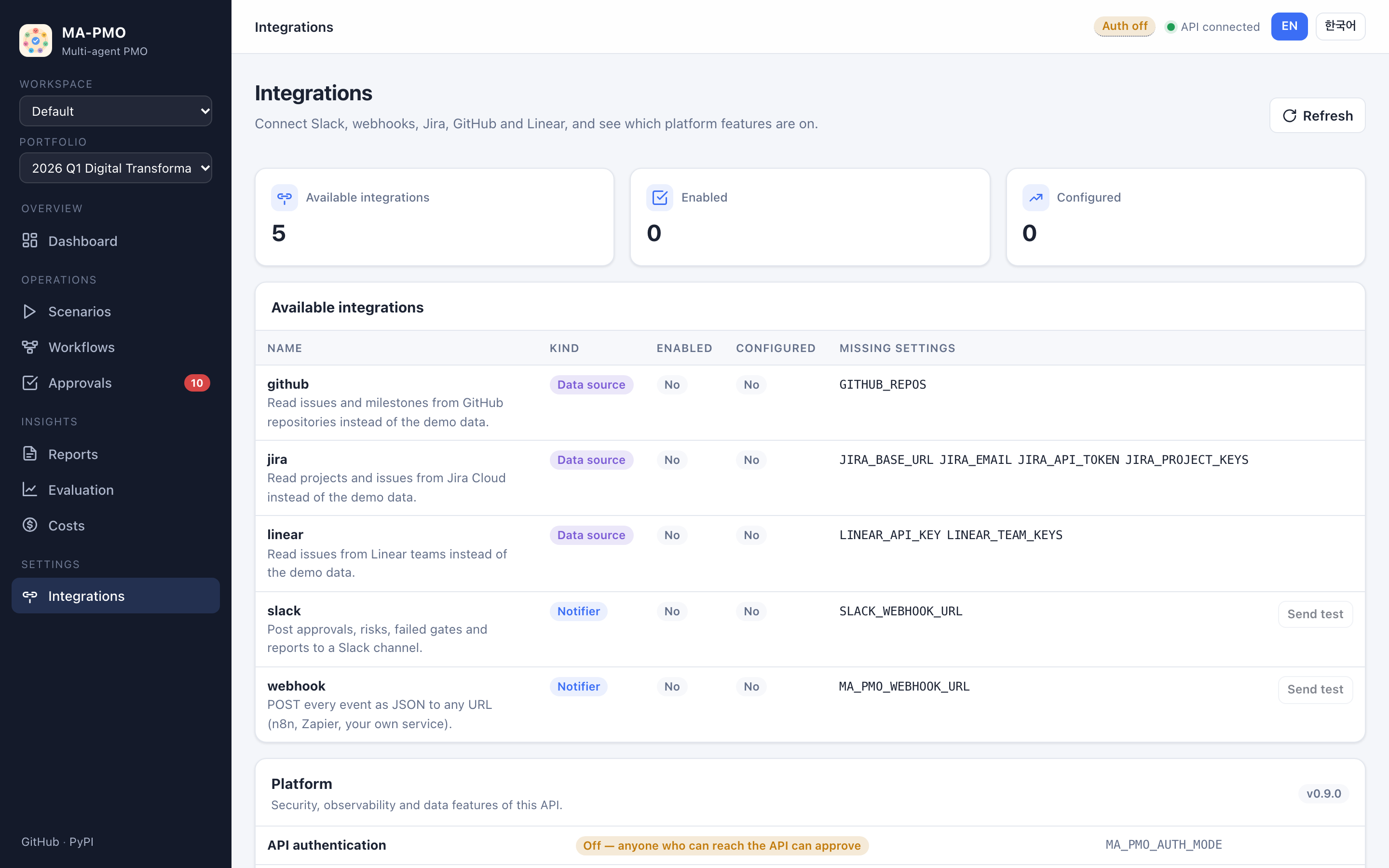 |
Korean UI: dashboard · scenario trace · evaluation · approvals · scenarios · integrations. Light and dark themes follow the OS setting.
Quick start
Install from PyPI (API + agents + CLI)
pip install ma-pmo
ma-pmo init-db                 # create the SQLite schema and load the demo portfolio
ma-pmo serve                   # API on http://127.0.0.1:8000 (Swagger UI at /docs)
ma-pmo eval                    # H1–H5 evaluation summary (no API key needed)
Run from source (includes the Next.js dashboard)
git clone https://github.com/ma-pmo/ma-pmo-ext.git && cd ma-pmo-ext
make dev          # install dependencies + create .env
make db-init      # SQLite schema + fixtures
make test         # test suite
make api          # FastAPI on http://localhost:8000/docs
make web          # dashboard on http://localhost:3000
LLM options (all optional — without them the deterministic fallbacks run):
| Mode | Setup |
|---|---|
| Offline | nothing to configure |
| Local Ollama (free) | ollama pull llama3.1:8b then make api-ollama |
| Anthropic Claude | set ANTHROPIC_API_KEY in .env, then make api |
Docker Compose and Kubernetes manifests are described in deploy/README.md.
Integrations (Slack, Jira, webhooks)
Turn them on with environment variables; failures never stop the agents.
MA_PMO_INTEGRATIONS=slack,jira
SLACK_WEBHOOK_URL=https://hooks.slack.com/services/...
JIRA_BASE_URL=https://your-team.atlassian.net  JIRA_EMAIL=...  JIRA_API_TOKEN=...  JIRA_PROJECT_KEYS=PAY,DATA
GET /integrations shows what is active; POST /integrations/slack/test sends a test message. Setup, event list and how to write your own plugin: docs/INTEGRATIONS.md.
Language
| Where | How |
|---|---|
| Dashboard | EN | 한국어 toggle (remembered), or ?lang=ko in the URL |
| API | ?lang=ko query parameter or Accept-Language: ko header |
| Default for CLI, reports and LLM output | MA_PMO_LANG=en (default) or ko |
End-to-end demo
curl -X POST localhost:8000/orchestrate \
  -H 'content-type: application/json' \
  -d '{"goal": "Generate Q1 portfolio executive report"}'
# → A1 routes to A5 → status roll-up → report (LLM or fallback) → report.v1 validation → RCT KPI

curl 'localhost:8000/kpi?axis=time'      # report cycle time (RCT)
curl localhost:8000/approvals             # HITL pending queue

# A4 Risk: event-driven early detection
curl -X POST localhost:8000/webhooks/issue \
  -H 'content-type: application/json' \
  -d '{"project_id": "PROJ-31", "event_type": "issue_updated"}'
curl 'localhost:8000/risks?lang=ko'       # risk register, in Korean

# A2 Planning · A3 Resources · A6 Governance · A7 Knowledge (deterministic)
curl -X POST localhost:8000/plan
curl -X POST localhost:8000/allocate
curl -X POST 'localhost:8000/gate-review?gate=G2-planning'
curl -G localhost:8000/knowledge/search --data-urlencode 'q=data migration delay risk'

# Scenarios (plan → execute → complete → insight) with paper-ready Markdown
curl -X POST 'localhost:8000/scenarios/quarterly_review/run?format=markdown'
curl localhost:8000/eval                  # H1–H5 as JSON
Evaluate on your own data (templates)
ma-pmo template data ./my-org            # fill-in CSV/JSON files + guide (English/Korean)
ma-pmo template validate ./my-org        # line-by-line checks: dates, numbers, ids, cycles
ma-pmo eval --data ./my-org              # H1–H5 on your data, in an isolated DB inside the folder
ma-pmo template report --data ./my-org --format html --out report.html   # report with verdicts
ma-pmo harness new risk_focus --hypothesis H3 --repeat 3                  # scaffold an experiment
The same is available over HTTP: GET /templates/data.zip, POST /templates/validate (zip body), GET /eval/report?format=md|html.
Architecture
Presentation   Next.js dashboard · scenarios · HITL approval UI (English / Korean)
Orchestration  A1 Orchestrator (LangGraph supervisor)
Workers        A2 Planning · A3 Resources · A4 Risk · A5 Reporting · A6 Governance · A7 Knowledge
Shared state   Blackboard (PortfolioState) · append-only message log
Persistence    SQLite (SQLAlchemy) + LangGraph SqliteSaver checkpointer (Postgres-ready)
Platform       LLM gateway (LiteLLM: Anthropic / Ollama) · local RAG · structured logging
| Agent | Role | Needs an LLM? |
|---|---|---|
| A1 Orchestrator | decompose the goal → route to workers → synthesize | optional (keyword routing fallback) |
| A2 Planning | CPM critical path, projected finish, SPI/slippage | no |
| A3 Resources | skill-matching allocation, utilization/idle rate, overload alerts | no |
| A4 Risk | rule-based signals → severity and mitigation → HITL gate | optional (rule-based fallback) |
| A5 Reporting | executive status report (report.v1) + RCT |
optional (rule-based fallback) |
| A6 Governance | stage gates G1–G4 against a checklist | no |
| A7 Knowledge | lessons-learned retrieval with enforced citations | retrieval no, synthesis optional |
Hypothesis validation (H1–H5)
| Hypothesis | Measurement | Baseline / ground truth |
|---|---|---|
| H1 Reporting time | RCT before/after (A5) | manual baseline in ma_pmo/fixtures/baselines.json |
| H2 Idle rate | resource utilization / idle rate (A3) | target utilization |
| H3 Risk | rule-based detection precision / recall / F1 | labels in ma_pmo/fixtures/risk_ground_truth.json |
| H4 Success rate | A7 knowledge ablation (citation coverage) | A7 on / off |
| H5 Moderation | SPI stratified by portfolio complexity | complexity median |
See docs/PAPER_VALIDATION_GUIDE.md for the full reproduction procedure, and ma_pmo/harness/README.md for batch experiments and ablations.
Five-axis KPIs
| Axis | Metric | Instrumentation |
|---|---|---|
| Time | report cycle time (RCT) | request → completion timestamps |
| Resource | utilization / idle rate | allocated vs. available capacity |
| Delivery | SPI, slippage, gate score | CPM + EVM events |
| Risk | lead time (RLT), detections | detected_at vs. expected materialization |
| Cost | tokens, latency, approval delay | LLM gateway usage + HITL |
Includes the agent operating cost (tokens, latency, hand-offs, approval delay) that the original simulation left out.
Paper ↔ implementation
| Paper | Implementation |
|---|---|
| §3.2 Agent table | ma_pmo/agents/ |
| §3.3 Message protocol | ma_pmo/core/schemas/, ma_pmo/core/protocol.py |
| §3.5 Five-axis metrics | ma_pmo/core/kpi.py, kpi_event table |
| §4 Simulation → real measurement | ma_pmo/agents/, ma_pmo/core/, ma_pmo/eval/ |
| Hypotheses H1–H5 | ma_pmo/eval/, ma_pmo/harness/ |
| §8 Governance (HITL) | ma_pmo/core/hitl.py, ma_pmo/core/graph.py |
Project layout
ma_pmo/            Python package (published to PyPI)
  agents/          A1–A7
  api/             FastAPI app and routers
  core/            schemas, protocol, KPIs, HITL, graph, i18n, scenarios
  connectors/      issue tracker (mock), calendar (stub), knowledge store
  integrations/    Slack, webhook and Jira integrations + plugin registry
  db/              SQLAlchemy models and init
  eval/  harness/  hypothesis evaluation and experiment harness
  fixtures/        demo portfolio, lessons learned (English + Korean), baselines
apps/web/          Next.js dashboard (English / Korean)
deploy/  infra/    Docker, Kubernetes, optional production infra
docs/              paper validation guide, evidence, screenshots
tests/             pytest suite
Contributing
Contributions are welcome! Please read CONTRIBUTING.md for setup, tests and the PR process, and follow the Code of Conduct. Report vulnerabilities privately as described in SECURITY.md. Release notes are in CHANGELOG.md.
License
MA-PMO is dual-licensed:
| Use case | License | Cost |
|---|---|---|
| Personal, academic, research, evaluation and open-source projects | GNU AGPL-3.0-or-later | Free |
| Commercial / proprietary use where you cannot or do not want to meet the AGPL obligations (e.g. closed-source SaaS, embedding in a proprietary product, a hosted service without source disclosure) | Commercial license | Contact us |
Under the AGPL you may use, modify and redistribute MA-PMO freely — including commercially — as long as you release the complete corresponding source of your modified version under the AGPL, including when users interact with it over a network (AGPL §13). If that does not work for your business, a commercial license removes those obligations and can include support, warranty and custom terms.
Copyright © 2026 myeongjin.ji. See NOTICE.
This section is a plain-language summary, not legal advice. The LICENSE text governs.
Trademark
"MA-PMO" and the MA-PMO logo are trademarks of myeongjin.ji. The open-source license covers the code, not the name. You can say a product is "built with MA-PMO" or "a fork of MA-PMO", but using the name for a commercial product or service needs permission. See TRADEMARKS.md.
Commercial use & contact
- Commercial licensing — closed-source / SaaS / OEM use, pricing and terms
- Enterprise support — deployment, integration (Jira, calendar, vector DB connectors), customization
- Research collaboration — paper validation (H1–H5), joint experiments, citation questions
- General questions — anything not suited to a public issue
For bugs and feature requests, please use GitHub Issues so others can benefit. For security vulnerabilities, follow SECURITY.md and do not open a public issue.
Citation
If you use MA-PMO in research, please cite it using CITATION.cff (GitHub's "Cite this repository" button).
1 maintainer

Metadata
1 maintainer
Release files for ma-pmo 0.2.0
For a detailed explanation of source distributions (sdists) and built distributions (wheels), please see the package formats documentation.
Source distribution (sdist)
| File | Size | Uploaded | Provenance | Actions |
|---|---|---|---|---|
| ma_pmo-0.2.0.tar.gz | 129.9 kB | With provenance | Details for ma_pmo-0.2.0.tar.gz |
Built distribution (wheel)
| File | Interpreter | ABI | Platform | Actions Reset |
|---|---|---|---|---|
| ma_pmo-0.2.0-py3-none-any.whl | Python 3 | none | any | Details for ma_pmo-0.2.0-py3-none-any.whl |
Total release size: 267.3 kB
Release files / ma_pmo-0.2.0.tar.gz
| Download URL | ma_pmo-0.2.0.tar.gz |
|---|---|
| Size | 129.9 kB |
| Tags | Source |
|
SHA-256 checksum How to use checksums |
a29ea5b79e0e416f84ee2529d62e79195382933baae4cdaa6c227dc300721f83
|
|
BLAKE2b-256 checksum How to use checksums |
4fe9a46c52c4382a83448c08c1add35baf94f4999fa1e631b1f8483fe0774f84
|
| Upload date | |
|
Uploaded using Trusted Publishing? What is trusted publishing? |
Yes |
| Uploaded via |
twine/7.0.0 CPython/3.13.16
|
Provenance
Provenance describes where a file came from. On PyPI, provenance is shared via attestations, which provide a verifiable record of the build or publishing details. View details, limitations and caveats.


PyPI Publish Attestation
PyPI verified that this artifact, at this checksum, originated from the publisher listed below.
Signed by GitHub Actions, verified by PyPI on Nov 3, 2026.
Transparency logRelease files / ma_pmo-0.2.0-py3-none-any.whl
| Download URL | ma_pmo-0.2.0-py3-none-any.whl |
|---|---|
| Size | 137.4 kB |
| Tags | Python 3 |
|
SHA-256 checksum How to use checksums |
662b295e8645560a10adf42b3d97ec2373eb53550384f4a9d809cbfe4825be89
|
|
BLAKE2b-256 checksum How to use checksums |
d42ad7cd5f8e67629e6df0029ec071a8089bf64c707f974edaea027070844c9c
|
| Upload date | |
|
Uploaded using Trusted Publishing? What is trusted publishing? |
Yes |
| Uploaded via |
twine/7.0.0 CPython/3.13.16
|
Provenance
Provenance describes where a file came from. On PyPI, provenance is shared via attestations, which provide a verifiable record of the build or publishing details. View details, limitations and caveats.
PyPI Publish Attestation
PyPI verified that this artifact, at this checksum, originated from the publisher listed below.
Signed by GitHub Actions, verified by PyPI on Nov 3, 2026.
Transparency logSecurity for ma-pmo 0.2.0
Provenance
Provenance describes where a file came from. On PyPI, provenance is shared via attestations, which provide a verifiable record of the build or publishing details. View details, limitations and caveats.
Full provenance
Both files in this release have been uploaded with provenance metadata.
Attestation for ma_pmo-0.2.0.tar.gz
PyPI Publish Attestation
PyPI verified that this artifact, at this checksum, originated from the publisher listed below.
Signed by GitHub Actions, verified by PyPI on Nov 3, 2026.
Transparency logA note on package security
PyPI is a repository for distributing packages, not a service for auditing them. While third-party security researchers and our staff do their best to detect and remove malicious packages, PyPI cannot guarantee the quality, security or suitability of any given package.
To learn more about protecting yourself from malicious actors, visit our package security documentation.