
Machine Gnostics


Machine Gnostics: Laws of Nature, Encoded — For Everyone!
Machine Gnostics is a Python library for robust, assumption-free data analysis and machine learning. It replaces the probabilistic assumptions of classical statistics with Mathematical Gnostics — a deterministic, finite, algebraic theory rooted in Riemannian geometry, Einsteinian relativity, vector bi-algebra, and thermodynamics.
The result: analysis that treats every data point as a real event with its own importance and uncertainty — resilient to outliers, honest about structure, and reliable even on small datasets.
Why Machine Gnostics?
- Non-statistical by design — deterministic gnostic algebra instead of probability and averages
- Outlier-resilient — gnostic weights automatically downweight leverage and corruption
- Finite theory for finite data — works directly with small, real-world datasets
- Structure-aware — detects curves, clusters, and degenerate cases that summary statistics flatten
- Deep learning with MAGNET — PyTorch-backed neural networks with gnostic layers
- Classical + gnostic metrics — accuracy, R2, F1 alongside gnostic mean, relevance, entropy
- MLflow integration — tracking, registry, reproducibility
Benchmark: Anscombe's Quartet
Four datasets share identical classical statistics — mean x≈9, mean y≈7.5, r²≈0.67, slope≈0.5 — yet they are radically different: linear, parabolic, outlier-distorted, and degenerate. Classical statistics reports the same summary for all four. Machine Gnostics reads the structure of each.
Key results
| Case | Classical Statistics | Machine Gnostics |
|---|---|---|
| Dataset I — linear | ✅ Fit is valid | ✅ Fit is valid |
| Dataset II — parabola | ❌ Linear fit is structurally wrong | ✅ Parabolic shape exposed via weight pattern |
| Dataset III — outlier | ❌ One high-leverage point distorts the line | ✅ Outlier weight ≈ 0.04 — leverage removed |
| Dataset IV — degenerate | ❌ Regression is meaningless | ✅ Vertical cluster flagged as degenerate |
Capability radar (1–10)
| Capability | Classical | Machine Gnostics |
|---|---|---|
| Shape detection | 1 | 9 |
| Outlier flagging | 1 | 9 |
| Fit quality | 3 | 9 |
| Structural honesty | 1 | 9 |
| Diagnostic power | 1 | 9 |
| Average | 1.4 | 9.0 |
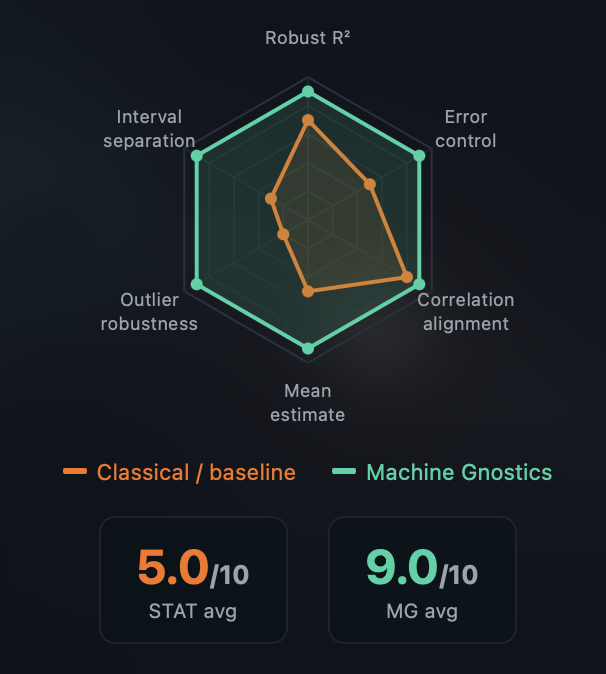
Image 1 — MG structural read vs classical summary (Anscombe quartet) |
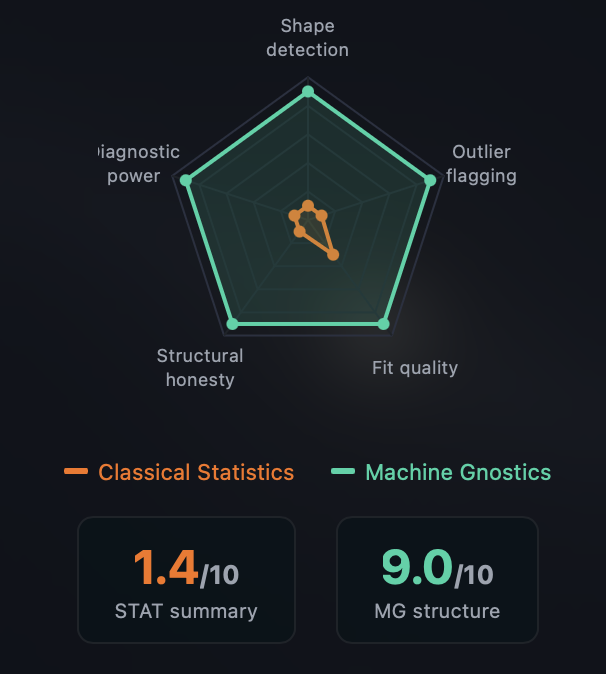
Image 2 — Capability radar & metrics (MG 9.0 vs Classical 1.4) |
This is the first time Machine Gnostics solves the Anscombe case through calculation — deterministic gnostic weight computation, centered coordinate, structural divergence — rather than through plotting or visual inspection alone. Numerical weights reveal the parabola, downweight the outlier (weight ~0.04), and flag the degenerate vertical cluster structurally.
Machine Gnostics is presented as a complementary lens that adds structural insight — not as a replacement for classical statistics. Scores are benchmark comparisons, not peer-reviewed ratings; the direction of the difference is the key result.
Installation
# create an environment (uv or venv)
uv venv .mg-env --python 3.11 && source .mg-env/bin/activate
# or: python3 -m venv .mg-env && source .mg-env/bin/activate

# install
pip install machinegnostics        # or: uv add machinegnostics
Windows
uv venv .mg-env --python 3.11
.mg-env\Scripts\activate
pip install machinegnostics
Verify:
import machinegnostics
print("imported successfully!")
Quick Start
Gnostic Distribution Function
import numpy as np
from machinegnostics.magcal import EGDF

data = np.array([-13.5, 0, 1., 2., 3., 4., 5., 6., 7., 8., 9., 10.])
egdf = EGDF()
egdf.fit(data)
egdf.plot()
print(egdf.params)
Robust Polynomial Regression
import numpy as np
from machinegnostics.models import PolynomialRegressor

X = np.array([0., 0.4, 0.8, 1.2, 1.6, 2.])
y = np.array([17.89, 69.62, -7.20, 9.38, -10.56, 16.58])

model = PolynomialRegressor(degree=2)
model.fit(X, y)
print("Predictions:", model.predict(X))
print("Coefficients:", model.coefficients)
Deep Learning with MAGNET
from machinegnostics.magnet import Sequential, Dense, ReLU, Adam

model = Sequential(layers=[
    Dense(in_features=64, out_features=32),
    ReLU(),
    Dense(in_features=32, out_features=1),
])
model.compile(loss='mse', optimizer=Adam(lr=0.001))
model.fit(X_train, y_train, epochs=10, batch_size=32)
model.predict(X_test)
What's Inside
| Module | Contents |
|---|---|
| Data Analysis | Gnostic distribution functions, cluster & interval analysis, gnostic data tests |
| Machine Learning | Regression, classification, clustering, forecasting |
| Metrics | Classical statistical metrics + gnostic algebra metrics (mean, median, MAE, MSE, R², relevance, entropy, …) |
| MAGNET | Activations, losses, initializers, optimizers, models, layers — PyTorch-backed |
| Integration | MLflow experiment tracking and model registry |
Resources
- Documentation: docs.machinegnostics.com
- Benchmark: machinegnostics.com/benchmark
- Discord: Join the community
- YouTube: @MachineGnostics
- LinkedIn: Machine Gnostics
- Instagram: @machinegnostics
- PyPI: machinegnostics
License
Machine Gnostics is released under the GPL v3 License.
Machine Gnostics is a pioneering open-source initiative redefining the mathematical underpinnings of machine learning. As a young project, some features are still being refined — new models, methods, and benchmarks are on the way. Community support and collaboration are essential to building a new AI grounded in a rational and resilient paradigm.
Author: Nirmal Parmar
1 maintainer

Metadata
1 maintainer
Release files for machinegnostics 0.0.8
For a detailed explanation of source distributions (sdists) and built distributions (wheels), please see the package formats documentation.
Source distribution (sdist)
| File | Size | Uploaded | Provenance | Actions |
|---|---|---|---|---|
| machinegnostics-0.0.8.tar.gz | 343.9 kB | Without provenance | Details for machinegnostics-0.0.8.tar.gz |
Built distribution (wheel)
| File | Interpreter | ABI | Platform | Actions Reset |
|---|---|---|---|---|
| machinegnostics-0.0.8-py3-none-any.whl | Python 3 | none | any | Details for machinegnostics-0.0.8-py3-none-any.whl |
Total release size: 845.9 kB
Release files / machinegnostics-0.0.8.tar.gz
| Download URL | machinegnostics-0.0.8.tar.gz |
|---|---|
| Size | 343.9 kB |
| Tags | Source |
|
SHA-256 checksum How to use checksums |
f700fa7e0110302108cdce6ad329d8c28f05117fe08d8bd3401259775fe2e62a
|
|
BLAKE2b-256 checksum How to use checksums |
8438b73937be10fb9a81655fbd5fcbb90cd3037642c1f95867b2f314a660d890
|
| Upload date | |
|
Uploaded using Trusted Publishing? What is trusted publishing? |
No |
| Uploaded via |
twine/6.2.0 CPython/3.11.18
|
Release files / machinegnostics-0.0.8-py3-none-any.whl
| Download URL | machinegnostics-0.0.8-py3-none-any.whl |
|---|---|
| Size | 502.0 kB |
| Tags | Python 3 |
|
SHA-256 checksum How to use checksums |
0bdc70047e4959fdc13fa78ecf7815ee0c211410457698415aa55f969e5f5d5b
|
|
BLAKE2b-256 checksum How to use checksums |
1572484fdd890c544c0c70ce97a0f6c8cef8fd3ff1130ea8e96d616d961eb5b8
|
| Upload date | |
|
Uploaded using Trusted Publishing? What is trusted publishing? |
No |
| Uploaded via |
twine/6.2.0 CPython/3.11.18
|
Security for machinegnostics 0.0.8
Provenance
Provenance describes where a file came from. On PyPI, provenance is shared via attestations, which provide a verifiable record of the build or publishing details. View details, limitations and caveats.
No provenance found
None of the files in this release were uploaded with provenance metadata.
A note on package security
PyPI is a repository for distributing packages, not a service for auditing them. While third-party security researchers and our staff do their best to detect and remove malicious packages, PyPI cannot guarantee the quality, security or suitability of any given package.
To learn more about protecting yourself from malicious actors, visit our package security documentation.














