
AI coding agent — multi-provider, privacy-first, trust layer

Project description
Rewriting Project Claw Code
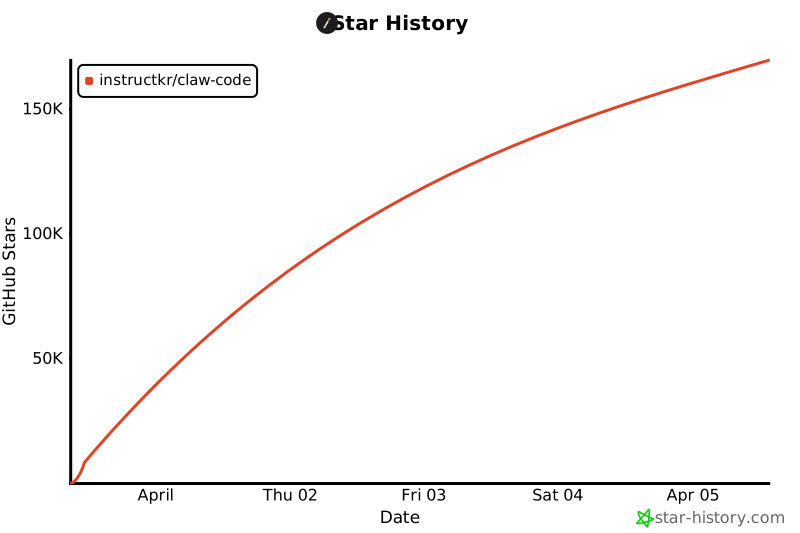
⭐ The fastest repo in history to surpass 50K stars, reaching the milestone in just 2 hours after publication ⭐

Better Harness Tools, not merely storing the archive of leaked Claude Code

[!IMPORTANT] Rust port is now in progress on the
dev/rustbranch and is expected to be merged into main today. The Rust implementation aims to deliver a faster, memory-safe harness runtime. Stay tuned — this will be the definitive version of the project.
If you find this work useful, consider sponsoring @instructkr on GitHub to support continued open-source harness engineering research.
Backstory
At 4 AM on March 31, 2026, I woke up to my phone blowing up with notifications. The Claude Code source had been exposed, and the entire dev community was in a frenzy. My girlfriend in Korea was genuinely worried I might face legal action from Anthropic just for having the code on my machine — so I did what any engineer would do under pressure: I sat down, ported the core features to Python from scratch, and pushed it before the sun came up.
The whole thing was orchestrated end-to-end using oh-my-codex (OmX) by @bellman_ych — a workflow layer built on top of OpenAI's Codex (@OpenAIDevs). I used $team mode for parallel code review and $ralph mode for persistent execution loops with architect-level verification. The entire porting session — from reading the original harness structure to producing a working Python tree with tests — was driven through OmX orchestration.
The result is a clean-room Python rewrite that captures the architectural patterns of Claude Code's agent harness without copying any proprietary source. I'm now actively collaborating with @bellman_ych — the creator of OmX himself — to push this further. The basic Python foundation is already in place and functional, but we're just getting started. Stay tuned — a much more capable version is on the way.
https://github.com/instructkr/claw-code

The Creators Featured in Wall Street Journal For Avid Claude Code Fans
I've been deeply interested in harness engineering — studying how agent systems wire tools, orchestrate tasks, and manage runtime context. This isn't a sudden thing. The Wall Street Journal featured my work earlier this month, documenting how I've been one of the most active power users exploring these systems:
AI startup worker Sigrid Jin, who attended the Seoul dinner, single-handedly used 25 billion of Claude Code tokens last year. At the time, usage limits were looser, allowing early enthusiasts to reach tens of billions of tokens at a very low cost.
Despite his countless hours with Claude Code, Jin isn't faithful to any one AI lab. The tools available have different strengths and weaknesses, he said. Codex is better at reasoning, while Claude Code generates cleaner, more shareable code.
Jin flew to San Francisco in February for Claude Code's first birthday party, where attendees waited in line to compare notes with Cherny. The crowd included a practicing cardiologist from Belgium who had built an app to help patients navigate care, and a California lawyer who made a tool for automating building permit approvals using Claude Code.
"It was basically like a sharing party," Jin said. "There were lawyers, there were doctors, there were dentists. They did not have software engineering backgrounds."
— The Wall Street Journal, March 21, 2026, "The Trillion Dollar Race to Automate Our Entire Lives"

Porting Status
The main source tree is now Python-first.
src/contains the active Python porting workspacetests/verifies the current Python workspace- the exposed snapshot is no longer part of the tracked repository state
The current Python workspace is not yet a complete one-to-one replacement for the original system, but the primary implementation surface is now Python.
Why this rewrite exists
I originally studied the exposed codebase to understand its harness, tool wiring, and agent workflow. After spending more time with the legal and ethical questions—and after reading the essay linked below—I did not want the exposed snapshot itself to remain the main tracked source tree.
This repository now focuses on Python porting work instead.
Repository Layout
.
├── src/                                # Python porting workspace
│   ├── __init__.py
│   ├── commands.py
│   ├── main.py
│   ├── models.py
│   ├── port_manifest.py
│   ├── query_engine.py
│   ├── task.py
│   └── tools.py
├── tests/                              # Python verification
├── assets/omx/                         # OmX workflow screenshots
├── 2026-03-09-is-legal-the-same-as-legitimate-ai-reimplementation-and-the-erosion-of-copyleft.md
└── README.md
Python Workspace Overview
The new Python src/ tree currently provides:
port_manifest.py— summarizes the current Python workspace structuremodels.py— dataclasses for subsystems, modules, and backlog statecommands.py— Python-side command port metadatatools.py— Python-side tool port metadataquery_engine.py— renders a Python porting summary from the active workspacemain.py— a CLI entrypoint for manifest and summary output
Quickstart
Render the Python porting summary:
python3 -m src.main summary
Print the current Python workspace manifest:
python3 -m src.main manifest
List the current Python modules:
python3 -m src.main subsystems --limit 16
Run verification:
python3 -m unittest discover -s tests -v
Run the parity audit against the local ignored archive (when present):
python3 -m src.main parity-audit
Inspect mirrored command/tool inventories:
python3 -m src.main commands --limit 10
python3 -m src.main tools --limit 10
Current Parity Checkpoint
The port now mirrors the archived root-entry file surface, top-level subsystem names, and command/tool inventories much more closely than before. However, it is not yet a full runtime-equivalent replacement for the original TypeScript system; the Python tree still contains fewer executable runtime slices than the archived source.
Built with oh-my-codex
The restructuring and documentation work on this repository was AI-assisted and orchestrated with Yeachan Heo's oh-my-codex (OmX), layered on top of Codex.
$teammode: used for coordinated parallel review and architectural feedback$ralphmode: used for persistent execution, verification, and completion discipline- Codex-driven workflow: used to turn the main
src/tree into a Python-first porting workspace
OmX workflow screenshots

Ralph/team orchestration view while the README and essay context were being reviewed in terminal panes.

Split-pane review and verification flow during the final README wording pass.
Community

Join the instructkr Discord — the best Korean language model community. Come chat about LLMs, harness engineering, agent workflows, and everything in between.

Star History
See the chart at the top of this README.
Ownership / Affiliation Disclaimer
- This repository does not claim ownership of the original Claude Code source material.
- This repository is not affiliated with, endorsed by, or maintained by Anthropic.
Release history Release notifications | RSS feed


Download files
Download the file for your platform. If you're not sure which to choose, learn more about installing packages.
Source Distribution
Built Distribution
Filter files by name, interpreter, ABI, and platform.
If you're not sure about the file name format, learn more about wheel file names.
Copy a direct link to the current filters
File details
Details for the file maestro_ai-1.5.1.tar.gz.
File metadata
- Download URL: maestro_ai-1.5.1.tar.gz
- Upload date:
- Size: 6.4 MB
- Tags: Source
- Uploaded using Trusted Publishing? No
- Uploaded via: twine/6.2.0 CPython/3.11.8
File hashes
| Algorithm | Hash digest | |
|---|---|---|
| SHA256 |
b6bd78864009e47a08496bf1ef7457a4ee7bf9dd04998ae489d5a0fe3a398bb6
|
|
| MD5 |
dbbfef4f7ddc8cb50bfda42f6f27b027
|
|
| BLAKE2b-256 |
194e43160664879fae6932afc4dcc354be990767a5f90f221f4ec8f8b98bef15
|
File details
Details for the file maestro_ai-1.5.1-py3-none-any.whl.
File metadata
- Download URL: maestro_ai-1.5.1-py3-none-any.whl
- Upload date:
- Size: 339.4 kB
- Tags: Python 3
- Uploaded using Trusted Publishing? No
- Uploaded via: twine/6.2.0 CPython/3.11.8
File hashes
| Algorithm | Hash digest | |
|---|---|---|
| SHA256 |
39f2a519080027d4cb0521eff12459e58840fd28f127960869d2bb8ef50be70b
|
|
| MD5 |
11d960e7612a099676a1494ccf903557
|
|
| BLAKE2b-256 |
a3c333d0ea98b08ec374cda195457874a7d3972e7adce3af11c4a57a77b9b009
|






