
maf-sandbox-codeact



Experimental. Releases before 1.0 may change or remove APIs. Importing this package emits
MafSandboxCodeactExperimentalWarning.
Give an agent one execute_code tool. The model writes Python statements, the sandbox runs them, and the tool returns content items for completion, an ok or failed verdict when an exit status is available, and the execution report. Programs must print results; a final expression is not echoed.
This is an independent package for Microsoft Agent Framework. It uses the maf-sandbox protocol and has no backend dependency.
Quickstart
pip install maf-sandbox-codeact
from maf_sandbox_codeact import make_codeact_tools

tools = make_codeact_tools(
    router,
    "data-analyst",
    context,
    image="mcr.microsoft.com/devcontainers/python:3.13-bookworm",
)
The host supplies the router and CallerContext. With no configured backend the factory returns []. Unsupported requirements are refused before attachment.
The default path writes program.py and runs it with python3. It requires EXEC and FILES_IN. Source text is file content, never part of the command line.
Use the Docker sample, ACAS sample or WSLC sample for complete applications.
Optional channels
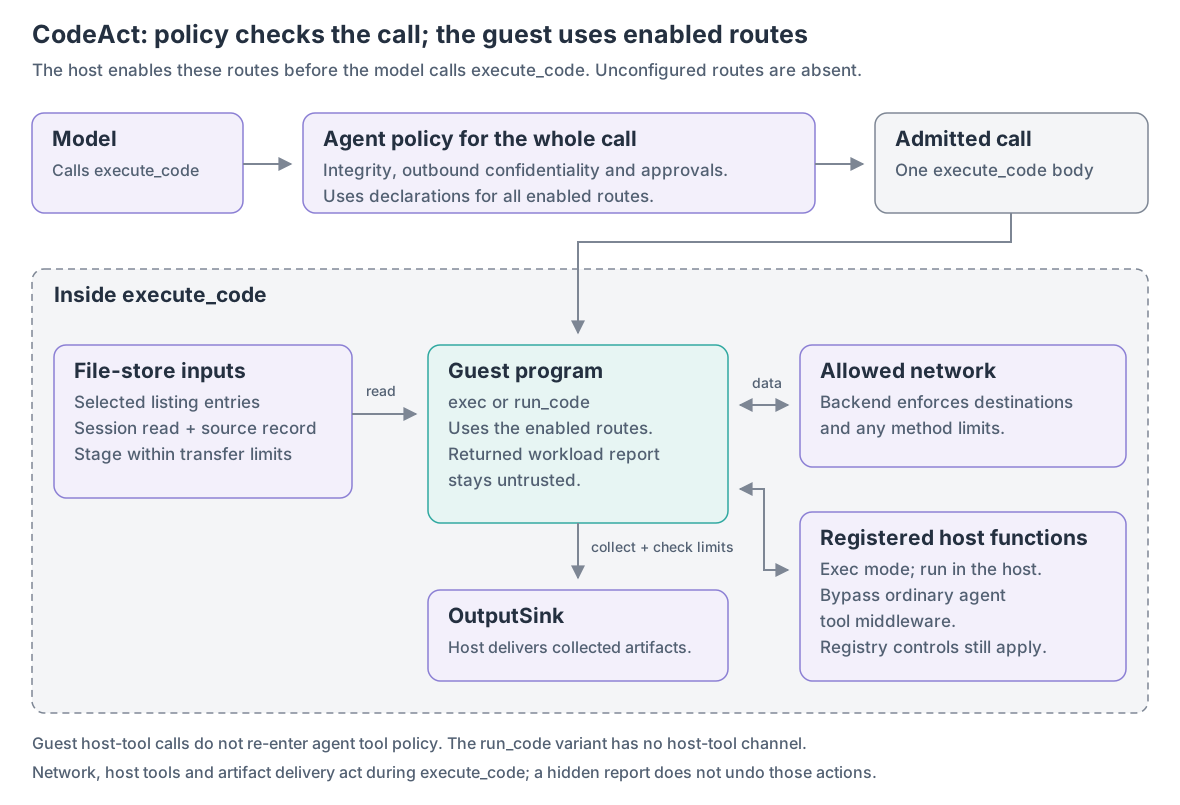
All four channels below are off by default. The host enables them when building the tool.
| Setting | What it enables |
|---|---|
file_store=store |
A files argument selecting caller-visible input files. |
output_sink=sink, outputs=... |
Collection and delivery of named output files. |
host_tools=registry |
Calls from guest Python to registered host functions, in exec mode. |
egress_allow=(...) |
Network requests to named destinations. |
These channels operate during execute_code. Hiding its final report does not undo host calls, network requests or artifact delivery.
Input and output files
Inputs must appear in CallerContext.list_files. They are staged under their listed names, so a program can open data/sales.csv. The listing controls which files are shared; it does not make their contents trustworthy.
Choose one output mode:
| Mode | Names come from |
|---|---|
NONE |
No output collection. This is the default. |
DECLARED |
The model's outputs argument, checked before execution. |
MANIFEST |
The program's outputs.json, read after execution. |
Both collection modes require a sink and FILES_OUT. They collect literal paths and do not require FILES_LIST. The manifest consumes one file slot and part of the byte budget, so that mode needs at least two output slots.
from maf_sandbox_codeact import CodeactOutputs, make_codeact_tools

tools = make_codeact_tools(
    router,
    "data-analyst",
    context,
    file_store=store,
    output_sink=sink,
    outputs=CodeactOutputs.DECLARED,
    image="mcr.microsoft.com/devcontainers/python:3.13-bookworm",
)
files_in and files_out bound file count, individual bytes and total bytes. A missing declared output is reported. Artifacts carry no guest-selected media type; the host decides how to handle them.
Keep the output sink separate from the agent's writable input store. Otherwise guest code could overwrite files through a channel that bypasses the host's file-write approval. See the files sample.
Host functions and network access
Register host functions before passing the registry to the factory. Reading its combined policy seals it against later registration.
from maf_sandbox import HostToolRegistry, TransferLimits

registry = HostToolRegistry(
    max_host_tool_calls_per_run=32,
    response_limits=TransferLimits(
        max_bytes_per_file=64 * 1024,
        max_total_bytes=1024 * 1024,
        max_files=32,
    ),
)
registry.register(exchange_rate)
exchange_rate is a host-defined function. Its body runs with host authority and bypasses ordinary agent middleware. Configure declarations, permitted identities and approval policy before exposing it. Registering a user-authority function makes the enclosing tool approval-gated.
A nonempty registry requires HOST_TOOLS and FILES_OUT as well as EXEC and FILES_IN. Docker and ACAS support this transport; WSLC does not. The image needs the POSIX launcher utilities, including sh and nohup.
Transport traffic counts toward backend transfer limits. Set response limits to fit your functions; broad defaults can make the tool fail attachment. Model-named files live separately from transport files. Without a registry, program.py is reserved.
Network access is closed unless egress_allow names hosts. An allowed host can receive any data the program can read. A method-scoped EgressRule also requires EGRESS_METHODS, which no shipped backend declares.
See host-tool controls for registration, identities and limits.
Runtime backends
Use CodeactRuntime to select run_code instead of command execution. The host must verify that the backend evaluates Python statements and returns their output. The required instructions describe the modules and facilities available to the model.
from maf_sandbox_codeact import CodeactRuntime, codeact_sandbox_spec, make_codeact_tools

runtime = CodeactRuntime(
    instructions="Python statements with json and math. No subprocess or network modules."
)
spec = codeact_sandbox_spec(runtime=runtime)
tools = make_codeact_tools(router, "data-analyst", context, runtime=runtime)
The stdout-only profile requires RUN_CODE. It submits source directly and uses no inbound file slot, but source bytes still count toward the input byte limits. There is no automatic fallback between variants.
File channels require a verified absolute POSIX guest_work_dir. Programs receive guest_call_path and use it with open; model-facing names remain relative. By default the runtime must provide os.makedirs for fresh call directories.
Use use_call_directory=False only for a prepared base that cannot create directories. That mode requires at least reset cleanup. The Hyperlight package supplies matching instructions for its /output base.
Runtime profiles do not support host-tool registries. Changing the execution variant, instructions or storage contract requires disposal or a new sandbox key.
Results and labels
Both output modes use the result contract. Completion, the exit verdict and fixed host explanations are trusted. A call with no exit status has completed=False and no verdict. Program output and variable diagnostics remain untrusted. The ordinary report includes stdout, available stderr and a nonzero exit code. With the host-tool transport, program stderr is merged into stdout; a separate note: comes from the transport.
FIDES may hide the report while the conversation is trusted. Hidden content still affects confidentiality. The host controls whether later tools may accept it. See information flow.
withhold_guest_output=True removes guest-authored text from the report. It requires CodeactOutputs.DECLARED and a sink. Completion and the verdict remain readable, alongside separate trusted route guidance so the model can learn how to read saved output through host file tools. Variable status details remain untrusted.
This mode omits sink display text and guest-selected filenames. Exit success and whether declared files landed still depend on the program. The trusted verdict exposes exit success deliberately; withholding does not make variable diagnostics trusted or eliminate every data channel.
Calls and cleanup
Calls run one at a time in each sandbox, including collection and cleanup. exec_timeout_seconds defaults to 120. Runtime deadlines include the backend queue; a queued timeout means the program did not start.
Core disposes after each call by default. A host can permit snapshot reset, or accept possible leftover state by explicitly choosing reclaim on a supporting backend.
CodeAct makes no call-directory confinement claim. Programs can access other guest paths and leave processes running. Choose the isolation floor and image for everything the program may read, including shared files and network responses.
The CodeAct guide covers execution, withholding and cleanup in detail.
Maintained by SOKOLAI BV.
1 maintainer

Release files for maf-sandbox-codeact 0.20.0
For a detailed explanation of source distributions (sdists) and built distributions (wheels), please see the package formats documentation.
Source distribution (sdist)
| File | Size | Uploaded | |
|---|---|---|---|
| maf_sandbox_codeact-0.20.0.tar.gz | 39.3 kB | Details |
Built distribution (wheel)
| File | Interpreter | ABI | Platform | Reset |
|---|---|---|---|---|
| maf_sandbox_codeact-0.20.0-py3-none-any.whl | Python 3 | none | any | Details |
Total release size: 79.7 kB
Release files / maf_sandbox_codeact-0.20.0.tar.gz
| Download URL | maf_sandbox_codeact-0.20.0.tar.gz |
|---|---|
| Size | 39.3 kB |
| Tags | Source |
|
SHA-256 checksum How to use checksums |
344ff515884db2ca1a6e3257f4bc88d31e2db24ab565842874a2e8381b6a9123
|
|
BLAKE2b-256 checksum How to use checksums |
73d04068e44966364b27e3a5f24ecc2218aabaa2154d71979fbb102a241a4f8e
|
| Upload date | |
|
Uploaded using Trusted Publishing? What is trusted publishing? |
Yes |
| Uploaded via |
twine/7.0.0 CPython/3.13.14
|
Provenance
Provenance describes where a file came from. On PyPI, provenance is shared via attestations, which provide a verifiable record of the build or publishing details. View details, limitations and caveats.


PyPI Publish Attestation
PyPI verified that this artifact, at this checksum, originated from the publisher listed below.
Signed by GitHub Actions, verified by PyPI on Sep 21, 2026.
Transparency logRelease files / maf_sandbox_codeact-0.20.0-py3-none-any.whl
| Download URL | maf_sandbox_codeact-0.20.0-py3-none-any.whl |
|---|---|
| Size | 40.4 kB |
| Tags | Python 3 |
|
SHA-256 checksum How to use checksums |
b46fe27e20e211daa1158cdc375aa0b9a7157d1628d53959ac9285b48503e9c5
|
|
BLAKE2b-256 checksum How to use checksums |
e00ccbed3f02ea334eacad0a06324075b661fda5bb37770b5cac14b2f07ed164
|
| Upload date | |
|
Uploaded using Trusted Publishing? What is trusted publishing? |
Yes |
| Uploaded via |
twine/7.0.0 CPython/3.13.14
|
Provenance
Provenance describes where a file came from. On PyPI, provenance is shared via attestations, which provide a verifiable record of the build or publishing details. View details, limitations and caveats.
PyPI Publish Attestation
PyPI verified that this artifact, at this checksum, originated from the publisher listed below.
Signed by GitHub Actions, verified by PyPI on Sep 21, 2026.
Transparency log













