
maf-sandbox



Experimental. Releases before 1.0 may change or remove APIs. Importing this package emits
MafSandboxExperimentalWarning.
Run agent tools through a shared sandbox protocol. The host chooses the isolation and cleanup policy. A backend creates the sandbox; a workload package, called a kind, uses it.
The protocol uses only the Python standard library. Microsoft Agent Framework integration lives in maf_sandbox.maf; the distribution includes the framework dependency. This is an independent package, not a Microsoft product.
Install and wire a backend
pip install maf-sandbox
Install a backend for the environment where code will run. The router defaults to microVM isolation and disposal after each sandboxed tool call.
from maf_sandbox import Capability, SandboxKey, SandboxRouter, SandboxSpec

router = SandboxRouter([backend])
key = SandboxKey(scope="tenant-1", thread_id="thread-1", agent_id="analyst")
spec = SandboxSpec(
    kind="python",
    image="python-3.13",
    work_dir=None,
    requires=frozenset({Capability.EXEC}),
)

router.ensure_can_serve(spec)
try:
    sandbox = await router.acquire(key, spec)
    result = await sandbox.exec(["python3", "-c", "print(6 * 7)"], working_directory=".", timeout=30)
    print(result.stdout_text)
finally:
    await router.dispose(key)
backend is supplied by the host. The image name above selects ACAS's prebuilt Python image; use an image supported by your backend. Docker and WSLC require explicit min_isolation=Isolation.CONTAINER on the router.
Direct acquire does not wrap a tool call or schedule its cleanup. The finally above owns disposal. Packaged kinds use sandboxed_tool, which handles call admission, labels and cleanup.
For complete application wiring, start with the ACAS Bicep sample or Docker CodeAct sample.
Main types
| Type | Purpose |
|---|---|
SandboxKey |
Names the host scope, conversation, agent and optional tool call. |
SandboxSpec |
States a kind's image, commands, file limits, network policy and other requirements. |
SandboxBackend |
Acquires sandboxes and disposes them by key or conversation. |
BackendDeclarations |
States the backend's capabilities and limits. |
Sandbox |
Runs commands or code and provides the declared file operations. |
SandboxRouter |
Matches requirements to a backend and enforces host policy. |
CallerContext |
Reads the caller's scope, conversation and allowed file listing at call time. |
The host supplies key values. They must not become model arguments. CallerContext uses callables so one tool can serve different requests without capturing the wrong conversation.
Kinds use the protocol and never import backends. See the architecture guide for package responsibilities.
Policy checks
ensure_can_serve(spec) checks configuration before a tool is attached. acquire repeats the same policy checks before reaching the backend.
| Check | Rule |
|---|---|
| Isolation | Meet the stronger of the host and kind minimums. |
| Capabilities | Supply every required operation, including requirements derived from other settings. |
| Network | Enforce the exact requested mode and allowed destinations. |
| Guest platform | Match requires_os_family when the kind names one. |
| Transfers | Accept the requested per-file bytes, total bytes and file count. |
| Lifetime | Meet the host and kind isolation-scope requirements. |
| Attached authority | Respect explicit opt-in, sharing, destination and retention bounds. |
The isolation order is none < runtime < os_process < container < hardened_container < microvm < vm. These are backend declarations. Core does not create or independently verify the underlying boundary.
Network access defaults to Egress.CLOSED. An allowlist requires Egress.ALLOWLIST and egress_allow. Method rules such as EgressRule("api.example.com", ("GET",)) require EGRESS_METHODS; path rules require EGRESS_PATHS. Docker and WSLC can enforce these rules with their configured TLS proxy. GET requests can still carry data.
The default transfer limits in each direction are 8 MiB per file, 32 MiB total and 64 files. They bound accepted transfers; they do not promise an SDK memory ceiling.
By default, Selection.FIXED uses selected= or the first registered backend. Selection.PER_SPEC uses the first backend whose declarations meet the spec. Registration order sets preference. A runtime failure does not trigger fallback to another backend.
See policy and capabilities for the complete rules.
Attached authority
BackendDeclarations.attached_identity describes authority supplied through the core contract. A workload must request ATTACHED_IDENTITY, bound its sharing and lifetime, and name authorized destinations. The host separately sets max_identity_scope; its default permits none.
No real backend advertises this core contract. ACAS sandbox-group identity is separate, deployment-owned configuration. Core does not discover or bound those Azure assignments. See host identity.
Files in and out
work_dir=None lets the backend choose the guest storage base. An explicit path requests that exact base. The spec's default is /maf-sandbox/work. Acquisition prepares the base for workloads using commands or files; it does not grant the guest extra permissions.
Use working_directory="." for the base and relative child paths beneath it. Commands and their arguments are passed through unchanged. SandboxToolSession.guest_call_path() supplies a relative call directory; do not prepend a guessed guest path.
File operations check paths against their working directory. The strength of that check depends on the backend. In particular, ACAS and WSLC document concurrent path changes that can escape a checked directory.
For outputs, declare literal filenames and provide a host-owned destination:
from pathlib import Path

from maf_sandbox import Capability, DeclaredOutput, SandboxSpec, collect_outputs, make_file_system_sink

spec = SandboxSpec(
    kind="diagram",
    requires=frozenset({Capability.EXEC, Capability.FILES_IN, Capability.FILES_OUT}),
    declared_outputs=(DeclaredOutput("diagram.png", media_type="image/png"),),
)
sink = make_file_system_sink(Path("out"))

# After the workload has written its declared output:
landed = await collect_outputs(sandbox, spec, sink=sink)
Collection validates names, checks every declared file and reads all files destined for the sink before delivering any. Transfer failure therefore prevents delivery. A sink failure can still leave earlier artifacts delivered; delivery has no transaction or rollback.
OutputDisposition.CONSUME reserves an output for the kind to parse instead of landing it. It still counts against transfer limits. Call-time declarations require outputs_named_at_call_time=True on the spec.
| Sink | Behavior |
|---|---|
make_file_system_sink(root) |
Writes beneath the root and refuses existing files by default. existing="replace" permits replacement. |
make_file_store_sink(store, provenance=...) |
Writes UTF-8 text beneath a call-ID folder, refuses replacement and records untrusted origin before writing. |
Custom OutputSink |
Owns destination checks, storage policy and the model-facing display reference. |
The filesystem sink checks resolved paths but does not hold them against concurrent host-side replacement. Protect its destination from other writers. A store used for sandbox outputs should be readable by the agent and separate from its writable input store.
For binary content use ExecResult.stdout_bytes and stderr_bytes. Text views, including stdout and stderr, use UTF-8 replacement decoding. Keep byte fields out of JSON serialization unless you encode them explicitly. See execution output.
Labels and model-visible results
Source tools declare what they produce. Returned content items carry integrity and confidentiality labels. The host's information-flow middleware decides what the model can read and which later tools may receive it.
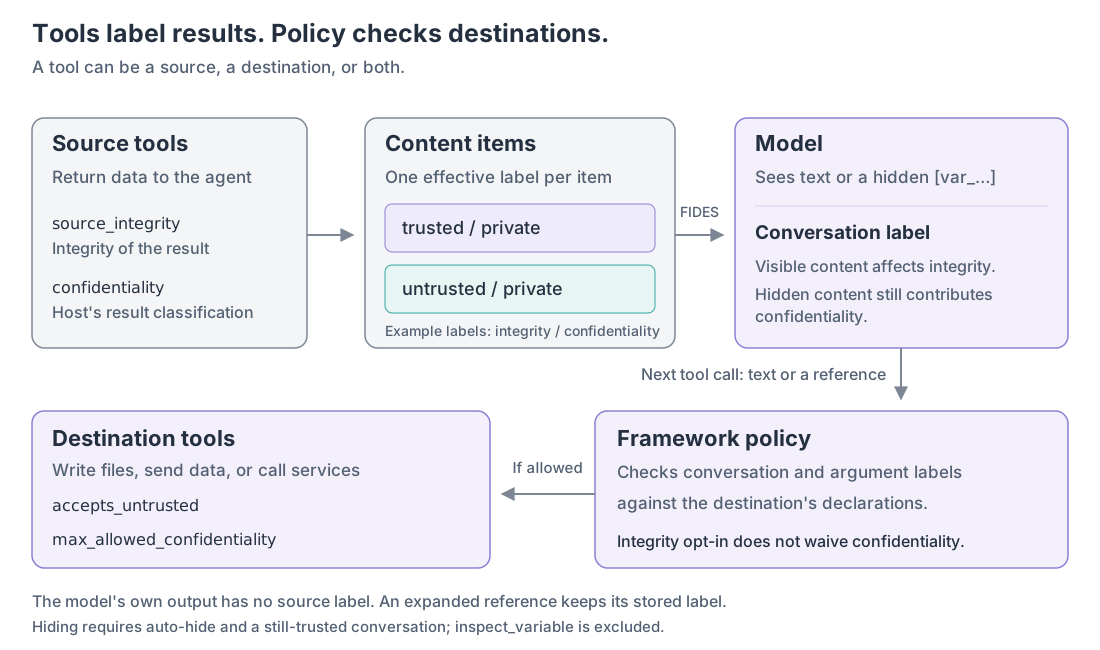
With automatic hiding enabled, untrusted content is hidden while the conversation remains trusted. Hidden content still affects confidentiality. Passing its reference to another tool remains subject to that destination's policy.
sandboxed_tool accepts a string or unlabelled Content items. A kind can commit fixed standing_guidance and return it last on every normal path. Core verifies that text and stamps it trusted/public, while the framework preserves stricter call confidentiality. Counts, exit statuses and advice chosen from guest output do not qualify as fixed guidance.
For these mixed results, the framework-facing source declaration is trusted. The kind's output claim remains in maf_sandbox_derived_integrity, and core labels each derived item separately. Every shipped kind claims untrusted output.
FileStoreProvenance records the integrity of stored text. Session reads can weaken a call's derived result; trusted reads never promote an untrusted kind. requires_file_integrity can refuse weak or unknown inputs before execution. The host must wire the shared provenance record into both writes and reads.
See information flow for label rules and the decided result contract. Its status table identifies the contract work that is not yet implemented.
Calling host tools from guest code
HostToolRegistry exposes only functions the host registers. Registered functions run in the host process with its privileges. These nested calls bypass ordinary agent tool middleware, so the registry must enforce their policy.
Use @sandbox_tool(source=..., sink=..., identity=...) to declare each function's role. Set require_declared=True to refuse undeclared functions. The registry reads declarations at registration and seals when their combined policy is read.
Application authority is allowed by default. User authority requires explicit allowed_identities, a host mint_user_identity callback and approval of the enclosing tool. Identity labels describe authority; they do not reduce the function's permissions.
Call-count and response-size limits apply per run. The router can forbid the entire channel with denied_capabilities={Capability.HOST_TOOLS}. Docker and ACAS support the exec-based transport; WSLC and Hyperlight do not.
See host-tool controls and CodeAct for wiring.
Call cleanup and concurrency
sandboxed_tool disposes sandboxes after each call by default. Hosts can explicitly choose Cleanup.RESET for snapshot restore, or Cleanup.RECLAIM for removal of call files on a supporting backend. Reclaim can leave other files and processes behind. A confinement declaration alone does not permit reuse.
Ordinary calls can overlap through one router. Whole-sandbox cleanup stops new admission and waits for active siblings. Kinds requesting exclusive admission run one call at a time, including cleanup.
This coordination belongs to one router. It does not separate siblings' data or coordinate unrelated processes. Use IsolationScope.CALL when calls must never share a sandbox; it always requires disposal.
Failed call cleanup normally refuses the key until removal succeeds. dispose_unclean retries recorded targets. FailedReclaimPolicy.KEEP is an explicit host choice to accept reuse after failure.
At conversation deletion, stop new work across replicas and call router.dispose_scope(scope, thread_id). Check the returned ScopePurge.undisposed; a count alone does not establish completion. router.scope(...) provides this cleanup as an async context manager.
dispose_kind(key, kind, timeout=...) narrows cleanup to one kind. Adding instance_id= targets one physical instance and protects replacements. Direct admission users must await release_call(...), which may perform queued cleanup.
See call cleanup and host disposal for timeouts, retries and ownership.
Observability and extension points
Register a SandboxObserver on the router and host-tool registry. Kinds also pass it to output collection. Events describe acquisitions, calls, transfers, processes, network decisions and cleanup. Use maf-sandbox-otel for OpenTelemetry export.
Callbacks run synchronously and may arrive on different threads. Keep them short and send records to a thread-safe queue. Ordinary observer failures are logged without changing the tool result. Event delivery is not a durable audit guarantee.
effective_state_middleware() can persist the served configuration in AgentSession.state. It records configuration rather than payloads. See observability.
For new implementations, use writing a kind or writing a backend. Backend declarations belong in BackendDeclarations, not standalone capability attributes.
Run the shared conformance suites against real backends. A kind claiming call-directory confinement must run assert_nothing_left_behind with an engine-backed fingerprint subject. A skipped probe or in-process fake does not prove confinement.
BoundedExec, shell file-transfer helpers and SyncRunner are optional building blocks. Their contracts and failure handling are covered by the guest guide and backend authoring guide.
Maintained by SOKOLAI BV.
1 maintainer

Release files for maf-sandbox 0.43.0
For a detailed explanation of source distributions (sdists) and built distributions (wheels), please see the package formats documentation.
Source distribution (sdist)
| File | Size | Uploaded | |
|---|---|---|---|
| maf_sandbox-0.43.0.tar.gz | 301.3 kB | Details |
Built distribution (wheel)
| File | Interpreter | ABI | Platform | Reset |
|---|---|---|---|---|
| maf_sandbox-0.43.0-py3-none-any.whl | Python 3 | none | any | Details |
Total release size: 620.8 kB
Release files / maf_sandbox-0.43.0.tar.gz
| Download URL | maf_sandbox-0.43.0.tar.gz |
|---|---|
| Size | 301.3 kB |
| Tags | Source |
|
SHA-256 checksum How to use checksums |
c988cafbb89f5a766ebd989ac593b63db8d3793a008ad14581898e211fccebf2
|
|
BLAKE2b-256 checksum How to use checksums |
785789ab187f1253368a8dccd91fb8caa1e1b16929572ceb4f815b7bc9793dea
|
| Upload date | |
|
Uploaded using Trusted Publishing? What is trusted publishing? |
Yes |
| Uploaded via |
twine/7.0.0 CPython/3.13.14
|
Provenance
Provenance describes where a file came from. On PyPI, provenance is shared via attestations, which provide a verifiable record of the build or publishing details. View details, limitations and caveats.


PyPI Publish Attestation
PyPI verified that this artifact, at this checksum, originated from the publisher listed below.
Signed by GitHub Actions, verified by PyPI on Sep 24, 2026.
Transparency logRelease files / maf_sandbox-0.43.0-py3-none-any.whl
| Download URL | maf_sandbox-0.43.0-py3-none-any.whl |
|---|---|
| Size | 319.5 kB |
| Tags | Python 3 |
|
SHA-256 checksum How to use checksums |
cd9473fe5092859556853d5eea9f4597e64b64caf972f59f06011fc76c4d2b88
|
|
BLAKE2b-256 checksum How to use checksums |
60763aed885ea94491a38aa608bd089389ad3a5e70c5961e0479b7b20c1a325c
|
| Upload date | |
|
Uploaded using Trusted Publishing? What is trusted publishing? |
Yes |
| Uploaded via |
twine/7.0.0 CPython/3.13.14
|
Provenance
Provenance describes where a file came from. On PyPI, provenance is shared via attestations, which provide a verifiable record of the build or publishing details. View details, limitations and caveats.
PyPI Publish Attestation
PyPI verified that this artifact, at this checksum, originated from the publisher listed below.
Signed by GitHub Actions, verified by PyPI on Sep 24, 2026.
Transparency log













