
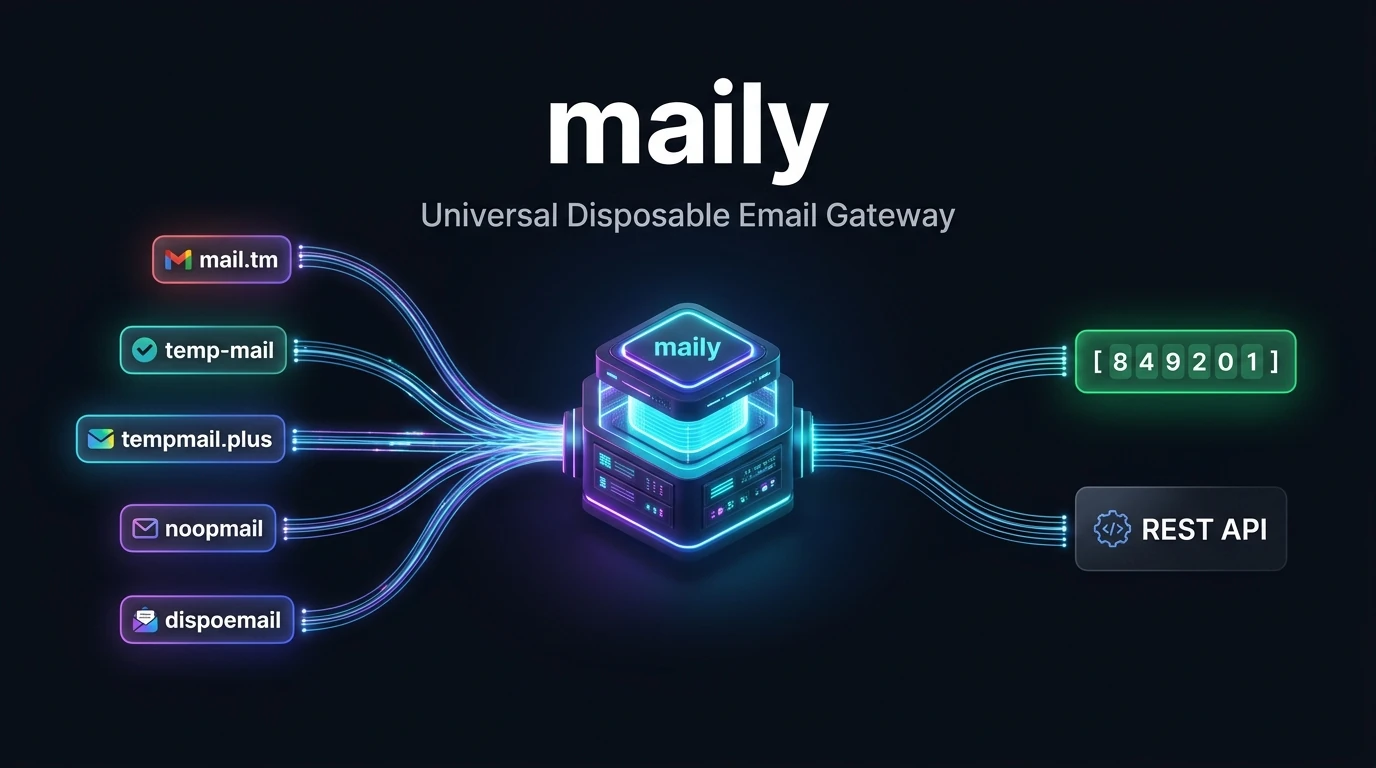
✉️ maily-client
The Unified Disposable Email SDK & Temp Mail API for Python (Async & Sync)
Control the zoo of temporary email providers (Mail.tm, TempMail, 1secmail alternatives) with 1-line automatic OTP code extraction for Playwright & Pytest.
⚡ Unite the disposable email zoo in Python: Stop juggling multiple brittle temp-mail client libraries.
maily-clientprovides a high-level Python temp mail API with 1-line mailbox creation, 40+ rotating domains across 8 provider fleets, and automatic OTP code extraction (await api.wait_for_code(box)).🇷🇺 Асинхронный Python SDK и Temp Mail API для временной почты: единый клиент для десятка temp-mail сервисов (надёжная замена 1secmail, Mail.tm, TempMail) с автоматическим извлечением 6-значных OTP кодов и ссылок активации в тестах Playwright и Pytest.








📖 Documentation & Guides • 🚀 Server Package (PyPI) • 📦 Client Package (PyPI) • 🐳 Docker GHCR • 🐙 GitHub Repository • ⚡ Quickstart
Fast, fully-typed async & sync Python SDK for the maily multi-provider temporary email platform.
Built for integration tests (Pytest, Playwright, Selenium, Cypress), automation bots, and QA verification pipelines. Features 1-line disposable mailbox creation, automatic OTP verification code extraction via regex, magic activation link parsing, real-time message streaming, and resilient networking.
✨ Key Features
- Standard Import (
maily_client): Clean, conflict-free Python imports (from maily_client import Maily, SyncMaily). - Single-File Portability: Ships as a lightweight client requiring only
httpx,loguru, andpydantic. Zero heavy dependencies. - Fully Typed (PEP 561): 100% type annotations with
py.typedcompliance and Pydantic response models for rich IDE autocompletion. - Async & Sync Support: Native
async/await(Maily) with high-concurrency polling, plus a lightweight synchronous facade (SyncMaily) for traditional test suites. - Magic Verification Extraction: Built-in polling and regex extraction for OTP verification codes (
wait_for_code) and account activation links (wait_for_link). - Resilient Networking: Optional exponential backoff retry policy handling transient errors (HTTP 502/504, connection timeouts) and honoring HTTP 429
Retry-After. - Self-Updating CLI: Built-in CLI tool
maily-clientto check for and apply updates directly from git.
📦 Installation & Import
Preferred — via PyPI:
pip install maily-client
Import in Python:
from maily_client import Maily, SyncMaily, WaitTimeoutError
Alternative 1: Direct from GitHub:
pip install "maily-client @ git+https://github.com/stormsia/maily.git#subdirectory=client"
Alternative 2: Standalone Single-File Download (Zero Install)
Because the client has no internal server dependencies, you can download maily_client.py directly into your project:
# Linux / macOS
curl -O https://raw.githubusercontent.com/stormsia/maily/main/client/maily_client.py

# Windows PowerShell
Invoke-WebRequest -Uri "https://raw.githubusercontent.com/stormsia/maily/main/client/maily_client.py" -OutFile "maily_client.py"
Dependencies for standalone use:
pip install httpx loguru pydantic
⚠️ Important: Attribute Access vs Dictionary Key Access
CRITICAL RULE: In
maily-client, native dot/attribute access is supported ONLY on Pydantic models and specificallyExtractedConfirmation(which implementsMappingand allows dual access: bothres.confirmation_codeandres["confirmation_code"]).All other client methods returning standard Python dictionaries (such as
await api.config.get(),sync_api.config.get(), or raw response dicts) DO NOT support attribute/dot access. You MUST access dictionary values using standard bracket key indexing (d["key"]), NEVER dot syntax (d.key).
# 1. ExtractedConfirmation (Pydantic model implementing Mapping) supports BOTH:
res = await api.wait_for_confirmation_email(box, digit_code_mask=r"\b(\d{6})\b")
if res is not None:
    # ✅ Attribute / dot access:
    print(res.subject)
    print(res.confirmation_code)
    print(res.confirmation_link)
    print(res.message_id)
    print(res.from_address)

    # ✅ Dictionary mapping access:
    print(res["confirmation_code"])
    print(res["confirmation_link"])
    print(res["subject"])

# 2. Standard dictionary responses (e.g., api.config.get()):
cfg = await api.config.get()
print(cfg["client_version"])  # ✅ CORRECT: standard dictionary indexing
# print(cfg.client_version)   # ❌ ERROR: AttributeError ('dict' object has no attribute 'client_version')
🚀 Quickstart
1-Line Mailbox & Verification Code Extraction
import asyncio

# Preferred when using maily-client SDK:
from maily_client import Maily, WaitTimeoutError
# (Or if using the maily-server package directly: from maily import Maily, WaitTimeoutError)


async def main():
    async with Maily("http://127.0.0.1:8477", api_key="your_secret_api_key") as api:
        # Create a disposable mailbox with automatic domain selection
        box = await api.create_temp_mailbox()
        print(f"Disposable email: {box.address}")

        # Send an email to box.address, then wait for the code:
        try:
            code = await api.wait_for_code(box, timeout=60.0)
            print(f"Received verification code: {code}")
        except WaitTimeoutError:
            print("Timed out waiting for email.")


asyncio.run(main())
Confirmation Extraction (ExtractedConfirmation Dual Access)
async with Maily("http://127.0.0.1:8477") as api:
    box = await api.create_temp_mailbox()

    # Wait for email and extract both verification code and activation link
    res = await api.wait_for_confirmation_email(box, digit_code_mask=r"\b(\d{6})\b")
    if res is not None:
        # 1. Attribute / dot access:
        print(f"Subject: {res.subject}")
        print(f"Code: {res.confirmation_code}")

        # 2. Key mapping access:
        print(f"Link: {res['confirmation_link']}")
        print(f"Code: {res['confirmation_code']}")
Synchronous Client (SyncMaily)
# Standalone client:
from maily_client import SyncMaily
# Or via server package: from maily import SyncMaily

with SyncMaily("http://127.0.0.1:8477", api_key="your_secret_api_key") as api:
    box = api.create_temp_mailbox()
    code = api.wait_for_code(box, timeout=45.0)
    print(f"Received code synchronously: {code}")
Confirmation Link Extraction
async with Maily("http://127.0.0.1:8477") as api:
    box = await api.create_temp_mailbox(provider="tempmail.plus")
    print(f"Address: {box.address}")

    # Automatically extracts URLs containing 'confirm', 'verify', or 'activate'
    link = await api.wait_for_link(box, timeout=90.0)
    print(f"Confirmation URL: {link}")
Real-Time Email Streaming (Async Iterator)
async with Maily("http://127.0.0.1:8477") as api:
    box = await api.mailboxes.create(domain="mail.tm")

    # Continuously yields new messages as they arrive
    async for msg in api.messages.iter_messages(box, poll_interval=2.0, timeout=120.0):
        print(f"Incoming: {msg.subject} from {msg.from_address}")
        detail = await api.messages.get(box, msg.message_api_id)
        print("Body text:\n", detail.text)
Granular Exception Handling
All API errors inherit from ApiError, which inherits from ClientError:
from maily_client import (
    AuthenticationError,  # 401: Invalid API key
    ForbiddenError,  # 403: Scope denied
    NotFoundError,  # 404: Mailbox or message missing
    ValidationError,  # 422 / 400: Bad params
    RateLimitError,  # 429: Rate limited
    UpstreamProviderError,  # 502/504: Provider downtime
    WaitTimeoutError,  # Timeout waiting for email/code
)

try:
    detail = await api.messages.get(box, "unknown_id")
except NotFoundError:
    print("Message not found!")
except AuthenticationError:
    print("Check your API key!")
Scoped API Key Management
async with Maily("http://127.0.0.1:8477", api_key="root_secret") as api:
    # Create key restricted to mail.tm only
    new_key = await api.keys.create(
        name="bot-worker",
        scope={"providers": ["mail.tm"], "parent_ids": [], "actions": ["read", "write"]},
    )
    print(f"Key Prefix: {new_key.prefix} | Secret: {new_key.secret}")
Retention & Database Maintenance
async with Maily("http://127.0.0.1:8477", api_key="root_secret") as api:
    # Run regular retention sweep (triggers DB maintenance if interval has elapsed)
    res = await api.admin.retention_run()
    print(f"Deleted: {res.mailboxes_deleted} boxes, {res.messages_deleted} messages")

    # Or force immediate full database maintenance (VACUUM, REINDEX, ANALYZE):
    res = await api.admin.retention_run(force_maintenance=True)
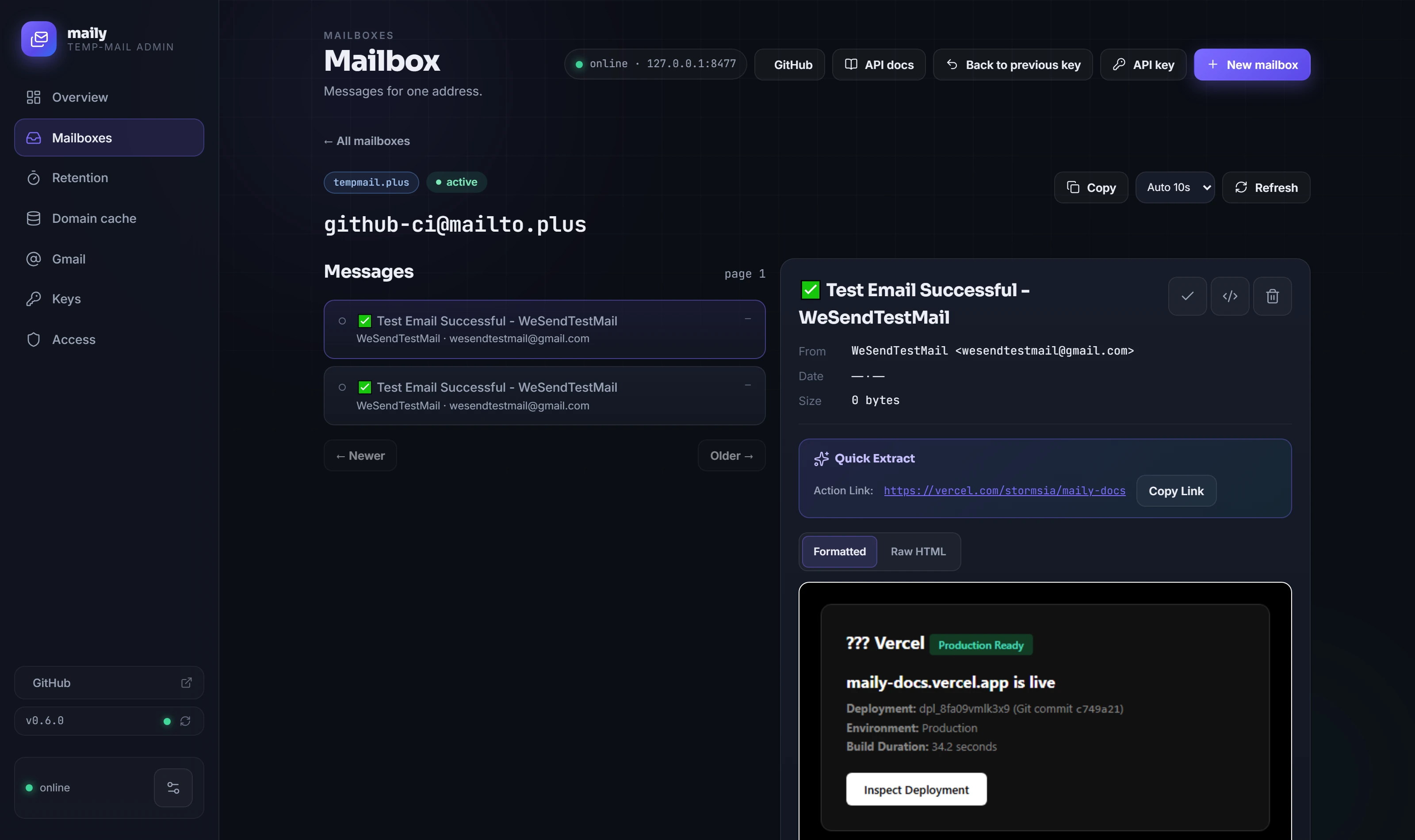
Visualizing OTP Extraction: How await api.wait_for_code(box) and await api.wait_for_link(box) isolate verification codes in the background, as viewed inside the Maily web dashboard. (See the Full Dashboard Carousel & Console Tour).
🛠️ API Overview & Structure
Maily exposes organized domain resource sections as well as top-level flat convenience methods:
Resource Sections
| Section | Description | Key Methods |
|---|---|---|
api.mailboxes |
Mailbox lifecycle | create(), list(), get(), by_address(), delete() |
api.messages |
Message inspection & polling | list(), get(), mark_read(), delete(), source(), wait_for(), wait_for_confirmation_email(), wait_for_code(), wait_for_link(), iter_messages() |
api.providers |
Upstream provider status | list(), targets() |
api.gmail |
Gmail OAuth multi-tenant management | oauth_start(), import_account(), accounts(), delete_account(), sync() |
api.admin |
Server administration | stats(), retention_list(), retention_set(), retention_disable(), retention_run(), domain_cache(), domain_cache_save(), domain_cache_run() |
api.keys |
API keys management | create(), list(), get(), delete(), me(), update(), rotate(), secret(), retention_set() |
api.health |
System health | ping() |
api.config |
Server public configuration | get() (returns dict[str, Any] — use dict["key"]) |
⚡ Flat Facade Shortcut Methods
Both Maily (async) and SyncMaily (sync) provide direct top-level facade shortcuts for rapid automation. All 19 flat shortcut methods forward directly to their respective section implementations:
| # | Facade Method Signature | Return Type | Description |
|---|---|---|---|
| 1 | create_mailbox(*, provider=None, domain=None, parent_id=None, address=None, password=None) |
Mailbox |
Creates a new disposable or parent mailbox. |
| 2 | list_mailboxes(provider=None, active=None) |
list[Mailbox] |
Lists mailboxes registered under the active API key. |
| 3 | mailbox(mailbox_id: int | Mailbox) |
Mailbox |
Retrieves details and metadata for a specific mailbox ID. |
| 4 | mailbox_by_address(email: str) |
Mailbox |
Finds a mailbox by its exact email address string. |
| 5 | delete_mailbox(mailbox_id: int | Mailbox) |
None |
Deletes a mailbox and purges all its stored messages. |
| 6 | list_messages(mailbox_id: int | Mailbox, page: int = 1) |
list[MessageSummary] |
Lists message headers/summaries received by the mailbox. |
| 7 | get_message(mailbox_id: int | Mailbox, message_id: str) |
MessageDetail |
Retrieves complete message body, HTML, attachments, and text. |
| 8 | mark_read(mailbox_id: int | Mailbox, message_id: str) |
MessageSummary |
Marks the specified message as read on the upstream provider. |
| 9 | delete_message(mailbox_id: int | Mailbox, message_id: str) |
None |
Permanently deletes a message from the mailbox. |
| 10 | get_source(mailbox_id: int | Mailbox, message_id: str) |
MessageSource |
Fetches the raw RFC822 MIME source data and download URL. |
| 11 | gmail_oauth_start() |
OAuthStart |
Initiates Google OAuth2 consent flow, returning auth_url and state. |
| 12 | gmail_import_account(*, refresh_token=None, token_json=None) |
GmailAccount |
Connects a Gmail parent account via OAuth refresh token or JSON credential. |
| 13 | list_gmail_accounts() |
list[GmailAccount] |
Lists all registered Gmail parent accounts and their send_as aliases. |
| 14 | delete_gmail_account(parent_id: int) |
None |
Removes a connected Gmail parent account and disables its aliases. |
| 15 | sync_gmail_account(parent_id: int) |
GmailAccount |
Triggers immediate upstream IMAP/REST synchronization for a Gmail account. |
| 16 | domain_cache_settings() |
DomainCache |
Inspects provider domain background cache status and refresh interval. |
| 17 | save_domain_cache_settings(*, enabled=None, interval_seconds=None) |
DomainCache |
Updates background domain cache configuration. |
| 18 | refresh_domain_cache() |
DomainCacheRun |
Triggers an immediate cache refresh sweep across all providers. |
| 19 | wait_for_message(mailbox_id, *, timeout=120.0, interval=2.0, predicate=None) |
MessageSummary |
Polls mailbox until a message arrives matching an optional predicate filter. |
Additional Root Convenience Methods
create_temp_mailbox(*, provider: str | None = None, domain: str | None = None) -> Mailbox— Instantly creates a temporary mailbox, automatically selecting the best available active domain if omitted.wait_for_code(mailbox_id, *, pattern=r"\b(\d{4,8})\b", sender_domain=None, timeout=60.0, check_interval=3.0) -> str— Polls for incoming email and returns the extracted digit verification code (raisesWaitTimeoutErroron timeout).wait_for_link(mailbox_id, *, url_contain=None, sender_domain=None, timeout=60.0, check_interval=3.0) -> str— Polls for incoming email and returns the matching activation URL (raisesWaitTimeoutErroron timeout).wait_for_confirmation_email(mailbox_id, *, sender_domain=None, url_contain=None, digit_code_mask=None, timeout=60.0, check_interval=5.0) -> ExtractedConfirmation | None— High-level extractor returningExtractedConfirmation(supports dot and dict access) orNoneon timeout.check_client_version() -> str— Queries/v1/configand logs a warning via Loguru if the client version does not match the server.
💻 CLI Commands
The package includes a command-line interface executable as maily-client (or via python -m maily_client):
# Display help and usage
maily-client --help

# Show current installed client version
maily-client version

# Check GitHub repository for newer version (exit codes: 0=up-to-date, 2=update available, 1=network error)
maily-client check

# Download and replace local client file with latest release from GitHub
maily-client update
CLI Exit Codes
| Exit Code | Meaning |
|---|---|
0 |
Success / local client file is already up to date. |
1 |
Network or I/O failure (failed to connect to GitHub or file write error). |
2 |
Update available (when running check), or invalid CLI argument. |
Environment Variables
MAILY_CLIENT_SOURCE: URL to fetch the canonical client from when checking or updating (defaults to GitHubmainbranch raw file:https://raw.githubusercontent.com/stormsia/maily/main/client/maily_client.py).
🛡️ Error Handling & Resiliency
The client provides explicit exceptions inheriting from ClientError:
ClientError
 ├── WaitTimeoutError
 └── ApiError
      ├── AuthenticationError   (HTTP 401: Invalid API key or missing Authorization header)
      ├── ForbiddenError        (HTTP 403: Scoped API key does not have permission)
      ├── NotFoundError         (HTTP 404: Mailbox or message does not exist)
      ├── ValidationError       (HTTP 422: Malformed input or schema validation failure)
      ├── RateLimitError        (HTTP 429: Rate limited by server or upstream provider)
      └── UpstreamProviderError (HTTP 502 / 504: Upstream temporary mail provider failure)
HTTP 422 Validation Error Formatting
FastAPI validation errors returning a list of field error objects ([{"loc": ["body", "domain"], "msg": "..."}]) are automatically formatted into readable messages:
from maily_client import Maily, ValidationError

async with Maily("http://127.0.0.1:8477") as api:
    try:
        # Invalid input parameters
        await api.mailboxes.create(domain="invalid domain!@#")
    except ValidationError as exc:
        print(f"Status Code: {exc.status_code}")  # 422
        # Clean formatted string: "body -> domain: Value error, invalid domain name characters"
        print(f"Validation Detail: {exc.detail}")
HTTP 429 Rate Limiting & Automatic Retries
When max_retries > 0, the client automatically honors HTTP 429 Retry-After headers and applies exponential backoff for transient HTTP 502/504 errors and network connection timeouts:
from maily_client import Maily, RateLimitError

# Configure client-side retry policy
api = Maily(
    "http://127.0.0.1:8477",
    max_retries=3,  # Retry up to 3 times before raising
    retry_backoff=0.5,  # Base backoff in seconds (0.5s, 1.0s, 2.0s)
)

try:
    box = await api.create_temp_mailbox()
except RateLimitError as exc:
    # If retries are exhausted or max_retries is 0
    print(f"Rate limited (HTTP 429). Server message: {exc.detail}")
🔍 Search Discovery & Keywords Reference
maily-client is engineered for automated testing, CI/CD pipelines, and web scrapers requiring disposable email inboxes:
| Search Category | Solution in maily-client |
Top Ranked Query Terms |
|---|---|---|
| Python Temp Mail Client | Async/sync SDK with typed Pydantic models & zero heavy dependencies | temp mail python, temporary email python client, disposable email sdk, mailtm python, maily-client, python temp mail library |
| Instant OTP Extraction | Automatic 4–8 digit verification code detection & regex isolation | extract otp code from email python, auto receive verification code, wait_for_code, email verification code python |
| Playwright / Pytest Verification | Non-blocking async polling & clean context managers for browser tests | playwright temp mail, pytest disposable email fixture, selenium email verification, e2e email testing python |
| Multi-Provider Unification | Unified models across Mail.tm, TempMail, DispoEmail, NoopMail | 1secmail python alternative, tempmail plus python, disposable email api python, fake email python sdk |
| Поиск на русском языке (CIS SEO) | Асинхронный клиент временной почты для тестов и ботов | временная почта python, одноразовая почта python, прием кодов подтверждения python, получить код из письма playwright |
📄 License
This project is licensed under the MIT License.
1 maintainer

Metadata
1 maintainer
Release files for maily-client 0.7.0
For a detailed explanation of source distributions (sdists) and built distributions (wheels), please see the package formats documentation.
Source distribution (sdist)
| File | Size | Uploaded | Provenance | Actions |
|---|---|---|---|---|
| maily_client-0.7.0.tar.gz | 27.3 kB | With provenance | Details for maily_client-0.7.0.tar.gz |
Built distribution (wheel)
| File | Interpreter | ABI | Platform | Actions Reset |
|---|---|---|---|---|
| maily_client-0.7.0-py3-none-any.whl | Python 3 | none | any | Details for maily_client-0.7.0-py3-none-any.whl |
Total release size: 53.1 kB
Release files / maily_client-0.7.0.tar.gz
| Download URL | maily_client-0.7.0.tar.gz |
|---|---|
| Size | 27.3 kB |
| Tags | Source |
|
SHA-256 checksum How to use checksums |
acc7d062a27aff4c1421b3bd97a3fe69087abb981863293f67aa69799cc98b09
|
|
BLAKE2b-256 checksum How to use checksums |
490e1b473d05f188ab783dfce881903024f4196568daead494a1ae4cfd509567
|
| Upload date | |
|
Uploaded using Trusted Publishing? What is trusted publishing? |
Yes |
| Uploaded via |
twine/7.0.0 CPython/3.13.16
|
Provenance
Provenance describes where a file came from. On PyPI, provenance is shared via attestations, which provide a verifiable record of the build or publishing details. View details, limitations and caveats.


PyPI Publish Attestation
PyPI verified that this artifact, at this checksum, originated from the publisher listed below.
Signed by GitHub Actions, verified by PyPI on Nov 3, 2026.
Transparency logRelease files / maily_client-0.7.0-py3-none-any.whl
| Download URL | maily_client-0.7.0-py3-none-any.whl |
|---|---|
| Size | 25.8 kB |
| Tags | Python 3 |
|
SHA-256 checksum How to use checksums |
8d900d036f498c1e00cb1f45ebe4dc83fd985a8583b28dca448c93cca5ec66a5
|
|
BLAKE2b-256 checksum How to use checksums |
964f399fde11167cdb2abb6b01c57daab0be730eddecedfe9e13179b8c36f814
|
| Upload date | |
|
Uploaded using Trusted Publishing? What is trusted publishing? |
Yes |
| Uploaded via |
twine/7.0.0 CPython/3.13.16
|
Provenance
Provenance describes where a file came from. On PyPI, provenance is shared via attestations, which provide a verifiable record of the build or publishing details. View details, limitations and caveats.
PyPI Publish Attestation
PyPI verified that this artifact, at this checksum, originated from the publisher listed below.
Signed by GitHub Actions, verified by PyPI on Nov 3, 2026.
Transparency logSecurity for maily-client 0.7.0
Provenance
Provenance describes where a file came from. On PyPI, provenance is shared via attestations, which provide a verifiable record of the build or publishing details. View details, limitations and caveats.
Full provenance
All 2 files in this release have been uploaded with provenance metadata.
Attestation for maily_client-0.7.0.tar.gz
PyPI Publish Attestation
PyPI verified that this artifact, at this checksum, originated from the publisher listed below.
Signed by GitHub Actions, verified by PyPI on Nov 3, 2026.
Transparency logA note on package security
PyPI is a repository for distributing packages, not a service for auditing them. While third-party security researchers and our staff do their best to detect and remove malicious packages, PyPI cannot guarantee the quality, security or suitability of any given package.
To learn more about protecting yourself from malicious actors, visit our package security documentation.














