
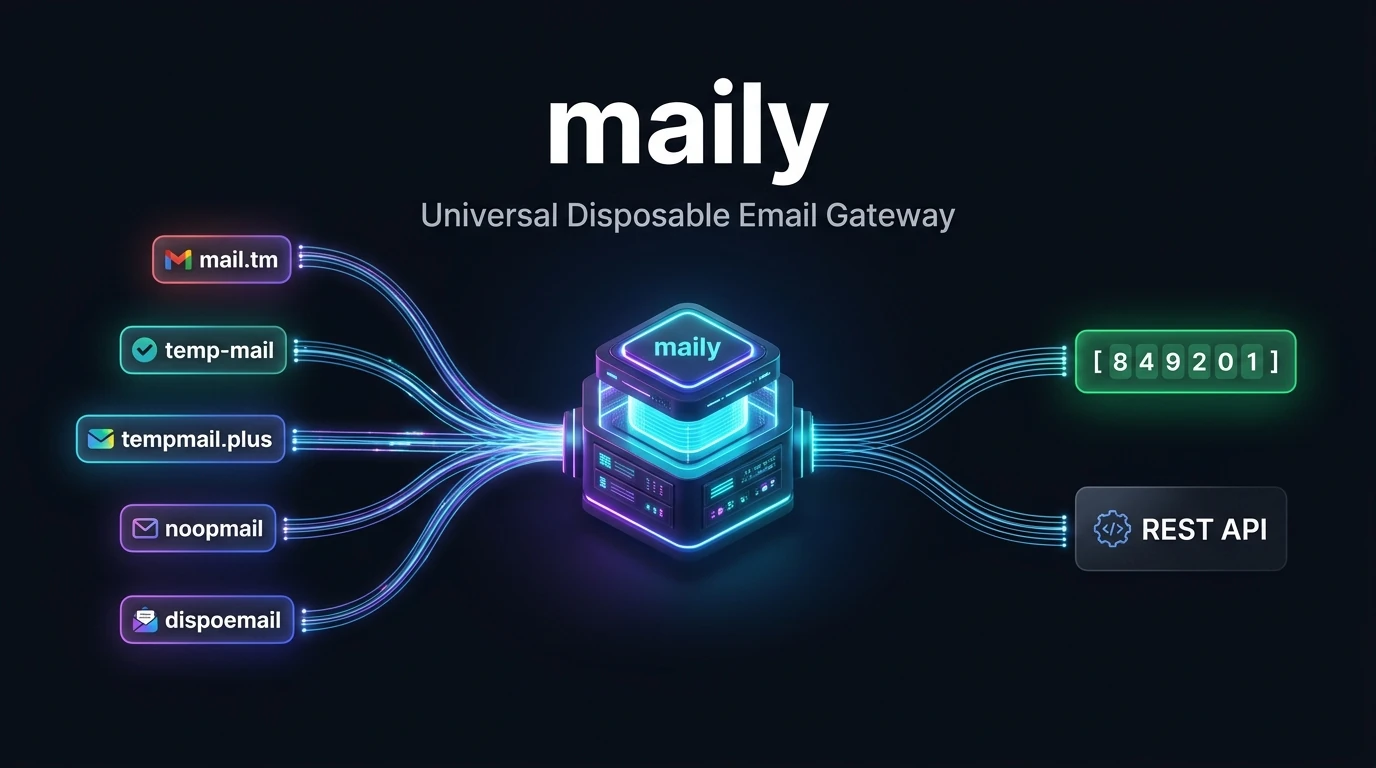
✉️ maily
The Universal Temporary Email Gateway & REST API Platform
Taming the disposable email zoo (Mail.tm, TempMail, 1secmail alternatives) under a single high-performance REST API, modern async Python SDK, and dark-mode web console.
⚡ Universal Temp Mail API to Rule the Disposable Email Zoo: Stop wrestling with 8 incompatible temp-mail APIs, daily domain blacklists, and fragile regexes. Maily acts as a resilient, drop-in 1secmail alternative aggregating Mail.tm, Tempmail Plus, Temp-Mail.io, and 5+ disposable email providers into one unified REST gateway with 1-line automatic OTP verification code extraction for Playwright, Pytest, and QA bots.
🇷🇺 Универсальный шлюз и REST API временной почты: объединяем зоопарк temp-mail сервисов (надёжная замена 1secmail, Mail.tm, TempMail) в едином быстром REST API с удобным тёмным веб-интерфейсом и мгновенным извлечением проверочных OTP кодов.











📖 Interactive Docs & Swagger • 🚀 Server Package (PyPI) • 📦 Client SDK (PyPI) • 🐳 Docker GHCR • 🌐 Live Provider Health • ⚡ Quick Start • 🧪 Test Automation Recipes
🦁 Why Maily? Taming the Disposable Email Zoo
Integrating disposable email into automated tests, QA pipelines, or bots usually means dealing with an unmaintainable nightmare:
- 💥 8 incompatible, brittle APIs — Each provider has custom headers, obscure JSON shapes, non-standard timestamps, or missing MIME source.
- 🛑 Random downtime & domain blacklists — Upstream domains get blocklisted daily, breaking your E2E test suites with zero warning.
- 🧩 Complex regex parsing — Writing and maintaining brittle regexes to fish 4–8 digit OTP codes and activation links out of raw HTML.
- 🔓 Zero security & isolation — No access controls, no credential encryption, no audit log, and no retention sweep.
Maily solves this once and for all. It acts as a resilient, high-availability abstraction gateway over the entire temp-mail ecosystem. Switch or rotate providers dynamically with a single parameter, automatically extract verification codes, and control everything from a sleek dark dashboard or async Python SDK.
| Capability | Fragmented Provider Zoo ❌ | Maily Universal Gateway ⚡ |
|---|---|---|
| API Uniformity | 8+ different endpoints, schemas & authentication rules | Single normalized REST API & Python SDK |
| Domain Reliability | Single point of failure; breaks when domain is blocked | 40+ rotating domains across 8 provider fleets |
| OTP Code Extraction | Manual HTML scraping, regex writing, and polling loops | await api.wait_for_code(box) (instant 1-line extraction) |
| Activation Links | Hardcoded regex URL patterns | await api.wait_for_link(box) with auto-scoring |
| Execution Engines | Custom HTTP requests with unhandled 429/502 retries | Native Async (Maily) + Sync facade (SyncMaily) |
| Observability | Blind execution; logs scattered everywhere | Dark-mode web console with live telemetry & charts |
| Security & Privacy | Public endpoints with zero key control | Multi-tenant scoped API keys & Fernet-encrypted credentials |
| State Maintenance | Orphaned mailboxes & bloated disks | Background retention sweep + zero-downtime VACUUM |
🏗️ Architecture & Data Flow
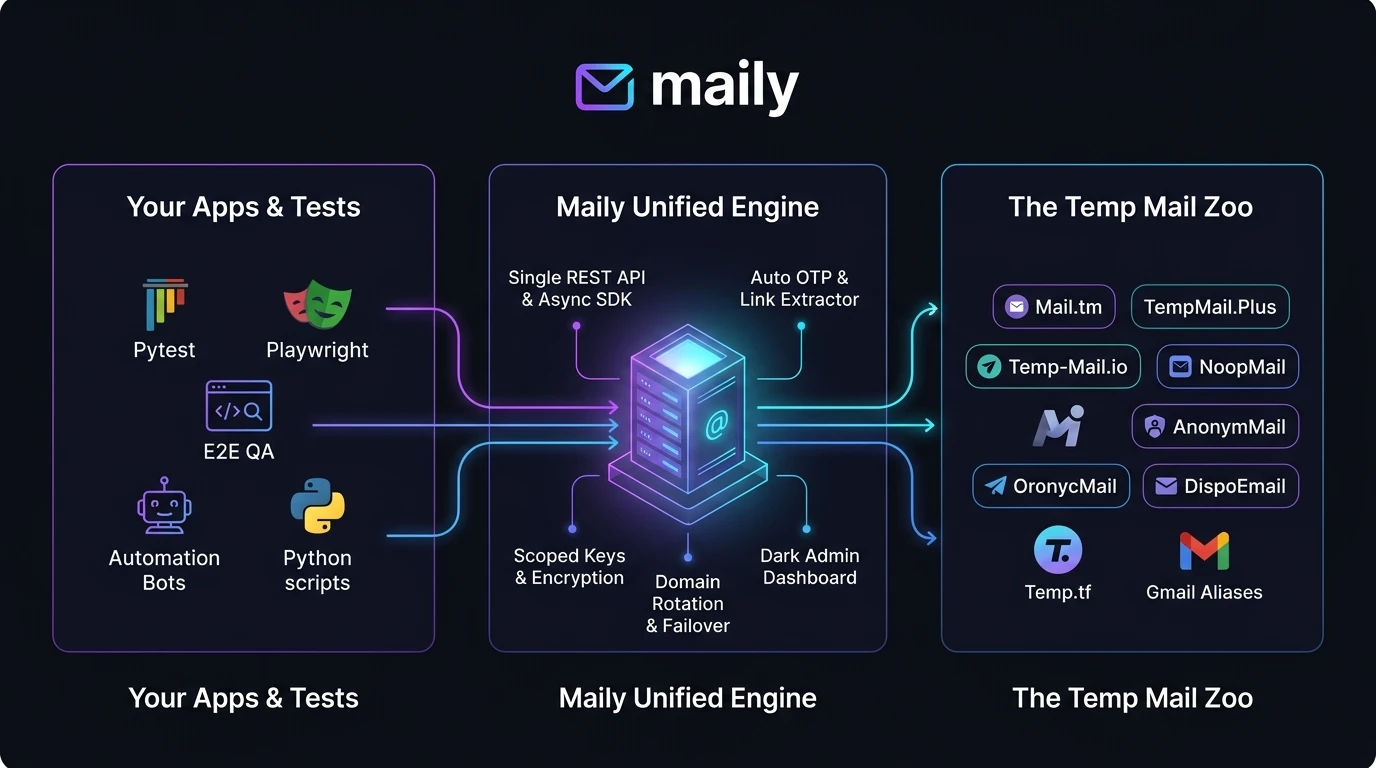
flowchart LR
    subgraph Clients["1. Clients & Test Suites"]
        direction TB
        pytest["Pytest Automation"]
        playwright["Playwright / Selenium"]
        bot["QA Bots & Scrapers"]
        sdk["maily-client (Async / Sync)"]
    end

    subgraph Gateway["2. Maily Unified Engine"]
        direction TB
        fastapi["FastAPI High-Speed Core"]
        extractor["Magic OTP & Link Extractor"]
        rbac["Scoped RBAC & Fernet Vault"]
        cache["Domain Cache & Auto-Failover"]
        retention["Retention Sweeper & SQLite WAL"]
        ui["Dark-Mode Admin Dashboard"]
    end

    subgraph Zoo["3. The Temp Mail Zoo"]
        direction TB
        p1["Mail.tm"]
        p2["TempMail.Plus"]
        p3["Temp-Mail.io"]
        p4["NoopMail.org"]
        p5["AnonymMail.net"]
        p6["DispoEmail.org"]
        p7["Temp.tf"]
        p8["Gmail OAuth2 + Aliases"]
    end

    Clients -->|Single REST / SDK Call| Gateway
    Gateway -->|Unified Adapter Engine| Zoo
✨ Features at a Glance
- 8 Integrated Providers Under One Roof — Aggregates public temporary-mail networks and private Gmail accounts:
mail.tm— High reliability, custom usernames, passwords, full MIME sourcetempmail.plus— Custom usernames, PIN protection, domains, MIME sourcetemp-mail.io— Disposable web mailboxes with automatic CORS tokensnoopmail.org— Domain rotation and raw source inspectionanonymmail.net— Session & CSRF-managed disposable maildispoemail.org— Astro-session based disposable mailtemp.tf— Real provider aliases on Outlook, Hotmail, Gmail, and high.edu.pl with plus/dot syntaxgmail— OAuth2 integration with unlimitedusername+alias@gmail.commailboxes
- ⚡ Magic Verification Extraction — Wait for an incoming email and automatically extract 4–8 digit verification codes (e.g.
849201) or confirmation action links with a single async call. - 🐍 Async Python Client (
maily-client) — Zero-heavy-dependency standalone client (httpx,pydantic,loguru) with async context managers, async iterators, typed pydantic models, and granular exceptions. - 📡 Real-Time Email Streaming — Stream incoming messages via
async for message in api.messages.iter_messages(box): .... - 🖥️ Cyberpunk Dark Web Dashboard — Modern dark-mode UI with live charts, message preview with verification highlights, auto-refresh polling, and an integrated Swagger / API documentation explorer at
/docs. - 🔑 Scoped API Keys & Multi-Tenancy — Root keys and granular issued keys with provider/action/parent restrictions and custom TTL cleanup rules.
- 🧹 Automatic Retention & DB Maintenance — Configurable background worker sweeps expired mailboxes and messages based on TTL policies, paired with automatic throttled database maintenance (WAL truncate, VACUUM, REINDEX, ANALYZE, PRAGMA optimize, quick_check) to defragment storage without downtime.
- 🔄 Domain Cache & Fallback — Periodic background cache of provider domains with instant refresh and auto-failover.
- 🐳 Docker-Ready in 10 Seconds — Hermetic multi-stage Docker build with SQLite volume persistence.
🌐 Supported Providers & Capabilities
| Provider | Target Kind | Custom Username | Custom Domain | Passwords / PIN | Raw Source | Read Tracking |
|---|---|---|---|---|---|---|
| mail.tm | domain |
✅ Supported | ✅ Supported | ✅ Supported | ✅ Supported | ✅ Supported |
| tempmail.plus | domain |
✅ Supported | ✅ Supported | ✅ PIN Code | ✅ Supported | ✅ Supported |
| temp-mail.io | domain |
✅ Supported | ✅ Supported | ❌ No | ✅ Supported | ⚪ No-op |
| noopmail.org | domain |
✅ Supported | ✅ Supported | ❌ No | ✅ Supported | ⚪ No-op |
| anonymmail.net | domain |
✅ Supported | ✅ Supported | ❌ No | ✅ Supported | ⚪ No-op |
| dispoemail.org | domain |
✅ Supported | ✅ Supported | ❌ No | ✅ Supported | ⚪ No-op |
| temp.tf | domain |
✅ Supported | ✅ Supported | ❌ No | ✅ Supported | ⚪ No-op |
| gmail | parent |
✅ +alias |
❌ Own Account | ❌ OAuth2 | ✅ Supported | ✅ Supported |
💡 Extending Providers: Want to add your own provider? Check out the comprehensive guide for developers and AI agents in docs/ADDING_PROVIDERS.md.
🌐 Live Provider Operational Status
Last Verified:
2026-11-03 00:28 UTC| Overall Health: 🟡 Degraded Performance
| Provider | Slug | Targets | API Health | E2E Delivery | Latency | Status |
|---|---|---|---|---|---|---|
| Mail.tm | mail.tm |
1 | 🟢 PASS | 🟢 4.3s |
1.21s |
🟢 Operational |
| TempMail Plus | tempmail.plus |
8 | 🟢 PASS | 🟢 5.6s |
1.24s |
🟢 Operational |
| TempMail.io | temp-mail.io |
6 | 🟢 PASS | 🟢 3.5s |
0.75s |
🟢 Operational |
| Temp.tf | temp.tf |
4 | 🟢 PASS | 🔴 Failed | 0.67s |
🔴 Delivery Outage |
| AnonymMail.net | anonymmail.net |
6 | 🟢 PASS | 🔴 Failed | 33.01s |
🔴 Delivery Outage |
| DispoEmail.org | dispoemail.org |
4 | 🟢 PASS | 🟢 3.6s |
0.66s |
🟢 Operational |
| NoopMail.org | noopmail.org |
16 | 🟢 PASS | 🟢 3.6s |
25.09s |
🟢 Operational |
Automated health checks run hourly via GitHub Actions.
🖥️ Sleek Web Dashboard Tour
Maily includes a high-performance dark-mode web console served directly at http://127.0.0.1:8477/. Built for developers, QA engineers, and automation ops teams who need effortless visual control over their disposable email infrastructure.
🎬 Live Dashboard Walkthrough: Auto-playing carousel cycling through all 6 admin console workstations (346 KB payload). Click to expand high-resolution inspection below.
🖼️ Expand Full-Resolution Screen Matrix (3×2 Grid) & Detailed Tour (Click to expand)
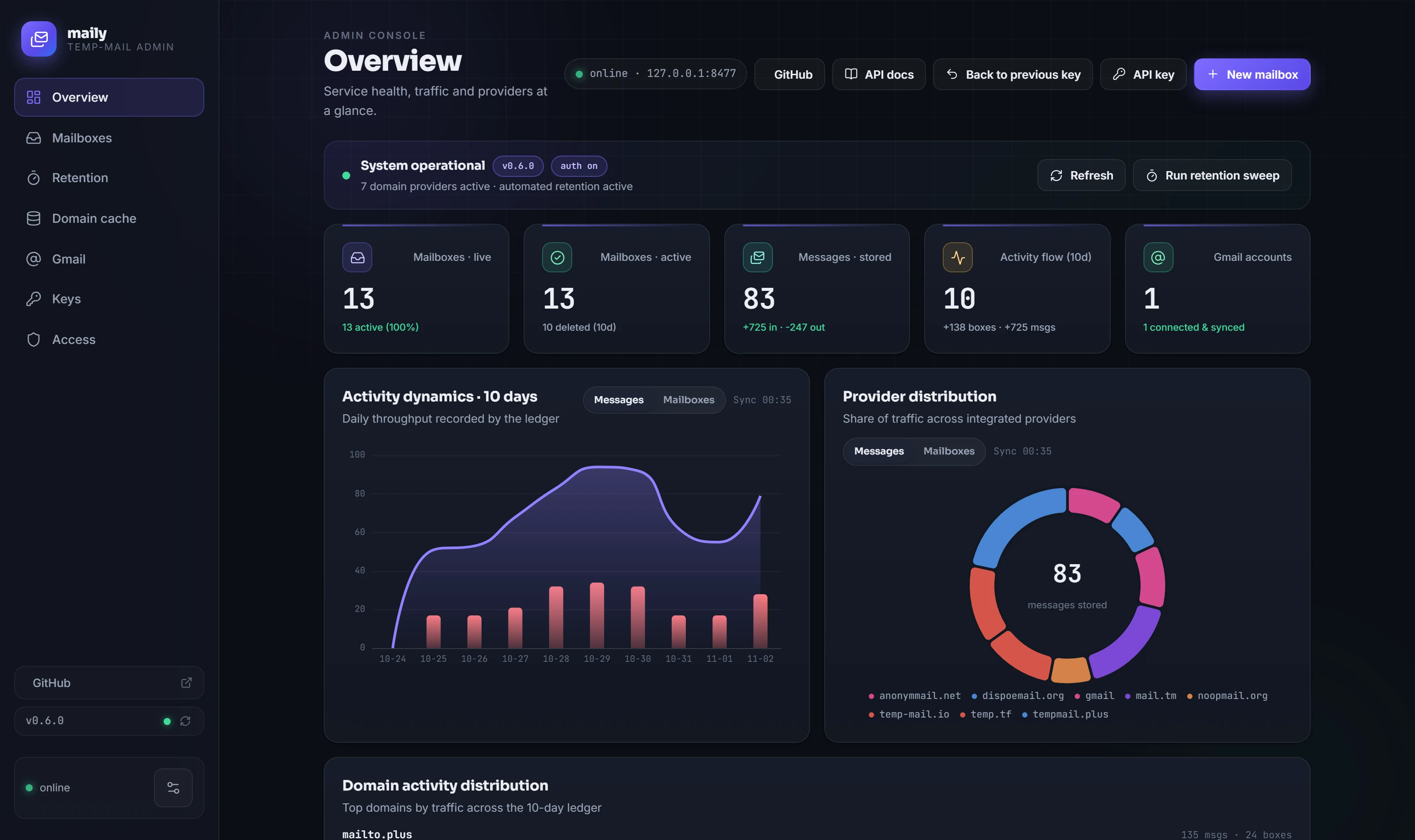
📊 1. Live Telemetry & Traffic Dynamics Real-time active inboxes, message rates, 10-day activity trends, and provider distribution donut charts. |
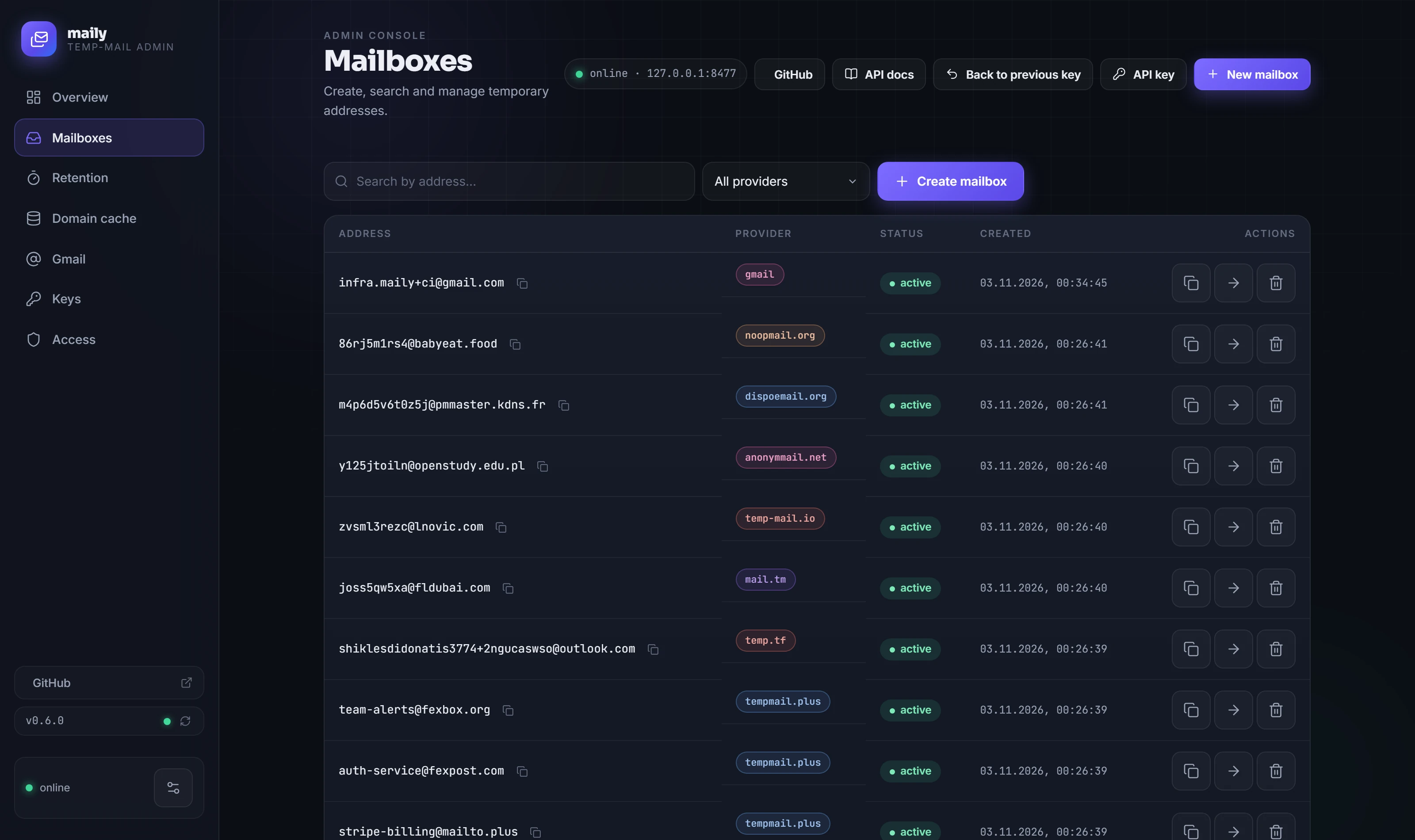
📬 2. Multi-Provider Mailbox Fleet Search & filter across 8 provider fleets, copy addresses in 1-click, and monitor mailbox lifecycles. |
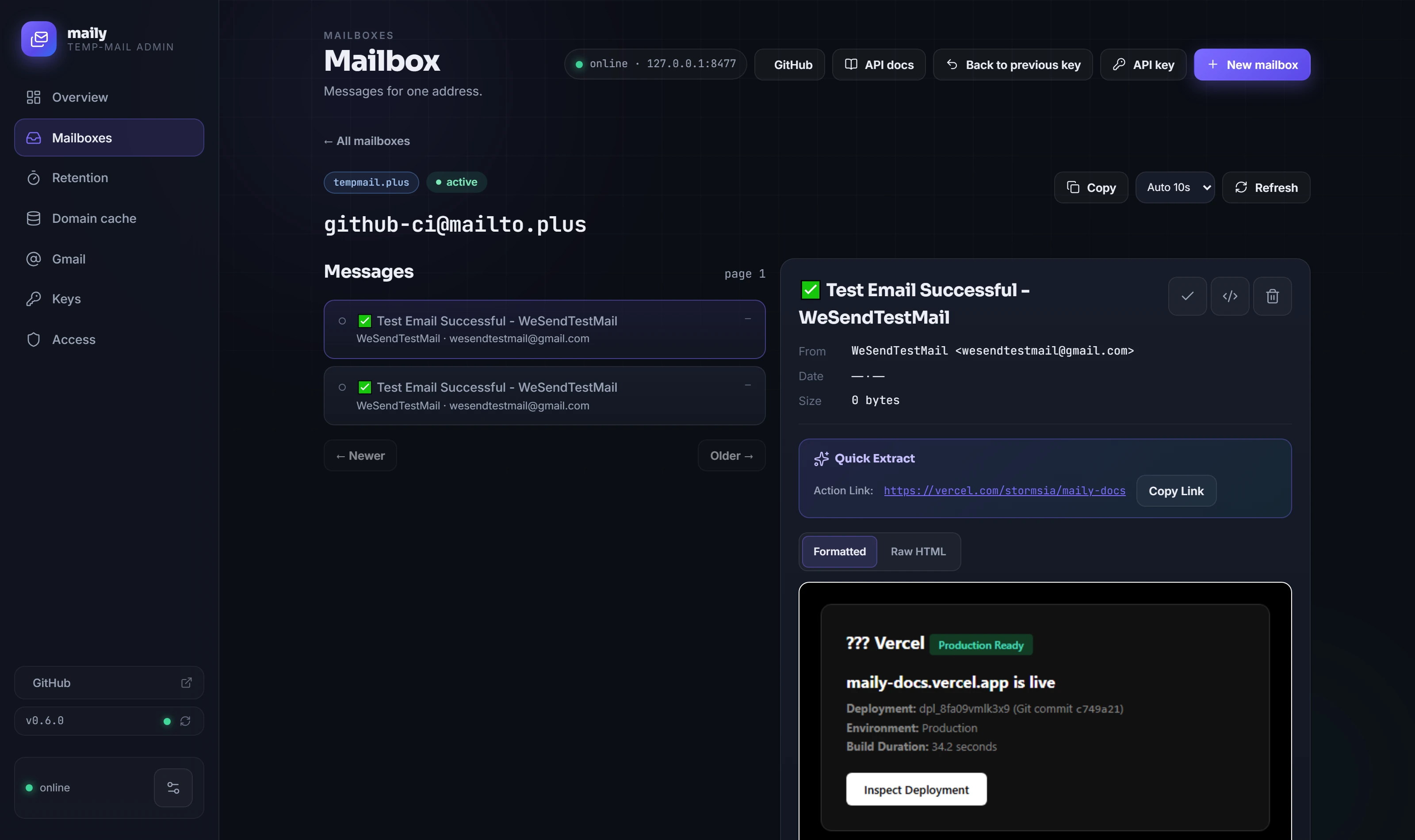
⚡ 3. Magic Verification & OTP Inspector Automated Quick Extract card isolating 4–8 digit OTP codes, activation links, HTML previews, and MIME source. |
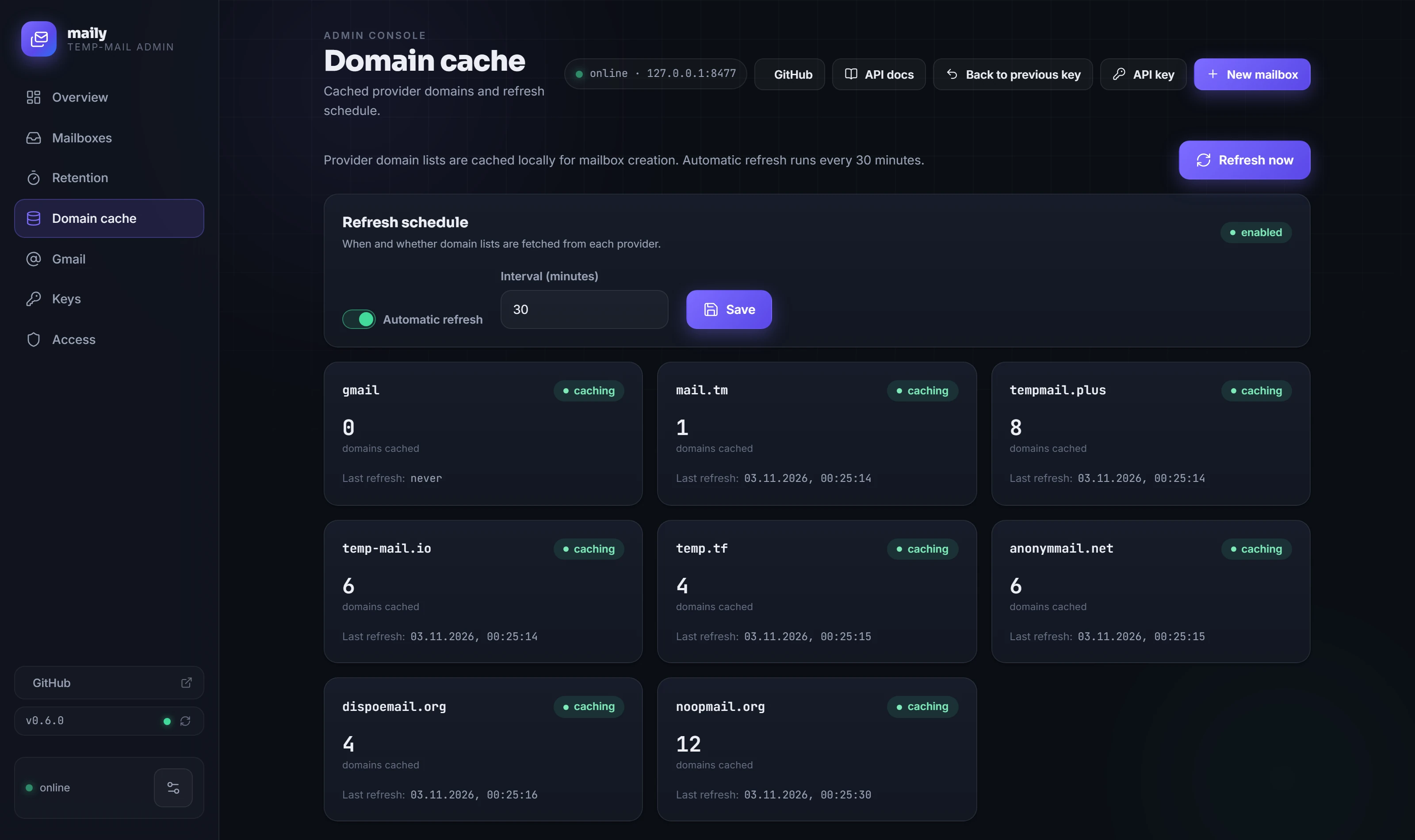
🌐 4. 40+ Rotating Domains & Health Cache Zero blacklist disruptions: multi-provider domain cache with automatic health sweeps and instant manual flush. |
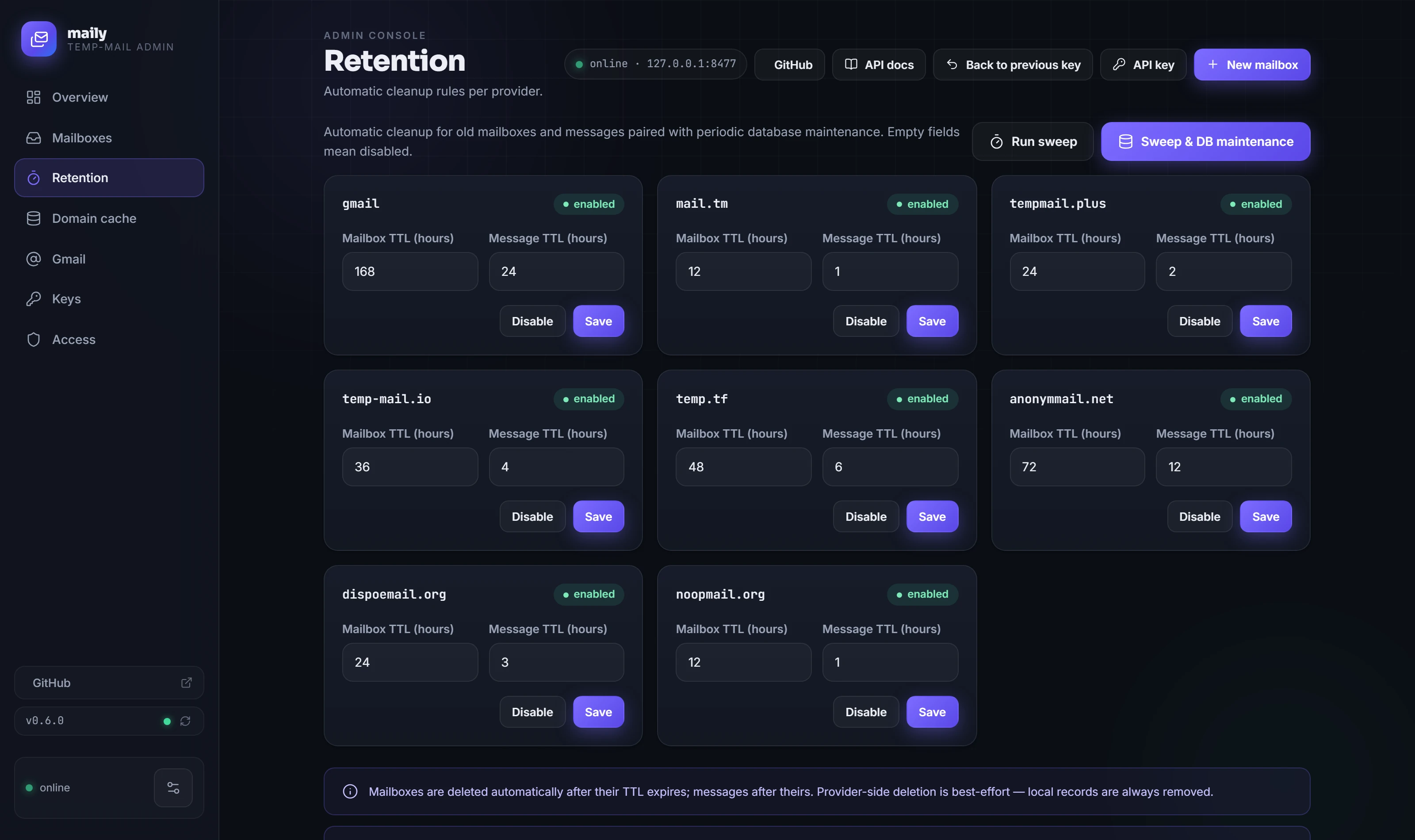
🧹 5. Automated Retention Sweeper & SQLite Defrag Granular TTL policies per provider, background expiration sweeps, and zero-downtime SQLite WAL defragmentation. |
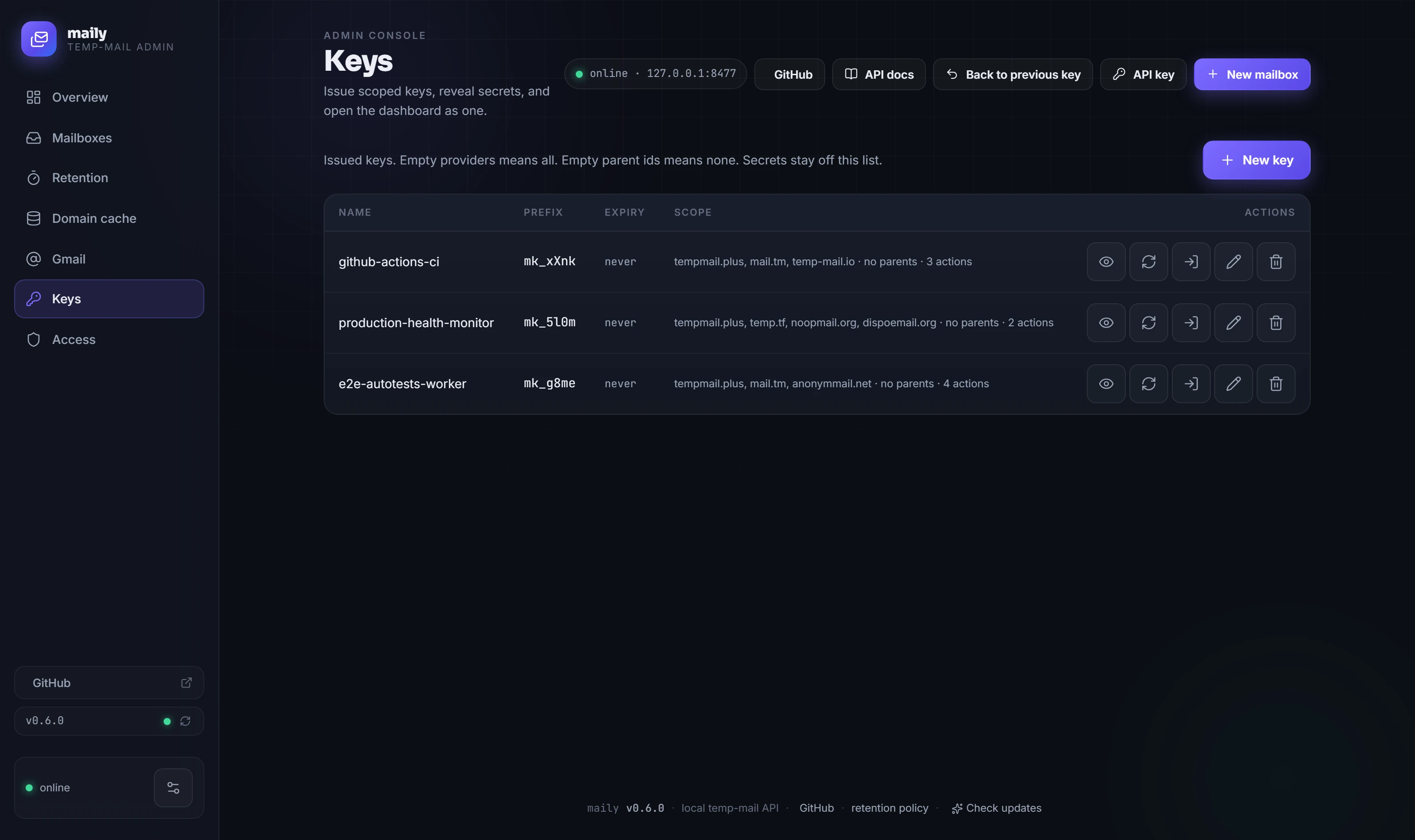
🔐 6. Multi-Tenant Scoped API Keys Least-privilege API token generation with provider-specific restrictions, secret revelation, and role switching. |
1. Live Telemetry & Provider Distribution
Track your temporary inbox fleet, inbound email traffic, 10-day activity dynamics, provider distribution donut charts, and domain throughput in real time.
- ⚡ Instant Status & Fleet Counts: Real-time visibility of active inboxes, stored messages, and system health status.
- 📊 Traffic Dynamics & Provider Split: 10-day activity trends paired with donut charts breakdown across integrated providers.
- 🧹 One-Click Maintenance: Trigger instant background retention sweeps and SQLite database defragmentation directly from the header.
2. Multi-Provider Mailbox Fleet
Search across all temporary addresses generated across 8 providers, inspect active statuses, view creation timestamps, and copy addresses in 1 click.
- 🔍 Instant Search & Provider Filter: Quickly filter mailboxes by provider (
mail.tm,tempmail.plus,temp-mail.io,gmail, etc.) or lifecycle state. - 📋 1-Click Copy: Fast address copying to clipboard for manual testing or form filling.
- 🗑️ Lifecycle Actions: Delete individual mailboxes with automated cascading message cleanup.
3. Magic Verification Inspector & Quick Extract
The core debugging workstation for email verification flows. Features the automated Quick Extract card that isolates 4–8 digit verification codes and confirmation action links.
- 🎯 Quick Extract Card: Auto-detects 4–8 digit OTP codes and activation URLs with 1-click clipboard copy buttons.
- 🌐 Multi-View Reading Pane: Switch seamlessly between rendered HTML preview, sanitized plain text, and complete RFC822 raw MIME source.
- 📎 Attachment Inspection: View, inspect, and download email attachments directly from the web console.
4. Provider Domain Cache & 40+ Rotating Domains
Monitor cached domain inventories across all 8 integrated providers. Never get blocked by single-domain blacklists again.
- 🌐 Unified Domain Inventory: Real-time visibility into cached domains for Gmail, Mail.tm, TempMail.Plus, Temp-Mail.io, Temp.tf, AnonymMail, DispoEmail, and NoopMail.
- ⏱️ Configurable Refresh Interval: Set background cache sweep intervals (default: 30 minutes) to automatically poll provider APIs.
- 🔄 Instant Manual Refresh: Flush and repopulate provider domain pools on demand with one click.
5. Automated Retention Sweeper & SQLite Defrag
Fine-grained TTL policies per provider to prevent orphaned mailboxes and stale messages from consuming disk space.
- ⏳ Granular TTL Rules: Configure mailbox and message retention policies per upstream provider.
- 🧹 Background Sweeper: Automated periodic workers prune expired records with zero downtime.
- 💾 SQLite Optimization: Scheduled WAL truncation, VACUUM, REINDEX, and ANALYZE ensure sub-millisecond query performance.
6. Multi-Tenant Scoped API Keys
Issue least-privilege API tokens restricted to specific providers, specific actions (read, write), or parent accounts.
- 🔐 Granular Scopes: Restrict CI/CD tokens to specific providers (e.g.
mail.tmonly) or specific actions. - 👁️ Secret Revelation & Rotation: Reveal secrets on demand or rotate compromised keys instantly.
- 🔄 Console Identity Switching: Test scoped permissions directly from the web dashboard by switching active keys.
🚀 Quick Start
Run Maily via official pre-built Docker containers, Docker Compose, or develop locally from source.
Option A — Docker (Pre-built Image, No Git Clone Required)
The fastest and recommended way to run maily in production without cloning the repository or building from source:
1. In One Command (docker run)
docker run -d \
  --name maily \
  -p 8477:8477 \
  -e MAILY_API_KEY=your_secret_api_key \
  -v maily_data:/data \
  --restart unless-stopped \
  ghcr.io/stormsia/maily:latest
2. Using Docker Compose
Download only the production Compose configuration:
# Linux / macOS (curl)
curl -O https://raw.githubusercontent.com/stormsia/maily/main/docker-compose.prod.yml
docker compose -f docker-compose.prod.yml up -d

# Windows (PowerShell)
Invoke-WebRequest -Uri https://raw.githubusercontent.com/stormsia/maily/main/docker-compose.prod.yml -OutFile docker-compose.prod.yml
docker compose -f docker-compose.prod.yml up -d
Updating the Pre-built Image
# If using Docker Compose:
docker compose -f docker-compose.prod.yml pull
docker compose -f docker-compose.prod.yml up -d

# If using docker run:
docker pull ghcr.io/stormsia/maily:latest
docker stop maily && docker rm maily
docker run -d --name maily -p 8477:8477 -e MAILY_API_KEY=your_secret_api_key -v maily_data:/data --restart unless-stopped ghcr.io/stormsia/maily:latest
- Web Dashboard: http://127.0.0.1:8477/
- API Documentation: http://127.0.0.1:8477/docs
Option B — Build from Source / Development
1. Docker Compose (Local Build)
git clone https://github.com/stormsia/maily.git && cd maily
cp .env.example .env        # adjust if needed
docker compose up -d --build
To update when building from source:
git pull
docker compose up -d --build
2. Local Python (Python 3.13+)
From PyPI (Recommended for Python CLI)
pip install maily-server
maily
From Git Source (Development)
git clone https://github.com/stormsia/maily.git && cd maily
python -m venv .venv
# Windows:
.venv\Scripts\activate
# Linux / macOS:
source .venv/bin/activate

pip install -e ".[dev]"
maily
Development server with auto-reload:
uvicorn maily.app.main:create_app --factory --reload --port 8477
🐍 Standalone Python Client SDK (maily-client)
The repository includes a dedicated, self-contained standalone Python client package (maily-client) requiring only httpx, pydantic, and loguru. It supports both high-concurrency async/await (Maily) and a synchronous facade (SyncMaily).
📖 Full Documentation: See CLIENT_GUIDE.md and maily-client README for comprehensive recipes (Pytest fixtures, Playwright/Selenium automation, streaming, and retry policies).
Installation
Preferred — PyPI package:
pip install maily-client
Alternative options:
# Directly from GitHub repository:
pip install "maily-client @ git+https://github.com/stormsia/maily.git#subdirectory=client"

# Or download the zero-dependency single-file client directly:
curl -O https://raw.githubusercontent.com/stormsia/maily/main/client/maily_client.py
⚠️ Important: Attribute Access vs Dictionary Key Access
In
maily-client, native dot/attribute access is supported ONLY on Pydantic models and specificallyExtractedConfirmation(which implementsMappingand supports dual access: e.g.res.subject,res.confirmation_codeas well asres["confirmation_link"]).All other client methods returning standard Python dictionaries (such as
await api.config.get()) DO NOT support attribute/dot access. You MUST use standard dictionary key indexing (dict["key"]), never dot access (dict.key).
1-Line Mailbox & Verification Code Extraction
import asyncio

# Preferred when using maily-client SDK:
from maily_client import Maily, WaitTimeoutError
# (Or if using the maily-server package directly: from maily import Maily, WaitTimeoutError)


async def main():
    async with Maily("http://127.0.0.1:8477", api_key="your_secret_api_key") as api:
        # Create a disposable mailbox with automatic domain selection
        box = await api.create_temp_mailbox()
        print(f"Disposable email: {box.address}")

        # Send an email to box.address, then wait for the code:
        try:
            code = await api.wait_for_code(box, timeout=60.0)
            print(f"Received verification code: {code}")
        except WaitTimeoutError:
            print("Timed out waiting for email.")


asyncio.run(main())
Confirmation Extraction (ExtractedConfirmation Dual Access)
async with Maily("http://127.0.0.1:8477") as api:
    box = await api.create_temp_mailbox()

    # Wait for email and extract both verification code and activation link
    res = await api.wait_for_confirmation_email(box, digit_code_mask=r"\b(\d{6})\b")
    if res is not None:
        # 1. Attribute / dot access:
        print(f"Subject: {res.subject}")
        print(f"Code: {res.confirmation_code}")

        # 2. Key mapping access:
        print(f"Link: {res['confirmation_link']}")
        print(f"Code: {res['confirmation_code']}")
Synchronous Client (SyncMaily)
# Standalone client:
from maily_client import SyncMaily
# Or via server package: from maily import SyncMaily

with SyncMaily("http://127.0.0.1:8477", api_key="your_secret_api_key") as api:
    box = api.create_temp_mailbox()
    code = api.wait_for_code(box, timeout=45.0)
    print(f"Received code synchronously: {code}")
Confirmation Link Extraction
async with Maily("http://127.0.0.1:8477") as api:
    box = await api.create_temp_mailbox(provider="tempmail.plus")
    print(f"Address: {box.address}")

    # Automatically extracts URLs containing 'confirm', 'verify', or 'activate'
    link = await api.wait_for_link(box, timeout=90.0)
    print(f"Confirmation URL: {link}")
Real-Time Email Streaming (Async Iterator)
async with Maily("http://127.0.0.1:8477") as api:
    box = await api.mailboxes.create(domain="mail.tm")

    # Continuously yields new messages as they arrive
    async for msg in api.messages.iter_messages(box, poll_interval=2.0, timeout=120.0):
        print(f"Incoming: {msg.subject} from {msg.from_address}")
        detail = await api.messages.get(box, msg.message_api_id)
        print("Body text:\n", detail.text)
Granular Exception Handling
All API errors inherit from ApiError, which inherits from ClientError:
from maily_client import (
    AuthenticationError,  # 401: Invalid API key
    ForbiddenError,  # 403: Scope denied
    NotFoundError,  # 404: Mailbox or message missing
    ValidationError,  # 422 / 400: Bad params
    RateLimitError,  # 429: Rate limited
    UpstreamProviderError,  # 502/504: Provider downtime
    WaitTimeoutError,  # Timeout waiting for email/code
)

try:
    detail = await api.messages.get(box, "unknown_id")
except NotFoundError:
    print("Message not found!")
except AuthenticationError:
    print("Check your API key!")
Scoped API Key Management
async with Maily("http://127.0.0.1:8477", api_key="root_secret") as api:
    # Create key restricted to mail.tm only
    new_key = await api.keys.create(
        name="bot-worker",
        scope={"providers": ["mail.tm"], "parent_ids": [], "actions": ["read", "write"]},
    )
    print(f"Key Prefix: {new_key.prefix} | Secret: {new_key.secret}")
Retention & Database Maintenance
async with Maily("http://127.0.0.1:8477", api_key="root_secret") as api:
    # Run regular retention sweep (triggers DB maintenance if interval has elapsed)
    res = await api.admin.retention_run()
    print(f"Deleted: {res.mailboxes_deleted} boxes, {res.messages_deleted} messages")

    # Or force immediate full database maintenance (VACUUM, REINDEX, ANALYZE):
    res = await api.admin.retention_run(force_maintenance=True)
🧪 E2E Test Automation Recipes (Pytest, Playwright, Selenium)
Maily is the ideal engine for automated testing and CI/CD pipelines. Here are battle-tested recipes ready to copy-paste into your test suite:
Recipe 1: Pytest Async Fixture (Automated Signup Verification)
import pytest
from maily_client import Maily, WaitTimeoutError


@pytest.fixture
async def temp_inbox():
    """Provides a fresh temporary inbox for each test, cleaned up afterwards."""
    async with Maily("http://127.0.0.1:8477", api_key="your_secret_api_key") as api:
        box = await api.create_temp_mailbox(provider="tempmail.plus")
        try:
            yield api, box
        finally:
            await api.mailboxes.delete(box)


@pytest.mark.asyncio
async def test_user_signup_with_email_otp(temp_inbox):
    api, box = temp_inbox

    # 1. Trigger registration inside your app / microservice
    # response = await test_client.post("/api/register", json={"email": box.address})
    # assert response.status_code == 201

    # 2. Wait for incoming verification code (timeout in 30s)
    code = await api.wait_for_code(box, timeout=30.0)
    assert len(code) in (4, 6, 8)

    # 3. Submit verification code back to your service
    # verify_resp = await test_client.post("/api/verify-otp", json={"code": code})
    # assert verify_resp.json()["verified"] is True
Recipe 2: Playwright Web Automation (Browser OTP Form Fill)
import asyncio
from maily_client import Maily
from playwright.async_api import async_playwright


async def run_e2e_verification():
    async with (
        Maily("http://127.0.0.1:8477", api_key="your_secret_api_key") as api,
        async_playwright() as p,
    ):
        # 1. Create a disposable email address
        box = await api.create_temp_mailbox()

        # 2. Automate browser registration flow
        browser = await p.chromium.launch(headless=True)
        page = await browser.new_page()
        await page.goto("https://example.com/signup")
        await page.fill('input[name="email"]', box.address)
        await page.click('button[type="submit"]')

        # 3. Wait for email code automatically via Maily
        code = await api.wait_for_code(box, timeout=45.0)

        # 4. Fill OTP in the browser form and assert success
        await page.fill('input[name="verification_code"]', code)
        await page.click("button#confirm")
        await page.wait_for_selector(".dashboard-welcome")
        await browser.close()


asyncio.run(run_e2e_verification())
🛡️ Architecture & CI/CD Pipeline
The project implements a state-of-the-art continuous integration and delivery architecture with multi-layer security scanning:
flowchart LR
    subgraph CI["Fast Feedback CI (< 90s)"]
        lint["Ruff + HTMLHint"]
        alembic["Alembic Migrations Check"]
        deptry["Deptry Clean Dependencies"]
        mypy["Mypy Strict Type Check"]
        pytest["Pytest Matrix (3.13-3.15) + Coverage >= 80%"]
        smoke["Docker Runtime Smoke Test"]
    end

    subgraph Security["Security & SAST"]
        codeql["CodeQL SAST (Python + JS)"]
        gitleaks["Gitleaks Secret Scanning"]
        pipaudit["pip-audit PyPA Advisory CVE"]
        trivy["Trivy Container & OS Scan"]
    end

    subgraph CD["Release & Distribution"]
        pypi["PyPI Trusted Publisher (OIDC)"]
        ghcr["Multi-Arch GHCR (amd64/arm64)"]
        sbom["SPDX Signed SBOM"]
        pages["GitHub Pages Interactive Docs"]
    end

    CI --> Security --> CD
Security & Compliance Controls
- GitHub CodeQL Analysis — Deep semantic static application security testing (SAST) detecting SQL injection, path traversal, and SSRF.
- Gitleaks Secret Scanning — Pre-merge blocking of accidental token, key, or credential commits (
.gitleaks.tomlconfigured). - Trivy Container Scanner — Full CVE inspection of Debian Bookworm OS packages and Python wheels exported directly to the GitHub Security tab (SARIF).
- pip-audit — Automated vulnerability audit against the PyPA Advisory Database.
- Hermetic Test Suite — 480+ tests passing hermetically with 80%+ code coverage across Python 3.13, 3.14, and 3.15.
⚙️ Configuration Reference
Copy .env.example to .env and customize:
| Variable | Default | Description |
|---|---|---|
MAILY_HOST |
127.0.0.1 |
Bind address (0.0.0.0 in Docker) |
MAILY_PORT |
8477 |
HTTP port |
MAILY_API_KEY |
(empty) | Root master key. If empty on loopback, open root access is allowed. Non-loopback requires a key. |
MAILY_DATABASE_URL |
sqlite+aiosqlite:///mailtm.db |
SQLite database URI |
MAILY_SECRET_KEY |
(auto-generated) | Fernet encryption key used to protect credentials |
MAILY_PROXY |
(empty) | Optional HTTP/SOCKS5 proxy for upstream provider requests |
MAILY_RETENTION_INTERVAL_SECONDS |
60 |
Background retention sweep frequency |
MAILY_DB_MAINTENANCE_ENABLED |
true |
Enable periodic database maintenance during retention |
MAILY_DB_MAINTENANCE_INTERVAL_MINUTES |
60 |
Minimum interval between database maintenance runs (in minutes) |
MAILY_SQLITE_BUSY_TIMEOUT_MS |
60000 |
SQLite lock wait timeout in ms to prevent request drops during maintenance |
MAILY_DOMAIN_CACHE_INTERVAL_SECONDS |
1800 |
Background domain refresh frequency |
MAILY_GMAIL_CLIENT_ID |
(empty) | Google OAuth2 Client ID |
MAILY_GMAIL_CLIENT_SECRET |
(empty) | Google OAuth2 Client Secret |
MAILY_TEMP_TF_GMAIL_DOT |
true |
Enable dot-aliased Gmail addresses for temp.tf (user.name@gmail.com) |
MAILY_TEMP_TF_GMAIL_PLUS |
true |
Enable plus-aliased Gmail addresses for temp.tf (username+tag@gmail.com) |
🧪 Testing & Code Quality
The repository has 100% passing tests and strict typing and linting checks:
# Run full test suite across all workers
python -m pytest

# Run ruff linter & formatter checks
uv run ruff check src tests client scripts

# Run mypy static type checking
uv run mypy src client scripts

# Check Alembic migrations consistency
uv run alembic upgrade head
uv run alembic check

# Verify clean pyproject.toml dependencies
uvx deptry src

# Verify standalone client mirror integrity
python scripts/build_client.py --check
🔍 Search Discovery & Keywords Reference
Maily is engineered as the definitive open-source answer to all disposable email, temporary mailbox, and test automation search queries across Google, GitHub, and PyPI:
High-Intent Search Queries & Coverage
| Search Category | Problem Maily Solves | Top Ranked Query Terms |
|---|---|---|
| Multi-Provider Temp Mail API | Unifies 8+ public & private temp mail services under one normalized REST API | temp mail api, disposable email api, temporary email api, fake mail api, disposable mailbox rest api, burner email api, multi-provider temp mail |
| Python Client / SDK | Dedicated async & sync Python SDK with typed models and zero heavy dependencies | temp mail python, temporary email python client, disposable email sdk, mailtm python, maily-client, python temp mail library |
| Alternative to Flaky Services | Resilient self-hosted replacement with failover and domain rotation | 1secmail alternative, mail.tm alternative, guerrilla mail alternative, tempmail plus api, fake email generator api, throwaway email service |
| Automated Testing & QA | 1-line OTP verification code extraction and activation link scoring | playwright temp mail, pytest disposable email fixture, selenium email verification, e2e email testing otp, wait for verification code email python |
| Self-Hosted Infrastructure | Docker-ready, SQLite WAL, Fernet encrypted secrets, scoped RBAC tokens | self hosted temp mail, open source temporary email server, docker disposable email, fastapi temp mail gateway, on premise disposable email |
| Поиск на русском языке (CIS SEO) | Единый шлюз и API временной почты для тестов и ботов | временная почта api, апи временной почты, одноразовая почта python, прием кодов подтверждения email, playwright временная почта, генератор одноразовой почты api |
💡 Frequently Asked Questions (FAQ) & Search Index
How does Maily differ from single-provider libraries like mailtm or tempmail?
Single-provider libraries break whenever that specific upstream provider encounters downtime, changes its schema, or gets added to spam blocklists. Maily abstracts the entire disposable email ecosystem into a resilient gateway: you get a single consistent API, 40+ rotating domains across 8 provider networks, automatic domain fallback, and standardized OTP extraction. If one provider is down, switch to another with a single parameter (provider="tempmail.plus").
How fast is OTP verification code extraction in automated tests?
Incoming emails are processed within sub-second latency of arrival upstream. With await api.wait_for_code(box, timeout=30.0), Maily continuously polls and extracts 4–8 digit verification codes (e.g. 849201) or confirmation action links, returning cleanly as soon as the email hits the server.
How does Maily prevent domain blacklisting in E2E tests?
Many SaaS sign-up forms block known disposable email domains like @mailtm.com. Maily solves this by maintaining a live pool of 40+ rotating domains across multiple providers (including obscure domains and real Gmail alias domains username+tag@gmail.com via OAuth2).
Can I run Maily completely self-hosted with Docker?
Yes! Maily is packaged as an optimized multi-stage Docker container (ghcr.io/stormsia/maily:latest). Run it with a single command:
docker run -d -p 8477:8477 -v maily_data:/data ghcr.io/stormsia/maily:latest
It stores state in embedded SQLite with Write-Ahead Logging (WAL) and automatic defragmentation (VACUUM/REINDEX), requiring zero external databases or Redis caches.
Can I use my own domain or Gmail account?
Yes! Maily supports Gmail via OAuth2 with infinite username+alias@gmail.com addresses, as well as providers with custom domains (mail.tm, tempmail.plus, temp.tf).
Как Maily помогает в автотестах Playwright и Pytest?
Вместо ручного парсинга HTML и написания хрупких регулярных выражений, клиент maily-client предоставляет готовые высокоуровневые асинхронные методы: create_temp_mailbox() создает ящик за 0.1 секунды, а wait_for_code(box) ждет письмо и возвращает чистый проверочный код для подстановки в page.fill().
Как Maily объединяет зоопарк temp-mail сервисов?
Каждый провайдер временной почты (Mail.tm, TempMail.Plus, NoopMail, DispoEmail и др.) имеет свои уникальные заголовки, форматы дат и ограничения. Maily нормализует ответы всех сервисов в единый формат Mailbox и MessageDetail, автоматически кэширует доступные домены и управляет жизненным циклом ящиков.
📄 License
MIT © stormsia
1 maintainer

Metadata
1 maintainer
Release files for maily-server 0.8.0
For a detailed explanation of source distributions (sdists) and built distributions (wheels), please see the package formats documentation.
Source distribution (sdist)
| File | Size | Uploaded | Provenance | Actions |
|---|---|---|---|---|
| maily_server-0.8.0.tar.gz | 3.3 MB | With provenance | Details for maily_server-0.8.0.tar.gz |
Built distribution (wheel)
| File | Interpreter | ABI | Platform | Actions Reset |
|---|---|---|---|---|
| maily_server-0.8.0-py3-none-any.whl | Python 3 | none | any | Details for maily_server-0.8.0-py3-none-any.whl |
Total release size: 3.5 MB
Release files / maily_server-0.8.0.tar.gz
| Download URL | maily_server-0.8.0.tar.gz |
|---|---|
| Size | 3.3 MB |
| Tags | Source |
|
SHA-256 checksum How to use checksums |
7d410a5cb1481d838c4a1dd276cd994c052da19bc85f8e20bfca5a5ebfdfb76a
|
|
BLAKE2b-256 checksum How to use checksums |
b30724aded246a7838f6f1b040e03c9bd33d422610c9c93fb9b61b7b073d4d37
|
| Upload date | |
|
Uploaded using Trusted Publishing? What is trusted publishing? |
Yes |
| Uploaded via |
twine/7.0.0 CPython/3.13.16
|
Provenance
Provenance describes where a file came from. On PyPI, provenance is shared via attestations, which provide a verifiable record of the build or publishing details. View details, limitations and caveats.


PyPI Publish Attestation
PyPI verified that this artifact, at this checksum, originated from the publisher listed below.
Signed by GitHub Actions, verified by PyPI on Nov 3, 2026.
Transparency logRelease files / maily_server-0.8.0-py3-none-any.whl
| Download URL | maily_server-0.8.0-py3-none-any.whl |
|---|---|
| Size | 223.9 kB |
| Tags | Python 3 |
|
SHA-256 checksum How to use checksums |
456dfcc3b6621c3e04c9c4bb763768d196d48f597875e44026729f75428867bc
|
|
BLAKE2b-256 checksum How to use checksums |
92245be4ecb35e029c28c6def62448bf540749bcf41db02489f71941a198cbab
|
| Upload date | |
|
Uploaded using Trusted Publishing? What is trusted publishing? |
Yes |
| Uploaded via |
twine/7.0.0 CPython/3.13.16
|
Provenance
Provenance describes where a file came from. On PyPI, provenance is shared via attestations, which provide a verifiable record of the build or publishing details. View details, limitations and caveats.
PyPI Publish Attestation
PyPI verified that this artifact, at this checksum, originated from the publisher listed below.
Signed by GitHub Actions, verified by PyPI on Nov 3, 2026.
Transparency logSecurity for maily-server 0.8.0
Provenance
Provenance describes where a file came from. On PyPI, provenance is shared via attestations, which provide a verifiable record of the build or publishing details. View details, limitations and caveats.
Full provenance
All 2 files in this release have been uploaded with provenance metadata.
Attestation for maily_server-0.8.0.tar.gz
PyPI Publish Attestation
PyPI verified that this artifact, at this checksum, originated from the publisher listed below.
Signed by GitHub Actions, verified by PyPI on Nov 3, 2026.
Transparency logA note on package security
PyPI is a repository for distributing packages, not a service for auditing them. While third-party security researchers and our staff do their best to detect and remove malicious packages, PyPI cannot guarantee the quality, security or suitability of any given package.
To learn more about protecting yourself from malicious actors, visit our package security documentation.














