
makeshift


An open-source Python package for accessing and analyzing NMR data from either custom input or NMR-STAR files from the BMRB.
Installation
pip install makeshift-nmr
Quickstart
import makeshift as ms

# Fetch and parse a BMRB entry into tidy chemical shifts
cs = ms.ChemicalShifts.from_bmrb(5363)
cs.data            # one row per shift: Seq_ID, Comp_ID, Atom_ID, Atom_type, Val
cs.sequences()     # one row per entity: ID, polymer type, sequence

# Re-reference shifts
cs = ms.ChemicalShifts.from_bmrb(4527, reref="lacs", calc_csi=True)
#    calc_csi=True -> wishart_94 (HA/CA/CB/C′ + consensus SS);
#    or calc_csi="wishart_92" for 1Ha only
cs.reref_offsets   # {atom: offset applied}

# Build an assigned peak list (e.g. for an HSQC)
peaks = cs.peaklist()
peaks.data
Modules
| Module | What it does |
|---|---|
makeshift (core) |
ChemicalShifts, NMRStarEntry, PeakList — fetch/parse BMRB entries, extract shifts, sequences, relaxation/order-parameter data, build peak lists. |
makeshift.reref |
LACS and PANAV chemical-shift re-referencing (via ChemicalShifts.reref). |
makeshift.spectra |
Read Sparky .ucsf spectra (Spectrum), pick peaks, and align peak lists (map_peaklists). |
makeshift.relaxation |
CPMG dispersion pipeline (CPMGExperiment) and RelaxationProfile — RelaxDB-style per-residue dynamics from deposited R1/R2/NOE. |
makeshift.hydronmr |
Predict per-residue T1/T2/NOE from a PDB structure (run). |
makeshift.talosn |
Predict backbone torsion angles, S2 order parameters, and secondary structure from chemical shifts via the NIH TALOS-N binary (TalosN). |
makeshift.rci |
Predict per-residue backbone flexibility from chemical shifts (RCI) — Random Coil Index, pure Python, no binary. |
makeshift.utils |
Dependency-light helpers: dataset/structure fetching (fetch_structure), constants. |
See demos/ for worked examples:
quick_start.ipynb(core workflow),reref.ipynb(re-referencing),cpmg_demo.ipynb(the CPMG pipeline),bmrb_relaxation_demo.ipynb(deposited relaxation → dynamics profile)talosn_demo.ipynb(TALOS-N prediction).
Re-referencing
BMRB shifts are sometimes mis-referenced — a constant offset shifts every peak
of a given nucleus. ChemicalShifts.reref corrects this in place using one of
two methods:
- PANAV (Wang & Wishart 2005) — uses rarely-misreferenced HA shifts to assign secondary structure, then aligns N/CA/CB to curated per-structure reference distributions (Wang & Jardetzky 2002).
- LACS (Wang & Markley 2009) — fits secondary shift vs. CSI so the random-coil regime intercepts at the origin; covers CA, CB, C′, N, and HN.
cs = ms.ChemicalShifts.from_bmrb(4527)
cs.reref(method="panav")   # or "lacs"
print(cs.reref_offsets)    # {'N': ..., 'CA': ..., 'CB': ..., ...}
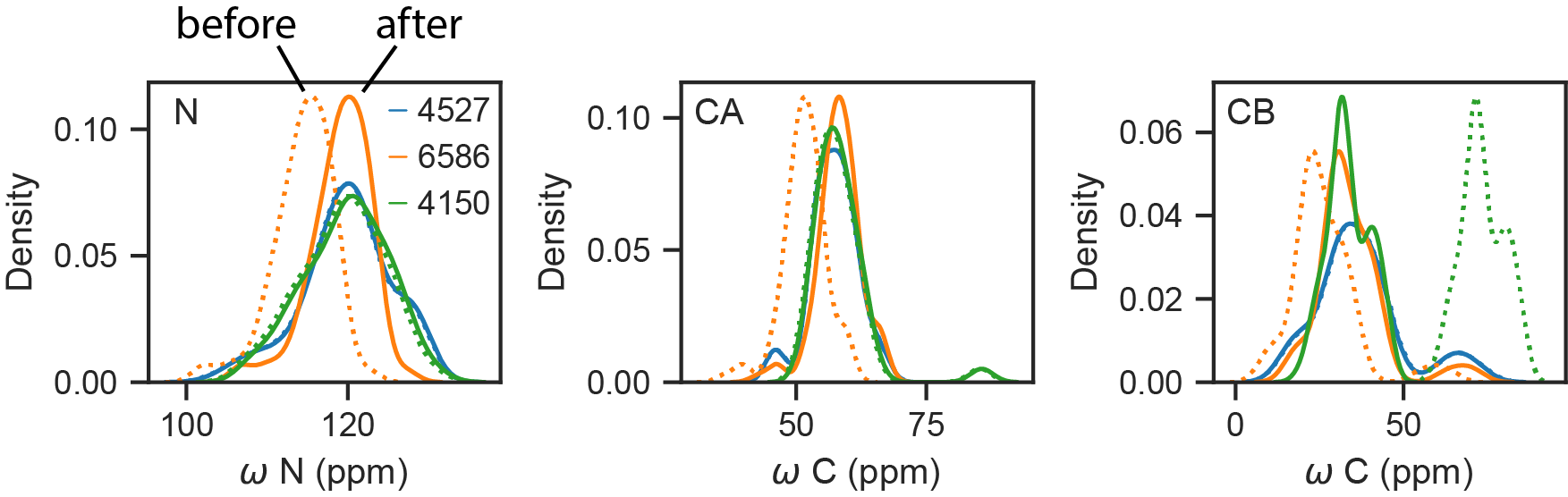
Entry 4527 is correctly referenced; entries 6586 and 4150 have been described in the literature as needing re-referencing. The two methods have not yet been extensively compared.
Relaxation and dynamics
NMRStarEntry extracts any deposited relaxation data, and RelaxationProfile
turns it into a per-residue dynamics analysis in the style of RelaxDB
(Wayment-Steele, El Nesr et al.).
Pull deposited data straight from an entry:
entry = ms.NMRStarEntry.from_bmrb(25013)
entry.datasets()                 # which data types the entry holds
entry.relaxation("T2")           # R2 (also "T1"/"R1", "T1rho", "NOE") — units-aware
entry.order_parameters()         # model-free S2 (S2, Tau_e, Rex)
entry.data_loop("spectral_density_values", "_Spectral_density")  # anything else
RelaxationProfile assembles R1/R2/NOE into the R₂/R₁ observable, compares it to
a HYDRONMR rigid-body prediction, and labels each residue by motional regime.
Pass a PeakList
so missing peaks are marked (.) instead of treated as dynamics:
from makeshift import PeakList
from makeshift.relaxation import RelaxationProfile

pl = PeakList.from_bmrb(19151)
prof = RelaxationProfile.from_bmrb(25013, peaklist=pl)  # T1/T2/NOE, aligned to sequence
prof.add_rigid_prediction()                              # HYDRONMR; see source= below
prof.label(rex_n_std=1.0, noe_cut=0.65)                  # per-residue motion tokens
prof.plot("R2_R1")
For the rigid prediction, pass a structure or let the entry choose one:
prof.add_rigid_prediction()                 # auto: entry PDB → else AlphaFold
prof.add_rigid_prediction(source="rcsb")    # force deposited PDB cited by the entry
prof.add_rigid_prediction(source="afdb")    # force AlphaFold / UniProt cited by the entry
prof.add_rigid_prediction("1WRP")           # specific PDB id
prof.add_rigid_prediction("P0DP23")         # UniProt accession (AlphaFold DB)
prof.add_rigid_prediction("model.pdb")      # local file
source is "auto" | "rcsb" | "afdb" | "file". makeshift does not predict
structure itself — see the relaxation guide.
Label tokens: A ordered, ^ µs–ms exchange (elevated R₂/R₁), v ps–ns motion
(hetNOE ≤ 0.65), b both, . peak missing, t disordered terminus, p proline.
TALOS-N: prediction from chemical shifts
makeshift.talosn wraps the NIH
TALOS-N binary (Shen &
Bax, J. Biomol. NMR 2013), which predicts backbone φ/ψ torsion angles,
per-residue S2 order parameters, and secondary structure from assigned backbone
chemical shifts using a trained neural network.
The binary and its database aren't bundled — they're downloaded on demand from
NIH (under their Terms of Use,
which the installer prints) into a data_dir you choose. Keep that path in a
variable and pass the same one to install and to each TalosN:
from pathlib import Path
from makeshift import talosn

data_dir = Path.home() / "talosn_data"
talosn.install_talosn_data(data_dir=data_dir)     # one-time, ~ a few hundred MB

tn = talosn.TalosN.from_bmrb(4527, data_dir=data_dir)
tn.run()                    # or run(auto_install=True) to fetch the binary on first use
tn.order_parameters         # predS2.tab — per-residue S2
tn.torsion_angles           # pred.tab   — φ/ψ per residue + confidence class
tn.secondary_structure      # predSS.tab — helix/sheet/coil
data_dir defaults to inside the installed package if omitted (usually not what
you want for a few-hundred-MB download).
NMR-STAR concepts
NMR-STAR files are organised around saveframes, each belonging to a category
(e.g. assigned_chemical_shifts, entity, sample). The three you interact
with most:
- Entry — a single BMRB deposition (one
.strfile). - Entity — a distinct molecular species (protein, DNA strand, ligand), each
with its own
Entity_ID. - Chemical shift list — the
_Atom_chem_shiftloop inside anassigned_chemical_shiftssaveframe; one row per observed shift.
License
MIT License.
makeshift.talosn downloads and runs the TALOS-N binary, which is distributed
separately by NIH under its own
Terms of Use (including no
redistribution without permission from the authors); those terms govern the
downloaded software, not this wrapper.
Acknowledgments
- The Biological Magnetic Resonance Bank (BMRB) for maintaining and sharing NMR data.
- The Bax lab at NIH for TALOS-N.
1 maintainer

Metadata
1 maintainer
Release files for makeshift-nmr 0.1.44
For a detailed explanation of source distributions (sdists) and built distributions (wheels), please see the package formats documentation.
Source distribution (sdist)
| File | Size | Uploaded | |
|---|---|---|---|
| makeshift_nmr-0.1.44.tar.gz | 12.4 MB | Details |
Built distribution (wheel)
| File | Interpreter | ABI | Platform | Reset |
|---|---|---|---|---|
| makeshift_nmr-0.1.44-py3-none-any.whl | Python 3 | none | any | Details |
Total release size: 25.1 MB
Release files / makeshift_nmr-0.1.44.tar.gz
| Download URL | makeshift_nmr-0.1.44.tar.gz |
|---|---|
| Size | 12.4 MB |
| Tags | Source |
|
SHA-256 checksum How to use checksums |
f523d696b31251f9726ac47cc61ec35e8be0e658d0b46a5a92a60aca92112cbf
|
|
BLAKE2b-256 checksum How to use checksums |
57b165039b0d2381ca806bd3c5cd8fbbaad25b3c68fa9e9c5e248674fddae0fe
|
| Upload date | |
|
Uploaded using Trusted Publishing? What is trusted publishing? |
No |
| Uploaded via |
twine/7.0.0 CPython/3.12.13
|
Release files / makeshift_nmr-0.1.44-py3-none-any.whl
| Download URL | makeshift_nmr-0.1.44-py3-none-any.whl |
|---|---|
| Size | 12.7 MB |
| Tags | Python 3 |
|
SHA-256 checksum How to use checksums |
cb4dc4f67ef78fdede373c2d4de452624c877369117fe63a90c34c2a7474d419
|
|
BLAKE2b-256 checksum How to use checksums |
e1453a57e79d24a731f47bb8080e92e5e90d3c587573205123c1cecad7c825e1
|
| Upload date | |
|
Uploaded using Trusted Publishing? What is trusted publishing? |
No |
| Uploaded via |
twine/7.0.0 CPython/3.12.13
|














