
Fast Manhattan Silhouette
Fast exact silhouette evaluation under Manhattan distance.
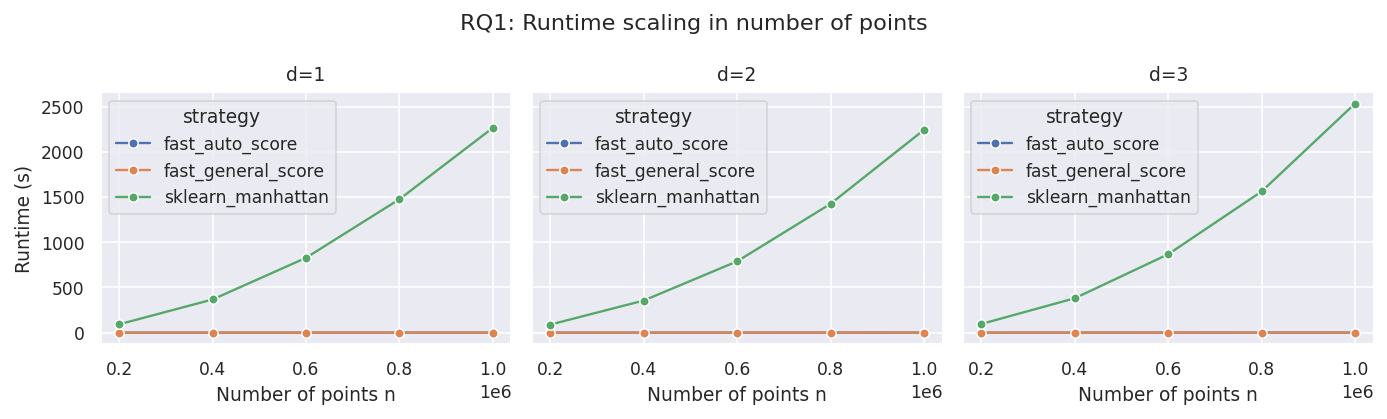
Figure 1: Runtime comparison between a generic pairwise-distance baseline and Manhattan-specific implementations on synthetic benchmark instances.
Overview
Evaluating clustering quality is a common task in cluster analysis. The silhouette width compares, for each data point, the average distance to points in its own cluster with the average distance to points in the nearest other cluster. The mean over all samples is often called the Average Silhouette Width (ASW).
Generic silhouette implementations usually work from pairwise distances. This is simple and metric-independent, but it becomes expensive for large datasets because the full distance matrix has quadratic size.
manhattan-silhouette computes exact silhouette values for fixed cluster labels
under Manhattan (L1) distance without materializing the full n × n distance
matrix. It uses the additive structure of the Manhattan distance to make repeated scoring and large synthetic benchmarks
practical.
The package answers the question:
Given data points and cluster labels, how can we compute the silhouette widths under Manhattan distance in subquadratic time?
| Standard Silhouette | Fast Manhattan Silhouette |
|---|---|
| - Compute pairwise distances | - Uses sorted one-dimensional sweeps |
| - Time: $\mathcal{O}(n^{2}d)$ | - Time: $\mathcal{O}(nd(\log n+k))$ |
| - Memory: $\mathcal{O}(n^{2})$ | - Memory: $\mathcal{O}(nk)$ or $\mathcal{O}(nd)$ |
Installation
pip install manhattan-silhouette
For development from source:
git clone git@github.com:anomatomato/manhattan-silhouette.git
cd manhattan-silhouette
uv sync --all-extras --all-groups
Examples
The public API mirrors the two common silhouette use cases:
silhouette_samples_manhattan(...)returns one silhouette value per sample.silhouette_score_manhattan(...)returns the mean silhouette score.
Quickstart
import numpy as np

from manhattan_silhouette import (
    silhouette_samples_manhattan,
    silhouette_score_manhattan,
)

X = np.array(
    [
        [0.0, 0.0],
        [0.2, 0.1],
        [3.0, 3.1],
        [3.3, 3.0],
    ],
    dtype=np.float64,
)
labels = np.array([0, 0, 1, 1], dtype=np.intp)

samples = silhouette_samples_manhattan(X, labels)
score = silhouette_score_manhattan(X, labels)

print(samples)
print(score)
API
silhouette_samples_manhattan(
    X,
    labels,
    check_1d_disjoint=False,
    compute_by_cluster=True,
)
Returns an array of shape (n_samples,) with one silhouette value per sample.
silhouette_score_manhattan(
    X,
    labels,
    check_1d_disjoint=False,
    compute_by_cluster=True,
)
Returns the mean silhouette value as a float.
Parameters:
X: array-like of shape(n_samples, n_features)labels: array-like of shape(n_samples,)check_1d_disjoint: ifTrue, use a specialized kernel for one-dimensional data when cluster intervals are disjointcompute_by_cluster: choose the cluster-oriented implementation (True, default) or the axis-oriented implementation (False)
Experimental Results
We benchmarked the implementation on synthetic Gaussian-blob and uniform instances. The benchmark compares:
fast_by_cluster_score: the default cluster-oriented implementationfast_by_axis_score: an axis-oriented implementationsklearn_manhattan: a generic scikit-learn Manhattan silhouette baseline
On million-point instances with five clusters, the cluster-oriented implementation was several thousand times faster than the sklearn baseline:
| Dimensions | Standard baseline (s) | fast_by_cluster_score (s) |
Speedup |
|---|---|---|---|
| 1 | 2322.3 | 0.161 | 14,467× |
| 2 | 2281.6 | 0.274 | 8,318× |
| 3 | 2572.1 | 0.406 | 6,341× |
More plots and the scripts that generated them are available in
evaluation/runtime_manhattan_silhouette/.
Development
Install development dependencies:
uv sync --all-groups
Run tests:
uv run pytest
Build the source distribution and wheel:
uv build
Check package metadata before uploading:
uvx twine check dist/*
Contribution
Contributions are welcome. Useful contributions include:
- bug reports with small reproducible examples
- comparisons against trusted silhouette implementations
- documentation improvements
- performance investigations on additional datasets
Before opening a pull request, please run the test suite with uv run pytest.
References
[1] Rousseeuw, P. J. (1987). Silhouettes: A graphical aid to the interpretation and validation of cluster analysis. Journal of Computational and Applied Mathematics, 20, 53–65. https://doi.org/10.1016/0377-0427(87)90125-7
[2] Chen, Y., Debnath, T., Cai, A., & Song, M. (2023). Circular Silhouette and a Fast Algorithm. IEEE Transactions on Pattern Analysis and Machine Intelligence, 45(11), 14038–14044. https://doi.org/10.1109/TPAMI.2023.3310495
1 maintainer

Metadata
1 maintainer
Release files for manhattan-silhouette 0.1.1
For a detailed explanation of source distributions (sdists) and built distributions (wheels), please see the package formats documentation.
Source distribution (sdist)
| File | Size | Uploaded | |
|---|---|---|---|
| manhattan_silhouette-0.1.1.tar.gz | 11.4 kB | Details |
Built distribution (wheel)
| File | Interpreter | ABI | Platform | Reset |
|---|---|---|---|---|
| manhattan_silhouette-0.1.1-py3-none-any.whl | Python 3 | none | any | Details |
Total release size: 25.7 kB
Release files / manhattan_silhouette-0.1.1.tar.gz
| Download URL | manhattan_silhouette-0.1.1.tar.gz |
|---|---|
| Size | 11.4 kB |
| Tags | Source |
|
SHA-256 checksum How to use checksums |
de30db4d92459ba1372da00c681aff34194a6813e799bfbf9b54a547daa1b776
|
|
BLAKE2b-256 checksum How to use checksums |
47d210cd5767af2eb4492468b9ca769945c31c5e5625f664ed395576a90323ef
|
| Upload date | |
|
Uploaded using Trusted Publishing? What is trusted publishing? |
Yes |
| Uploaded via |
twine/6.1.0 CPython/3.13.12
|
Provenance
Provenance describes where a file came from. On PyPI, provenance is shared via attestations, which provide a verifiable record of the build or publishing details. View details, limitations and caveats.


PyPI Publish Attestation
PyPI verified that this artifact, at this checksum, originated from the publisher listed below.
Signed by GitHub Actions, verified by PyPI on Jun 28, 2026.
Transparency logRelease files / manhattan_silhouette-0.1.1-py3-none-any.whl
| Download URL | manhattan_silhouette-0.1.1-py3-none-any.whl |
|---|---|
| Size | 14.3 kB |
| Tags | Python 3 |
|
SHA-256 checksum How to use checksums |
6b89cb7f163c76f27bd3a940b728e062863b34433cf80bb1e794e6f94858d2f0
|
|
BLAKE2b-256 checksum How to use checksums |
0e7014beec72e7a17d6f6c738edff9accf6a6b21f5633e9991ea86babed08d52
|
| Upload date | |
|
Uploaded using Trusted Publishing? What is trusted publishing? |
Yes |
| Uploaded via |
twine/6.1.0 CPython/3.13.12
|
Provenance
Provenance describes where a file came from. On PyPI, provenance is shared via attestations, which provide a verifiable record of the build or publishing details. View details, limitations and caveats.
PyPI Publish Attestation
PyPI verified that this artifact, at this checksum, originated from the publisher listed below.
Signed by GitHub Actions, verified by PyPI on Jun 28, 2026.
Transparency log













