
manicule
Self-hosted retrieval infrastructure for AI assistants.
An agent searches a private corpus or asks a grounded question, and gets evidence that resolves to a real location in a real document — a page, a heading, a line, a cell. It can write one back, too, as a markdown file the corpus keeps.



Install · First run · The four surfaces · Authoring · As a server · In a container · Design · Layout · Extending
manicule init                     # pick a backend, write a config, seed what no wheel ships
manicule index ~/Documents        # walk it, parse it, chunk it, embed it
manicule search "retry policy"    # ranked passages, no model involved
manicule ask "how do retries work?"
manicule doctor                   # what is wrong, and what to do about it
What it is
MCP is the primary interface. The core value is the accuracy of the embedding and retrieval pipeline, plus evidence a caller can inspect at its source. The command line and HTTP expose the same service; the browser is a functional operator and retrieval-inspection console, not the primary knowledge-work interface.
An assistant can write, and the file is still the record. document_create writes a markdown
file into a configured source's root and indexes that path — so manicule gains an author without
gaining a second notion of what a document is, and the corpus stays a directory of markdown any
other tool can read. That is its own section, because it is the one
operation here that is not a read, and it is off until it is configured.
Re-indexing is copy-on-write at the document boundary. Vectors are staged under a publication id, then the document, chunks, glossary and lineage become active in one relational transaction. A failed or interrupted refresh keeps the previous indexed revision searchable; unpublished vectors are filtered during hydration and reclaimed by the normal sweep. The same atomic flip applies when parsing, middleware or chunking concludes that a document has no chunks.
Every command that emits data takes --json, on either side of the command name — manicule --json search … and manicule search … --json are the same invocation, and --workspace/-w
works the same way.
Most of them are also MCP tools, so an assistant reaches the same operations through manicule start --mcp-only, and manicule start --transport http serves them over HTTP with an OpenAPI
document at /api/docs. All three emit the same envelope, and the shape is a contract written
down in docs/surfaces.md.
Install
Requires Python 3.14 or newer. With uv:
uv tool install "manicule[all]"
manicule --version
That is the whole install — an isolated environment, manicule on PATH, and uv tool upgrade manicule later. With pipx it is pipx install "manicule[all]", and
uvx --from "manicule[all]" manicule --version runs it once without installing anything at all.
On Apple silicon, add the Metal backend:
uv tool install "manicule[all]" --with manicule-mlx
manicule-mlx is four to five times faster on the indexing path, and it
is a separate distribution because it is GPL-3.0-or-later while manicule is MIT — see
License for what that means for you. Without it manicule runs onnx everywhere, and
the vectors are the same either way: backend is excluded from the embedding fingerprint, so
adding or removing the package is an operation rather than a migration.
Two extras are not in [all], and the reason is size rather than taste:
| Cost | Add it with | |
|---|---|---|
rerank |
torch, and on Linux 2.7 GB of CUDA wheels behind it | uv tool install "manicule[all,rerank]" |
browser-auth |
playwright, then a browser download | uv tool install "manicule[all,browser-auth]" |
Neither is needed to index, search or ask. rerank buys the cross-encoder that the balanced
and precise retrieval profiles rescore with — fast sets rerank=False and never constructs
one — and browser-auth buys interactive sign-in for a Confluence Server behind an identity
provider that has disabled tokens — manicule opens a browser and you sign in there.
The Chrome extension needs neither, and is the other way round: it reads the session already
in your own browser and hands it over, so nothing is installed, nothing is downloaded and no
window opens. manicule browser-auth install, then load the directory it prints. See
Confluence auth.
Working on manicule rather than with it is Development; running it without a Python at all is In a container.
First run
The shortest path from an install to an answer about your own documents.
manicule init                             # config, grammars, vocabularies — seconds
manicule index ~/Documents                # walk it, parse it, chunk it, embed it
manicule search "how are citations verified"
init first — it does more than write a file
It picks the embedding backend this machine can run, then pre-seeds the two things no Python
wheel ships: the 26 tree-sitter grammars the code and diagram readers need, and the two BPE
vocabularies every search measures a context with. Both are small, and both are the kind of
thing manicule refuses to download in the middle of a question. Skip init and the first
search refuses rather than fetching — doctor calls a missing vocabulary failing, in as many words, because
no corpus can be searched without one.
The model weights are the one thing init does not fetch
The first index does. They are the big artifact: about 1.1 GB for BAAI/bge-m3 on Apple
silicon (the MLX conversion, fp16) and about 2.3 GB elsewhere (the ONNX export). init says
so on its way past, and manicule doctor says so too, because the download itself is quiet — a
Hugging Face progress bar, and a stretch with no manicule output at all.
To take that wait deliberately, before you have a corpus to be impatient about:
uv run tools/prefetch_embedding_models.py --backend mlx # or --backend onnx
How weights are pinned to vector identity
Weights are pinned as part of vector identity, not merely downloaded by model name. The exact
executed hub commit (or a digest for local weights) is recorded with the index. Only the
built-in ONNX/MLX artifact pairs covered by the parity suite are portable across backends;
custom remote weights must set an immutable weights_revision, and changing any artifact
changes the fingerprint, so the index refuses it rather than reusing incomparable vectors. The
move to the new model is manicule reembed on the built-in LanceDB store, or
manicule reset-index --yes and a re-sync on any other.
A served model is pinned by its digest, not by the server computing with it, so upgrading
Ollama leaves the fingerprint unchanged and can still move the vectors: qwen3-embedding:0.6b
went from Ollama 0.19.0 to 0.34.2 at a minimum cosine similarity of 0.99915 on the same text.
manicule document reindex --re-embed re-embeds every indexed document under the fingerprint
the index already records, reusing no stored vector, on any vector store and with search up
throughout.
Local model card/tokenizer inputs are content-addressed too, including when weights are
separate; local embedding.revision claims are rejected. The MCP index_status result exposes
the exact weights_ref and its compatibility identity.
ask additionally needs a generator
search needs only the embedder. The default configuration expects
Ollama on localhost:11434 serving qwen2.5:14b:
ollama pull qwen2.5:14b
manicule ask "what does an anchor carry when the location is unknown?"
An installed, already-authenticated Codex or Claude CLI can answer instead. Select the built-in
cli generator once; both manicule ask and browser chat then use it through the same retrieval,
redaction and citation-verification path:
manicule config set llm.generator cli
manicule config set llm.provider codex       # or: claude
manicule config set llm.model default        # keep the CLI's configured model
manicule config set llm.context_window 32768 # use a conservative value the model supports
manicule ask "what does an anchor carry when the location is unknown?"
The executable must be on the PATH of the process running manicule. Restart a running server
after changing these settings. The CLI owns its own login, but its destination is treated as
remote for data-policy purposes because manicule cannot inspect where the command sends a prompt.
When something does not work
manicule doctor reports what is wrong and what to do about it, and it is the first thing to run.
manicule doctor --fix repairs what it can: the grammars and the vocabularies, from an offline
bundle when one is installed and from upstream otherwise. It is the only part of that command
that writes to the machine or uses the network, which is why it is a flag — and it does not
fetch the model weights, which is why the line above exists.
If doctor reports an obsolete fingerprint on an otherwise empty workspace, the explicit repair
is manicule reset-index --yes. It removes only that workspace's derived chunks, memberships,
FTS/vector visibility, publication checkpoints and cached runtime handles. Retained source
snapshots, document-version history, connector configuration, credentials and other workspaces
survive. The command is idempotent and its JSON result separates relational rows, vector rows,
publications, terminalized generations, retained snapshots, fingerprint cleanup and runtime-cache
invalidation. A non-empty fingerprint mismatch remains a refusal: use the rebuild or re-embed
path instead of discarding a searchable corpus.
What it costs to wait
| Step | Measured here |
|---|---|
manicule init, with every cache cold |
9 s |
first index of docs/, model still to download |
1 m 21 s and 2 m 04 s, on two runs |
the same index with the model already present |
38 s |
the same index inside the container, on ONNX |
5 m 04 s |
One machine — an Apple M4 Max — against this repository's docs/: 13 documents, about 677 kB.
They are here to set expectations about orders of magnitude. They are not benchmarks, and a
busier machine moves them: the 38-second run above took 54 seconds with a container build
alongside it.
Durable connector hand-off and offline rebuild
A configured connector can stop after it has promoted a complete, locally retained source snapshot. The snapshot can then be verified and rebuilt without constructing the connector or contacting the source:
manicule connector sync handbook --acquire-only
manicule connector snapshot handbook --json       # copy data.snapshot_id
manicule connector verify SNAPSHOT_ID
manicule rebuild plan SNAPSHOT_ID
manicule rebuild execute SNAPSHOT_ID
manicule rebuild status GENERATION_ID
There is no separate settlement command: successful publication atomically settles the exact
acquisition manifests it consumed, and rebuild has no connector or source fallback. Planning
binds the newest promoted snapshot for every connector scope in the workspace into one ordered
shadow generation, together with the earlier snapshots needed to account for every live document
when that newest one is an incremental manifest. A replacement that cannot account for all of
them is refused rather than published (docs/ingest.md §10.4). An interrupted worker resumes its durable sequence checkpoint, and the old
corpus remains queryable until the complete multi-source replacement validates and publishes in
one transaction.
The structural chunk policy is component configuration. Defaults remain 512 final embed_text
tokens with up to 64 tokens of prose/list overlap:
[plugins.config."chunker.structural"]
max_tokens = 768
overlap_tokens = 96
These values are fingerprinted and must fit the configured embedding model's effective context
window. Changing either value requires rebuild plan followed by rebuild execute; it rechunks
and re-embeds retained originals alongside the live corpus. A larger budget is a
retrieval-quality, index-size and embedding-cost tradeoff, not an automatic improvement.
Recovery state, deletion reconciliation and Confluence pagination internals
connector snapshot and connector list expose aggregate recovery state. Authentication,
transport, capacity and temporary body failures retry the same valid manifest. A confirmed
post-enumeration source_deleted reports reenumeration_required; the next ordinary sync fences
that run, starts one replacement from the last committed watermark and reports reenumerating.
Matching retained bodies are validated and reused. Only a replacement discovery that reaches its
real end may report reconciled and remove an absent identity from required membership. A limit,
expired cursor, cancellation or failed discovery never proves deletion.
Confluence discovery and deletion enumeration preserve the source's own response-page boundary.
Each page (at most 250 records) is admitted atomically before _links.next is followed, so a
large space pays one capacity-guarded SQLite writer transaction per source page rather than one
per record. Cursor expiry, repetition, corruption and cross-origin guards remain fail-closed; a
10,251-record synthetic run crosses the 10,000 boundary and records true completion only after
the final one-record page. Cursor-cycle history and subtree membership use temporary,
fixed-cache SQLite indexes, keeping pagination and subtree scope bookkeeping independent of
corpus size in process memory.
Server and Data Center whole-space connectors may set
full_inventory_authority = "direct_current_content". Complete discovery and reconciliation
then use the direct current-content inventory, while incremental discovery remains CQL-backed.
The compatibility default is search; Cloud and page-tree scopes keep their existing CQL
behavior even when the direct option is present. The effective authority is included in durable
cursor identity and aggregate connector/snapshot status, so switching authority performs one
complete replacement without exposing configured spaces. Exact retained bodies are reused after
their source revision and acquisition evidence are revalidated. Direct native pagination is
scope-pinned on every request and only true exhaustion can authorize deletion reconciliation.
Strict policy never promotes while a current member lacks validated evidence. An
allow_omissions snapshot remains honestly partial, and it cannot turn a known-stale inventory
green. Once a promoted snapshot publishes, source acquisition and derived publication settle in
the same transaction; a complete snapshot reaches zero backlog while its retained source bytes
remain available for later connector-free rebuilds. Status exposes counts and typed states, never
source ids, paths, URLs, bodies, blob hashes, credentials or copied source exceptions.
The full contract and recovery details are in
docs/ingest.md and the
shared result shape is in docs/surfaces.md.
The four surfaces
| Surface | Started by | Shape |
|---|---|---|
| MCP | manicule start --mcp-only |
45 tools over stdio, which opens no socket; 27 at /mcp/ when served over a port — the read-only ones, plus document_create |
| Command line | manicule <command> |
32 commands; --json anywhere data is emitted |
| HTTP API | manicule start --transport http |
12 route groups on 127.0.0.1:8765, OpenAPI at /api/docs |
| Browser | the same process, at /ui |
Functional operator and retrieval-inspection console; 15 areas of server-rendered HTML, 14 in the navigation, and a sign-in page |
They are adapters over one application service, and tests/app/test_surface_parity.py holds
them to it: for the same operation and the same arguments the CLI under --json, the MCP tool
and the HTTP route return byte-identical envelopes, and the browser page is asserted to
show what that envelope said rather than anything it worked out for itself.
The command line
Thirty-two commands; manicule --help lists them. Under --json the result envelope is the
whole of stdout — no prose, no progress, nothing else — and a failure is that same envelope with
"ok": false, a typed error and a non-zero exit status. So jq reads well-formed JSON whether
the command succeeded or not.
Rule-driven collections select current and future documents without enumerating ids or rebuilding the index:
manicule collection create "Team A" --source wiki-team-a --source wiki-team-a-archive
manicule collection rule show COLLECTION_ID
manicule collection rule set COLLECTION_ID --source wiki-team-a
manicule collection rule clear COLLECTION_ID
A rule can also name a directory, which is how a collection over a local corpus keeps itself
filled — a document joins by arriving there, whether a sync, an editor or document_create put
it in:
manicule collection create journals --uri-prefix /corpus/journals
Write it as an ordinary absolute path; it is stored as the file: URI the connector records,
and always with a trailing separator, so /corpus/journals never also selects
/corpus/journals-old.
Values within one field are alternatives; source, directory, media-type, tag, and update-bound fields are combined. Manual members remain unioned with the rule. Creating, replacing, or clearing a rule changes only collection metadata: existing indexes adopt it immediately, with no source fetch, re-ingestion, chunking, or re-embedding.
How a connector sync reports its outcome
Connector syncs additionally report data.outcome as complete, bounded, or incomplete.
An incomplete sync exits non-zero and keeps its partial counters in data; a requested
--limit is bounded, exits zero, and never advances the watermark. A document-level failure
that left a durable repairable row does not by itself make the source enumeration incomplete.
If an external SQLite writer remains present beyond the bounded retry policy, the failure type is
StorageBusyError; retrying resumes the committed acquisition prefix without advancing the
watermark or exposing SQL and local paths in the envelope.
A sync also reports in collections and in no collection for the source it ran over, and says
so out loud when the second is all of them. Every other number a run keeps can be perfect while
the corpus it wrote into holds no collections at all, in which case each of those documents is
indexed, searchable and outside the reach of every collection-scoped search. manicule doctor
reports the same state for the whole workspace, as collection-membership.
The HTTP API
Twelve route groups over the same service — health, documents, chat with SSE streaming,
conversations and shareable links, collections, tags, admin, plugins, auth, a workbench, a
websocket channel and an MCP endpoint — plus an embeddable chat widget at /widget. manicule start --transport http serves them on 127.0.0.1:8765, and only there unless three separate
things say otherwise. It prints where it is listening, and every path on it that you might want
next:
Transport request and MCP tool completions are available as local JSON Lines on stderr and in
<data_dir>/logs/requests.jsonl through the manicule.requests logger; see
docs/surfaces.md §9.7.
HTTP API on http://127.0.0.1:8765 (this machine only)
browser surface    http://127.0.0.1:8765/ui
MCP endpoint       http://127.0.0.1:8765/mcp/
API documentation  http://127.0.0.1:8765/api/docs
The address itself works. / redirects to the browser surface — temporarily, so no browser
caches it — and when there is no browser surface to redirect to, it says so and names what this
process is serving. docs/surfaces.md §6.3.
MCP is served from that same process and port, at /mcp/, and it carries the read-only
tools, plus document_create — every other write tool is not registered on it rather than
refused, so there is no handler behind document_delete or connector_sync there at all.
Authoring is the one exception because it is bounded by configuration an operator wrote rather
than by arguments a caller sends, and it is off until that configuration exists. Authentication
decides who may call that write, never whether the socket carries it; a socket serving
configured authoring without authentication refuses to start unless --no-authentication says
otherwise. Over stdio, where one client talks to one process down
a pipe, the whole surface is offered. docs/surfaces.md §6.1 says why.
/api/docs is Swagger over the OpenAPI document at /api/openapi.json. Every response is the
same envelope the CLI prints under --json.
The browser surface
The functional operator and inspection console, not the primary knowledge-work interface. It is
server-rendered HTML at /ui, on the same socket, with fourteen areas in its navigation: a
dashboard; chat with streaming citations, confidence and feedback; documents, their chunks, the
trash and restore; collections and tags; connectors; plugins; workspaces; health; an admin
dashboard; re-embedding and lifecycle plans; the people who are members of the workspace; API
keys; and settings. Where people sign in (security.auth.mode = "oauth"), /ui/login offers
Google and GitHub and the frame carries a sign-out; docs/surfaces.md §9.2.1 is how that works.
Command palette on Ctrl/Cmd+K, keyboard navigation, dark mode. manicule start --no-web
prints browser surface off (--no-web), keeps the API, and answers 404 for every /ui path
— and / lists the surfaces that are still there rather than redirecting to one that is not.
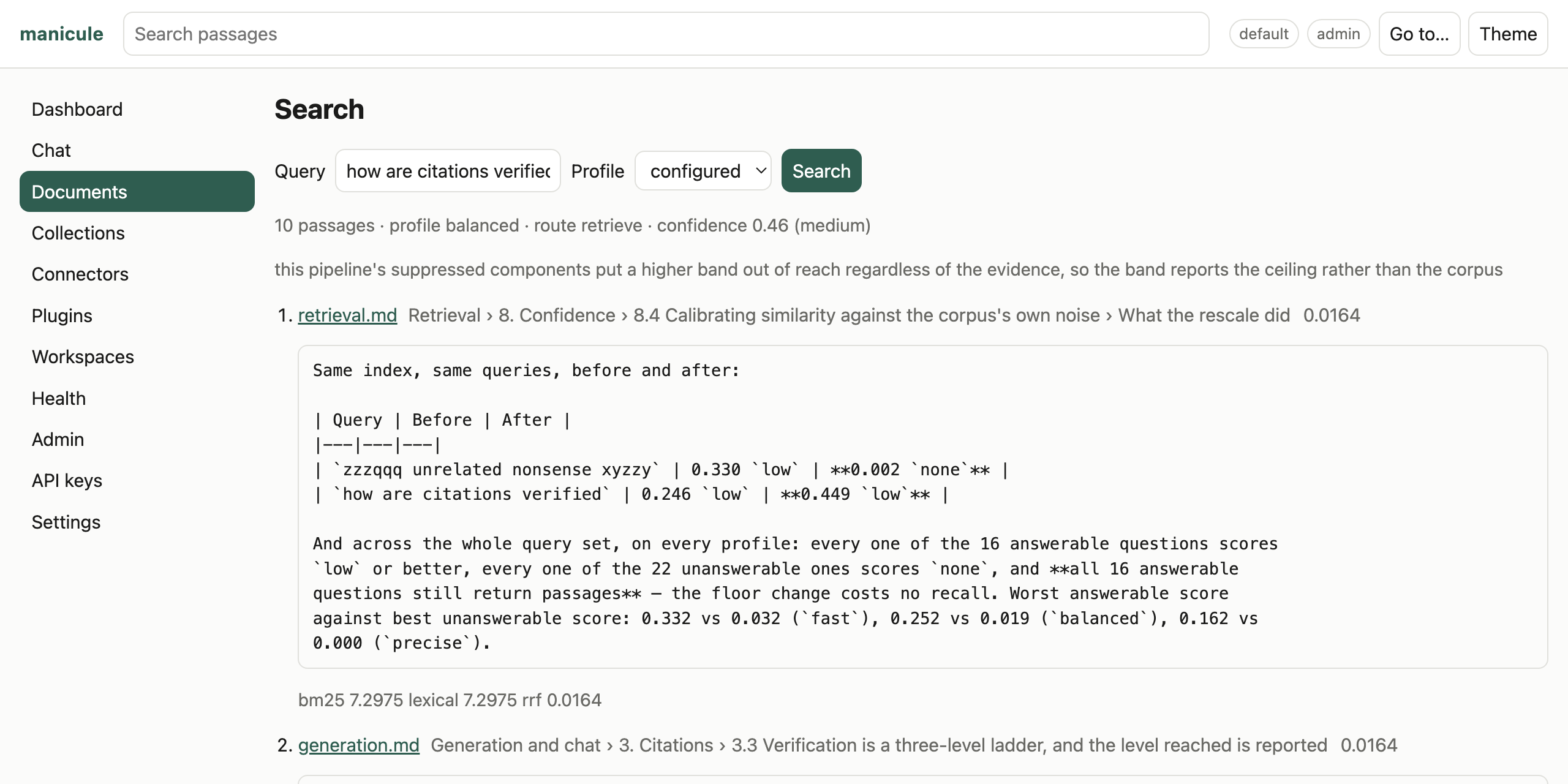
It adds no build toolchain: Jinja2 templates, one hand-written stylesheet and one
hand-written script, so uv sync is still the whole install and the container image stays free
of Node. It also adds no operation — every page reads through a service method that already
has a route, so there is no upload and no configuration write here either.
docs/web.md has the reasoning, including what that costs.
The MCP server
The primary interface: forty-five tools over the same service, speaking stdio by default, which opens no socket at all. To let Claude Code use your index:
claude mcp add manicule -s project -- "$(pwd)/.venv/bin/manicule" start --mcp-only
-s project is what puts it in .mcp.json beside the project, where it is checked in and
everyone working on the repository gets it; the default scope is local, which records the
server for you alone. What it writes:
{
  "mcpServers": {
    "manicule": {
      "type": "stdio",
      "command": "/absolute/path/to/.venv/bin/manicule",
      "args": ["start", "--mcp-only"],
      "env": {}
    }
  }
}
The server is also reachable as python -m manicule.mcp, for a client that would rather name an
interpreter and a module than trust a console script to be on the PATH it happens to have.
Writing into the corpus
Every other way content enters is a connector pulling from a source. document_create is the one
operation that lets a caller supply a body, and it is what lets an assistant keep durable memory
here rather than only search documents something else wrote.
It is off until two settings name where it may write:
[authoring]
source = "memories"        # a configured filesystem connector instance
collections = ["memory"]   # the collections it may author into
manicule document create memory retry-policy -f fact.md # or pipe the body on stdin
Like every other write command, that one needs a running manicule serve — the server owns the
data directory. Over MCP and HTTP it is a call like any other.
It writes a markdown file into that source's root and then indexes that path, returning only once the document is published and searchable — so an assistant that writes a memory and immediately searches for it finds it. The file stays the record. The corpus remains a directory of markdown that git versions and anything else can read, which is what keeps this an author rather than a note database, and what keeps the exit door open.
A caller supplies a collection, a slug and a complete markdown body — never a path. manicule
derives <collection>/<slug>.md beneath the configured root, so traversal is impossible by
construction rather than by validation. The slug is the document's permanent identity: it
becomes the filename and the id every citation and inbound link resolves through, which is why
retitling breaks neither. Front matter is yours and is written exactly as sent; nothing here
invents name, description or a type.
Four refusals are worth knowing before you call it:
| Unconfigured | Both settings empty is the default, and means authoring is off. The tool is offered on every surface and refuses every call, naming the settings it needs. |
| An unlisted collection | Refused even when the workspace has it — so creating a collection is not also the act of granting write access to it. |
| A slug already taken | Refused unless overwrite is passed, and the refusal names the document that holds it. A file nothing has indexed counts as holding it too. |
| A socket with no authentication | Refuses to start, loopback included — so a corpus is never exposed by forgetting a setting. manicule serve --no-authentication waives it deliberately, for a network you own: the socket then serves authoring to anything that can route to it, and says so at startup naming the corpus. |
If the file is written and the index then declines it, the file is kept and the result says
so with the path — the content is not lost, and a later sync indexes it.
docs/memory-authoring.md is the whole of the reasoning, including
why this is a narrower authority than indexing a directory.
Knowledge that cites where it was said
Operational knowledge — how an environment really behaves — mostly lives in chat, tickets and wikis,
and without the place and the time it is folklore. A memory whose front matter declares a
knowledge_type is a structured memory: a title, a problem, an answer and where it applies in
the body, and in front matter its type, its evidence and how the memory relates to others. Each
source carries a kind, an http(s) locator, when the source said it (said_at), and the
quote — required, because a permalink is a pointer and pointers die.
Nothing connects to any chat product; a caller reads a message however it reads it and records the
claim. Sources are attested, never verified — manicule cannot open a permalink and says so in
the vocabulary — and every search hit and citation reports them with the age of the newest. A
malformed memory is refused at document_create naming the field to fix, before anything is
written. The format, and what is deliberately not built, is
docs/memory-authoring.md §6.
[[wikilinks]] become a graph
Install manicule-plugin-wikilinks beside it and
[[wikilinks]] in those documents become typed chunk_relations edges:
[plugins]
middleware = ["wikilinks"]
Two types, because two things are being written: links_to for a link that is the content of its
line (- [[x]], Related: [[a]], [[b]]), and mentions for a reference inside a sentence. A
link may name a document that does not exist yet — that is part of the writing convention — so
it is resolved from the other end when the target is published. Targets match after
normalization, because [[a-b]] and [[a_b]] are one target.
The extractor carries a fingerprint of its own, recorded per document, so correcting one of its rules makes the corpus visibly stale. Bringing it up to date is the repair rung the glossary already has:
manicule document reindex --stale-relations # --dry-run first, to see the selection
It reads stored chunks and writes rows — no parser, no connector, no embedder — and on the run that first configures an extractor it selects everything, because until then no document has been scanned by one.
Running it as a server
$ manicule serve # holds the data directory, runs the schedule, keeps sessions
One process owns the data directory at a time. manicule serve is that process for as long as
it runs, and three things follow:
- Write commands go to it.
connector sync,index,document reindex,rebuild executeand the repair verbs detect the running server and forward to it over a0600Unix domain socket, streaming progress back. You get the same result, the same output and the same exit status you would have got locally, because it is the same operation. With no server they refuse and say to start one — they never start one for you. - Reads never need it.
search,ask,doctoranddocument listtake no lock and work whether or not a server is running. - Confluence sessions live in its memory and nowhere else — no keychain, no file, no
environment variable, so nothing prompts for a password and nothing is left on disk. They are
gone when it stops, which is the right lifetime now that
manicule connector login --browsermakes signing in again a few seconds of clicking — or nothing at all, with the Chrome extension, which notices you signing in to the wiki normally and hands the new session over by itself. No server, no sync.
Per-source schedules are configuration:
[connectors.handbook]
type = "confluence"
schedule_s = 3600      # a served manicule syncs this hourly, with nothing typed
A website whose source pages already live in a local Git repository can be indexed without copying those source bytes into Manicule's blob store:
[connectors.product-docs]
type = "git-site"
schedule_s = 300
retain_source_bytes = false

[connectors.product-docs.options]
repository = "/srv/product-docs"
revision = "HEAD"
content_root = "docs"
base_url = "https://docs.example.com/"
Each sync resolves one commit, inventories only committed page blobs, and keeps using that commit
even if HEAD moves before fetching finishes. Markdown, MDX and HTML routes are inferred from
their paths by default; sites with custom permalinks can commit an authoritative route manifest.
See docs/connectors/web-crawler.md for the manifest format,
include/exclude rules and the operational tradeoff of disabled source-byte retention.
A directory on disk is the simplest configured source, and it can be told what not to walk:
[connectors.corpus]
type = "filesystem"

[connectors.corpus.options]
root = "/srv/corpus"
exclude = ["archive/**"]
That is for material which has to stay in the directory — superseded work kept because it is the
record of what was tried — and must never rank beside what replaced it. The alternative people
reach for otherwise is deleting it, which is content leaving the working tree purely to keep it out
of an index. docs/connectors/filesystem.md has the field table,
and is honest about what an exclusion does not do to documents already indexed.
An admin may also start one already-configured connector through
POST /api/v1/admin/connectors/{name}/sync. The route cannot declare or reconfigure a source:
connectors hold credentials and reach remote systems, so the complete set remains in
configuration where it can be reviewed. Per-source schedules remain the unattended path.
docs/deployment.md §6 has the whole of it.
In a container
A Dockerfile and a compose.yaml are here, and the image is
self-contained: the grammars, the model weights and the Python environment all arrive with it.
The last thing the build does is run doctor, index a corpus and search it with the network
switched off, so an image that would have fetched something on first use fails to build
instead.
Every release publishes that image, so you need not build it:
docker pull ghcr.io/mgd43b/manicule:latest             # amd64; pin the version for real use
docker run --rm ghcr.io/mgd43b/manicule:latest doctor
Building it yourself is the path for a modified tree, and the only one for arm64:
docker compose build                                   # ~2.3 GB of model weights, once
docker compose run --rm manicule doctor
docker compose run --rm manicule index /corpus/docs    # this repository, mounted read-only
docker compose run --rm manicule search "how are citations verified"
The build downloads the weights and the grammars, and the resulting image is about 3.4 GB.
That cost is paid at build, where a long step is legible, rather than inside the first index,
where it looks like a hang.
The image runs as an unprivileged user with a 0700 data directory and publishes no port — a
statement about what can reach in, not about what this process reaches out to; the compose file
additionally drops every capability. It runs the ONNX backend, because MLX is Apple silicon and
no Linux container can use it: the same vectors, at a lower rate — indexing this
repository's docs/ took 5 minutes 4 seconds in the container against 38 seconds natively on
MLX. manicule ask needs a generator; the compose file points at an Ollama on the host, which is
one line to change, and a storage.vector_db = "qdrant" install dials its server the same way,
over the network this container was never asked to listen on.
docs/deployment.md covers what the data directory holds, the permissions
it needs, and what publishing a port will require when there is one.
The idea it is organized around
A citation carries a correct location, or none at all.
That sounds like a small thing. It decides most of the architecture:
- Parsers return located blocks, not text, because structure is visible exactly once — while the markup is still in hand — and no downstream component can recover it afterwards.
Anchorhas anUnlocatedmember carrying a reason, rather than usingNone. "We could not determine a location" and "nobody asked" are different facts, and only one of them is a bug to fix.- Every parser must pass a round-trip check: resolving an anchor returns the text the chunk claims. It is a test, not a convention, because the failure is silent — a citation pointing at a page that does not exist looks exactly like one that does.
- A locally mirrored page can say what it is a copy of. A file named
123456.htmlcites as123456.htmlunless something supplies the document's real title and address, so an adjacent123456.html.source.jsonmay — and the canonical identity and the local snapshot are then both kept, in two types neither of which is able to hold the other's fields. A citation that is precise about a file nobody else has is a correct location for the wrong thing.
The same instinct runs through the rest. Wherever something can be wrong quietly, there is a guard that makes it loud: a mismatched embedding model, a chunk budget past what the model attends to, a scanned PDF that yielded nothing, a plugin built for another version.
Layout
| Package | What is in it |
|---|---|
src/manicule/core |
The types and protocols everything is written against. No implementation dependencies |
src/manicule/config |
One declarative layer over the config file, the environment and plugin manifests |
src/manicule/plugins |
Manifests, compatibility checking, entry-point discovery |
src/manicule/container |
Typed resolution and lifecycle. Assembled at startup, injected |
src/manicule/testing |
Conformance suites every implementation must pass |
src/manicule/app |
The application service. All the behavior, once, for every surface |
src/manicule/cli |
Thirty-two commands over that service, and nothing else |
src/manicule/mcp |
Forty-five MCP tools over that service, and nothing else |
src/manicule/api |
Twelve HTTP route groups over that service, and nothing else |
src/manicule/extension |
A Chrome extension that hands this browser's Confluence session to a local manicule. No build step |
src/manicule/web |
Fifteen areas of HTML — fourteen pages and the frame they render inside — plus a sign-in page. No build step, no new operation |
packages/manicule-plugin-example |
The smallest complete plugin. Copy it to start one |
packages/manicule-plugin-wikilinks |
Turns [[wikilinks]] into typed chunk relations. A plugin doing real work |
packages/manicule-ollama |
Embedding on an Ollama server, for a host that cannot embed in process |
The four surfaces are adapters: they parse arguments, call one method, and render what comes back. A rule that lived in one of them would be a rule the others did not have — and two of them are called unattended, so that is not a distinction worth risking.
Nothing binds a network socket unless it is asked to. The MCP server speaks stdio by default,
which opens no socket at all; every HTTP bind goes through one policy that starts at loopback,
and widening it takes an address somebody wrote down, an explicit flag no config file can supply,
and authentication switched on — or a second flag, also reachable from no config file, saying the
operator accepts serving without it. Any one missing is a refusal, and what that second flag
produces is a surface anyone who can route to it may read — and, where authoring is configured,
write into. That is the deployment it exists for, and it is said out loud at startup naming the
corpus. That is a claim about what
listens, not about what this process dials: a qdrant vector store reaches out to
storage.vector_db_url the same way a remote generator or a connector does, and it is
Settings.policy_problems() — not this rule — that refuses the connection when the data
policy does not allow the corpus to leave the machine.
Nothing believes a forwarded address unless it was told to. X-Forwarded-For is read only
from a peer inside security.transport.trusted_proxies, which is empty by default — so on an
ordinary install the header is not consulted at all, and every IP-based decision rests on a
socket peer rather than on a value the caller chose.
Extending it
Everything pluggable is a typing.Protocol, and the ten registerable kinds are Parser,
Chunker, Embedder, VectorStore, DocStore, RetrievalStage, Reranker, Generator,
Connector and Middleware. Implementations are found through the manicule.plugins
entry-point group.
Built-in components use that same path — there is no shorter internal route — so the extension mechanism is exercised by every installation rather than only by the people using it. A plugin interface that nothing depends on rots without anyone noticing.
Importing manicule gives you the contracts and nothing heavier: no vector database, no model runtime, no web framework. That boundary is enforced by a test, not by good intentions.
See CONTRIBUTING.md for the plugin-authoring rules and the definition of
done.
Development
Requires uv and Python 3.14+.
uv sync --all-groups
uv run pytest
uv run ruff check . && uv run pyright
License
MIT. See LICENSE.
Nothing in manicule's dependency closure is copyleft. A plugin you write is yours to license as you choose, and so is anything you build on top.
One optional package is not MIT, and it is packaged separately for exactly that reason.
manicule-mlx is the Metal-native embedding backend for Apple silicon,
roughly four to five times faster than the default on the indexing path. It links
mlx-embeddings, which is GPL-3.0, so that package is GPL-3.0-or-later. manicule was
GPL-3.0-or-later itself until the backend moved out of it.
What that means:
| You install | You get | License of the combination |
|---|---|---|
uv pip install manicule |
An MIT program, with onnx as the embedding backend. Runs everywhere |
MIT |
uv pip install manicule manicule-mlx |
Faster on Apple silicon | GPL-3.0 on your machine |
uv pip install manicule manicule-ollama |
Embedding on an Ollama server, for a host that is the wrong place to embed in process. In manicule[all] and in the container image |
MIT |
Running it obliges you to nothing; the GPL's obligations attach to distribution. A plugin that
imports manicule_mlx is very likely a derivative work of it. A plugin that does not, is not.
Switching backends never re-embeds. backend is excluded from the embedding fingerprint's
identity, and the two agree to cosine 0.99999998 with identical retrieval ranking — asserted in
packages/manicule-mlx/tests/test_parity.py rather than assumed. Installing or removing the
package is an operation, not a migration.
1 maintainer

Metadata
1 maintainer
Release files for manicule 0.2.11
For a detailed explanation of source distributions (sdists) and built distributions (wheels), please see the package formats documentation.
Source distribution (sdist)
| File | Size | Uploaded | |
|---|---|---|---|
| manicule-0.2.11.tar.gz | 5.0 MB | Details |
Built distribution (wheel)
| File | Interpreter | ABI | Platform | Reset |
|---|---|---|---|---|
| manicule-0.2.11-py3-none-any.whl | Python 3 | none | any | Details |
Total release size: 7.2 MB
Release files / manicule-0.2.11.tar.gz
| Download URL | manicule-0.2.11.tar.gz |
|---|---|
| Size | 5.0 MB |
| Tags | Source |
|
SHA-256 checksum How to use checksums |
a126c88aa04a084affff437715a34b6db50d74e881c0aee242532c10e8ee2db1
|
|
BLAKE2b-256 checksum How to use checksums |
ad809725b963e978f99940bba5328cb40297c4956c54f00e65d78ff539da5f0b
|
| Upload date | |
|
Uploaded using Trusted Publishing? What is trusted publishing? |
Yes |
| Uploaded via |
twine/7.0.0 CPython/3.13.14
|
Provenance
Provenance describes where a file came from. On PyPI, provenance is shared via attestations, which provide a verifiable record of the build or publishing details. View details, limitations and caveats.


PyPI Publish Attestation
PyPI verified that this artifact, at this checksum, originated from the publisher listed below.
Signed by GitHub Actions, verified by PyPI on Oct 15, 2026.
Transparency logRelease files / manicule-0.2.11-py3-none-any.whl
| Download URL | manicule-0.2.11-py3-none-any.whl |
|---|---|
| Size | 2.2 MB |
| Tags | Python 3 |
|
SHA-256 checksum How to use checksums |
52a4a60c8c7e199a5dbd357863e6cf921a7af358f20f34d57ecd0fbdf3d1f960
|
|
BLAKE2b-256 checksum How to use checksums |
a61daa72890299bd8753c7546b29b1f0b7bba5a00812bdbab0fa7720e629b7ea
|
| Upload date | |
|
Uploaded using Trusted Publishing? What is trusted publishing? |
Yes |
| Uploaded via |
twine/7.0.0 CPython/3.13.14
|
Provenance
Provenance describes where a file came from. On PyPI, provenance is shared via attestations, which provide a verifiable record of the build or publishing details. View details, limitations and caveats.
PyPI Publish Attestation
PyPI verified that this artifact, at this checksum, originated from the publisher listed below.
Signed by GitHub Actions, verified by PyPI on Oct 15, 2026.
Transparency log













