
Classic convolutional autoencoders on the mantissa C engine, built on mantissa-cnn

Project description
mantissa-autoencoder




Classic autoencoders, with a C engine.
Convolutional autoencoders (fit / encode / decode / reconstruct)
built on top of mantissa-cnn:
its Conv2D / MaxPool2D / Flatten / Dense layers, its
mantissa C-engine and pure-numpy
backends, and its dataset loaders are all reused, not reimplemented. This
package adds only what an autoencoder needs on top of a classifier: the two
decoder layers (Upsample2D, Reshape), an MSE-trained Autoencoder, a
three-model zoo, and helpers for the four tasks autoencoders are classically
used for — denoising, compression, anomaly detection, super-resolution.
Deliberately minimal, like the rest of the family: NCHW float32 images, pixel MSE, plain SGD. No autograd graph, no optimizer zoo. The convolutions and the nearest-neighbor upsample run in C on zero-copy float32 buffers (the upsample since mantissa 0.2.3, with an automatic numpy fallback for older engines); the loss is memory-bound array movement and honestly stays in numpy. Layers allocate their scratch once per batch shape and reuse it — steady-state training does no per-batch allocation.
Install
pip install mantissa-autoencoder
This pulls in mantissa-cnn >= 0.1.0 (which pulls the engine
mantissa-core >= 0.2.1).
The engine-accelerated decoder path (nearest-neighbor upsample in C) needs
mantissa-core >= 0.2.3 for Session.upsample2d; older engines and
backend="numpy" fall back to the numpy expressions automatically — nothing
breaks, it is just slower.
From checkouts (works today, no PyPI needed): clone this repo, cnn, and
mantissa side by side, build the
engine (make dist there), then here:
pip install -e ../cnn && pip install -e ".[dev]"
mantissa-cnn finds the sibling engine checkout automatically, and this
package finds mantissa-cnn's data/ directory automatically (set
MANTISSA_CNN_DATA to override).
Quickstart
# datasets are mantissa-cnn's; nothing downloads implicitly — fetch once:
python -m mantissa_cnn.datasets download fashion_mnist
from mantissa_autoencoder import models, datasets, tasks

X_train, _, X_test, _ = datasets.load("fashion_mnist")   # labels unused
ae = models.denoise_ae()                 # C engine; backend="numpy" also works
print(ae.summary())

# the denoising recipe: corrupt the INPUT, reconstruct the clean target
ae.fit(X_train, epochs=5, batch_size=32, lr=0.01,
       noise=lambda x: tasks.add_gaussian_noise(x, sigma=0.3), verbose=True)

noisy = tasks.add_gaussian_noise(X_test, sigma=0.3)
print("PSNR noisy   :", tasks.psnr(noisy, X_test))
print("PSNR denoised:", tasks.psnr(ae.reconstruct(noisy), X_test))
Or compose your own from mantissa-cnn's layers plus the two added here:
from mantissa_cnn import Conv2D, MaxPool2D, Flatten, Dense
from mantissa_autoencoder import Autoencoder, Upsample2D, Reshape

ae = Autoencoder(
    encoder_layers=[Conv2D(16, 3, pad=1), MaxPool2D(2),
                    Flatten(), Dense(32)],           # 784 pixels -> 32 floats
    decoder_layers=[Dense(16 * 14 * 14, act="relu"), Reshape((16, 14, 14)),
                    Upsample2D(2), Conv2D(1, 3, pad=1, act="identity")],
    seed=0)
New to autoencoders? The idea, and the four things it buys
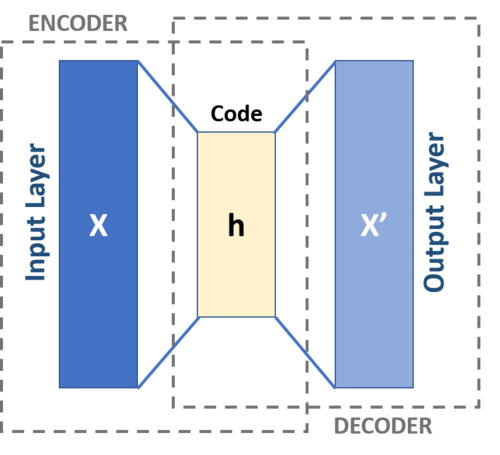
An autoencoder is a network trained to output its own input. That sounds useless until you make it hard: the encoder squeezes the image down — pooling away resolution, or all the way to a few numbers — into a bottleneck code, and the decoder has to rebuild the image from that code alone. Reconstruction error is the whole training signal (no labels), so the only way to do well is for the code to keep what actually matters about the image and drop the rest. The compression is the learning.
Why our decoders upsample-then-convolve. A decoder must grow small
feature maps back to image size. The obvious inverse of convolution —
transposed convolution — overlaps its kernel footprints unevenly and stamps
a checkerboard pattern into the output. Nearest-neighbor resize followed by
a plain convolution cannot produce that artifact by construction, at the
same parameter cost (Odena, Dumoulin & Olah, 2016, "Deconvolution and
Checkerboard Artifacts", Distill). That is Upsample2D + Conv2D
everywhere in this zoo, and why there is no ConvTranspose2D.
Denoising. Corrupt the input, keep the target clean, and the identity shortcut is gone: the network can only succeed by learning what digits and sleeves look like and using that to fill in what the noise destroyed. Denoising started as a way to force robust features, not as an application — the cleaned-up image was the byproduct (Vincent, Larochelle, Bengio & Manzagol, 2008, "Extracting and Composing Robust Features with Denoising Autoencoders", ICML).
Compression. Make the bottleneck a handful of numbers and the code becomes a learned, lossy compression of the image — Hinton & Salakhutdinov squeezed MNIST digits through 30 floats and reconstructed recognizably, beating PCA at equal dimension because the mapping is nonlinear (2006, "Reducing the Dimensionality of Data with Neural Networks", Science 313(5786)). Our compress task quantizes the 32-float code to uint8 and counts real shipped bytes: 40 per image against the 784-byte original.
Anomaly detection. Train on normal data only. The autoencoder learns to reconstruct what it has seen — and only that. Feed it something it never saw and the reconstruction goes wrong, so per-sample reconstruction error is an anomaly score, no anomaly labels needed at training time (Sakurada & Yairi, 2014, "Anomaly Detection Using Autoencoders with Nonlinear Dimensionality Reduction", MLSDA). Our task holds digit 1 out of training and asks the error to rank the unseen 1s highest.
Super-resolution. Upscale a low-res image by simple interpolation outside the net, then train a small stack of convolutions to refine that blurry guess toward the original — SRCNN showed three conv layers (extraction → mapping → reconstruction) beat the classical sparse-coding pipeline (Dong, Loy, He & Tang, 2014/2016, "Image Super-Resolution Using Deep Convolutional Networks", TPAMI 38(2)). No bottleneck here; it earns its place as the input→target form of the same MSE trainer.
Deliberate non-goals. U-Net's skip connections pass encoder maps
straight to the decoder, which needs a graph, not a chain — out of scope
for Sequential-style stacks (Ronneberger, Fischer & Brox, 2015, "U-Net:
Convolutional Networks for Biomedical Image Segmentation", MICCAI, is the
pointer). Variational autoencoders sample the code through the
reparameterization trick and add a KL term — machinery this trainer does
not have (Kingma & Welling, 2014, "Auto-Encoding Variational Bayes",
ICLR).
Autoencoder schema by Michela Massi, via Wikimedia Commons, licensed CC BY-SA 4.0 — redistributed here with attribution, scaled to 500 px.
Model zoo
Honest names: classic recipes at small-image scale, with deviations from the papers flagged in each docstring.
| model | architecture | paper |
|---|---|---|
denoise_ae |
Conv 16 → pool → Conv 32 → pool ‖ Upsample → Conv 16 → Upsample → Conv 1 (identity); spatial 32@7×7 latent. Conv body instead of the paper's dense stacks — flagged | Vincent, Larochelle, Bengio & Manzagol (2008), "Extracting and Composing Robust Features with Denoising Autoencoders", ICML |
bottleneck_ae |
same conv body around Flatten → Dense(32) ‖ Dense → Reshape; a 32-float linear code (theirs was 30, RBM-pretrained — flagged) | Hinton & Salakhutdinov (2006), "Reducing the Dimensionality of Data with Neural Networks", Science 313(5786) |
srcnn |
Conv 32@5×5 → Conv 16@3×3 → Conv 1@3×3, size-preserving; input is nearest-upscaled low-res, upscaled outside the net (paper uses bicubic — flagged) | Dong, Loy, He & Tang (2014/2016), "Image Super-Resolution Using Deep Convolutional Networks", TPAMI 38(2) |
Datasets
mantissa-cnn's loaders, re-exported (mantissa_autoencoder.datasets just
points them at the right data/ directory from this repo). Same contract:
NCHW float32 in [0, 1], nothing downloads implicitly, subset() gives
seeded stratified slices. mnist / fashion_mnist / kmnist / qmnist / cifar10 —
sources, sample gallery and download CLI are documented in
mantissa-cnn.
Results
Protocol (fixed in bench/protocol.py before the first number was
measured): the same architecture, re-expressed layer-for-layer in each
framework (torch.nn.Sequential eager, tf.keras.Sequential, our
encoder/decoder stacks — parameter counts asserted equal by
python -m bench.contenders), identical hyperparameters everywhere —
plain SGD, lr 0.01, batch 32, 5 epochs, MSE, seed 0 — on stratified
2000-train / 1000-test subsets, CPU only. Fit wall-time is the median of
5 interleaved repeats (one untimed warm-up each); reconstruct is a batch
pass over the 1000-image test subset, median of 20 interleaved calls;
peak RSS is one fresh subprocess per (contender, task), import cost
included. Task metrics come from the models the benchmark itself trained.
vanilla numpy is our pure-numpy reference backend — no mantissa engine —
showing what the C core buys.
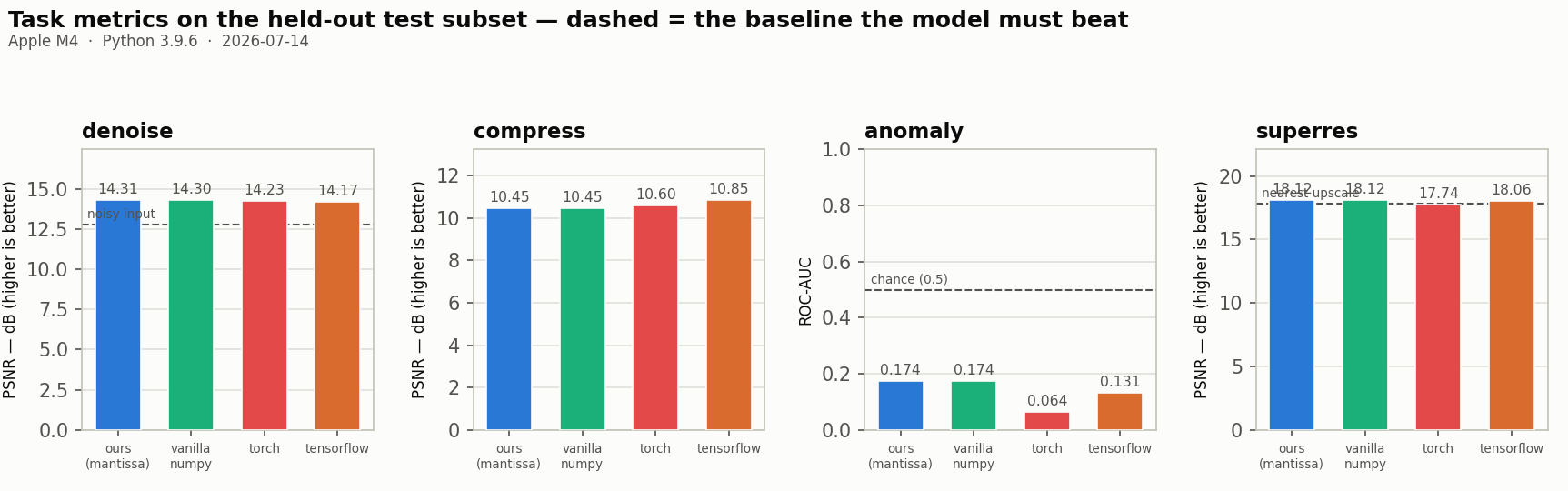
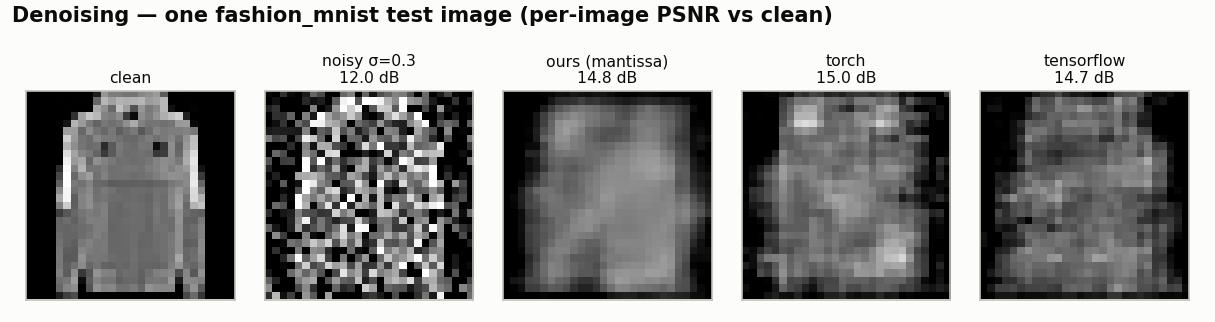
denoise — fashion_mnist, Gaussian σ 0.3 on the input only; the noisy test input scores 12.77 dB against clean, the floor every model must beat:
| contender | fit (s) ↓ | reconstruct (ms) ↓ | PSNR (dB) ↑ | peak RSS (MB) ↓ |
|---|---|---|---|---|
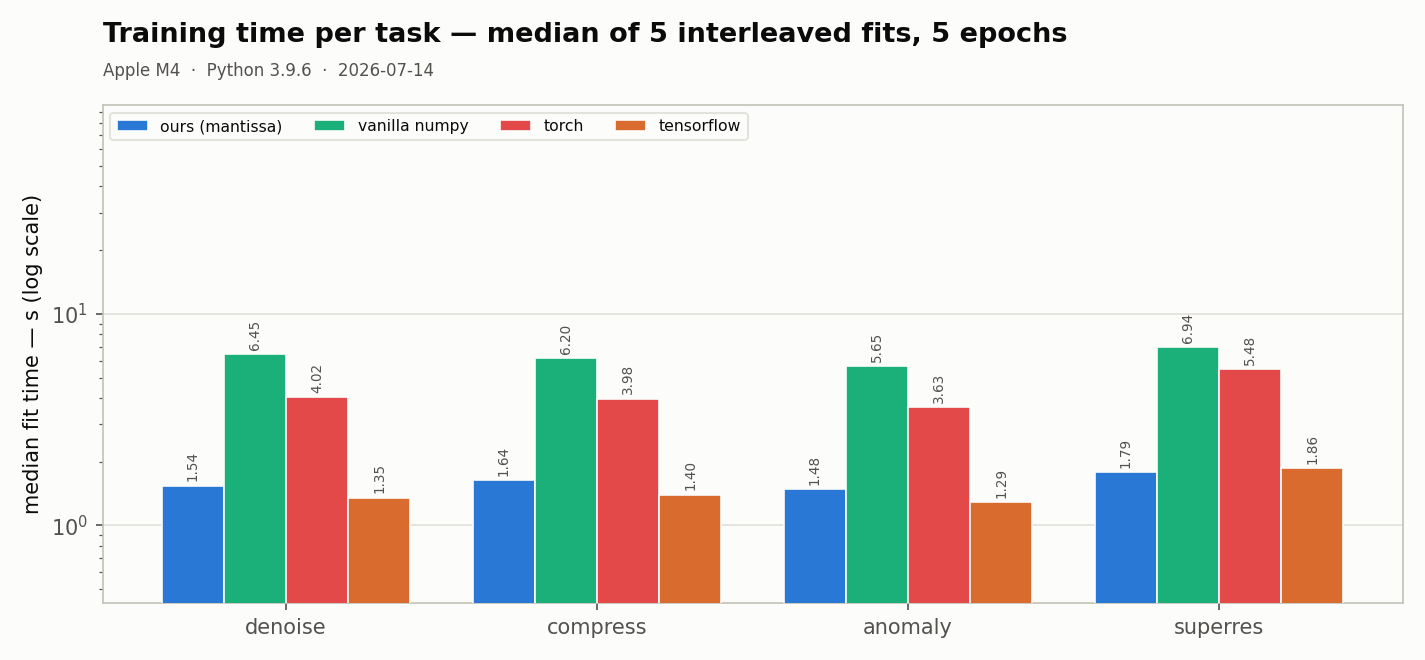
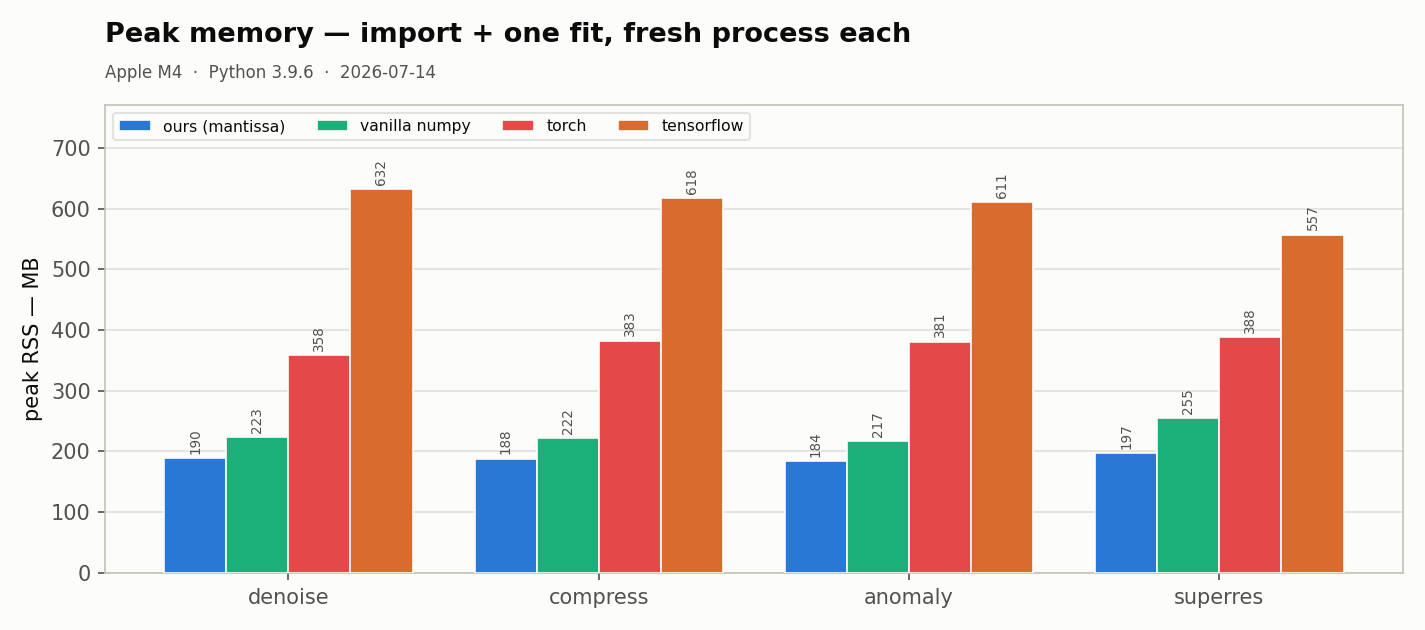
| tensorflow | 1.352 | 53.3 | 14.17 | 632 |
| ours (mantissa) | 1.541 | 35.1 | 14.31 | 190 |
| torch | 4.025 | 41.3 | 14.23 | 358 |
| vanilla numpy | 6.449 | 225.4 | 14.30 | 223 |
compress — mnist through a 32-float code, then uint8-quantized: 32 code bytes + an 8-byte range header = 40 B/image vs the 784-byte uint8 original, an honest 19.6× (quantization costs < 0.001 dB at this code size — the float32-code PSNR is in the JSON):
| contender | fit (s) ↓ | reconstruct (ms) ↓ | PSNR @ 19.6× (dB) ↑ | peak RSS (MB) ↓ |
|---|---|---|---|---|
| tensorflow | 1.399 | 55.6 | 10.85 | 618 |
| ours (mantissa) | 1.643 | 37.6 | 10.45 | 188 |
| torch | 3.977 | 41.5 | 10.60 | 383 |
| vanilla numpy | 6.202 | 207.9 | 10.45 | 222 |
anomaly — mnist, digit 1 held out of training (1800 fit samples), per-sample reconstruction MSE as the score, held-out 1s positive:
| contender | fit (s) ↓ | reconstruct (ms) ↓ | ROC-AUC | peak RSS (MB) ↓ |
|---|---|---|---|---|
| tensorflow | 1.290 | 56.8 | 0.131 | 611 |
| ours (mantissa) | 1.479 | 37.9 | 0.174 | 185 |
| torch | 3.635 | 41.8 | 0.064 | 381 |
| vanilla numpy | 5.649 | 210.1 | 0.174 | 217 |
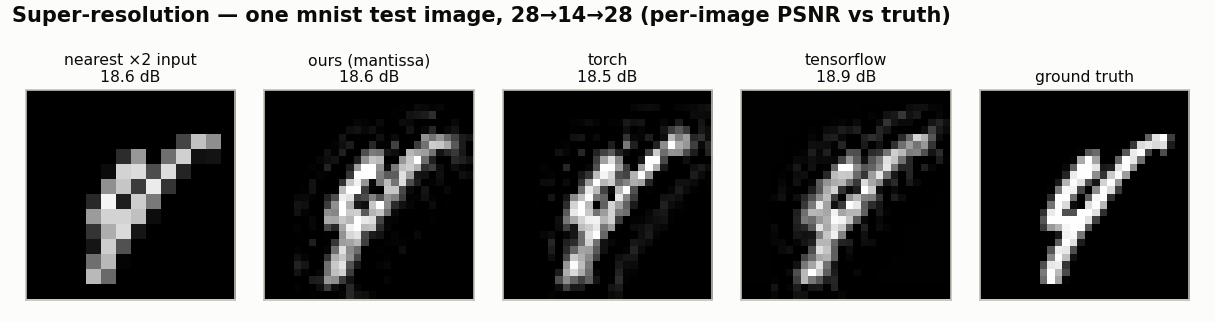
superres — mnist 28 → 14 (2×2 mean) → nearest-upscaled back to 28
outside the net, srcnn refines; the nearest-upscaled input scores
17.82 dB, the floor:
| contender | fit (s) ↓ | reconstruct (ms) ↓ | PSNR (dB) ↑ | peak RSS (MB) ↓ |
|---|---|---|---|---|
| ours (mantissa) | 1.789 | 44.5 | 18.12 | 197 |
| tensorflow | 1.859 | 64.9 | 18.06 | 557 |
| torch | 5.476 | 84.7 | 17.74 | 388 |
| vanilla numpy | 6.935 | 197.5 | 18.12 | 256 |
The galleries below are the models the benchmark trained — same seed, same test image, nothing retrained or cherry-picked:
The honest read.
- Fit: TensorFlow's compiled graph still leads three of four tasks,
but the gap collapsed from ~1.5× to 1.14–1.17×. The previous run's
recorded next target — an engine-side upsample primitive — landed in
mantissa 0.2.3 (
upsample2d; at these decoder shapes the numpy forward ran at 4 vs 74 GB/s and the backward's fusednp.sumover two interleaved length-k axes was ~9× off, up to 47× end-to-end), and our denoise fit fell 2.34 → 1.54 s. Ours keeps superres — the control architecture with no upsample and no pooling, pure engine convolutions — and beats torch eager 2.4–3.1× on every task; the numpy backend trails ours 3.8–4.2×. TF's remaining lead has the same mechanical explanation as before, now smaller: decoders convolve at full 28×28 resolution — the heavy-conv regime where the cnn repo's benchmark also found TF's graph executor strongest — and the stages still running as numpy between engine calls (the denoise corruption, batch staging, the MSE/loss step) are what TF fuses into one graph. - Reconstruct is now ours on all four tasks (35–45 ms; torch 41–85, tf 53–65 — what was a three-way photo finish broke open when the decoder's upsample forward moved into C); the numpy backend is 4.4–6.4× slower than ours.
- Peak memory is ours across the board: 185–197 MB against 358–388 MB for torch and 557–632 MB for tensorflow — a ~2× and ~3× gap, fresh process, import included.
- Task quality lands in the same band for everyone, as it must with identical structure and budget: denoise within 0.14 dB (all 1.4–1.5 dB above the noisy input), superres ours/tf above the nearest baseline with torch 0.08 dB below it, compress spread 0.4 dB with TF ahead — differences of this size are init/shuffle-stream noise (seeded per framework; they cannot be made bit-identical across libraries), not framework superiority. The engine's metrics match its numpy oracle's to within 0.0002 dB on every deterministic task — same model, just faster. Adopting the C upsample changed no deterministic-task metric by even a printed digit versus the 0.2.2 run: every decoder here upsamples by 2, where the C backward's block sum is bit-exact against the numpy reduction.
- The anomaly recipe fails honestly, for every framework (AUC 0.06–0.17, far below chance 0.5). With digit 1 held out, reconstruction-error detection breaks: 1s are the lowest-complexity digit, and an autoencoder trained on the other nine reconstructs their thin strokes better than average — reconstruction MSE is confounded with image complexity, a known failure mode of the Sakurada & Yairi recipe. The protocol pinned digit 1 before any measurement, so the number is reported as measured; all four contenders agree, which is exactly what the column is for — it compares frameworks, not the recipe's wisdom.
Fairness caveats. TF's one-time graph tracing is excluded from fit
timing via an identical untimed warm-up for every contender (as imports
are); torch runs eager, its default mode. CPU only — no MPS/Metal for
anyone. The per-batch denoise corruption uses each framework's native
RNG (numpy / torch.randn / a tf.data map) — same distribution,
different streams; ours draws it unseeded, so the denoise PSNR of
ours/vanilla-numpy wobbles a few hundredths of a dB between benchmark
runs (14.29 → 14.31 and 14.23 → 14.30 across the last two passes,
vanilla's code unchanged) while the seeded torch/tf values repeat
exactly. Keras is NHWC, so its dense bottleneck connects to a
permuted flatten — identical parameter count and function class. Thread
settings left at each framework's defaults and recorded in the JSON. All
raw samples live in bench/results/results.json (regenerable,
gitignored).
Environment. Apple M4 · Python 3.9.6 · numpy 2.0.2 · torch 2.8.0 ·
tensorflow 2.20.0 · mantissa 0.2.3 (f32 CNN primitives + the upsample2d
decoder op) · 2026-07-14. Full run: 398 s.
Reproduce: python -m bench.contenders && python -m bench.speed && python -m bench.plots.
Methodology
Identical architectures, subsets, epochs, batch size, learning rate and seeds for every contender; timings are medians over interleaved repeats on one machine, library versions recorded in the results JSON. Peak RSS is measured per contender in a fresh subprocess because that is what a user pays. Measure, don't assume.
License
MIT — © Tekin Ertekin. Base package: mantissa-cnn; engine: mantissa — same author, MIT.
Release history Release notifications | RSS feed


Download files
Download the file for your platform. If you're not sure which to choose, learn more about installing packages.
Source Distribution
Built Distribution
Filter files by name, interpreter, ABI, and platform.
If you're not sure about the file name format, learn more about wheel file names.
Copy a direct link to the current filters
File details
Details for the file mantissa_autoencoder-0.1.1.tar.gz.
File metadata
- Download URL: mantissa_autoencoder-0.1.1.tar.gz
- Upload date:
- Size: 32.4 kB
- Tags: Source
- Uploaded using Trusted Publishing? Yes
- Uploaded via: twine/6.1.0 CPython/3.13.12
File hashes
| Algorithm | Hash digest | |
|---|---|---|
| SHA256 |
5033760c3ae7ed25b643d7f7ca32837fade7fce5907fd37918b9ae59ac12000e
|
|
| MD5 |
9dd3eb4cb479e7c57823841ea1f233a0
|
|
| BLAKE2b-256 |
86e80069bf60f20085d829bd76f1d8026ff2ab7f6669163e5455d8e769e09f0d
|
Provenance
The following attestation bundles were made for mantissa_autoencoder-0.1.1.tar.gz:
Publisher:
release.yml on tekinertekin/mantissa-auto-encoder
-
Statement:
-
Statement type:
https://in-toto.io/Statement/v1 -
Predicate type:
https://docs.pypi.org/attestations/publish/v1 -
Subject name:
mantissa_autoencoder-0.1.1.tar.gz -
Subject digest:
5033760c3ae7ed25b643d7f7ca32837fade7fce5907fd37918b9ae59ac12000e - Sigstore transparency entry: 2195073502
- Sigstore integration time:
-
Permalink:
tekinertekin/mantissa-auto-encoder@8be381872717530f62f65cf37aacf9b58aa6de64 -
Branch / Tag:
refs/tags/v0.1.1 - Owner: https://github.com/tekinertekin
-
Access:
public
-
Token Issuer:
https://token.actions.githubusercontent.com -
Runner Environment:
github-hosted -
Publication workflow:
release.yml@8be381872717530f62f65cf37aacf9b58aa6de64 -
Trigger Event:
push
-
Statement type:
File details
Details for the file mantissa_autoencoder-0.1.1-py3-none-any.whl.
File metadata
- Download URL: mantissa_autoencoder-0.1.1-py3-none-any.whl
- Upload date:
- Size: 23.2 kB
- Tags: Python 3
- Uploaded using Trusted Publishing? Yes
- Uploaded via: twine/6.1.0 CPython/3.13.12
File hashes
| Algorithm | Hash digest | |
|---|---|---|
| SHA256 |
d542f51e0a30f78494fc07d058abee57b31986a7efef45475c31fc7642762609
|
|
| MD5 |
5e06f79c06d6542ac1297bb6020575f0
|
|
| BLAKE2b-256 |
834052561c75ff6b5061934c682bd6c6932be7a76889de108419b49468dc49f0
|
Provenance
The following attestation bundles were made for mantissa_autoencoder-0.1.1-py3-none-any.whl:
Publisher:
release.yml on tekinertekin/mantissa-auto-encoder
-
Statement:
-
Statement type:
https://in-toto.io/Statement/v1 -
Predicate type:
https://docs.pypi.org/attestations/publish/v1 -
Subject name:
mantissa_autoencoder-0.1.1-py3-none-any.whl -
Subject digest:
d542f51e0a30f78494fc07d058abee57b31986a7efef45475c31fc7642762609 - Sigstore transparency entry: 2195073538
- Sigstore integration time:
-
Permalink:
tekinertekin/mantissa-auto-encoder@8be381872717530f62f65cf37aacf9b58aa6de64 -
Branch / Tag:
refs/tags/v0.1.1 - Owner: https://github.com/tekinertekin
-
Access:
public
-
Token Issuer:
https://token.actions.githubusercontent.com -
Runner Environment:
github-hosted -
Publication workflow:
release.yml@8be381872717530f62f65cf37aacf9b58aa6de64 -
Trigger Event:
push
-
Statement type:







