
mantissa



A low-precision neural-network compute core in C, with a Python binding.
mantissa is a from-scratch AI compute core: dense layers and 2-D convolution,
forward and backward, with weights and activations stored in a narrow float
format of your choice — bfloat16, fp16, FP8 (E4M3/E5M2), FP4 (E2M1), or a custom
1·7·24 type — while every accumulator stays float32. That is the standard
mixed-precision recipe, narrow storage / wide accumulate, and it is the whole
design: on a dense layer the budget is memory bandwidth, so halving the stored
size of a weight is worth nearly as much as halving the runtime.
It is dependency-free C11 with hand-written NEON and runtime-dispatched AVX2
kernels in one portable binary, a thread pool, and a ctypes Python layer. It
runs on the CPU today.
Roadmap (not yet implemented): a GPU backend, and the sequence models the
same primitive already implies — word2vec, GRU/LSTM, and transformer-shaped
work. See DESIGN.md §3 for why tk_linear_forward is the
shared building block of all of them.
Every performance number in this repository is measured, and the counter-stories are written down too: PERFORMANCE.md says where narrow storage does not pay, and DESIGN.md lists the optimizations that were tried and rejected with the measurement that killed them.
Started by Tekin Ertekin (2024); later refactored with Claude Code — see AUTHORS.md.
Version history and per-release benchmark scores: RELEASES.md.
Low-precision, in numbers
mantissa keeps weights and activations in a narrow storage format and
accumulates in float32 — narrow storage, wide accumulate. To show what that
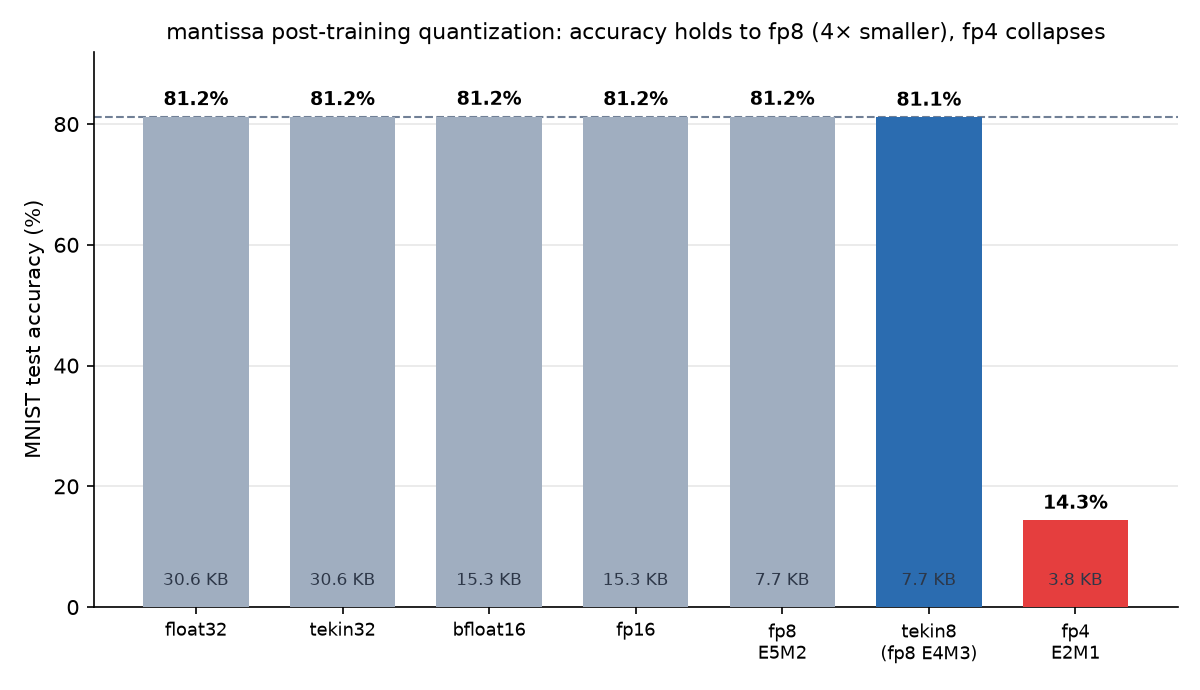
buys, a linear MNIST classifier (784→10) is trained once in float32, then its
weights are post-training-quantized into each storage format via
Mantissa.prepare() (rebuild the core with make DTYPE=N). Same weights, same
test set — only the storage type changes:
| storage format | bits (S-E-M) | bytes/param | model size | MNIST test acc |
|---|---|---|---|---|
| float32 (baseline) | 1-8-23 | 4 | 30.6 KB | 81.20 % |
| tekin32 | 1-7-24 | 4 | 30.6 KB | 81.20 % |
| fp16 | 1-5-10 | 2 | 15.3 KB | 81.20 % |
| bfloat16 | 1-8-7 | 2 | 15.3 KB | 81.25 % |
| fp8 E5M2 | 1-5-2 | 1 | 7.7 KB | 81.25 % |
| tekin8 (fp8 E4M3) | 1-4-3 | 1 | 7.7 KB | 81.10 % |
| fp4 E2M1 (MXFP4) | 1-2-1 | ½ | 3.8 KB | 12.63 % → 78.85 % with block scaling |
fp8 holds float32 accuracy at 4× less memory (−0.1 pt); fp16/bf16 are effectively lossless at 2×. fp4 is a step too far for naïve post-training quantization: its magnitudes run 0.5 to 6, so weights with std ~0.05 quantize almost entirely to zero.
Per-block scaling fixes that. With one shared power-of-two scale per 32
elements (MX v1.0, stored as an E8M0 byte), the same 4-bit weights give
78.85 % against float32's 79.57 % — at 3.8 KB instead of 30.6 KB. Pass
MANTISSA_BLOCKED=1 to the demo, or use prepare_blocked() from Python. It
costs throughput: the blocked kernel measures 3.4–4.7× slower than the flat one,
uniformly across storage types, because the scale is applied per block. Use it
where memory decides and the flat path where speed does.
Run it yourself:
make DTYPE=4 lib
MANTISSA_LIB=build/libmantissa.dylib python examples/mnist_demo.py   # .so on Linux
trains a classifier on MNIST and reports accuracy, throughput, and footprint at
the chosen storage precision (needs only numpy + matplotlib). MANTISSA_LIB is
what selects that build: without it the binding prefers the bundled library,
which is bfloat16, so DTYPE= would appear to have no effect.
The linear model tops out near 81 %; the point is the relative cost of each format, not the absolute number. Convolutions currently run in float32, so this low-precision story is about the dense/linear engine.
How it gets its speed: see docs/PERFORMANCE.md — the SIMD kernels (NEON + runtime-dispatched AVX2), im2col+GEMM convolution, and threading, each with measured numbers.
The mantissa family
Part of the mantissa family: a low-precision engine written in C, with small Python packages built on top. Each package sits under the one it depends on — ⭐ marks where you are, and every other name links to its repo.
- ⭐ mantissa — low-precision neural-network engine in C (the core) (you are here)
- mantissa-perceptron — perceptron & ADALINE, the linear classics
- mantissa-nn — shared neural-net primitives (layers, engine binding)
- mantissa-cnn — convolutional networks for images
- mantissa-auto-encoder — autoencoders for denoising & super-resolution
- mantissa-interpret — CNN interpretability (occlusion, saliency, Grad-CAM)
- mantissa-embed — CNN metric learning (image embeddings for similarity & retrieval)
- mantissa-mlp — multilayer perceptrons, fully-connected nets
- mantissa-cnn — convolutional networks for images
How it works
mantissa is a shared library with a plain C ABI, so any language that can
call C — Python (via ctypes), C/C++, Rust, Go — drives the same engine. The
caller passes ordinary float32 arrays in and gets float32 back; inside,
weights are kept in a narrow type to save memory.

A call is one of three kinds:
- Build — quantize weights from float32 into the compact storage type (once).
- Forward pass (
tk_linear_forward) — computey = activation(W·x + b). Called forward because data flows forward through the network, input → output (also feed-forward). There is no "fast" in it — the opposite direction is the backward pass. - Backward pass / training (
tk_linear_backward→tk_sgd_step) — gradients flow backward, output → input, and the weights are updated.
Whichever it is, the compute core does the same underneath: read the narrow weights, accumulate in float32, apply an activation, return float32.
Performance at a glance
A 2048×2048 dense layer (4.2M parameters) on an Apple M-series laptop, default
bfloat16 (make bench / make benchbp):
| value | |
|---|---|
| forward pass (10 threads) | 0.10 ms (~83 GFLOP/s) |
| forward pass (1 thread) | 0.35 ms (~29 GFLOP/s) |
| backward pass (10 threads) | 0.33 ms (~39 GFLOP/s) |
| backward pass (1 thread) | 1.01 ms (~12 GFLOP/s) |
| weight memory | 8 MB — half of float32 |
relu over 4M values |
0.41 ms |
Forward and backward use explicit NEON kernels (bfloat16 leads — half the bytes, same FMAs) and a persistent thread pool that splits rows across cores for large layers. Numbers are for the default bfloat16 on a 10-core Apple laptop.
Memory is the headline at scale — it decides whether a model loads at all:
| model | float32 | mantissa (bf16) | mantissa (1-byte) |
|---|---|---|---|
| 1B params | 4.0 GB | 2.0 GB | 1.0 GB |
| 7B params | 28 GB | 14 GB | 7 GB |
How it stays small and fast
- Narrow weight storage — weights are the bulk of a model, so storing each in 2 bytes (or 1) instead of 4 is where the RAM/VRAM savings come from, and since a dense layer is memory-bandwidth bound, moving fewer bytes is also faster. The precision is a build-time dial (below).
- float32 accumulation — compute always sums in float32 so accuracy holds across a layer's millions of terms (mixed precision; Micikevicius 2017).
- Tuned kernels — register-blocked GEMV with explicit SIMD FMA kernels
(NEON on arm64, AVX2 on x86-64) and a persistent thread pool across cores,
branchless activations
(sign-bit /
fmax/copysign, chosen by benchmark), and stochastic rounding so training survives narrow weights. Details and measurements in docs/DESIGN.md.
The precision dial
Storage precision is one build-time knob (DTYPE); the default needs no config.
It is how the core trades accuracy for memory — a means to the speed/RAM goal,
not the goal itself.
DTYPE |
Name | Bytes | When |
|---|---|---|---|
| 0 | float32 |
4 | reference / exact |
| 2 | bfloat16 |
2 | default — half the RAM, training-safe |
| 1 | fp16 |
2 | half RAM, more precision, less range |
| 3 | tekin32 |
4 | custom high-fidelity accumulator |
| 4 | tekin8 |
1 | FP8 E4M3 — 4× smaller |
| 5 | fp8_e5m2 |
1 | FP8, wider range |
| 6 | fp4_e2m1 |
½* | FP4 — the extreme |
*fp4 stores two values per byte on the block-scaled path, so the "½" is real there: 4.26 bits per weight including the shared scales, against MXFP4's 4.25. The flat path still stores one per byte. Packing costs ~22% throughput rather than gaining any — see docs/DESIGN.md.
Bit layouts, the tekin formats' design rationale, the hot/cold conversion
split, and the current-research context (MX / NVFP4 / posit / IEEE P3109) all
live in docs/DESIGN.md. Every value is stored in the selected
type but computed in float32.
Accuracy cost, seen
The same value stored in each format and read back (make DTYPE=<n> test).
This is the accuracy you trade away for the memory you save — float32 is the
reference column:
| input | float32 | tekin32 | fp16 | bfloat16 | e5m2 | tekin8 |
|---|---|---|---|---|---|---|
| 3.14159 | 3.14159 | 3.14159 | 3.14062 | 3.14062 | 3.0 | 3.25 |
| 100.0 | 100 | 100 | 100 | 100 | 96 | 104 |
| 0.01 | 0.01 | 0.01 | 0.0100021 | 0.0100098 | 0.0098 | 0.00977 |
fp4_e2m1 is coarser still: its 8 magnitudes are {0, ±0.5, ±1, ±1.5, ±2, ±3, ±4, ±6} — everything rounds onto that grid.
Full benchmarks
The numbers behind Performance at a glance, per dtype. make DTYPE=<n> bench —
a 2048×2048 dense layer (4.2M params), plus the activation-dispatch micro-test.
Apple M-series laptop, clang -O3; indicative, not absolute.
| dtype | weight memory | GEMV ms/pass | GEMV GFLOP/s | vectorised read |
|---|---|---|---|---|
| bfloat16 | 8.0 MB | 0.055 | ~153 | widen + shift (the shift is the conversion) |
| fp16 | 8.0 MB | 0.067 | ~125 | one FCVTL |
| float32 | 16.0 MB | 0.100 | ~84 | plain load, bandwidth-bound |
| fp4 E2M1 | 4.0 MB | 0.286 | ~29 | two TBL lookups |
| tekin8 | 4.0 MB | 0.308 | ~27 | mask/shift + one multiply |
| fp8 E5M2 | 4.0 MB | 0.371 | ~23 | scalar — its 256-entry table beats arithmetic |
All six rows come from one back-to-back run, so they are comparable with each other; absolute wall-clock on a laptop moves with thermal state and background load, so do not compare them against figures from another session. fp4 and tekin8 sit close enough that their order swaps between runs.
The forward pass is register-blocked (4 output rows share each x load and run
4 independent FMA chains), with explicit SIMD FMA kernels — NEON on arm64,
AVX2 on x86-64 (runtime-dispatched via __builtin_cpu_supports, scalar
fallback on older CPUs). bfloat16 leads on both axes: it moves half the bytes
of float32 for the same FMAs.
The one-byte formats are still conversion-bound rather than bandwidth-bound, but
two of the three now have a vectorised read of their own: tekin8 because its
E4M3 unpack is bit arithmetic, fp4 because its sixteen values fit what TBL
indexes. E5M2 keeps the scalar read on measurement — a 256-entry table in L1
beats reconstructing it arithmetically. Native FP8 hardware would close the
remaining gap; see docs/PERFORMANCE.md.
On top, a thread pool splits the output rows across cores for large layers, both forward and backward (the per-kernel numbers above are single-thread):
| bfloat16 (2048×2048) | 1 thread | 10 threads |
|---|---|---|
| forward GFLOP/s | ~29 | ~83 (2.9×) |
| backward GFLOP/s | ~12 | ~39 (3.1×) |
Scaling is sub-linear because GEMV does only ~2 FLOPs per byte, so it saturates
memory bandwidth before compute — float32 (twice the bytes) barely gains, which
is exactly why the narrow default matters. Small layers run serially (below a
work threshold) so the pool never hurts the millions-of-small-calls case; set
MANTISSA_THREADS to tune. Numbers are laptop-noisy.
Backward pass (make DTYPE=<n> benchbp, same 2048×2048 layer):
| dtype | backward ms/pass | backward GFLOP/s | SGD update (M weights/s) |
|---|---|---|---|
| float32 | 1.03 | 12.21 | 9379 |
| bfloat16 | 0.98 | 12.83 | 994 |
| tekin8 | 3.04 | 4.14 | 321 |
Activation dispatch (4M elements): a per-element switch beats a resolved
function pointer ~7× for relu and ~1.5× for sigmoid on Apple Silicon —
on the x86 CI runner the gap shrinks to ≤1.2× (parity on some cases), so the
win is real but platform-dependent. The inline switch
vectorizes (relu compiles to a single fmax per lane); an indirect call per
element does not. So tk_activate keeps the switch, and the function-pointer
API (tk_act_resolve) is reserved for genuinely pluggable dispatch. The
step/sign/relu kernels themselves are branchless (sign-bit read, fmax,
copysign), each picked by benchmark over the obvious comparison. Measure,
don't assume.
Mixed architectures
Every layer configures itself independently — bias is a per-call NULL-able pointer, activation is a per-call argument:
tk_linear_forward(W1, x,  b1,   h1, 6, 4, TK_ACT_TANH);     /* bias + tanh    */
tk_linear_forward(W2, h1, NULL, h2, 5, 6, TK_ACT_RELU);     /* no bias + relu */
tk_linear_forward(W3, h2, b3,   y,  2, 5, TK_ACT_SIGMOID);  /* bias + sigmoid */
(Under the default narrow storage each float output is requantized to
tk_scalar_t before it feeds the next layer — see examples/mlp_example.c;
the snippet elides that for readability. It compiles as-is only under DTYPE=0.)
That is a full 3-layer MLP with three different bias/activation setups —
exactly the heterogeneity a Transformer needs (bias-free attention projections,
bias-using feed-forward). Run it: make mlp.
Training (back-propagation)
The reverse pass mirrors the forward core: tk_linear_backward computes the
weight, bias, and input gradients for a dense layer; tk_sgd_step updates
narrow-stored weights; tk_loss (MSE / BCE) seeds the gradient. No autograd
graph — the caller drives the layers, keeping everything explicit and
inspectable.
One training step is a loop: run forward, measure the loss against the target, propagate gradients backward, update the weights, repeat.

Correctness is proven by a gradient check (make testbp): analytic
gradients vs central finite differences, matching to <1e-2 relative error for
tanh, sigmoid, relu, and gelu.
make train learns XOR — the problem a single perceptron cannot solve —
end to end, in the default bfloat16:
Training XOR  (dtype=bfloat16, stochastic_rounding=1)
  epoch    0  loss 0.31523
  epoch 1000  loss 0.00035
  epoch 4000  loss 0.00007
predictions:
  (0,0) -> 0.004   (0,1) -> 0.990   (1,0) -> 0.991   (1,1) -> 0.009
That it converges in bf16 is the point of stochastic rounding (config
TK_USE_STOCHASTIC_ROUNDING): under plain round-to-nearest, a weight update
smaller than the storage type's precision rounds to zero and training stalls; SR
rounds up/down with probability proportional to distance, so tiny updates
accumulate in expectation (Gupta et al., 2015; the technique behind FP8 training
on Hopper/Blackwell). It needs no fp32 master copy of the weights.
Measured — same XOR run, 4000 epochs, round-to-nearest vs SR (make DTYPE=<n> benchbp):
| dtype | round-to-nearest | stochastic rounding |
|---|---|---|
| float32 | 0.00008 | 0.00008 (SR is a no-op) |
| bfloat16 | 0.01090 | 0.00009 |
| tekin8 | 0.24862 — stalled | 0.00008 — converged |
In the 1-byte type, plain rounding never learns XOR; stochastic rounding does. That is the whole reason the technique exists.
Training config (all OFF by default)
| Flag | Effect |
|---|---|
TK_USE_DROPOUT / TK_DROPOUT_RATE |
inverted dropout on activations |
TK_USE_L1 / TK_L1_LAMBDA |
L1 weight penalty in the update |
TK_USE_L2 / TK_L2_LAMBDA |
L2 weight penalty in the update |
TK_USE_STOCHASTIC_ROUNDING |
SR on the weight write-back |
Each sets a default; the runtime tk_optim / dropout calls override per layer.
Back-propagation covers the dense layer (the shared primitive) and, since
v0.2.1, the conv/pool family (conv.h, float32 — see the roadmap section);
recurrent backward reuses the same pieces later.
Zero-config
Never touch config.h and you get Google's bfloat16 with bias enabled —
the safe general-purpose default. Override only when you want to:
make DTYPE=4 test # switch storage to tekin8
Install
pip install mantissa-core # import name stays `mantissa`
The wheel ships a prebuilt libmantissa (default bfloat16) — no compiler or
make needed. numpy is optional; install mantissa-core[numpy] for the zero-copy
training path. Then:
from mantissa import Mantissa, STEP
tk = Mantissa()
print(tk.dtype)                # 'bfloat16'
The distribution is named
mantissa-coreon PyPI (the baremantissaname is taken by an unrelated project); the Python import name is stillmantissa.
Installing from an sdist (or pip install . from a checkout) compiles the C
core on your machine, so a C toolchain (cc, make-grade compiler) is required
for that path — wheel users need nothing. Override the storage dtype at build
time with MANTISSA_DTYPE=<id> (same ids as DTYPE; default 2 = bfloat16):
pip install .                       # from a source checkout
MANTISSA_DTYPE=4 pip install .      # build the tekin8 (FP8) library instead
Download
Prebuilt shared libraries are attached to every release —
built by CI for Linux, macOS, and Windows. Grab the one for your OS and load it
straight from Python, no compiler or make needed:
| OS | file |
|---|---|
| Linux | libmantissa-linux-x86_64.so |
| macOS | libmantissa-macos-arm64.dylib |
| Windows | libmantissa-windows-x86_64.dll |
import ctypes
lib = ctypes.CDLL("./libmantissa-linux-x86_64.so")   # the file you downloaded
lib.tk_dtype_name.restype = ctypes.c_char_p
print(lib.tk_dtype_name().decode())                  # -> e.g. "bfloat16"
Or use the ctypes wrapper in python/mantissa/ (point
it at the downloaded file) — pass float32 numpy arrays (or array('f')) for
a zero-copy, in-place training path, ~200× faster per step than plain lists
(numpy optional). For an epoch loop, Mantissa.trainer() binds the buffers'
pointers once and roughly halves the per-epoch call cost again (measured
9.8 → 4.8 µs at 1030×4 — the conversion, not the C, was the cost); see
docs/USAGE.md. Runnable forward + back-prop examples for
Python, C++, C#, Java, JavaScript, and Rust live in
clients/ — all calling the same C ABI. To build from source
instead, see below.
For a full, installable client with honest benchmarks, see the sister project mantissa-perceptron — a Python perceptron classifier built on this engine.
Quick start
make test                     # tests, default bfloat16
make example                  # C perceptron
make mlp                      # mixed 3-layer MLP
make DTYPE=0 bench            # benchmark, float32
make dist && python3 python/perceptron_example.py
The Python binding is dtype-agnostic: it calls the float32 entry point, so the same script runs against any storage type the library was built for. Full API and examples in docs/USAGE.md.
Numeric landscape & roadmap
The low-precision frontier moves fast; mantissa tracks it deliberately:
- Microscaling (MX) — OCP MX v1.0 (2023): blocks of 32 elements share one
E8M0 scale, mitigating the tiny dynamic range of 4/6-bit elements.
MXFP8,MXFP6,MXFP4. - NVFP4 — NVIDIA Blackwell (2024 hardware): 16-element blocks with an FP8 E4M3 block scale; used to pretrain LLMs at 4 bits (arXiv:2509.25149, 2025).
- Posit / takum — tapered-precision alternatives to IEEE floats, strong for ≤8-bit inference on zero-centered weights.
- IEEE P3109 — an emerging standard for ML arithmetic formats.
mantissa implements the element formats (E4M3, E5M2, E2M1); block-level
microscaling (a shared per-block scale) is the next planned step. The
conv/pool primitives landed in v0.2.1 (conv.h): im2col + register-blocked
GEMM convolution, max pooling with argmax scatter, a batched dense head, fused
softmax-cross-entropy and plain-f32 SGD — the full CNN training family,
gradient-checked (make testconv) and benched at LeNet-5/VGG shapes
(make benchconv; VGG 64→64@3×3 forward 199 GFLOP/s threaded on M4). This
family is deliberately pure float32: narrow-storage conv stays on the roadmap,
gated on the same block-scaling work as the 4-bit packing. Recurrent backward
will reuse the same gradient and optimizer pieces.
Project layout
include/   config, dtypes + conversions, activations, ops, loss, backprop, conv, pool
src/       implementations (conv.c: the float32 CNN family — conv2d, maxpool, softmax-xent)
tests/     forward round-trip checks (7 formats) + backprop & conv gradient checks
examples/  perceptron, mixed-MLP, XOR training
bench/     GEMV + activation-dispatch benchmark, conv shapes (benchconv)
python/    ctypes binding + Python perceptron & training examples
clients/   forward + back-prop demos in C++, C#, Java, JavaScript, Rust
docs/      DESIGN.md (numerics, optimization), USAGE.md (API + examples)
License
MIT — see LICENSE. © 2024 Tekin Ertekin.
1 maintainer

Metadata
1 maintainer
Release files for mantissa-core 0.2.10
For a detailed explanation of source distributions (sdists) and built distributions (wheels), please see the package formats documentation.
Source distribution (sdist)
| File | Size | Uploaded | Provenance | |
|---|---|---|---|---|
| mantissa_core-0.2.10.tar.gz | 131.6 kB | With provenance | Details |
Built distributions (wheels)
| File | Interpreter | ABI | Platform | Reset |
|---|---|---|---|---|
| mantissa_core-0.2.10-py3-none-win_amd64.whl | Python 3 | none | Windows x86-64 | Details |
| mantissa_core-0.2.10-py3-none-manylinux_2_27_x86_64.manylinux_2_28_x86_64.whl | Python 3 | none | Linux glibc 2.28+ x86-64, Linux glibc 2.27+ x86-64 | Details |
| mantissa_core-0.2.10-py3-none-macosx_11_0_arm64.whl | Python 3 | none | macOS 11.0+ ARM64 | Details |
Total release size: 511.7 kB
Release files / mantissa_core-0.2.10.tar.gz
| Download URL | mantissa_core-0.2.10.tar.gz |
|---|---|
| Size | 131.6 kB |
| Tags | Source |
|
SHA-256 checksum How to use checksums |
e2afb1935bdd230193d08eec818d52bfbb273c9ee1f5b9cafb3c86783d24c3fd
|
|
BLAKE2b-256 checksum How to use checksums |
fb3d072eb707b3619845cebb48d5a5c27ee68ed54a4b4f0fcd44c14115c94c9c
|
| Upload date | |
|
Uploaded using Trusted Publishing? What is trusted publishing? |
Yes |
| Uploaded via |
twine/7.0.0 CPython/3.13.14
|
Provenance
Provenance describes where a file came from. On PyPI, provenance is shared via attestations, which provide a verifiable record of the build or publishing details. View details, limitations and caveats.


PyPI Publish Attestation
PyPI verified that this artifact, at this checksum, originated from the publisher listed below.
Signed by GitHub Actions, verified by PyPI on Aug 1, 2026.
Transparency logRelease files / mantissa_core-0.2.10-py3-none-win_amd64.whl
| Download URL | mantissa_core-0.2.10-py3-none-win_amd64.whl |
|---|---|
| Size | 170.8 kB |
| Tags | Python 3 Windows x86-64 |
|
SHA-256 checksum How to use checksums |
77739aab62b3dc7b2751e6754f757e893bd28481ea68826979d1c84135b72222
|
|
BLAKE2b-256 checksum How to use checksums |
31533e344bd11d3f1fc3c85e484f18d2fa66b937d0c5c76cf6844c475f3c4aa2
|
| Upload date | |
|
Uploaded using Trusted Publishing? What is trusted publishing? |
Yes |
| Uploaded via |
twine/7.0.0 CPython/3.13.14
|
Provenance
Provenance describes where a file came from. On PyPI, provenance is shared via attestations, which provide a verifiable record of the build or publishing details. View details, limitations and caveats.
PyPI Publish Attestation
PyPI verified that this artifact, at this checksum, originated from the publisher listed below.
Signed by GitHub Actions, verified by PyPI on Aug 1, 2026.
Transparency logRelease files / mantissa_core-0.2.10-py3-none-manylinux_2_27_x86_64.manylinux_2_28_x86_64.whl
| Download URL | mantissa_core-0.2.10-py3-none-manylinux_2_27_x86_64.manylinux_2_28_x86_64.whl |
|---|---|
| Size | 134.0 kB |
| Tags | Linux glibc 2.27+ x86-64 Linux glibc 2.28+ x86-64 Python 3 |
|
SHA-256 checksum How to use checksums |
e67aabb674b4956bc7b34a7b95fdd98aa496781326a353a352af4c47966948b5
|
|
BLAKE2b-256 checksum How to use checksums |
fcd19056e148c9c1c85cedb70d8188963830c6d753db22e717ebf56b6f84c53a
|
| Upload date | |
|
Uploaded using Trusted Publishing? What is trusted publishing? |
Yes |
| Uploaded via |
twine/7.0.0 CPython/3.13.14
|
Provenance
Provenance describes where a file came from. On PyPI, provenance is shared via attestations, which provide a verifiable record of the build or publishing details. View details, limitations and caveats.
PyPI Publish Attestation
PyPI verified that this artifact, at this checksum, originated from the publisher listed below.
Signed by GitHub Actions, verified by PyPI on Aug 1, 2026.
Transparency logRelease files / mantissa_core-0.2.10-py3-none-macosx_11_0_arm64.whl
| Download URL | mantissa_core-0.2.10-py3-none-macosx_11_0_arm64.whl |
|---|---|
| Size | 75.3 kB |
| Tags | Python 3 macOS 11.0+ ARM64 |
|
SHA-256 checksum How to use checksums |
556913a2e6c2b6130f466a419246f9a1623509b30d8b9dbcbfce2133cf8f4629
|
|
BLAKE2b-256 checksum How to use checksums |
b6ef40d65e224cebb6089691c4438ed1062db51fe1916d2095a33bfef77fffad
|
| Upload date | |
|
Uploaded using Trusted Publishing? What is trusted publishing? |
Yes |
| Uploaded via |
twine/7.0.0 CPython/3.13.14
|
Provenance
Provenance describes where a file came from. On PyPI, provenance is shared via attestations, which provide a verifiable record of the build or publishing details. View details, limitations and caveats.
PyPI Publish Attestation
PyPI verified that this artifact, at this checksum, originated from the publisher listed below.
Signed by GitHub Actions, verified by PyPI on Aug 1, 2026.
Transparency logSecurity for mantissa-core 0.2.10
Provenance
Provenance describes where a file came from. On PyPI, provenance is shared via attestations, which provide a verifiable record of the build or publishing details. View details, limitations and caveats.
Full provenance
All 4 files in this release have been uploaded with provenance metadata.
Attestation for mantissa_core-0.2.10.tar.gz
PyPI Publish Attestation
PyPI verified that this artifact, at this checksum, originated from the publisher listed below.
Signed by GitHub Actions, verified by PyPI on Aug 1, 2026.
Transparency logA note on package security
PyPI is a repository for distributing packages, not a service for auditing them. While third-party security researchers and our staff do their best to detect and remove malicious packages, PyPI cannot guarantee the quality, security or suitability of any given package.
To learn more about protecting yourself from malicious actors, visit our package security documentation.














