

Mantpy: extracellular-matrix analysis for spatial proteomics



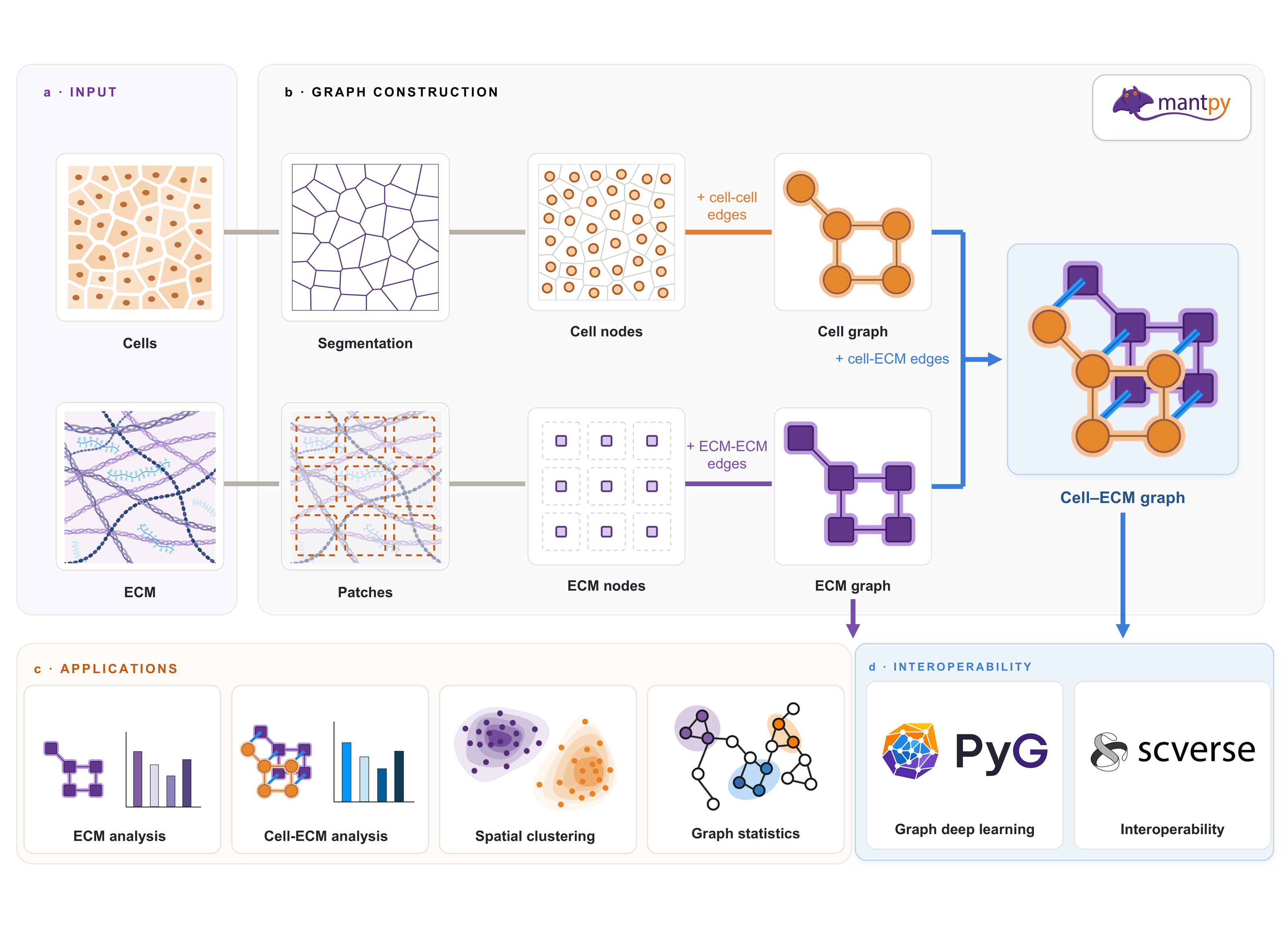
Mantpy is a scverse-based framework for graph analysis of the extracellular
matrix (ECM) in spatial proteomics. It represents cells and ECM patches as distinct,
linked node types, so matrix structure can be analysed on its own or together
with cellular context. Mantpy works with AnnData and interoperates with
Scanpy, Squidpy, and other single-cell and spatial tools.
- 2026: Accepted poster presentation, ML4SpatialBio workshop at NeurIPS.
- 2026: Flash talk, scverse conference.
- 2025: Top Poster Award, British Society for Matrix Biology conference.
Installation
Mantpy requires Python 3.11 or newer. CPU workflows run on Windows, Linux and macOS. GPU training additionally requires a compatible PyTorch installation; the package does not require a GPU for graph construction or descriptive analysis.
pip install mantpy
The current release is 1.2.0 (PyPI, GitHub release v1.2.0); the changelog lists what changed between releases.
Optional extras add heavier dependencies only when needed:
pip install "mantpy[gnn]"      # graph learning and explainability
pip install "mantpy[patch]"    # learned image-patch features
pip install "mantpy[spatial]"  # SpatialData integration
pip install "mantpy[segment]"  # Cellpose segmentation
System requirements
Tested on Windows 11 (Python 3.11) and Ubuntu (Python 3.11 and 3.14); no
special hardware is needed. Dependency versions are listed in
pyproject.toml.
Installing takes about 3 minutes and the quick start below about 20 seconds on
a desktop computer. Notebooks that run online in Google Colab are in the
reproducibility repository.
Quick start
toy_ecm_roi synthesises a small region of interest in memory, so there is
nothing to download. The example draws two figures: the joint cell-ECM graph
and the neighbourhood clusters.
import mantpy as mt

# A small synthetic ROI: image stack, channel panel, cell table.
roi = mt.datasets.toy_ecm_roi()

# Read multiplexed imaging and a cell table into AnnData.
adata = mt.io.read_imc(
    roi.image, panel=roi.panel, cells=roi.cells,
    sample_id="toy", condition="ctrl",
)

# Normalise channels and segment the ECM into patch nodes.
mt.pp.normalize(adata)
mt.pp.extract_ecm_patches(
    adata,
    roi.image,
    ecm_channel="ColIV",
    ecm_K="auto",
    features=["mean"],
)

# Build cell, ECM, and joint cell-ECM graph layers.
mt.gr.build_graph(adata, mode="cell")
mt.gr.build_graph(adata, mode="ecm")
mt.gr.build_graph(adata, mode="cell_ecm")

# Quantify spatial organisation.
mt.tl.cell_ecm_enrichment(adata, cell_type="B")
mt.tl.neighbourhood_clustering(adata, n_clusters=4)

# Visualise results.
mt.pl.cell_ecm_graph(adata)
mt.pl.neighbourhood_clusters(adata)
Point mt.io.read_imc at your own files to run the same pipeline on real data:
adata = mt.io.read_imc("image.tiff", panel="panel.csv", cells="cells.csv")
The toy ROI is synthetic — its clusters and statistics describe the generator, not biology. Use it to learn the API, then move to real data.
Tutorials
Step-by-step guides, each executed when the documentation is built:
- Loading data
- Building ECM graphs
- Cell–ECM graphs
- Exporting to AnnData
- Exporting to PyTorch Geometric
Paper reproducibility
The paper reproducibility repository contains tutorials, full experiment notebooks and figure plotting code.
Public datasets
intestine = mt.datasets.coliv_intestine()   #  93 MB
lung = mt.datasets.balbc_pbs_lung()         #  71 MB
liver = mt.datasets.schistosoma_ecm()       #  38 MB
Documentation
Documentation · API reference · Changelog
Citation
If you use Mantpy, please cite the preprint:
Ghafoor M, Parkinson JE, Pham T, Georgaka S, Haley MJ, Jokl E, Piper Hanley K, Allen JE, Sutherland TE, Rattray M. Mantpy: a framework for extracellular matrix analysis in spatial proteomics. bioRxiv (2026). doi: 10.1101/2025.06.04.657781
Contact
For questions, contact moeghaf@gmail.com or mohamed.ghafoor@postgrad.manchester.ac.uk. To report a bug, use the issue tracker.
1 maintainer

Metadata
1 maintainer
Release files for mantpy 1.2.0
For a detailed explanation of source distributions (sdists) and built distributions (wheels), please see the package formats documentation.
Source distribution (sdist)
| File | Size | Uploaded | Provenance | Actions |
|---|---|---|---|---|
| mantpy-1.2.0.tar.gz | 1.1 MB | With provenance | Details for mantpy-1.2.0.tar.gz |
Built distribution (wheel)
| File | Interpreter | ABI | Platform | Actions Reset |
|---|---|---|---|---|
| mantpy-1.2.0-py3-none-any.whl | Python 3 | none | any | Details for mantpy-1.2.0-py3-none-any.whl |
Total release size: 1.4 MB
Release files / mantpy-1.2.0.tar.gz
| Download URL | mantpy-1.2.0.tar.gz |
|---|---|
| Size | 1.1 MB |
| Tags | Source |
|
SHA-256 checksum How to use checksums |
6b6f2507bee304ca8ecb51f8f7a10d8469b261c528bb61872f230ae950d2988f
|
|
BLAKE2b-256 checksum How to use checksums |
8ba13b7cf9e6fdd7d62787e80e617ecac56a0fbf489a25624c8a920bb790027f
|
| Upload date | |
|
Uploaded using Trusted Publishing? What is trusted publishing? |
Yes |
| Uploaded via |
twine/7.0.0 CPython/3.13.14
|
Provenance
Provenance describes where a file came from. On PyPI, provenance is shared via attestations, which provide a verifiable record of the build or publishing details. View details, limitations and caveats.


PyPI Publish Attestation
PyPI verified that this artifact, at this checksum, originated from the publisher listed below.
Signed by GitHub Actions, verified by PyPI on Nov 9, 2026.
Transparency logRelease files / mantpy-1.2.0-py3-none-any.whl
| Download URL | mantpy-1.2.0-py3-none-any.whl |
|---|---|
| Size | 317.2 kB |
| Tags | Python 3 |
|
SHA-256 checksum How to use checksums |
84f79beaf80f1994afdba513ca21c483113c78bc13e456979cffbbc7508c27cc
|
|
BLAKE2b-256 checksum How to use checksums |
0df55640a0d3957d43c16c7d00eee793f77a060478340ce04a1b8cd47ac8ec27
|
| Upload date | |
|
Uploaded using Trusted Publishing? What is trusted publishing? |
Yes |
| Uploaded via |
twine/7.0.0 CPython/3.13.14
|
Provenance
Provenance describes where a file came from. On PyPI, provenance is shared via attestations, which provide a verifiable record of the build or publishing details. View details, limitations and caveats.
PyPI Publish Attestation
PyPI verified that this artifact, at this checksum, originated from the publisher listed below.
Signed by GitHub Actions, verified by PyPI on Nov 9, 2026.
Transparency logSecurity for mantpy 1.2.0
Provenance
Provenance describes where a file came from. On PyPI, provenance is shared via attestations, which provide a verifiable record of the build or publishing details. View details, limitations and caveats.
Full provenance
Both files in this release have been uploaded with provenance metadata.
Attestation for mantpy-1.2.0.tar.gz
PyPI Publish Attestation
PyPI verified that this artifact, at this checksum, originated from the publisher listed below.
Signed by GitHub Actions, verified by PyPI on Nov 9, 2026.
Transparency logA note on package security
PyPI is a repository for distributing packages, not a service for auditing them. While third-party security researchers and our staff do their best to detect and remove malicious packages, PyPI cannot guarantee the quality, security or suitability of any given package.
To learn more about protecting yourself from malicious actors, visit our package security documentation.














