
A lightweight markup language and Python library for writing, composing, and rendering structured LLM prompts.
Verified details
These details have been verified by PyPIProject links
GitHub Statistics
Maintainers

Project description
MARGARITA



Margarita aims to make writing Agents as easy as writing Markdown.
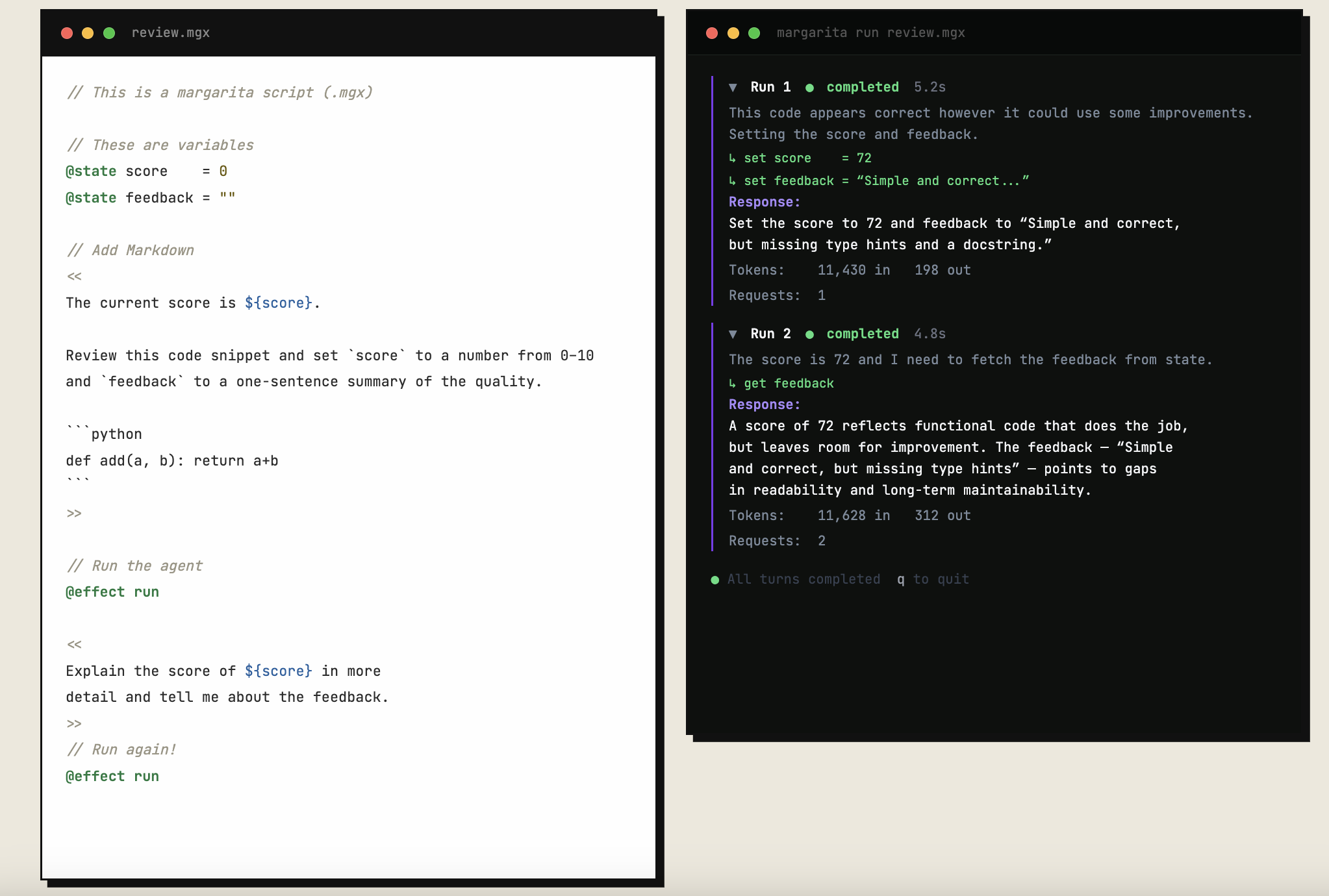
It provides two file formats:
.mg— A templating language that renders dynamic prompts to Markdown. Extends Markdown with variables, conditionals, loops, and includes..mgx— An agent scripting language that extends.mgwith agentic execution: state, memory, tool calls, user input, and more.
Features
- Agentic execution — run
.mgxscripts as stateful agents with memory and tool calls in a TUI. - Composable — .mg files can be split, reused, and nested with
[[ include.mg ]]syntax. - Logical structures — conditionals and loops for dynamic prompt generation.
if,else,elif, andforblocks supported. - Context management — manage agent context with
@effect context. - Memory — persist variables across runs with
@memory. - Input — prompt the user for input during a run with
@effect input. - Tools — register Python functions as LLM-callable tools with
@effect tools. - Function calls — execute Python functions directly and save their result to state with
@effect func. - Sub Agents — call other
.mgxfiles as sub-agents with@effect exec. - Metadata — attach version and description metadata alongside your prompts.
parametersfield for defining expected context variables.
Requirements
- A Github Copilot subscription or Ollama installed locally is required to use the agentic features of Margarita (i.e. to run
.mgxfiles). We're working on adding more llm backends currently.
Installation
Run the following command to install Margarita using uv:
uv tool install margarita

margarita use ollama

margarita run example.mgx
.mg — Prompt Templates
.mg files are Margarita templates. They render to plain Markdown and can be used anywhere Markdown is supported.
Hello World
// file: helloworld.mgx
@state name = "World"

<<
Hello, ${name}!
Welcome to Margarita templating.
>>

@effect run
Conditionals
if is_admin:
    << Welcome, Admin ${name}! >>
else:
    << Welcome, User ${name}! >>
Loops
<< # Items >>
for item in items:
    <<
    - ${item}
    >>
Range loops are also supported:
for i in range(3):
    << Step ${i} >>
Includes
Split prompts into reusable fragments and compose them:
// file: role.mg
<< You are a ${type} AI assistant. >>
// file: prompt.mg
[[ role type="helpful" ]]

if output_json:
    [[ json_output_format ]]
Metadata
---
title: "Greeting Template"
version: "1.0"
author: "Batman"
---

<<
Hello, ${name}!
Welcome to Margarita templating.
>>
CLI Reference
# Render a template
margarita render template.mg

# Render with inline JSON context
margarita render template.mg -c '{"name": "Alice"}'

# Render with a context file
margarita render template.mg -f context.json

# Render a directory of .mg files
margarita render templates/ -o output/

# Show metadata
margarita metadata template.mg

# Render and show metadata
margarita render template.mg --show-metadata
.mgx — Agent Templates
.mgx files extend .mg templates with agentic capabilities: Python imports, @state, @memory, @effect directives, and agent execution.
Run them with:
margarita run example.mgx
Note: Margarita's agent runner uses GitHub Copilot CLI. You will need it installed and configured.
Hello World Agent
---
description: Hello world agent template
---

<<
# Hello World

Tell the user Hello, and welcome them to Margarita!
>>

@effect run
The << >> block loads Markdown content into the agent's context. @effect run tells the agent to execute with the current context.
State
Define variables accessible during a run with @state:
@state count = 0

<< Set the count variable to 5. >>

@effect run
Memory
Persist variables across runs with @memory. Values are saved to memory.json at the end of each run and loaded at the start of the next:
@memory var favorite_color

<<
If favorite_color is not set, set it to "blue".
Otherwise log "The user's favorite color is ${favorite_color}".
>>

@effect run
Custom Tools
Register Python functions as LLM-callable tools with @effect tools:
from math import add, AddParams

<< Add 3 and 5. >>

@effect tools add(x: AddParams) => result

@effect run
Note: Tool params must be a valid Pydantic model.
Function Calls
Execute Python functions directly (without an LLM tool call) and save their result to state:
from my_module import compute

@effect func compute(x) => result
User Input
Prompt the user for input during a run:
@effect input "What is your favorite color?" => favorite_color

@effect log "The user's favorite color is ${favorite_color}."
Specify the Model
---
model: "gpt-4"
---

<< Your prompt here. >>

@effect run
Python Library
Install via pip, poetry, uv, or any package manager:
pip install margarita
poetry add margarita
uv add margarita
Basic Usage
from margarita.parser import Parser
from margarita.renderer import Renderer

template = """
<<
You are a helpful assistant.

Task: ${task}
>>
if context:
    <<
    Context:
        ${context}
    >>

<< Please provide a detailed response. >>
"""

parser = Parser()
metadata, nodes = parser.parse(template)

renderer = Renderer(
    context={"task": "Summarize the key points", "context": "User is researching AI agents"}
)

prompt = renderer.render(nodes)
print(prompt)
Composer
Use the Composer to build prompts from multiple template fragments:
from margarita.composer import Composer
from pathlib import Path

manager = Composer(Path("./templates"))

prompt = manager.compose_prompt(
    snippets=[
        "snippets/system_role.mg",
        "snippets/task_context.mg",
        "snippets/chain_of_thought.mg",
        "snippets/output_format.mg"
    ],
    context={
        "role": "data scientist",
        "user_name": "Bob",
        "task": "Analyze customer churn",
        "format": "JSON",
        "tone": "analytical"
    }
)
Documentation
Full documentation is available at https://banyango.github.io/margarita/latest
Development
This project uses uv for dependency management.
Setup
make install
Tests
make test
Code Quality
make format
make lint
Build
uv build
Contributing
Contributions are welcome! Please feel free to submit a Pull Request.
- Fork the repository
- Create your feature branch (
git checkout -b feature/amazing-feature) - Commit your changes (
git commit -m 'Add some amazing feature') - Push to the branch (
git push origin feature/amazing-feature) - Open a Pull Request
Please make sure to:
- Update tests as appropriate
- Follow the existing code style
- Update documentation for any changed functionality
Authors
- Kyle Reczek - Initial work - Banyango
Changelog
See CHANGELOG.md for a history of changes to this project.
Support
If you encounter any problems or have questions, please open an issue.
Project details
Verified details
These details have been verified by PyPIProject links
GitHub Statistics
Maintainers
Release history Release notifications | RSS feed


Download files
Download the file for your platform. If you're not sure which to choose, learn more about installing packages.
Source Distribution
Built Distribution
Filter files by name, interpreter, ABI, and platform.
If you're not sure about the file name format, learn more about wheel file names.
Copy a direct link to the current filters
File details
Details for the file margarita-0.7.0rc4.tar.gz.
File metadata
- Download URL: margarita-0.7.0rc4.tar.gz
- Upload date:
- Size: 1.3 MB
- Tags: Source
- Uploaded using Trusted Publishing? Yes
- Uploaded via: uv/0.11.13 {"installer":{"name":"uv","version":"0.11.13","subcommand":["publish"]},"python":null,"implementation":{"name":null,"version":null},"distro":{"name":"Ubuntu","version":"24.04","id":"noble","libc":null},"system":{"name":null,"release":null},"cpu":null,"openssl_version":null,"setuptools_version":null,"rustc_version":null,"ci":true}
File hashes
| Algorithm | Hash digest | |
|---|---|---|
| SHA256 |
c460f6c957ac2509c69dc334e29fb7eef779b607af695e6f59b8994061595ca3
|
|
| MD5 |
545117904de268bedc864470c8bf1b70
|
|
| BLAKE2b-256 |
9bbd931e125c98956336080f7ff7141ddadba6f5c57add309a878e30e0e4e017
|
File details
Details for the file margarita-0.7.0rc4-py3-none-any.whl.
File metadata
- Download URL: margarita-0.7.0rc4-py3-none-any.whl
- Upload date:
- Size: 110.4 kB
- Tags: Python 3
- Uploaded using Trusted Publishing? Yes
- Uploaded via: uv/0.11.13 {"installer":{"name":"uv","version":"0.11.13","subcommand":["publish"]},"python":null,"implementation":{"name":null,"version":null},"distro":{"name":"Ubuntu","version":"24.04","id":"noble","libc":null},"system":{"name":null,"release":null},"cpu":null,"openssl_version":null,"setuptools_version":null,"rustc_version":null,"ci":true}
File hashes
| Algorithm | Hash digest | |
|---|---|---|
| SHA256 |
dde5f77be85c46580603a78cda95cb2cc42bbf998b0ac92fd009ca2d84c59db7
|
|
| MD5 |
591dec039e1f2d4f2a348c2bf2f11b0f
|
|
| BLAKE2b-256 |
e07cc859de8983c5bd889b5d1e6e3a78123e9609aaa7839501317993f6d841bc
|






