
markdown-memory
Your coding agent reads whole Markdown files to answer one question. This returns the section that answers it.
Ask an agent a question about your docs and it opens the files that might answer it, whole. Most of what lands in its context is about something else, and the part you wanted competes with it. markdown-memory indexes your documentation by heading, so the same question comes back as the section that answers it, quoted verbatim, with pointers to the next few.
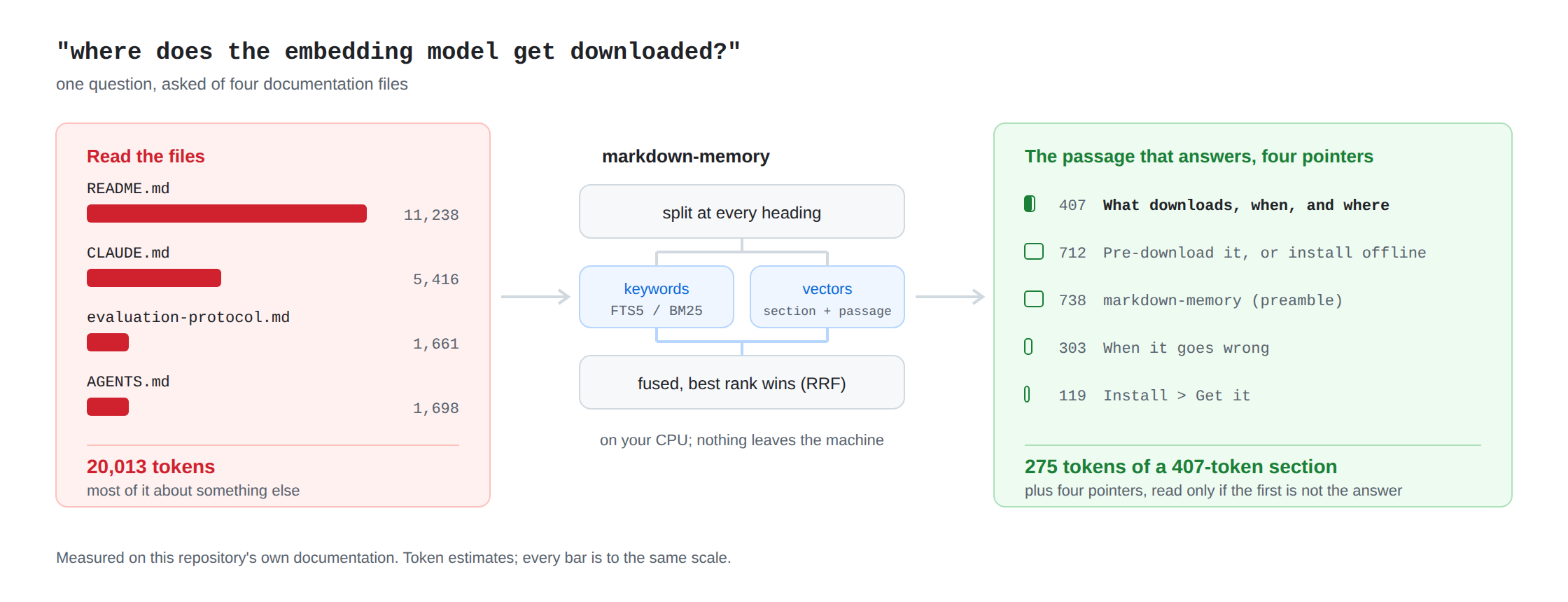
Measured on this repository's own documentation - README.md, CLAUDE.md, AGENTS.md and
docs/evaluation-protocol.md, 16,360 tokens in all:
search_docs("where does the embedding model get downloaded")

  407 tok  README.md  markdown-memory > The embedding model > What downloads, when, and where
  712 tok  README.md  markdown-memory > The embedding model > Pre-download it, or install offline
  666 tok  README.md  markdown-memory
  738 tok  CLAUDE.md  markdown-memory > Commands
  383 tok  README.md  markdown-memory > The embedding model > What is checked before the model is loaded
One section in full - 407 tokens - instead of 16,360: the one that answers, first. The
other four come back as pointers - where each section is, what reading it costs, and the
passage that matched - so when the first is not the answer, one read_section fetches the
one that is.
It is a local Model Context Protocol server - MCP is the
protocol agents use to call tools - and it runs entirely on your machine: parsing with
markdown-it-py, embeddings with
EmbeddingGemma-300m
(4-bit ONNX on CPU, 768 dimensions), storage in SQLite - one database per documentation
root, with a keyword index and two vector indexes over it. No API key, no network after the
first model download, nothing leaves the machine.
Install
Prerequisites
- Python 3.11 or newer. The project develops on 3.12 and CI runs 3.11 through 3.14 on x86-64 Linux.
- uv, which manages the interpreter and the dependencies:
curl -LsSf https://astral.sh/uv/install.sh | sh # macOS / Linux
- Roughly 1 GB of disk: ~218 MB for the embedding model, the rest for the index.
- Linux or macOS, x86-64 or arm64. Everything runs on CPU; there is no GPU path and no API
key. CI covers arm64 Linux on every change and Apple Silicon on
main, because the 4-bit graph picks itsMatMulNBitskernel from what the CPU offers rather than from the file - see What downloads, when, and where. Those kernels do not all return the same numbers: the gate measures four CPU families and the same text embeds up to 1.6e-3 cosine apart between x86-64 and arm64. Copying an index between two machines therefore searches vectors from one kernel with queries from another, which nothing detects - and which was measured, on the labelled set and through the real ranking, to move no top result and lose no answer. It reshuffles positions two to five.
Get it
uv tool install markdown-memory        # or: pipx install markdown-memory
markdown-memory --download-model       # optional: fetch the ~218 MB model now
uv tool install puts the markdown-memory command in ~/.local/bin; if your shell cannot
find it, uv tool update-shell adds that directory to your PATH. Fetching the model up
front is optional - the first search does it otherwise - but it keeps a 218 MB download
out of your first question.
Register it with your client
One registration serves every project. The server indexes the project the client was
started in - Claude Code tells it (CLAUDE_PROJECT_DIR), Codex starts it there - and each
project gets its own index.
claude mcp add --scope user markdown-memory -- markdown-memory    # Claude Code
codex mcp add markdown-memory -- markdown-memory                  # Codex
claude mcp list and codex mcp list should show it. Upgrade with
uv tool upgrade markdown-memory (or pipx upgrade markdown-memory); remove it with
claude mcp remove --scope user markdown-memory, codex mcp remove markdown-memory and
uv tool uninstall markdown-memory (or pipx uninstall markdown-memory).
Desktop apps (Claude Desktop, Cursor) usually do not see ~/.local/bin, so give them the
absolute path that command -v markdown-memory prints. Claude Desktop has no project
either, so name the documentation root:
{
  "mcpServers": {
    "markdown-memory": {
      "command": "/home/you/.local/bin/markdown-memory",
      "env": { "MARKDOWN_MEMORY_DOCS_DIR": "/absolute/path/to/your/docs" }
    }
  }
}
uvx markdown-memory works in place of the installed command too, with one catch: its
first launch downloads about 250 MB of dependencies before the server can answer, longer
than Codex waits by default - set startup_timeout_sec = 60 under
[mcp_servers.markdown-memory] in ~/.codex/config.toml if you go that way.
From source
For working on markdown-memory itself:
git clone https://github.com/hishamkaram/markdown-memory
cd markdown-memory
uv sync
uv run markdown-memory --version
The .mcp.json in the clone runs that checkout (uv run markdown-memory) whenever Claude
Code is opened in it, with no edit.
Index once, then search
The server keeps its documentation root indexed by itself. The first search_docs (or
list_documents without a directory) after it starts begins a catch-up run in the
background - whatever changed while no server ran, new files included - and answers from
the index as it stood, with index_status.indexing set. Nothing runs before that first
call: loading the model holds the interpreter for seconds, and a client waiting on the
handshake gives up quickly. After that, each of those calls decides whether another run is
due:
- a file it sees edited, deleted or unreadable starts one, at most every 10 seconds;
- a weights mismatch a search has just recorded starts one at once;
- otherwise one walks the tree every 5 minutes while the server is in use, which is what finds a file nobody indexed yet.
One run at a time, in one thread, stopped between two documents when the server shuts down;
a stopped run leaves what a killed run leaves, and the next one resumes. While it runs,
index_status.indexing is true and the message says so instead of asking for
index_directory. Nothing watches the filesystem, so a server nobody is using does not
spend anything; read_section and get_document_outline do not start a run. The first
run of a large tree embeds everything and competes with queries for CPU until it is done;
--no-auto-index (or MARKDOWN_MEMORY_AUTO_INDEX=0) turns all of this off, and then:
index_directory()                  # scans the docs root, embeds what it finds
list_documents()                   # index_status.coverage should read "verified"
The first run downloads the embedding model and then indexes, so it is the slow one - see
The embedding model. After that, indexing is incremental: re-running
it costs milliseconds when nothing changed. If coverage reads "unknown", something was
missed and index_status.message says what to run.
index_status also carries changed_files: indexed documents a cheap probe could not
confirm are still what was indexed - their bytes differ, or they are gone, unreadable, or no
longer a regular file. It is best-effort in both directions. Unreadability is noticed only
where a moved timestamp made it read the file at all: a file whose permissions changed and
whose time did not is answered from the time, and it is the next index_directory that
records the failure and takes coverage to "unknown". A path that cannot even be
stat-ed - its parent directory lost its permissions, say - has no timestamp to compare
and is counted straight away. It counts only rows the index
holds, so a file nobody has indexed yet is not among them: finding those means walking the
tree, which is the expensive half of indexing and not something a search should pay for.
And it reads bytes only where the modification time moved, so an edit that restores a file's
own timestamp is missed - indexing is not fooled by that, since it hashes every file it
walks; what is missed is only the hint that running it is worth it. A zero means nothing was
detected, not that every file was re-hashed. coverage stays "verified" while the count is
non-zero: the walk really did finish and really did read every file it found. What moved on
is the tree, and the message says so.
And it carries gitignore: what git said the last time a walk of the root finished -
applied, off (switched off), no_repository (nothing to ignore), unknown (no walk has
finished since the index was built), or unavailable: the root is in a repository git could
not be asked about - not installed, timed out, refused by safe.directory - so what it
ignores was indexed as well. Only unavailable gets a message, and only on a tree that is
otherwise whole; the server log says why.
The embedding model
What downloads, when, and where
The first search (or markdown-memory --download-model) fetches three files from
onnx-community/embeddinggemma-300m-ONNX
at a pinned revision: the 4-bit ONNX graph, its external weights, and the tokenizer.
About 218 MB, once per machine, into:
$XDG_CACHE_HOME/markdown-memory/models/embeddinggemma-300m-onnx-5090578d9565/ # ~/.cache/... by default
The revision is part of the folder name, so moving the pin fetches the new weights instead
of serving the old ones under a name that claims to be the new ones. One revision can publish
several graphs, though, so the folder name is not the whole answer: a .verified stamp that
does not name exactly the files this version needs - a cache left behind by the int8 graph at
this same revision, say - is rejected and the files are fetched, rather than half-trusted.
The cache is shared by every project on purpose - the weights are identical and read-only,
so copying them per project would be pure waste. Point MARKDOWN_MEMORY_MODEL_CACHE
somewhere else to move it.
The graph is onnx/model_q4.onnx, published 4-bit: the 262144x768 vocabulary table is
quantized and gathered by a single GatherBlockQuantized, and the projections run as
MatMulNBits, so the table is never expanded to float32. Nothing is derived or rewritten on
your machine - earlier versions ran the int8 graph and patched it here to get the same
effect. Using Gemma is covered by the
Gemma Terms of Use; this repository distributes no
weights.
What is checked before the model is loaded
Every file's size and sha256 is pinned at the pinned revision. After a full check, a
.verified stamp records each file's size, mtime, ctime, inode and device, so an ordinary
start is a handful of stat calls rather than most of a second of hashing. Anything that
differs sends the files back to be hashed against the pins, and a file that does not match
is re-fetched - just that file.
Guaranteed: any change to a model file's contents or metadata since it was verified is
caught. cp -p, tar x and rsync --inplace can overwrite a file and restore its mtime,
which is why ctime is in the stamp - nothing in user space can set that back. Not
guaranteed: silent disk bit-rot, with no write at all.
A failure to load verified files is not treated as damage: it means onnxruntime, permissions or memory, so the error is raised as it stands and nothing is downloaded.
Verification and loading hold a shared flock; downloading and repairing hold it
exclusively, so several servers starting at once download once between them. A model cache
on NFS or SMB shared between machines is not supported - flock can be local-only
there.
Nothing is ever deleted to reclaim space. After a successful start, one log line on stderr
names any other embeddinggemma-300m-onnx* folders and what they cost, and any file sitting
in the current folder that this version does not use - the int8 graph an upgrade left behind
weighs about 310 MB - and removing them is yours to do.
Pre-download it, or install offline
To fetch the model deliberately rather than on the first query:
markdown-memory --download-model                          # the default, EmbeddingGemma
markdown-memory --download-model --embedder bge-small     # or the light preset
It downloads and loads the configured model, then exits; it touches no index.
For a machine with no network, copy the three files into
$XDG_CACHE_HOME/markdown-memory/models/embeddinggemma-300m-onnx-5090578d9565/, keeping
onnx/model_q4.onnx, onnx/model_q4.onnx_data and tokenizer.json where they are. The
first load hashes them once, writes the .verified stamp, and never touches the network.
bge-small is downloaded by fastembed, which pins no revision: if that cache is deleted,
it can come back with different weights under the same model name. EmbeddingGemma's
weights change on purpose, when a release moves its pin or graph. Either way, every document
records the weights that embedded it, and the index records the one revision that vouches
for all of its vectors:
- Indexing repairs in place. A document stamped by other weights is re-embedded like a
changed file, even when its bytes are the same. Before the first new vector is written the
index is marked as being re-embedded; nothing is deleted first, so keyword search answers
throughout, and a run that is killed resumes where it stopped, because each stamp is
written with its vectors. At the end of a run the revision is restored only once no
vector-bearing document in the whole database - every root's, and one indexed on its own
inside a pruned directory such as
.venv- is stamped by anything else. Until thenindex_status.coveragereads"unknown"and its message names the directories still to be indexed. - Searching compares for itself, after embedding the query, and falls back to keyword
ranking alone when the answer differs - for the old weights and the new alike while a
repair is under way. It does not wait to be told: weights can change while no Markdown
file does, and then there is no indexing run to notice. The search that notices records
it, and the next
index_directoryloads the model first and re-embeds what it finds.
A model that loads but cannot say which weights it is may not write into an index that
names its weights: its vectors could never be told apart from the ones already stored. An
index whose vectors no revision vouches for - built while the weights could not be read -
is not ranked against a query from weights that can name themselves - from the upgrade to
schema v6 on - and the first run with such weights re-embeds it. A server that loaded
bge-small while its revision could not be read keeps it unnamed until it restarts: the
revision is read beside the weights it loads, never after them.
Presets
Two presets, chosen with MARKDOWN_MEMORY_EMBEDDER:
| Preset | Dimensions | Download | Peak RAM | Indexing | Held-out Top-1 / Top-3 / Top-5 |
|---|---|---|---|---|---|
embeddinggemma (default) |
768 | ~218 MB | ~0.65 GB | ~7 vectors/s | 88% / 97% / 97% |
bge-small |
384 | ~65 MB | ~1.1 GB | ~12 vectors/s | 68% / 82% / 88% |
Accuracy is the frozen baseline in scripts/eval_data/baseline.json, recorded by
scripts/eval_retrieval.py over a 54-section corpus and the 34 held-out paraphrase
queries, which were written before any parameter was tuned. The dev set - the one
tuning is allowed to look at, and deliberately harder - scores 71% / 85% / 94% with
EmbeddingGemma and 53% / 68% / 79% with bge-small. Exact identifiers - flags, environment
variables, error strings - are 100% Top-1 with either preset, because FTS5 answers them.
Query latency is not in the table on purpose: it swings by 2-3x with what else the machine
is doing, so the baseline records it as informational and so should you.
The same run reports what the default search_docs call costs: the estimated tokens of the
text block the MCP server actually sends (one section in full, pointers to the rest and
index_status), beside
the section that answers each query, as a median, a p95 and a median ratio per set
(--show-costs lists every query). It is informational - it never gates and never enters
the baseline - and it depends on where the repository is checked out, since every hit
carries its absolute path, so compare two runs from the same checkout. On this corpus the
default call costs a median of about 600-700 tokens against answering sections of
roughly 50-80.
A no-answer stratum - 4 queries per split that the corpus cannot answer, written before any
abstention rule existed - is scored apart from the rest: how often the default call returns
nothing, and how often keyword_match says no section contains the terms. It never gates
either: at 4 queries a split, one query moves it 25pp.
Switching preset discards the whole index: the two produce vectors of different sizes,
which cannot be compared, so every documentation root has to be indexed again.
index_directory reports that when it happens.
The first index of a large documentation set is slow. Every paragraph, list item, table
row and code block costs one vector; a section costs none of its own, because its vector is
pooled from its passages. Measured on a 97-file set: 1,682 sections and 8,453 passages -
10,135 vectors - indexed in 24 minutes at 7.1 vectors per second, peaking at 667 MB,
after which a query over those 1,682 sections takes about 200 ms. Budget for it, and run it
once: indexing is incremental by SHA-256, so a
re-index that finds nothing changed takes milliseconds (8 ms for 36 sections) and only
edited files are re-embedded. bge-small indexes several times faster at a real cost in
accuracy.
EmbeddingGemma is distributed under the Gemma Terms of Use; the revision is pinned. See License for what that means for you.
When it goes wrong
- The server starts even when the model cannot load. Nothing loads it until the
first search, so the failure surfaces there, as
Cannot load embedding model onnx-community/embeddinggemma-300m-ONNX: .... So "the server is running" is not evidence the model is there;markdown-memory --download-modelis. - The first
search_docscan block for the length of a 218 MB download. Pre-download it (above) if that matters. - All logging goes to stderr. stdout carries JSON-RPC frames only, so a client that
shows you "the output" may be showing you nothing. Set
MARKDOWN_MEMORY_LOG_LEVEL=DEBUGand read stderr. - Switching preset discards the index. The two models produce vectors of different
sizes, which cannot be compared, so every root must be indexed again.
index_directorysays so when it happens. - Searches come back empty or stale. Run
index_directoryagain; it is incremental, so it is cheap. Ifindex_status.coveragestays"unknown", itsmessagenames the files that could not be read.
Tools
| Tool | Purpose |
|---|---|
index_directory(directory=None) |
Scan a tree, (re)index new/changed .md files (SHA-256), purge deleted ones |
list_documents(directory="") |
{documents, index_status}: indexed paths, titles and section counts, and whether a full index run vouches for them |
get_document_outline(file_path) |
Hierarchical TOC with line ranges and token estimates |
read_section(file_path, heading_path, include_subsections=False) |
Verbatim text of one section |
search_docs(query, limit=5) |
{results, keyword_match, index_status} (plus keyword_message unless matched): BM25 + passage-level vector search fused with Reciprocal Rank Fusion (k = 60); the first hit carries its section's content, the rest are pointers (file_path, heading_path, lines, tokens, matched_passage when a passage won, and for a (Part n) a part_preview of how it begins) for read_section; keyword_match says whether keyword search found the query's terms (no_match: no section contains them, so the hits are only semantic neighbours); and index_status says whether the tree searched is known to be whole |
Sections are addressed by breadcrumb: Root > Child > Subchild. Oversized sections
(> ~800 tokens) are stored as Root > Child (Part 1), (Part 2), ...; reading the base
path reassembles them byte-for-byte. file_path may be absolute, relative to the docs
root, or any unique path suffix. heading_path is matched exactly first, then ignoring
spacing around >, then ignoring case, then as a trailing fragment (Child > Subchild
or just the title); an ambiguous request lists the exact candidates.
Configuration
| Environment variable | CLI flag | Default |
|---|---|---|
MARKDOWN_MEMORY_DOCS_DIR |
--docs-dir |
$CLAUDE_PROJECT_DIR if the client exports it, else the working directory |
MARKDOWN_MEMORY_DB |
--db |
$XDG_DATA_HOME/markdown-memory/projects/<root>-<digest>/index.db — one index per docs root |
MARKDOWN_MEMORY_MODEL_CACHE |
- | $XDG_CACHE_HOME/markdown-memory/models (~/.cache/...) |
MARKDOWN_MEMORY_EXCLUDE |
--exclude (repeatable) |
none of your own - the built-in rules below still apply |
MARKDOWN_MEMORY_LOG_LEVEL |
--log-level |
INFO |
MARKDOWN_MEMORY_EMBEDDER |
--embedder |
embeddinggemma (or bge-small) |
MARKDOWN_MEMORY_THREADS |
- | unset: onnxruntime picks. A positive integer caps the threads one embedding pass may use |
MARKDOWN_MEMORY_INDEX_WORKERS |
- | 2 - files read, parsed and embedded at the same time while indexing |
MARKDOWN_MEMORY_AUTO_INDEX |
--no-auto-index |
on - 0, false, off or no stops the server indexing its root by itself |
MARKDOWN_MEMORY_GITIGNORE |
--no-gitignore |
on - 0, false, off or no indexes what git ignores as well |
The default preset does not spin-wait between operators, which is what makes a query cost ~0.6 s of
CPU instead of ~5.5 s and leaves the process idle at 0 while nothing is being asked of it; the
thread count is left to onnxruntime, and MARKDOWN_MEMORY_THREADS is there for a machine that
disagrees with its choice. bge-small runs through fastembed, which exposes no such switch, so
for that preset the count is the only lever: MARKDOWN_MEMORY_THREADS=4 took one query from 718 ms
of CPU to 95 ms.
Indexing embeds several files at once and writes them from one thread, in the order the
tree was walked. One ONNX session is shared, and its weights are mapped once however many
threads run against it, so each extra worker costs about the 150 MB of one forward pass.
Measured over 24 files of the eval corpus (879 passages): 196.3 s with one worker, 145.9 s
with two (1.35x) and 96.3 s with four (2.04x) - less than the embedding speed-up alone,
because parsing and the writes stay serial and a long file holds the head of the queue.
Two is the default because its peak measures around 0.8 GB (757-814 MB across runs),
well inside what a tool running beside an editor should take; raise MARKDOWN_MEMORY_INDEX_WORKERS on a machine with cores to spare.
MARKDOWN_MEMORY_EXCLUDE takes glob patterns separated by commas (only commas - a colon
would split a pattern that contains one). A pattern with no / matches that name at any
depth, the way .gitignore treats one: eval_data excludes scripts/eval_data/corpus/.
A pattern containing / is anchored at the documentation root (tests/fixtures,
docs/generated/*). Matching is case-sensitive everywhere, and a matching directory is
pruned, so its subtree costs nothing to skip. Files already indexed before an exclusion
was added are purged on the next index.
Without it, a repository that keeps fixtures, vendored documentation or a test corpus in-tree indexes them as if they were its own docs.
Three rules apply before your exclusions, so a monorepo indexes its own documentation and not copies of it:
- Built-in skips:
.git,node_modules, virtualenvs and tool caches are pruned (see Indexing rules). - Linked worktrees: a directory below the root that
git worktree addmade - its.gitfile names a gitdir holding acommondir- is not entered: it is a copy of some state of the repository. The root itself always is, so pointing a server at a worktree indexes that worktree. Submodules and nested clones are not copies and are indexed, unless git ignores them; their own.gitignoreis not read, so exclude their generated output yourself. - What git ignores: inside a git repository, paths
git ls-files --others --ignored --exclude-standardnames are left out, so generated output and caches are too. Tracked files are never ignored, and git's paths are matched literally ([id]/is a directory name, not a pattern). Without git, or outside a repository, the walk is unchanged.MARKDOWN_MEMORY_GITIGNORE=0turns this rule off for docs kept in ignored directories on purpose.
A Markdown symlink to a file the same run indexes is not indexed a second time; a link to
anything else (a target outside the root, excluded, or not named .md) is indexed under
its own path. Like an exclusion, each rule purges what it covers from an index built
before it applied.
Documents are stored under their absolute path, so one database can hold several
projects - but search only ever answers from the root this server was started with,
and list_documents shows only that root. Each project gets its own database by default,
so this matters only if you point two of them at one file with MARKDOWN_MEMORY_DB: the
second is then indexed, invisible, and paying for itself in disk.
One index per project
The user-level registration above already gives every project its own index. To set
exclusions for one repository, drop a .mcp.json like this into it (it takes precedence
there):
Each project owns its index without being told to: the database is keyed on the
documentation root it serves, so a project gets its own exclusions and no chance of
another project's sections - or another project's documents, which stay resolvable by
path across any database they share - appearing in its results.
{
  "mcpServers": {
    "markdown-memory": {
      "command": "markdown-memory",
      "env": {
        "MARKDOWN_MEMORY_EXCLUDE": "vendor,third_party,tests/fixtures"
      }
    }
  }
}
Any path you do add is written relative, on purpose. Claude Code expands only real
environment variables in .mcp.json: ${workspaceFolder} is a VS Code idea, and even
${CLAUDE_PROJECT_DIR} is not set at expansion time - measured on Claude Code 2.1.278,
both produce a "Missing environment variables" warning and are passed through as literal
text, which would make the server index a directory named ${workspaceFolder} and report
success over zero files. The server refuses such a value outright, and resolves a relative
path against CLAUDE_PROJECT_DIR (which Claude Code does export to the spawned server),
falling back to the working directory only when that is not set. The docs root defaults to
that same project root, so it needs no entry. Each worktree of a repository is its own
directory, so each gets its own index.
By default nothing is written into the repository. (A relative MARKDOWN_MEMORY_DB
is resolved against the project root and does land inside it - .gitignore covers
.markdown-memory/ for that reason, and any other relative path you choose is yours to
ignore.)
The index lives under $XDG_DATA_HOME/markdown-memory/projects/, in a directory named for
the documentation root and a digest of its resolved path - out of reach of git clean -xdf, writable when the checkout is not, and on local disk when the checkout is on a
network share, where SQLite's write-ahead log cannot take the locks it needs. Set
MARKDOWN_MEMORY_DB to override it; a relative value is resolved against the project
root. The index is a cache of the Markdown files and is rebuilt from them, so deleting it
costs only the time to index again.
How search ranks
- Keywords (FTS5, BM25). Stopwords are dropped, identifiers are kept verbatim. A hit only counts if it covers at least half of the query's IDF mass or matches an identifier-like term - a stray match on "data" or "deploy" no longer outvotes the vector index.
- Vectors. Every paragraph, list item, table row (rendered as
Header: cell; ...) and code block - also inside block quotes and list items - is embedded separately. The section's own vector is the mean of those passage vectors, not a separate embedding of the whole section: the model truncates at 512 tokens, which a long section exceeds. It is an aggregate of the passages rather than independent evidence about the section, and it finds no section that the passages do not. A passage longer than 600 characters is split into consecutive windows at line, sentence or word boundaries, so a long command list or configuration block keeps a vector for all of itself rather than for its first 600 characters. A table split across(Part n)sections keeps its header for every part. A section is ranked by its closest vector, so one relevant table row is enough. Heading-only sections have no vectors and are never returned ahead of their children. - Reciprocal Rank Fusion of the two rankings.
Cross-encoder rerankers (MiniLM, bge-reranker-base, jina, ColBERT) were benchmarked and rejected: every one lowered accuracy on technical documentation and cost 2-12 s a query.
All logging goes to stderr. stdout carries JSON-RPC frames only.
How malformed Markdown is handled
- Skipped heading levels (
#then####): a heading stack pops every level>= Lbefore pushing, so breadcrumbs stay well formed. - Preamble: badges/summary before the first heading become
[Overview / Preamble]. - YAML front matter: kept out of the AST (CommonMark would read it as a setext
heading) and used as a title fallback. A leading
---rule followed by prose is not mistaken for it. One case is inherently ambiguous - a singlekey: valueline between two---lines - and is read as front matter, as static-site generators do, unless the key is an admonition word (Note:,Warning:,TODO:...). - Unclosed code fences: CommonMark runs them to EOF - or to the closing marker of a
later fence - swallowing the sections in between. The fence is closed before the next
blank-line-preceded ATX heading instead. A level-1
# ...line is treated as a comment unless the fence language cannot have#comments (JSON, Go, ...). This is a heuristic: a fence that merely looks closed is only cut on strong evidence (it contains another opening fence with an info string, or the document ends inside a bare fence and the cut makes the rest well formed), and never when the repair would lose a heading that was already found. Repair work is capped per document, so a pathological file costs a bounded number of extra parses rather than one per fence. - No headings / walls of text: split on paragraph boundaries, then on lines, then on whitespace. A fenced block is only cut when it exceeds the limit by itself.
- Colliding breadcrumbs get a
[2],[3]suffix (also against generated(Part n)paths), so every stored path addresses exactly one section. - Headings like
Option<T>keep their type parameter; only lower-case formatting tags (<b>,<sub>,<a>, ...) are stripped from titles.
Indexing rules
.md/.markdown, regular files only, at most 10 MB; symlinked directories are not followed..git,node_modules, virtualenvs and tool caches are pruned - index such a tree by passing a directory inside it, and it is then left alone when an ancestor is re-indexed.- A document is purged when the walk could have found it and did not, or when it is out of scope (excluded, ignored by git, inside another checkout). Files under a directory that cannot be listed are kept and the directory is reported as an error.
Development
uv run ruff check . && uv run ruff format --check .
uv run mypy --strict src/
uv run pytest -v                      # unit + integration (real ONNX model for semantic tests)
uv run python scripts/live_test.py    # spawns the server, drives it over stdio JSON-RPC
uv run python scripts/eval_retrieval.py --show-misses   # retrieval accuracy; fails on regression
uv run python scripts/eval_retrieval.py --rebuild       # ... after discarding the cached index
uv run python scripts/eval_retrieval.py --show-costs    # ... and what each default call costs
uv run python scripts/reindex_docs.py DIR --force       # forced re-index + integrity verification
scripts/check.sh                                        # the whole pre-commit gate, fail-fast
For AI coding agents
CLAUDE.md is the developer guide (commands, layout, architecture rules, the retrieval
regression policy). AGENTS.md and .cursorrules carry the short form for Codex and
Cursor. All three share one block of rules for using the MCP tools - search first, then
outline, then read a single section; never dump whole Markdown files - and a test keeps the
three copies identical and in step with the code. Project skills for Claude Code live in
.claude/skills/: run-eval, reindex-docs, test-regression.
Built on the MCP Python SDK 2.x, where FastMCP was renamed MCPServer.
License
MIT - see LICENSE. Two things in this repository are not covered by it,
because they are not ours to license:
- The embedding models. EmbeddingGemma-300m, the default, is distributed under the
Gemma Terms of Use, which are not an OSI-approved
open-source licence; the revision is pinned. The
bge-smallpreset is two licences at once: theBAAI/bge-small-en-v1.5weights are MIT, andfastembed, which loads them, is Apache-2.0. Nothing is bundled - both are downloaded on first use - but if the Gemma terms do not suit you,MARKDOWN_MEMORY_EMBEDDER=bge-smallavoids them entirely. - The evaluation corpus.
scripts/eval_data/corpus_v2/is third-party documentation vendored verbatim from five projects, pinned by commit, and used only to measure retrieval accuracy. Each upstream keeps its own licence, and its licence and NOTICE files travel with it inscripts/eval_data/corpus_v2_licenses/. The table inscripts/eval_data/corpus_v2_LICENSES.mdsays what came from where; both it and the manifest beside it are generated byscripts/fetch_eval_corpus.py, so edit the script rather than the files.
1 maintainer

Metadata
1 maintainer
Release files for markdown-memory 0.2.2
For a detailed explanation of source distributions (sdists) and built distributions (wheels), please see the package formats documentation.
Source distribution (sdist)
| File | Size | Uploaded | |
|---|---|---|---|
| markdown_memory-0.2.2.tar.gz | 120.1 kB | Details |
Built distribution (wheel)
| File | Interpreter | ABI | Platform | Reset |
|---|---|---|---|---|
| markdown_memory-0.2.2-py3-none-any.whl | Python 3 | none | any | Details |
Total release size: 237.1 kB
Release files / markdown_memory-0.2.2.tar.gz
| Download URL | markdown_memory-0.2.2.tar.gz |
|---|---|
| Size | 120.1 kB |
| Tags | Source |
|
SHA-256 checksum How to use checksums |
b5aed7812b755fe920990275937508b1a3b02b675171fc89b8686e8addc59cd7
|
|
BLAKE2b-256 checksum How to use checksums |
2467f2eec9933fa6f3ec6889086a64e82ec5cad3c34458ea87dfa445f45e360e
|
| Upload date | |
|
Uploaded using Trusted Publishing? What is trusted publishing? |
Yes |
| Uploaded via |
twine/7.0.0 CPython/3.13.14
|
Provenance
Provenance describes where a file came from. On PyPI, provenance is shared via attestations, which provide a verifiable record of the build or publishing details. View details, limitations and caveats.


PyPI Publish Attestation
PyPI verified that this artifact, at this checksum, originated from the publisher listed below.
Signed by GitHub Actions, verified by PyPI on Oct 1, 2026.
Transparency logRelease files / markdown_memory-0.2.2-py3-none-any.whl
| Download URL | markdown_memory-0.2.2-py3-none-any.whl |
|---|---|
| Size | 117.0 kB |
| Tags | Python 3 |
|
SHA-256 checksum How to use checksums |
e4d0356c631507de242135d8fab279823cae25d959a654cc4b36190f14474aa5
|
|
BLAKE2b-256 checksum How to use checksums |
a59c2cde25769d5a17a885d49e6dfc65a8a1b2d34c6166d04712b355bd1882c0
|
| Upload date | |
|
Uploaded using Trusted Publishing? What is trusted publishing? |
Yes |
| Uploaded via |
twine/7.0.0 CPython/3.13.14
|
Provenance
Provenance describes where a file came from. On PyPI, provenance is shared via attestations, which provide a verifiable record of the build or publishing details. View details, limitations and caveats.
PyPI Publish Attestation
PyPI verified that this artifact, at this checksum, originated from the publisher listed below.
Signed by GitHub Actions, verified by PyPI on Oct 1, 2026.
Transparency log













