
market-sources


English | Русский
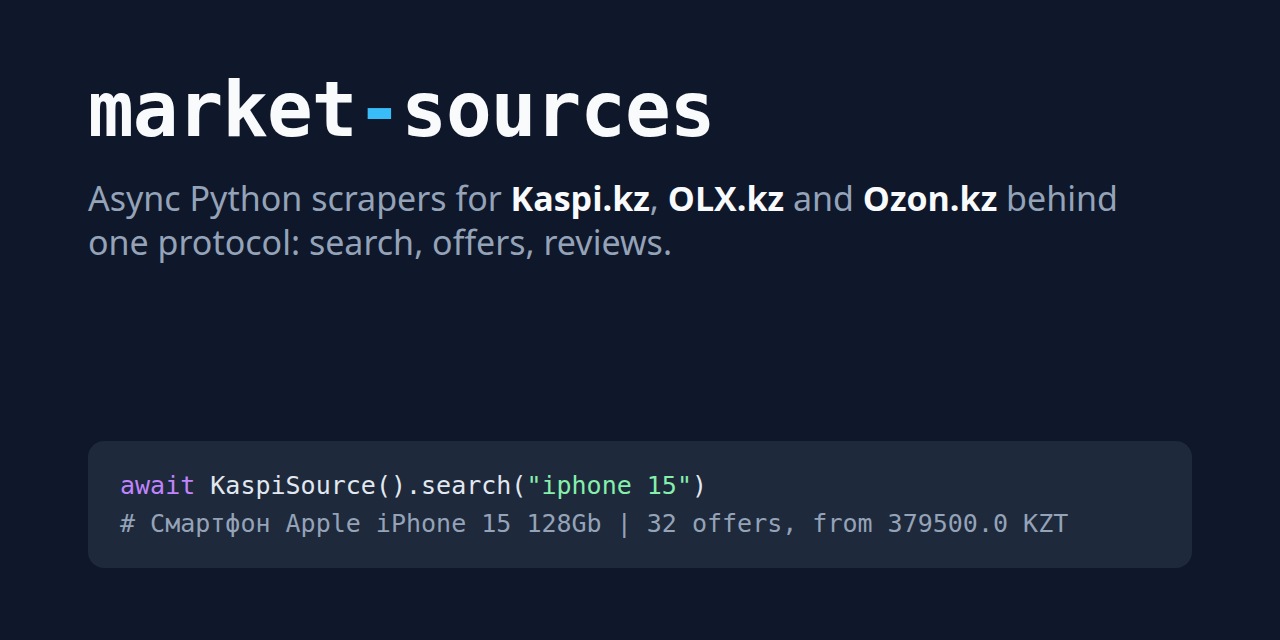
Async Python scrapers for Kaspi.kz, OLX.kz and Ozon.kz behind one ProductSource protocol.
Search a product, get every seller's offer with price and delivery, read reviews and specs. Built for people
who track prices and offers on Kazakhstan marketplaces: price monitors, deal bots, purchase research.
Under the adapters sit two reusable layers: PoliteClient, a paced, retrying async HTTP client, and
BrowserSession, a persistent headless Chromium for sites that need a real browser.
import asyncio
from market_sources import KaspiSource

async def main():
    kaspi = KaspiSource()
    products = await kaspi.search("iphone 15")
    offers = await kaspi.offers(products[0].product_id)
    cheapest = min(offers, key=lambda o: o.price)
    print(products[0].title, "|", len(offers), "offers, from", cheapest.price, cheapest.currency)
    await kaspi.aclose()

asyncio.run(main())
A real run on 2026-10-13 (Kaspi search took 1.4 s and returned 12 products):
Смартфон Apple iPhone 15 128Gb NanoSIM+eSIM черный | 32 offers, from 379500.0 KZT
Each offer is a plain Pydantic model:
RawOffer(source='kaspi', product_id='113137790', seller='Kaz_Phones', price=379500.0, currency='KZT',
         delivery='EXPRESS', in_stock=True, merchant_rating=4.8, merchant_review_count=32,
         delivery_date='2026-10-13', delivery_cost=995.0, ...)
Install
pip install market-sources                  # Kaspi; OLX needs the impersonate extra (below)
pip install "market-sources[impersonate]"   # + curl_cffi, so OLX.kz's WAF lets requests through
pip install "market-sources[browser]"       # + playwright, for Ozon.kz
playwright install chromium                 # once, for the browser extra
With uv: uv add "market-sources[impersonate,browser]". Latest code from GitHub:
pip install "git+https://github.com/octrow/market-sources".
Python 3.12+. Runtime dependencies are httpx and pydantic. Optional extras are imported lazily, so
import market_sources works without them.
Sources
| source | how it gets data | needs | notes |
|---|---|---|---|
KaspiSource |
Kaspi's internal JSON API over PoliteClient |
base install | search, offers, reviews, reviews_with_stats, specs; KASPI_PROXY env var for a proxy |
OlxSource |
OLX's public JSON API | impersonate extra |
CloudFront rejects httpx's TLS fingerprint; with curl_cffi installed the client impersonates Chrome automatically (a search took 1.9 s and returned 63 listings in the run above) |
OzonSource |
Ozon's composer API, read through a real browser | browser extra |
session saved to OZON_STATE_PATH (default ~/.config/market_sources/ozon_state.json); OZON_BASE_URL overrides the host |
Every source implements the same protocol, so consumer code doesn't care which site it talks to:
class ProductSource(Protocol):
    async def search(self, query: str, city: str | None = None) -> list[RawProduct]: ...
    async def offers(self, product_id: str) -> list[RawOffer]: ...
    async def reviews(self, product_id: str) -> list[RawReview]: ...
    async def specs(self, product_id: str) -> dict[str, str]: ...
Modules
| module | what it is |
|---|---|
market_sources.base |
ProductSource Protocol + RawProduct / RawOffer / RawReview / RawReviewStats |
market_sources.polite_http |
PoliteClient: semaphore + jittered delay + browser headers + proxy + retry/backoff |
market_sources.impersonate |
ImpersonateTransport: an httpx transport that sends through curl_cffi with a Chrome TLS fingerprint |
market_sources.playwright_session |
BrowserSession: lazy persistent Chromium, serialized navigation, ready hook, relaunch-retry |
market_sources.kaspi |
KaspiSource / KaspiClient / pure parse_*: internal JSON API |
market_sources.olx |
OlxSource / OlxClient / pure parse_*: public JSON API |
market_sources.ozon |
OzonSource / OzonBrowser / pure parse_*: composer API via browser |
How it differs from a plain httpx script or Scrapy
- A bare httpx request gets a 403. Each site has its own gate (Kaspi checks the referer, OLX fingerprints TLS, Ozon serves a JavaScript challenge). The adapters already pass them, and the reasons are written down below, so you don't rediscover them by trial.
- Scrapy is a crawler framework with its own runtime, pipelines and settings. This is a small async library you call from your own code (a bot, a FastAPI app, a cron script) and get Pydantic models back.
- Pacing is built in and hard to forget. Concurrency is capped inside the client, delays are jittered, and
Retry-Afteris honored, soasyncio.gatherover 40 pages won't hammer a site. - Raw data, not opinions. The models keep what the site said. Normalization, currency conversion, dedup and ranking are left to you.
Please use it responsibly: keep the default pacing, cache what you can, and respect each marketplace's terms.
Design rules
Every adapter is three files, and only one of them does I/O. client.py (or
browser.py) knows endpoints and nothing about shapes; parse.py is pure
functions over already-decoded dicts and never imports the client; source.py
wires them into a ProductSource. That split is what makes the parsers testable
against saved payloads with no network and no mocking.
Raw in, raw out. These models are deliberately source-shaped, not canonical. Normalization, currency conversion, dedup and ranking belong to the consumer — the library's job ends at "the site said this".
polite_http
- A bare
python-httpxUser-Agent gets 403'd by every site in scope. The browser UA is not politeness theatre, it is the price of a 200. Kaspi additionally gates onreferer— a page-matching referer is its entire anti-bot check, which is whyrequest()takesrefereras a first-class argument rather than making callers hand-roll the header. - Pacing is per logical request, not per attempt. One jittered
min_delay_s..max_delay_ssleep inside the semaphore, before the first attempt; retry backoff is additional sleep on top.max_delay_s=0disables pacing entirely (that is how the tests stay fast). - The semaphore is the flood guard, and it is small (2).
asyncio.gatherover 40 pages is one line of consumer code away at all times; the concurrency cap lives in the client so no consumer can forget it. - Retries never replay a side effect.
POST/PATCHare excluded by default; a caller who knows their POST is a read (Kaspi's offers endpoint) passesretry=Trueexplicitly. This is opt-in, one call at a time. - A 404 is an answer, not a hiccup. Only
429and5xx(plus transport errors) retry. Everything else raises throughraise_for_status()on the first attempt. Retry-Afterwins over the backoff formula (seconds or HTTP-date), clamped tobackoff_max_sso a hostileRetry-After: 86400cannot park the process for a day.- Backoff is exponential with jitter, capped:
backoff_base_s * 2**attemptplus up tobackoff_jitterof itself,min'd withbackoff_max_s. sleepandrngare injectable. Every pacing and backoff decision is therefore assertable without a clock — which is the only reason the retry schedule has tests at all.- One
AsyncClient, reused. The four originals built a freshhttpx.AsyncClientper request and threw away the connection pool every time. Callaclose()(or use the async context manager).
playwright_session
- Importing must never require playwright.
playwrightis imported inside the launch path, soimport market_sourcesworks on a machine with only the base deps — a consumer that only wants Kaspi and OLX installs nothing extra. There is a test that blocks the import to keep this true. - One page, therefore one lock. Every navigation mutates shared state
(cookies, history, the DOM the JSON is read off), so
fetch_textserializes behind anasyncio.Lock. Concurrency here is a correctness bug, not a speedup. - Do NOT route-block images/css/fonts. The anti-bot challenge loads its
assets through them; blocking earns a 403. This is the single most expensive
lesson encoded in this module, and the reason
LAUNCH_ARGShas no blocking. - The challenge is passed once per page, then cached.
prepare_pageis the hook (goto home, dwell, verify the title is not the anti-bot wall); its success is remembered until the session is torn down. - Stale session → full relaunch, not a retry in place. A
403/307or a "target closed" error means the cookie jar is dead; only a fresh browser+context+page fixes it, and only once per call. - Idle teardown takes the lock and detaches first. A headless Chromium
costs ~300 MB, so it closes after
idle_timeout_sand relaunches lazily. Two bugs from the original are fixed here: the idle task used tocancel()itself and thenawaitthe teardown (so theCancelledErrorlanded mid-close and left the browser process alive), and it tore the session down without the nav lock (so it could yank the page out from under an in-flight navigation).
Origin
Extracted from the author's buy-smarter project (src/buysmarter/sources/). The polite-HTTP and
browser-session design is informed by three more independent implementations of the same pattern in
olx-almaty-phone-analyzer and get_cool_event.
Changes from the original code
| change | reason |
|---|---|
PoliteClient replaces per-request httpx.AsyncClient() |
reuses the connection pool instead of discarding it per call; same headers/pacing |
retry/backoff is exponential + jittered, honors Retry-After |
originals used a flat 1.0 * (attempt+1) and ignored Retry-After — the audit's named gap |
Kaspi's offers POST passes retry=True |
preserves the original's retry-any-method behavior under the new "idempotent only" default |
KASPI_PROXY / OZON_BASE_URL read from the environment |
dropped the dependency on buy-smarter's config.get_settings(); still overridable per instance |
BrowserSession + prepare_page hook |
OzonBrowser is now site knowledge only (challenge + composer URL); the session machinery is shared with any future playwright source |
| dead-browser detection is message-based | it no longer requires a playwright.Error instance, so the state machine is testable with a fake page |
BrowserSessionError message is HTTP {status} for {url} |
was Ozon returned HTTP {status} for {path}; the class (OzonError) still carries the site identity |
every adapter grew aclose() |
there is now a pool/browser to close; the originals had nothing to release except Ozon's browser |
Tests
pytest — no network, no browser, no clock. HTTP is driven through an
httpx.AsyncBaseTransport double (not respx — one fewer dependency), the
browser through an injected page_factory, and time through injected sleep /
rng. Parser fixtures are minimal dicts built from the branches parse.py
actually reads.
uv run pytest
Contributing
See CONTRIBUTING.md. Report vulnerabilities privately: SECURITY.md.
License
1 maintainer

Metadata
1 maintainer
Release files for market-sources 0.1.1
For a detailed explanation of source distributions (sdists) and built distributions (wheels), please see the package formats documentation.
Source distribution (sdist)
| File | Size | Uploaded | |
|---|---|---|---|
| market_sources-0.1.1.tar.gz | 53.0 kB | Details |
Built distribution (wheel)
| File | Interpreter | ABI | Platform | Reset |
|---|---|---|---|---|
| market_sources-0.1.1-py3-none-any.whl | Python 3 | none | any | Details |
Total release size: 94.3 kB
Release files / market_sources-0.1.1.tar.gz
| Download URL | market_sources-0.1.1.tar.gz |
|---|---|
| Size | 53.0 kB |
| Tags | Source |
|
SHA-256 checksum How to use checksums |
f9fc9206041c5398113dcab228698f89ed3eb4932a168e78ff066b69675fc4bb
|
|
BLAKE2b-256 checksum How to use checksums |
229299c9b4697c24673faad6ff711af6b8a10e4c8a66ec7874661682ccf3ce8e
|
| Upload date | |
|
Uploaded using Trusted Publishing? What is trusted publishing? |
Yes |
| Uploaded via |
twine/7.0.0 CPython/3.13.14
|
Provenance
Provenance describes where a file came from. On PyPI, provenance is shared via attestations, which provide a verifiable record of the build or publishing details. View details, limitations and caveats.


PyPI Publish Attestation
PyPI verified that this artifact, at this checksum, originated from the publisher listed below.
Signed by GitHub Actions, verified by PyPI on Oct 13, 2026.
Transparency logRelease files / market_sources-0.1.1-py3-none-any.whl
| Download URL | market_sources-0.1.1-py3-none-any.whl |
|---|---|
| Size | 41.3 kB |
| Tags | Python 3 |
|
SHA-256 checksum How to use checksums |
44d240e3d14ba0d3293ca826d11d51ea6bc74dfc596a3ddbccd0d27349ad7b25
|
|
BLAKE2b-256 checksum How to use checksums |
9c11c53d065e1fa17d332617fcc2d0b9f47d305ab8c08b4a042ce3c279df2996
|
| Upload date | |
|
Uploaded using Trusted Publishing? What is trusted publishing? |
Yes |
| Uploaded via |
twine/7.0.0 CPython/3.13.14
|
Provenance
Provenance describes where a file came from. On PyPI, provenance is shared via attestations, which provide a verifiable record of the build or publishing details. View details, limitations and caveats.
PyPI Publish Attestation
PyPI verified that this artifact, at this checksum, originated from the publisher listed below.
Signed by GitHub Actions, verified by PyPI on Oct 13, 2026.
Transparency log













