
markovpath





A high-performance Python library for sequence probability estimation, next-state prediction, Markov attribution modeling, and AI agent trajectory analysis using Discrete-Time Markov Chains (DTMC).
markovpath is officially published and available on PyPI (Python Package Index).
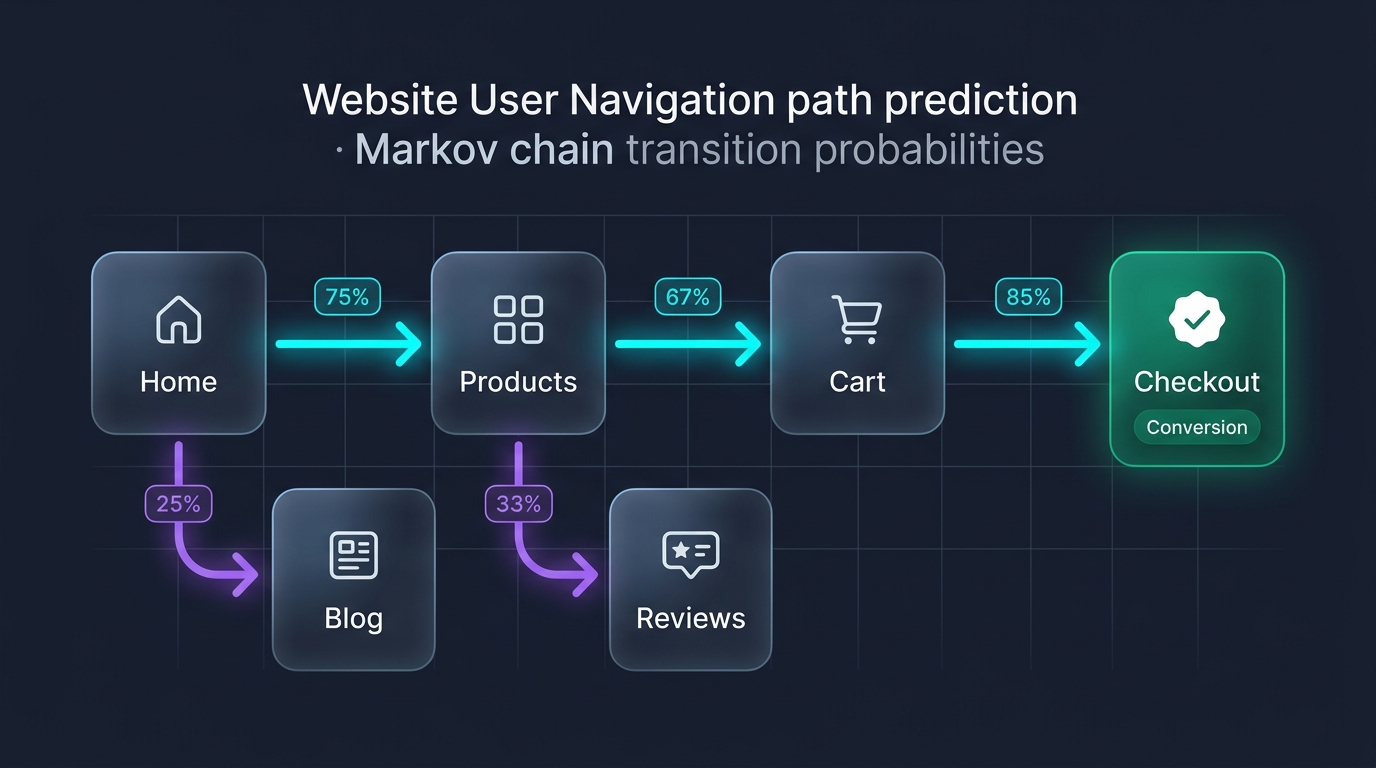
Rooted in peer-reviewed Web Usage Mining research (Sarukkai, 2000), markovpath provides a clean, vectorized, Scikit-learn-style API to model user navigation sessions, clickstreams, or AI decision traces.
🚀 Key Capabilities
- State Probability (Prior Distribution): Calculates the relative frequency distribution of states across all sessions.
- Transition Probability Matrix ($P$): Computes normalized, row-stochastic transition probabilities ($\sum_j P_{ij} = 1.0$) with optional self-loop modeling.
- Path / Trail Probability Scoring: Evaluates the joint probability $P(\text{Path})$ using the probability chain rule, with optional log-scale scoring to avoid numerical underflow on long sequences.
- Top-K Next-Link Prediction: Predicts and ranks the most probable next pages or actions given the current state.
- Multi-Touch Attribution (Removal Effect): Uses Absorbing Markov Chains $(I - Q)^{-1} R$ to calculate the exact conversion drop when a touchpoint is removed.
- Monte Carlo Path Simulation: Generates realistic synthetic user trails from learned transition distributions.
- Laplace Smoothing: Prevents zero-probability crashes on previously unseen state transitions.
🎯 Applications & Use Cases
1. 🤖 AI & Autonomous Agent Systems
- LLM Agent Trajectory Analysis & Pruning: Autonomous agents (e.g., ReAct, Tool-Calling Agents) follow sequential decision paths:
[Thought -> Search -> Read -> Code -> Test -> Exit].markovpathmodels agent traces to detect infinite loops ($A \to B \to A \to B$), score trajectory likelihood, and prune low-probability exploration branches in agent planning trees. - Model-Based Reinforcement Learning (RL): Bootstraps empirical transition matrices $P(s' \mid s, a)$ as environment priors for Markov Decision Processes (MDPs).
- Behavioral Anomaly & Bot Detection: Natural user navigation trails have high likelihood under the trained Markov model. Malicious bots or scrapers follow unnatural patterns that register as anomalous low-probability outliers.
- Synthetic Data Generation: Simulates realistic clickstreams for privacy-safe machine learning model training without exposing raw user logs.
2. 📊 Web Analytics & Marketing Attribution
- Multi-Touch Attribution (MTA): Moves beyond naive "first-click" or "last-click" heuristics by mathematically quantifying each marketing channel's true contribution via the Removal Effect.
- Conversion Rate & Funnel Optimization (CRO): Pinpoints friction points where users drop off from the purchase funnel to
exit. - Predictive Pre-fetching & Caching: Web browsers and CDNs can pre-load top predicted next pages (
model.predict_next()) to achieve near-instantaneous page transitions.
📦 Installation & PyPI Availability
The library is officially available on PyPI: 👉 https://pypi.org/project/markovpath/
Install it directly via pip:
pip install markovpath
To install or upgrade to the latest release:
pip install markovpath --upgrade
Requirements: Python >= 3.8, NumPy >= 1.20, Pandas >= 1.3
⚡ Quickstart
1. Basic Fitting & Next-State Prediction
from markovpath import MarkovPath

# Plain Python lists, NumPy arrays, or Pandas Series
paths = [
    ["Home", "Products", "Cart", "Checkout"],
    ["Home", "Products", "Reviews", "Products", "Cart"],
    ["Home", "Blog", "Home", "Products"],
    ["Home", "About"]
]

# Initialize and fit
model = MarkovPath(smoothing=1e-4)
model.fit(paths)

# Predict top 3 most likely next pages from "Products"
predictions = model.predict_next("Products", top_k=3)
print("Top next pages from 'Products':", predictions)
# -> [('Cart', 0.6666), ('Reviews', 0.3333)]
2. Inspecting Probabilities & Matrices
# Empirical State Probabilities
print("State Probabilities:")
print(model.state_probabilities)

# Transition Probability Matrix (Pandas DataFrame)
print("\nTransition Probability Matrix:")
print(model.transition_matrix)
3. Evaluating Path / Trail Probabilities
# Calculate joint trail probability
test_path = ["Home", "Products", "Cart"]
prob = model.score_path(test_path)
print(f"Path Probability: {prob:.6f}")

# Long sequences: Use log-scale to avoid underflow
log_likelihood = model.score_path(test_path, log_scale=True)
print(f"Log-Likelihood: {log_likelihood:.4f}")

# Batch scoring for multiple paths
scores = model.score_paths(paths)
4. Multi-Touch Attribution via Removal Effect
Quantify which touchpoints drive final conversions:
paths = [
    ["Facebook", "Google", "Cart"],
    ["Google", "Cart"],
    ["Organic", "Cart"],
    ["Facebook", "Organic"]
]
# 1 = converted, 0 = dropped off
conversions = [1, 1, 1, 0]

attribution_df = model.removal_effect(paths, conversions=conversions)
print(attribution_df)
Output:
    channel  removal_effect  attribution_weight  conversions_attributed
0    Google            0.60                0.40                     1.2
1  Facebook            0.50                0.33                     1.0
2   Organic            0.40                0.27                     0.8
5. Simulating User Journeys (Monte Carlo)
simulated_journey = model.simulate(
    start_state="Home",
    max_steps=10,
    stop_states={"Checkout", "About"},
    seed=42
)
print("Simulated Journey:", simulated_journey)
# -> ['Home', 'Products', 'Reviews', 'Products', 'Cart', 'Checkout']
📐 Mathematical Formulation
1. Markov Property
The probability of transitioning to state $S_{t+1}$ depends solely on the current state $S_t$: $$P(S_{t+1} = j \mid S_t = i, S_{t-1}, \dots, S_0) = P(S_{t+1} = j \mid S_t = i) = P_{ij}$$
2. Maximum Likelihood Transition Probability with Laplace Smoothing
$$P_{ij} = \frac{N(i \to j) + \alpha}{\sum_{k} N(i \to k) + |V| \alpha}$$ Where:
- $N(i \to j)$ is the frequency of observed transitions from $i$ to $j$.
- $|V|$ is the total number of distinct states.
- $\alpha \ge 0$ is the Laplace smoothing parameter (default
0.0). - Guarantee: For every non-terminal state $i$, $\sum_j P_{ij} = 1.0$.
3. Path / Trail Probability (Chain Rule)
$$P(S_0, S_1, \dots, S_T) = P(S_0) \times \prod_{t=0}^{T-1} P(S_{t+1} \mid S_t)$$ In log space: $$\ln P(\text{Path}) = \ln P(S_0) + \sum_{t=0}^{T-1} \ln P(S_{t+1} \mid S_t)$$
4. Absorbing Markov Chains for Attribution
Transition matrix partitioned into transient ($Q$) and absorbing ($R$) states: $$P = \begin{bmatrix} Q & R \ 0 & I \end{bmatrix}$$ The fundamental matrix $N = (I - Q)^{-1}$ yields absorption probabilities $B = N R$. Removing state $k$ recomputes conversion rate $CR_{-k}$, giving removal effect: $$RE_k = \frac{CR_{\text{total}} - CR_{-k}}{CR_{\text{total}}}$$
🔄 Legacy Migration from path_nav
If you previously used path_nav.py, your existing functions are fully supported with corrected mathematics:
# Legacy procedural style (still supported via path_nav)
import path_nav as nv

state_prob = nv.state_probability(df, 'path')
df = nv.add_start_end(df, 'path', 'conversions')
trans_df = nv.transition_probability(df, 'path')
path_df = nv.path_probability(df, 'path', trans_df)
To migrate to the modern OOP API:
# Recommended modern style
from markovpath import MarkovPath

model = MarkovPath().fit(df['path'])
matrix = model.transition_matrix
predictions = model.predict_next('Cart', top_k=3)
📚 Academic Citations & References
If you use markovpath in academic research or production systems, please cite the foundational literature:
-
Primary Reference (Link Prediction & Trail Modeling):
Sarukkai, R. R. (2000). Link prediction and path analysis using Markov chains. Computer Networks, 33(1–6), pp. 377–386.
DOI: 10.1016/S1389-1286(00)00044-X -
Web Navigation Mining Reference:
Borges, J., & Levene, M. (2000). Data mining of user navigation patterns. Advances in Web Usage Mining and Information Retrieval (WEBKDD'99), Springer LNAI 1836, pp. 92–112.
BibTeX:
@article{sarukkai2000link,
  title={Link prediction and path analysis using Markov chains},
  author={Sarukkai, Ramesh R},
  journal={Computer Networks},
  volume={33},
  number={1-6},
  pages={377--386},
  year={2000},
  publisher={Elsevier},
  doi={10.1016/S1389-1286(00)00044-X}
}
📄 License
Distributed under the MIT License. See LICENSE for details.
1 maintainer

Metadata
1 maintainer
Release files for markovpath 2.0.2
For a detailed explanation of source distributions (sdists) and built distributions (wheels), please see the package formats documentation.
Source distribution (sdist)
| File | Size | Uploaded | Provenance | Actions |
|---|---|---|---|---|
| markovpath-2.0.2.tar.gz | 19.2 kB | Without provenance | Details for markovpath-2.0.2.tar.gz |
Built distribution (wheel)
| File | Interpreter | ABI | Platform | Actions Reset |
|---|---|---|---|---|
| markovpath-2.0.2-py3-none-any.whl | Python 3 | none | any | Details for markovpath-2.0.2-py3-none-any.whl |
Total release size: 33.9 kB
Release files / markovpath-2.0.2.tar.gz
| Download URL | markovpath-2.0.2.tar.gz |
|---|---|
| Size | 19.2 kB |
| Tags | Source |
|
SHA-256 checksum How to use checksums |
d6c32d1fc857bfeeb38d4ede0492d70ee2f4ecf295a430dc67185e4189eba1df
|
|
BLAKE2b-256 checksum How to use checksums |
56451e05b4b418f6efac2290106bd4253abc6582b7103e9e4370bc51498d3711
|
| Upload date | |
|
Uploaded using Trusted Publishing? What is trusted publishing? |
No |
| Uploaded via |
twine/6.2.0 CPython/3.9.6
|
Release files / markovpath-2.0.2-py3-none-any.whl
| Download URL | markovpath-2.0.2-py3-none-any.whl |
|---|---|
| Size | 14.7 kB |
| Tags | Python 3 |
|
SHA-256 checksum How to use checksums |
faa94f17f00edaf0ba05daf4cab46b1a833d3666069e9108a5accd3da1552890
|
|
BLAKE2b-256 checksum How to use checksums |
c24bbb22083f5a904eb2c04a6f50a4e9ccec504b09895d7746b926824355d7fe
|
| Upload date | |
|
Uploaded using Trusted Publishing? What is trusted publishing? |
No |
| Uploaded via |
twine/6.2.0 CPython/3.9.6
|
Security for markovpath 2.0.2
Provenance
Provenance describes where a file came from. On PyPI, provenance is shared via attestations, which provide a verifiable record of the build or publishing details. View details, limitations and caveats.
No provenance found
None of the files in this release were uploaded with provenance metadata.
A note on package security
PyPI is a repository for distributing packages, not a service for auditing them. While third-party security researchers and our staff do their best to detect and remove malicious packages, PyPI cannot guarantee the quality, security or suitability of any given package.
To learn more about protecting yourself from malicious actors, visit our package security documentation.














