
Masked Autoencoders: An Updated PyTorch Implementation for Single GPU with 4GB Memory
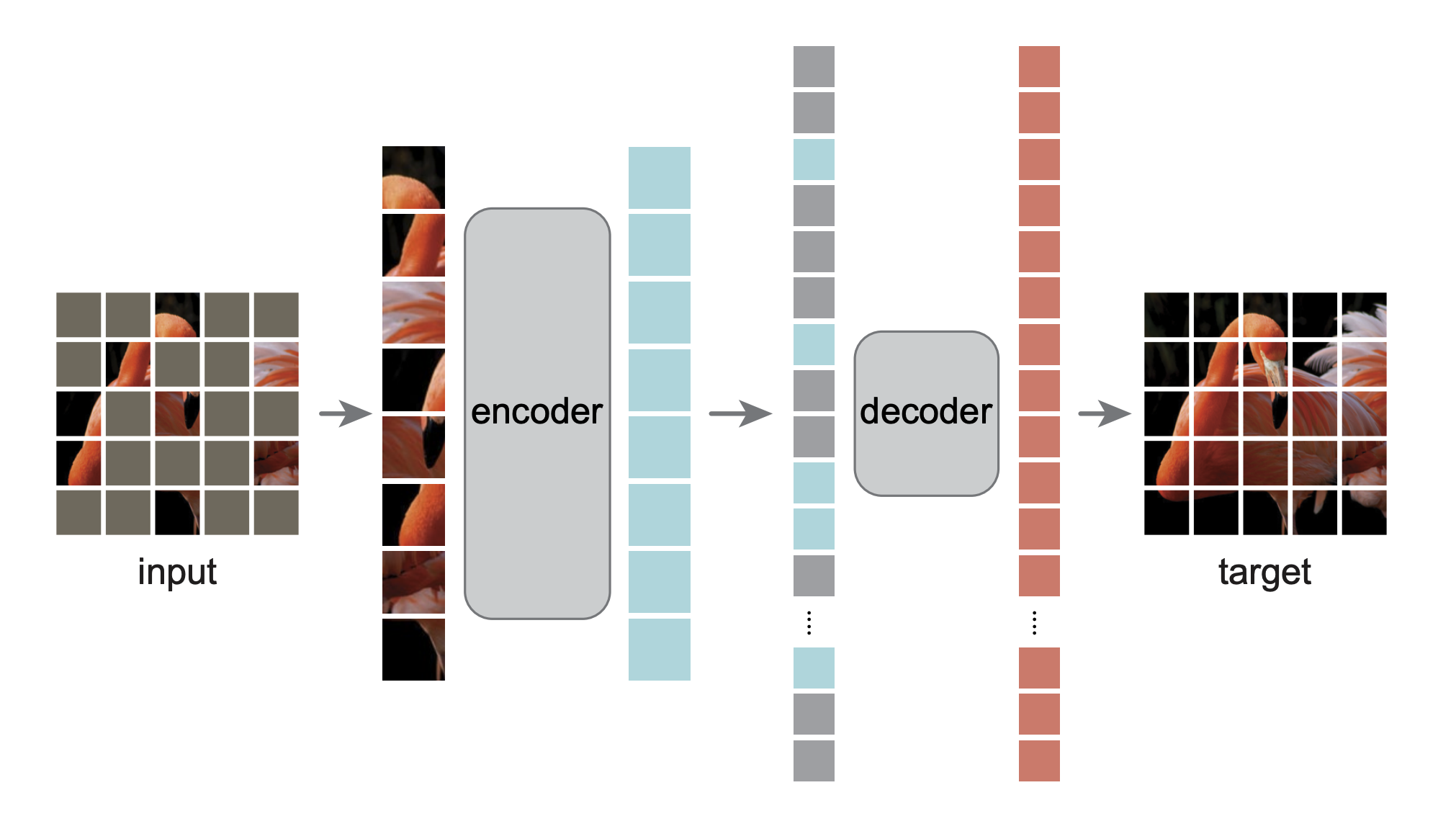
This is an updated PyTorch/GPU re-implementation of the paper Masked Autoencoders Are Scalable Vision Learners for consumer GPU user for learning purpose.
- Updated to latest Torch and Timm
- Use Imagenette as the default dataset so that you can run the training in a consumer GPU to debug the code immediately without downloading the huge Imagenet
Command to Train the model:
pip install maskedautoencoder

git checkout https://github.com/henrywoo/mae/
cd mae
pip install -r requirements.txt
bash run.sh
Screenshot of training it with a 4G GPU laptop:

One liner change to replace ImageNette with ImageNet1K:
Repalce
dataset_train = get_cv_dataset(path=DS_PATH_IMAGENETTE, transform=transform_train, name="full_size")
with
dataset_train = get_cv_dataset(path=DS_PATH_IMAGENET1K, transform=transform_train)
Catalog
- Visualization demo
- Pre-trained checkpoints + fine-tuning code
- Pre-training code
Visualization demo
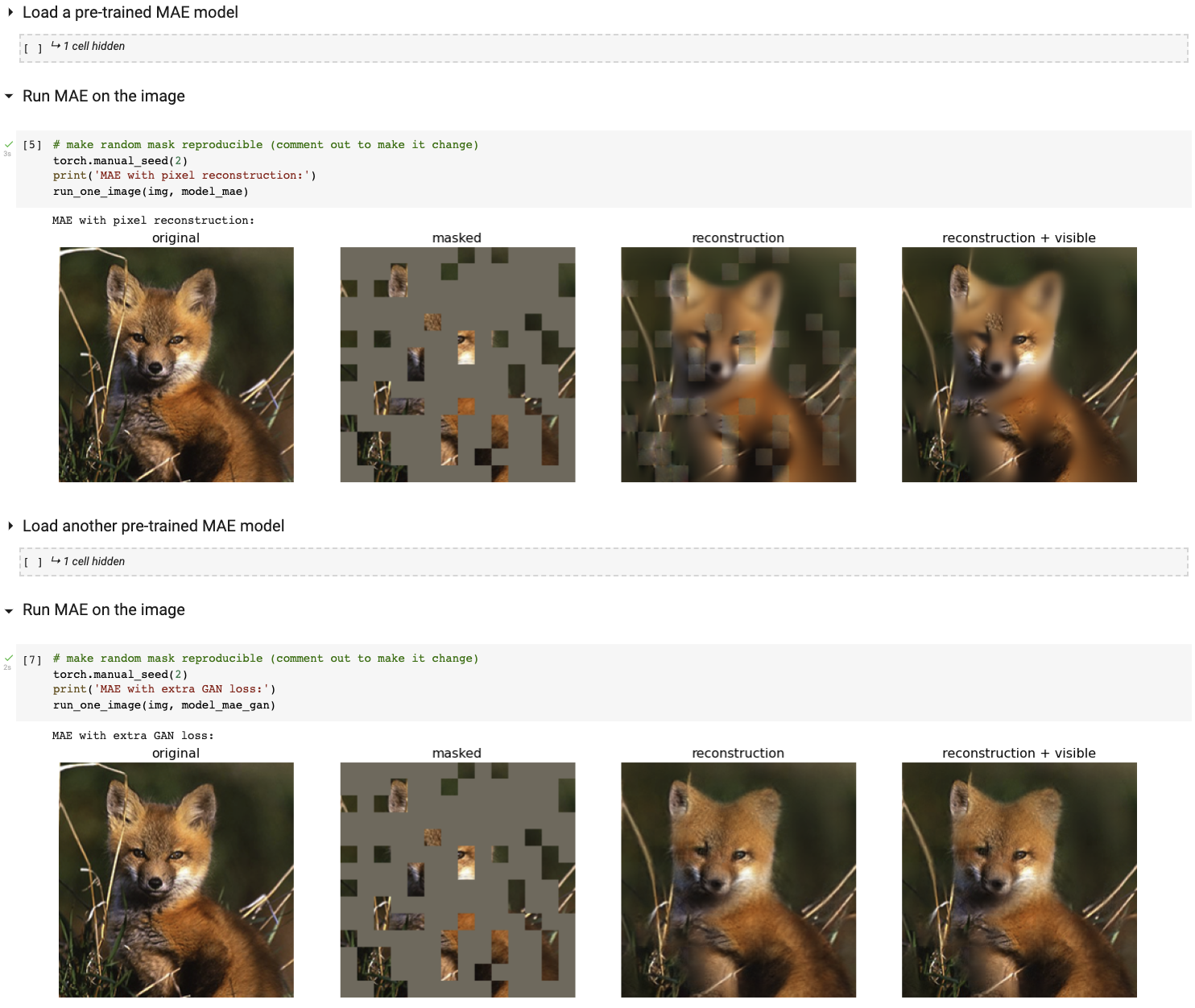
Run our interactive visualization demo using Colab notebook (no GPU needed):
Fine-tuning with pre-trained checkpoints
The following table provides the pre-trained checkpoints used in the paper, converted from TF/TPU to PT/GPU:
| ViT-Base | ViT-Large | ViT-Huge | |
|---|---|---|---|
| pre-trained checkpoint | download | download | download |
| md5 | 8cad7c | b8b06e | 9bdbb0 |
The fine-tuning instruction is in FINETUNE.md.
By fine-tuning these pre-trained models, we rank #1 in these classification tasks (detailed in the paper):
| ViT-B | ViT-L | ViT-H | ViT-H448 | prev best | |
|---|---|---|---|---|---|
| ImageNet-1K (no external data) | 83.6 | 85.9 | 86.9 | 87.8 | 87.1 |
| following are evaluation of the same model weights (fine-tuned in original ImageNet-1K): | |||||
| ImageNet-Corruption (error rate) | 51.7 | 41.8 | 33.8 | 36.8 | 42.5 |
| ImageNet-Adversarial | 35.9 | 57.1 | 68.2 | 76.7 | 35.8 |
| ImageNet-Rendition | 48.3 | 59.9 | 64.4 | 66.5 | 48.7 |
| ImageNet-Sketch | 34.5 | 45.3 | 49.6 | 50.9 | 36.0 |
| following are transfer learning by fine-tuning the pre-trained MAE on the target dataset: | |||||
| iNaturalists 2017 | 70.5 | 75.7 | 79.3 | 83.4 | 75.4 |
| iNaturalists 2018 | 75.4 | 80.1 | 83.0 | 86.8 | 81.2 |
| iNaturalists 2019 | 80.5 | 83.4 | 85.7 | 88.3 | 84.1 |
| Places205 | 63.9 | 65.8 | 65.9 | 66.8 | 66.0 |
| Places365 | 57.9 | 59.4 | 59.8 | 60.3 | 58.0 |
Pre-training
The pre-training instruction is in PRETRAIN.md.
License
This project is under the CC-BY-NC 4.0 license. See LICENSE for details.
Other Versions
- The original version: PyTorch Version
- Other version: TF, MAE-pytorch 1, MAE-pytorch 2
1 maintainer

Metadata
1 maintainer
Release files for maskedautoencoder 0.0.1
For a detailed explanation of source distributions (sdists) and built distributions (wheels), please see the package formats documentation.
Built distribution (wheel)
| File | Interpreter | ABI | Platform | Actions Reset |
|---|---|---|---|---|
| maskedautoencoder-0.0.1-py3-none-any.whl | Python 3 | none | any | Details for maskedautoencoder-0.0.1-py3-none-any.whl |
Release files / maskedautoencoder-0.0.1-py3-none-any.whl
| Download URL | maskedautoencoder-0.0.1-py3-none-any.whl |
|---|---|
| Size | 36.0 kB |
| Tags | Python 3 |
|
SHA-256 checksum How to use checksums |
e93d3921d7bdff8f66b95108797442c05a05e8e36d06856919f0ffb6cd94d329
|
|
BLAKE2b-256 checksum How to use checksums |
6f7641741bd1350cc42aacd6ce3e9fc8b962a201eb88fde8a53c5def130b4393
|
| Upload date | |
|
Uploaded using Trusted Publishing? What is trusted publishing? |
No |
| Uploaded via |
twine/5.1.0 CPython/3.10.13
|
Security for maskedautoencoder 0.0.1
Provenance
Provenance describes where a file came from. On PyPI, provenance is shared via attestations, which provide a verifiable record of the build or publishing details. View details, limitations and caveats.
No provenance found
None of the files in this release were uploaded with provenance metadata.
A note on package security
PyPI is a repository for distributing packages, not a service for auditing them. While third-party security researchers and our staff do their best to detect and remove malicious packages, PyPI cannot guarantee the quality, security or suitability of any given package.
To learn more about protecting yourself from malicious actors, visit our package security documentation.














