
This release is a pre-release and may not be stable for production use.
MAT-classification: Analysis and Classification methods for Multiple Aspect Trajectory Data Mining [MAT-Tools Framework]
[Publication] [Bibtex] [GitHub] [PyPi]
The present package offers a tool, to support the user in the task of classification of multiple aspect trajectories. It integrates into a unique framework for multiple aspects trajectories and in general for multidimensional sequence data mining methods.
Created on Dec, 2023 Copyright (C) 2023, License GPL Version 3 or superior (see LICENSE file)
Installation
Install directly from PyPi repository, or, download from github. (python >= 3.7 required)
pip3 install mat-classification
Getting Started
On how to use this package, see MAT-classification-Tutorial.ipynb
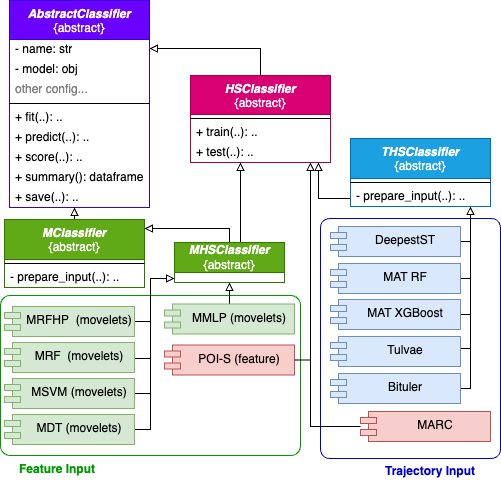
Available Classifiers:
Movelet-Based:
- MMLP (Movelet): Movelet Multilayer-Perceptron (MLP) with movelets features. The models were implemented using the Python language, with the keras, fully-connected hidden layer of 100 units, Dropout Layer with dropout rate of 0.5, learning rate of 10−3 and softmax activation function in the Output Layer. Adam Optimization is used to avoid the categorical cross entropy loss, with 200 of batch size, and a total of 200 epochs per training. [REFERENCE]
- MRF (Movelet): Movelet Random Forest (RF) with movelets features, that consists of an ensemble of 300 decision trees. The models were implemented using the Python language, with the keras. [REFERENCE]
- MSVN (Movelet): Movelet Support Vector Machine (SVM) with movelets features. The models were implemented using the Python language, with the keras, linear kernel and default structure. Other structure details are default settings. [REFERENCE]
Feature-Based:
- POI-S: Frequency-based method to extract features of trajectory datasets (TF-IDF approach), the method runs one dimension at a time (or more if concatenated). The models were implemented using the Python language, with the keras. [REFERENCE]
Trajectory-Based:
- MARC: Uses word embeddings for trajectory classification. It encapsulates all trajectory dimensions: space, time and semantics, and uses them as input to a neural network classifier, and use the geoHash on the spatial dimension, combined with others. The models were implemented using the Python language, with the keras. [REFERENCE]
- TRF: Random Forest for trajectory data (TRF). Find the optimal set of hyperparameters for each model, applying the grid-search technique: varying number of trees (ne), the maximum number of features to consider at every split (mf), the maximum number of levels in a tree (md), the minimum number of samples required to split a node (mss), the minimum number of samples required at each leaf node (msl), and finally, the method of selecting samples for training each tree (bs). [REFERENCE]
- TXGBost: Find the optimal set of hyperparameters for each model, applying the grid-search technique: number of estimators (ne), the maximum depth of a tree (md), the learning rate (lr), the gamma (gm), the fraction of observations to be randomly samples for each tree (ss), the sub sample ratio of columns when constructing each tree (cst), the regularization parameters (l1) and (l2). [REFERENCE]
- BiTuler: Find the optimal set of hyperparameters for each model, applying the grid-search technique: keeps 64 as the batch size and 0.001 as the learning rate and vary the units (un) of the recurrent layer, the embedding size to each attribute (es) and the dropout (dp). [REFERENCE]
- Tulvae: Find the optimal set of hyperparameters for each model, applying the grid-search technique: keeps 64 as the batch size and 0.001 as the learning rate and vary the units (un) of the recurrent layer, the embedding size to each attribute (es), the dropout (dp), and latent variable (z). [REFERENCE]
- DeepeST: DeepeST employs a Recurrent Neural Network (RNN), both LSTM and Bidirectional LSTM (BLSTM). Find the optimal set of hyperparameters for each model, applying the grid-search technique: keeps 64 as the batch size and 0.001 as the learning rate and vary the units (un) of the recurrent layer, the embedding size to each attribute (es) and the dropout (dp). [REFERENCE]
Available Scripts (#TODO update):
By installing the package the following python scripts will be installed for use in system command line tools:
MAT-TC.py: Script to run classifiers on trajectory datasets, for details type:MAT-TC.py --help;MAT-MC.py: Script to run movelet-based classifiers on trajectory datasets, for details type:MAT-MC.py --help;POIS-TC.py: Script to run POI-F/POI-S classifiers on the methods feature matrix, for details type:POIS-TC.py --help;MARC.py: Script to run MARC classifier on trajectory datasets, for details type:MARC.py --help.
One script for running the POI-F/POI-S method:
POIS.py: Script to run POI-F/POI-S feature extraction methods (poi,npoi, andwnpoi), for details type:POIS.py --help.
And one script for merging movelet resulting matrices:
MAT-MergeDatasets.py: Script to join all class train.csv and test.csv of movelets for using as input into a classifier, for details type:MAT-MergeDatasets.py --help.
Citing
If you use mat-classification please cite the following paper:
- Portela, T. T.; Machado, V. L.; Renso, C. Unified Approach to Trajectory Data Mining and Multi-Aspect Trajectory Analysis with MAT-Tools Framework. In: SIMPÓSIO BRASILEIRO DE BANCO DE DADOS (SBBD), 39. , 2024, Florianópolis/SC. [Bibtex]
Collaborate with us
Any contribution is welcome. This is an active project and if you would like to include your code, feel free to fork the project, open an issue and contact us.
Feel free to contribute in any form, such as scientific publications referencing this package, teaching material and workshop videos.
Related packages
This package is part of MAT-Tools Framework for Multiple Aspect Trajectory Data Mining, check the guide project:
- mat-tools: Reference guide for MAT-Tools Framework repositories
Change Log
This is a package under construction, see CHANGELOG.md
1 maintainer

Metadata
1 maintainer
Release files for mat-classification 0.1rc1
For a detailed explanation of source distributions (sdists) and built distributions (wheels), please see the package formats documentation.
Source distribution (sdist)
| File | Size | Uploaded | Provenance | |
|---|---|---|---|---|
| mat_classification-0.1rc1.tar.gz | 78.1 MB | Without provenance | Details |
Built distribution (wheel)
| File | Interpreter | ABI | Platform | Reset |
|---|---|---|---|---|
| mat_classification-0.1rc1-py3-none-any.whl | Python 3 | none | any | Details |
Total release size: 78.2 MB
Release files / mat_classification-0.1rc1.tar.gz
| Download URL | mat_classification-0.1rc1.tar.gz |
|---|---|
| Size | 78.1 MB |
| Tags | Source |
|
SHA-256 checksum How to use checksums |
e1f14845624ceb3b0e362a40ba1c8ea8cd5575f5e59e27a483c11dcc9f0f0339
|
|
BLAKE2b-256 checksum How to use checksums |
2618a6db534db2e5c47a8aebdc2bcb54216fbbfd55c31b2d67e429da1978bcb0
|
| Upload date | |
|
Uploaded using Trusted Publishing? What is trusted publishing? |
No |
| Uploaded via |
twine/5.1.1 CPython/3.9.13
|
Release files / mat_classification-0.1rc1-py3-none-any.whl
| Download URL | mat_classification-0.1rc1-py3-none-any.whl |
|---|---|
| Size | 128.3 kB |
| Tags | Python 3 |
|
SHA-256 checksum How to use checksums |
ce0cf4712b5a33588c56b5c85cda66cf17fea445cc55c1a5e68d4915cd63ba9b
|
|
BLAKE2b-256 checksum How to use checksums |
870f0723ea32b189edbc22838ce27bc579608c81cdedd4790fb80ee2e15b6cd8
|
| Upload date | |
|
Uploaded using Trusted Publishing? What is trusted publishing? |
No |
| Uploaded via |
twine/5.1.1 CPython/3.9.13
|
Security for mat-classification 0.1rc1
Provenance
Provenance describes where a file came from. On PyPI, provenance is shared via attestations, which provide a verifiable record of the build or publishing details. View details, limitations and caveats.
No provenance found
None of the files in this release were uploaded with provenance metadata.
A note on package security
PyPI is a repository for distributing packages, not a service for auditing them. While third-party security researchers and our staff do their best to detect and remove malicious packages, PyPI cannot guarantee the quality, security or suitability of any given package.
To learn more about protecting yourself from malicious actors, visit our package security documentation.














