

Material Definition with Automatic Differentiation.





matADi is a Python package for the definition of a constitutive hyperelastic material formulation by a strain energy density function. Both gradient (stress) and hessian (elasticity tensor) are carried out by Automatic Differentiation (AD) using casADi [1] as a backend. A high-level interface for hyperelastic materials based on the deformation gradient exists. Several isotropic hyperelastic material formulations like the Neo-Hookean or the Ogden model are included in the model library. Gradient and hessian methods allow input data with trailing axes which is especially useful for Python-based finite element modules, e.g. scikit-fem or FElupe. Mixed-field formulations suitable for nearly-incompressible material behavior are supported as well as single-field formulations based on the deformation gradient. A numerical lab is included to run, plot and analyze homogeneous uniaxial, equi-biaxial, planar shear and simple shear load cases.
Installation
Install matADi from PyPI via pip.
pip install matadi
Usage
First, a symbolic variable on which our strain energy function will be based on has to be created.
Note: A variable of matADi is an instance of a symbolic variable of casADi (casadi.SX.sym). Most (but not all) of matadi.math functions are simple links to (symbolic) casADi-functions.
from matadi import Variable, Material
from matadi.math import det, transpose, trace

F = Variable("F", 3, 3)
Next, take your favorite paper on hyperelasticity or be creative and define your own strain energy density function as a function of some variables x (where x is always a list of variables).
def neohooke(x, C10=0.5, bulk=200.0):
    """Strain energy density function of a nearly-incompressible
    Neo-Hookean isotropic hyperelastic material formulation."""

    F = x[0]

    J = det(F)
    C = transpose(F) @ F

    return C10 * (J ** (-2 / 3) * trace(C) - 3) + bulk * (J - 1) ** 2 / 2
With this simple Python function at hand, we create an instance of a Material, which allows extra args and kwargs to be passed to our strain energy function. This instance now enables the evaluation of both gradient (stress) and hessian (elasticity) via methods based on automatic differentiation - optionally also on input data containing trailing axes. If necessary, the strain energy density function itself will be evaluated on input data with optional trailing axes by the function method.
Mat = Material(
    x=[F],
    fun=neohooke,
    kwargs={"C10": 0.5, "bulk": 10.0},
)

# init some random deformation gradients
import numpy as np

defgrad = np.random.rand(3, 3, 5, 100) - 0.5

for a in range(3):
    defgrad[a, a] += 1.0

W = Mat.function([defgrad])[0]
P = Mat.gradient([defgrad])[0]
A = Mat.hessian([defgrad])[0]
In a similar way, gradient-vector-products and hessian-vector-products are accessible via gradient_vector_product and hessian_vector_product methods, respectively.
v = np.random.rand(3, 3, 5, 100) - 0.5
u = np.random.rand(3, 3, 5, 100) - 0.5

W   = Mat.function([defgrad])[0]
dW  = Mat.gradient_vector_product([defgrad], [v])[0]
DdW = Mat.hessian_vector_product([defgrad], [v], [u])[0]
Template classes for hyperelasticity
matADi provides several template classes suitable for hyperelastic materials. Some isotropic hyperelastic material formulations are located in matadi.models (see list below). These strain energy functions have to be passed as the fun argument into an instance of MaterialHyperelastic. Usage is exactly the same as described above. To convert a hyperelastic material based on the deformation gradient into a mixed three-field formulation suitable for nearly-incompressible behavior (displacements, pressure and volume ratio) an instance of a MaterialHyperelastic class has to be passed to ThreeFieldVariation. For plane strain or plane stress use MaterialHyperelasticPlaneStrain, MaterialHyperelasticPlaneStressIncompressible or MaterialHyperelasticPlaneStressLinearElastic instead of MaterialHyperelastic. For plane strain displacements, pressure and volume ratio mixed-field formulations use ThreeFieldVariationPlaneStrain. For a two-field formulation (displacements, pressure) use TwoFieldVariation on top of MaterialHyperelastic.
from matadi import MaterialHyperelastic, ThreeFieldVariation
from matadi.models import neo_hooke

# init some random data
pressure = np.random.rand(5, 100)
volratio = np.random.rand(5, 100) / 10 + 1

kwargs = {"C10": 0.5, "bulk": 20.0}

NH = MaterialHyperelastic(fun=neo_hooke, **kwargs)

W = NH.function([defgrad])[0]
P = NH.gradient([defgrad])[0]
A = NH.hessian([defgrad])[0]

NH_upJ = ThreeFieldVariation(NH)

W_upJ = NH_upJ.function([defgrad, pressure, volratio])
P_upJ = NH_upJ.gradient([defgrad, pressure, volratio])
A_upJ = NH_upJ.hessian([defgrad, pressure, volratio])
The output of NH_upJ.gradient([defgrad, pressure, volratio]) is a list with gradients of the functional as [dWdF, dWdp, dWdJ]. Hessian entries are provided as a list of upper triangle entries, e.g. NH_upJ.hessian([defgrad, pressure, volratio]) returns [d2WdFdF, d2WdFdp, d2WdFdJ, d2Wdpdp, d2WdpdJ, d2WdJdJ].
Available isotropic hyperelastic material models:
- Linear Elastic (code)
- Saint Venant Kirchhoff (code)
- Neo-Hooke (code)
- Mooney-Rivlin (code)
- Yeoh (code)
- Third-Order-Deformation (James-Green-Simpson) (code)
- Ogden (code)
- Arruda-Boyce (code)
- Extended-Tube (code)
- Van-der-Waals (Kilian) (code)
Available anisotropic hyperelastic material models:
- Fiber (code)
- Fiber-family (+/- combination of single Fiber) (code)
- Holzapfel Gasser Ogden (code)
Available micro-sphere hyperelastic frameworks (Miehe, Göktepe, Lulei) [2]:
Available micro-sphere hyperelastic material models (Miehe, Göktepe, Lulei) [2]:
Any user-defined isotropic hyperelastic strain energy density function may be passed as the fun argument of MaterialHyperelastic by using the following template:
def fun(F, **kwargs):
    # user code
    return W
In order to apply the above material model only on the isochoric part of the deformation gradient [3], use the decorator @isochoric_volumetric_split. If the keyword bulk is passed, an additional volumetric strain energy function is added to the base material formulation.
from matadi.models import isochoric_volumetric_split
from matadi.math import trace, transpose

@isochoric_volumetric_split
def nh(F, C10=0.5):
    # user code of strain energy function, e.g. neo-hooke
    return C10 * (trace(transpose(F) @ F) - 3)

NH = MaterialHyperelastic(nh, C10=0.5, bulk=200.0)
Lab
In matADi's Lab 🥼 numeric experiments on homogeneous loadcases on compressible or nearly-incompressible material formulations are performed. For incompressible materials use LabIncompressible instead. Let's take the non-affine micro-sphere material model suitable for rubber elasticity with parameters from [2, Fig. 19] and run uniaxial, biaxial and planar shear tests.
from matadi import Lab, MaterialHyperelastic
from matadi.models import miehe_goektepe_lulei

mat = MaterialHyperelastic(
    miehe_goektepe_lulei,
    mu=0.1475,
    N=3.273,
    p=9.31,
    U=9.94,
    q=0.567,
    bulk=5000.0,
)

lab = Lab(mat)
data = lab.run(
    ux=True,
    bx=True,
    ps=True,
    shear=True,
    stretch_min=1.0,
    stretch_max=2.0,
    shear_max=1.0,
)
fig, ax = lab.plot(data, stability=True)
fig2, ax2 = lab.plot_shear(data)
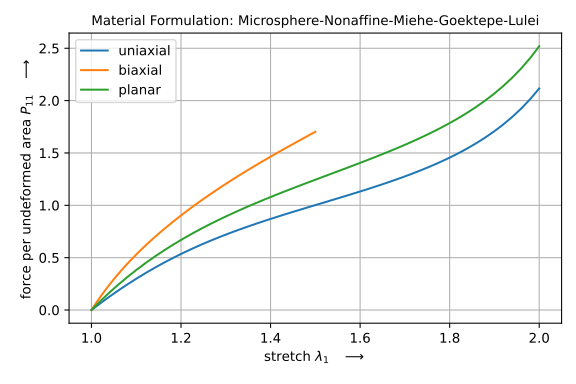
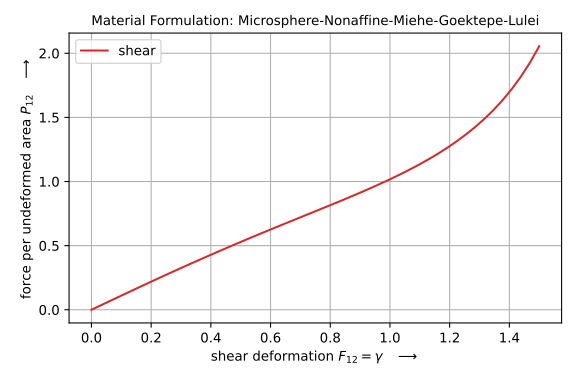
Unstable states of deformation can be indicated as dashed lines with the stability argument lab.plot(data, stability=True). This checks whether all incremental stretches due to a small superposed normal force in one direction are positive.
Hints and usage in FEM modules
For tensor-valued material definitions use MaterialTensor (e.g. any stress-strain relation). Also, please have a look at casADi's documentation. It is very powerful but unfortunately does not support all the Python stuff you would expect. For example Python's default if-else-statements can't be used in combination with symbolic conditions (use math.if_else(cond, if_true, if_false) instead). Contrary to casADi, the gradient of the eigenvalue function is stabilized by a perturbation of the diagonal components.
A Material with state variables
A generalized material model with optional state variables, optionally for the (u/p)-formulation, is created by an instance of MaterialTensor. If the argument triu is set to True the gradient method returns only the upper triangle entries of the gradient components. If some of the input variables are internal state variables the number of these variables have to be passed to the optional argument statevars. While the hyperelastic material classes are defined by a strain energy function, this one is defined by the first Piola-Kirchhoff stress tensor. Internally, state variables are equal to default variables but they are excluded from gradient calculations. State variables may also be used as placeholders for additional quantities, e.g. the initial deformation gradient at the beginning of an increment or the time increment. Hence, it is a very flexible class not restricted to hyperelasticity. For consistency, the methods gradient and hessian of a tensor-based material refer to the gradient and hessian of the strain energy function.
Included pseudo-elastic material models:
Included viscoelastic material models:
Included other material models:
import numpy as np

from matadi.models import (
    displacement_pressure_split, neo_hooke, volumetric, ogden_roxburgh
)
from matadi import MaterialTensor, Variable
from matadi.math import det, gradient

F = Variable("F", 3, 3)
z = Variable("z", 1, 1)

@displacement_pressure_split
def fun(x, C10=0.5, bulk=5000, r=3, m=1, beta=0):
    "Strain energy function: Neo-Hooke & Ogden-Roxburgh."

    # split `x` into the deformation gradient and the state variable
    F, Wmaxn = x[0], x[-1]

    # isochoric and volumetric parts of the hyperelastic
    # strain energy function
    W = neo_hooke(F, C10)
    U = volumetric(det(F), bulk)

    # pseudo-elastic softening function
    eta, Wmax = ogden_roxburgh(W, Wmaxn, r, m, beta)

    # first Piola-Kirchhoff stress and updated state variable
    # for a pseudo-elastic material formulation
    return eta * gradient(W, F) + gradient(U, F), Wmax

# get pressure variable from augmented function
p = fun.p

# Material as a function of `F` and `p`
# with **one** additional state variable `z`
NH = MaterialTensor(x=[F, p, z], fun=fun, triu=True, statevars=1)

defgrad = np.random.rand(3, 3, 5, 100) - 0.5
pressure = np.random.rand(1, 5, 100)
statevars = np.random.rand(1, 1, 5, 100)

for a in range(3):
    defgrad[a, a] += 1.0

dWdF, dWdp, statevars_new = NH.gradient([defgrad, pressure, statevars])
d2WdFdF, d2WdFdp, d2Wdpdp = NH.hessian([defgrad, pressure, statevars])
The Neo-Hooke, the MORPH and the Finite-Strain-Viscoelastic [4] material model formulations are available as ready-to-go materials in matadi.models as:
Hint: The state variable concept is also implemented for the Material class.
Simple examples for using matadi with scikit-fem as well as with felupe are shown in the Discussion section.
References
[1] J. A. E. Andersson, J. Gillis, G. Horn, J. B. Rawlings, and M. Diehl, CasADi - A software framework for nonlinear optimization and optimal control, Math. Prog. Comp., vol. 11, no. 1, pp. 1–36, 2019,

[2] C. Miehe, S. Göktepe and F. Lulei, A micro-macro approach to rubber-like materials. Part I: the non-affine micro-sphere model of rubber elasticity, Journal of the Mechanics and Physics of Solids, vol. 52, no. 11. Elsevier BV, pp. 2617–2660, Nov. 2004.

[3] J. C. Simo, R. L. Taylor, and K. S. Pister, Variational and projection methods for the volume constraint in finite deformation elasto-plasticity, Computer Methods in Applied Mechanics and Engineering, vol. 51, no. 1–3, pp. 177–208, Sep. 1985,

[4] A. V. Shutov, R. Landgraf, and J. Ihlemann, An explicit solution for implicit time stepping in multiplicative finite strain viscoelasticity, Computer Methods in Applied Mechanics and Engineering, vol. 265. Elsevier BV, pp. 213–225, Oct. 2013,

1 maintainer

Metadata
1 maintainer
Release files for matadi 0.5.0
For a detailed explanation of source distributions (sdists) and built distributions (wheels), please see the package formats documentation.
Source distribution (sdist)
| File | Size | Uploaded | |
|---|---|---|---|
| matadi-0.5.0.tar.gz | 47.8 kB | Details |
Built distribution (wheel)
| File | Interpreter | ABI | Platform | Reset |
|---|---|---|---|---|
| matadi-0.5.0-py3-none-any.whl | Python 3 | none | any | Details |
Total release size: 90.3 kB
Release files / matadi-0.5.0.tar.gz
| Download URL | matadi-0.5.0.tar.gz |
|---|---|
| Size | 47.8 kB |
| Tags | Source |
|
SHA-256 checksum How to use checksums |
3cafea1d94d9b3593abe835696d49cd3e23dc0dd867102249cf962b2753c5ef4
|
|
BLAKE2b-256 checksum How to use checksums |
4d57cf4fa6274cf4921d2903bab2cf3bcafbaa79d1ccf3512a0b1e2943dd8bc1
|
| Upload date | |
|
Uploaded using Trusted Publishing? What is trusted publishing? |
No |
| Uploaded via |
twine/7.0.0 CPython/3.13.14
|
Release files / matadi-0.5.0-py3-none-any.whl
| Download URL | matadi-0.5.0-py3-none-any.whl |
|---|---|
| Size | 42.5 kB |
| Tags | Python 3 |
|
SHA-256 checksum How to use checksums |
b21f43c7390478e6fdf32ef95389bd1d6159191ba13cf89fdf501daa585845be
|
|
BLAKE2b-256 checksum How to use checksums |
222169c62d4b191d02cf1596bbcc01eef3b51f7823e16e7cc4b006dae8689eca
|
| Upload date | |
|
Uploaded using Trusted Publishing? What is trusted publishing? |
No |
| Uploaded via |
twine/7.0.0 CPython/3.13.14
|














