
matador 🗡️
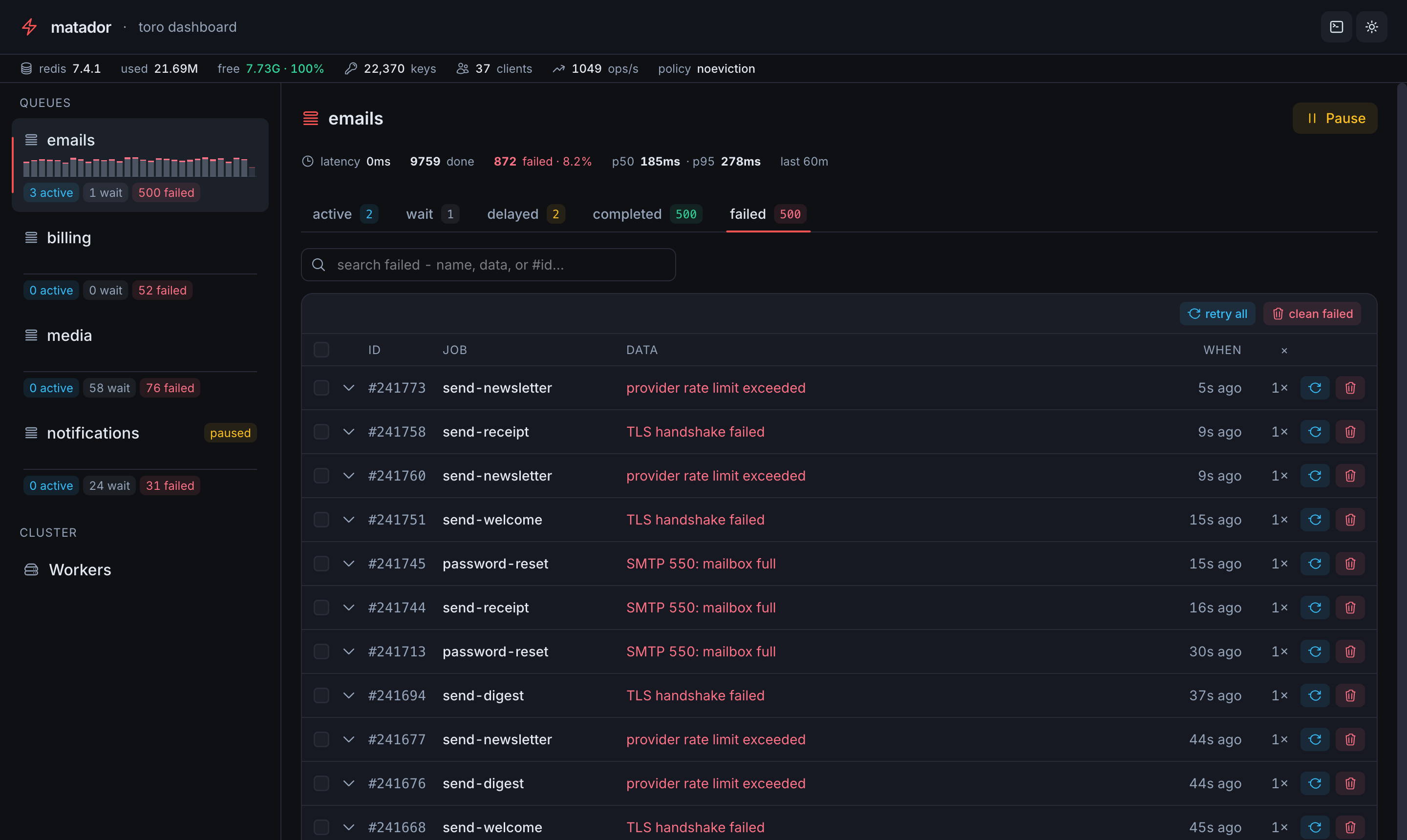
A live, server-rendered dashboard for toro queues - watch queues, inspect jobs, and act on them (retry, remove, promote, pause…) from the browser.









pip install matador-dashboard # the import name is `matador`
Installed as
matador-dashboardon PyPI (the namematadorwas taken), but youimport matador.
What it is
FastAPI + Jinja on the server, HTMX + Tailwind on the page - no SPA, no build step to run. Every queue / tab / page is a real URL, so reload, back/forward and deep-links all work. It reads straight from Redis through toro's async API.
Features
- Queues sidebar with per-state counts, a per-queue activity sparkline (last hour, all queues on one shared scale, failures in red), and state tabs (active / waiting / held / delayed / completed / failed / cancelled) that swap the job list over HTMX.
- Health chips per queue: latency (age of the next job in line, warns past 30s), completed/failed counts with failure share, and average duration over the last hour - server-rendered SVG, no chart library.
- Flows - toro's parent/child job trees, shown root-first: a flow is its root job moving through the normal tabs (parked roots fold into active), with children hidden from the lists and a recursive tree on the job detail with per-node status pills and fan-in progress that counts completions only; destructive actions warn that removing a parent takes its whole subtree. The active tab also carries a flow-throughput strip - whole flows completed/ failed over the last hour, with end-to-end flow-duration percentiles.
- Job detail lazy-loaded on expand: data, options, return value, timings, logs, and stack traces - syntax-highlighted server-side (Pygments, no client JS).
- Search within a state by job id or a name/data substring.
- Live updates over SSE - counts refresh as jobs complete, no reload.
- Actions: pause/resume a queue, retry/remove/promote a job, retry-all,
clean a state, and schedulers (run-now / remove) - each behind a styled confirm
dialog (not
window.confirm). - Numbered pagination, a Redis health bar (memory, clients, eviction policy), and a persistent dark / light theme.
/metricsfor a Prometheus-compatible scraper: every watched queue in one OpenMetrics exposition, rendered by toro rather than by the dashboard. The gauges count every job in the state it is in, which is not what the tab badges count.- Read-only mode - pass
can_mutate(request)and every action refuses, with the controls left out of the page rather than drawn and refused.
Run it
uv run python scripts/seed.py             # optional: populate demo data
uv run uvicorn scripts.run:app --reload   # http://localhost:8000
scripts/run.py watches a few demo queues; edit the list there, or wire it up yourself.
Integrate into an existing app
matador is an ASGI app - mount it into your FastAPI/Starlette service at any path.
URLs are root_path-aware (Starlette url_for), so a sub-path mount just works.
from fastapi import Depends
from matador import create_app

app.mount(
    "/toro",
    create_app(
        ["emails", "billing"],
        connection=redis,                       # share your existing redis pool
        dependencies=[Depends(require_admin)],  # protect it with your auth
    ),
)
- Mount anywhere - links, static assets and the SSE stream all carry the mount prefix automatically; works behind a path-stripping reverse proxy too.
connection=- pass yourredis.asyncio.Redisso matador shares your pool (it never closes a connection it didn't open). Omit it to open its own fromurl=. This is also the right way to embed: a mounted sub-app's lifespan doesn't run, so the host should own the connection.dependencies=- applied to every route, so your app's auth gates the dashboard. (The/staticmount isn't covered - wrap the whole mount if the assets themselves need auth.)can_mutate=- a predicate handed the raw request (matador has no identity of its own), deciding whether this caller may change anything. Read-only callers get a dashboard with no controls, not controls that refuse.- Other stacks (Django, Flask, non-Python): run matador standalone and reverse-proxy.
Security
matador ships no auth of its own - it inherits the host app's via
dependencies=, or sits behind an authenticating reverse proxy. An app built
without dependencies logs a warning at startup, because every route
(including delete/retry/pause) is open to whoever can reach it.
- CSRF: the same-origin guard turns on automatically when
dependenciesare configured (auth usually means cookies, and cookies are what make CSRF real). Passrequire_same_origin=explicitly to override. - Stack traces are shown in job detail by default and can leak source
paths or secrets from exception messages -
show_stacktraces=Falsehides them when the audience shouldn't see internals. - The dashboard can do whatever its Redis connection can do; scope that Redis
user/network accordingly. See toro's
docs/security.mdfor the queue-side model.
Standalone is just the no-extras case:
app = create_app(["emails", "billing"], url="redis://localhost:6379")
It serves HTML (an HTMX UI), not a JSON API - point a browser at it.
Develop
Managed with uv; the Astral toolchain throughout.
uv sync                          # venv + deps + dev group
uv run ruff check . && uv run ruff format .   # lint (strict) + format
uv run ty check                  # type check
uv run pytest                    # unit + integration (needs Redis on :6379)
uv run pytest -m e2e             # Playwright browser tests (run separately)

# rebuild the stylesheet while editing templates/styles
./tailwindcss -i styles/input.css -o matador/static/app.css --watch
License
1 maintainer

Release files for matador-dashboard 1.0.2
For a detailed explanation of source distributions (sdists) and built distributions (wheels), please see the package formats documentation.
Source distribution (sdist)
| File | Size | Uploaded | |
|---|---|---|---|
| matador_dashboard-1.0.2.tar.gz | 661.2 kB | Details |
Built distribution (wheel)
| File | Interpreter | ABI | Platform | Reset |
|---|---|---|---|---|
| matador_dashboard-1.0.2-py3-none-any.whl | Python 3 | none | any | Details |
Total release size: 821.0 kB
Release files / matador_dashboard-1.0.2.tar.gz
| Download URL | matador_dashboard-1.0.2.tar.gz |
|---|---|
| Size | 661.2 kB |
| Tags | Source |
|
SHA-256 checksum How to use checksums |
3aad097f6fa00ea0cf79e997f8f57f3d78d8665bf31d8707cb306855a0ea8c40
|
|
BLAKE2b-256 checksum How to use checksums |
9e46ef834b7fc8fb59d71cc3aff644da06e1caa57bfe09c8e0ce085c58109069
|
| Upload date | |
|
Uploaded using Trusted Publishing? What is trusted publishing? |
Yes |
| Uploaded via |
twine/7.0.0 CPython/3.13.14
|
Provenance
Provenance describes where a file came from. On PyPI, provenance is shared via attestations, which provide a verifiable record of the build or publishing details. View details, limitations and caveats.


PyPI Publish Attestation
PyPI verified that this artifact, at this checksum, originated from the publisher listed below.
Signed by GitHub Actions, verified by PyPI on Sep 23, 2026.
Transparency logRelease files / matador_dashboard-1.0.2-py3-none-any.whl
| Download URL | matador_dashboard-1.0.2-py3-none-any.whl |
|---|---|
| Size | 159.8 kB |
| Tags | Python 3 |
|
SHA-256 checksum How to use checksums |
90ee286fa5e8f430ccc44d8ea2b32dcceb8fc0b9efbfe4092675ad148d65ff12
|
|
BLAKE2b-256 checksum How to use checksums |
918610f3656f9b98b178dbaabea20290d76290256482ea2e62959969e7b78649
|
| Upload date | |
|
Uploaded using Trusted Publishing? What is trusted publishing? |
Yes |
| Uploaded via |
twine/7.0.0 CPython/3.13.14
|
Provenance
Provenance describes where a file came from. On PyPI, provenance is shared via attestations, which provide a verifiable record of the build or publishing details. View details, limitations and caveats.
PyPI Publish Attestation
PyPI verified that this artifact, at this checksum, originated from the publisher listed below.
Signed by GitHub Actions, verified by PyPI on Sep 23, 2026.
Transparency log













