
Materials Simulation Skills






Give your AI coding agent real expertise in numerical methods, simulation best practices, and computational materials science — so it stops guessing.
New to Agent Skills? A "skill" is a portable folder of instructions + small scripts that an AI coding agent discovers automatically and loads only when relevant. They follow the open Agent Skills standard and work across 20+ tools — Claude Code, Codex, Cursor, Antigravity, GitHub Copilot, and more. Nothing to wire up: drop them in and your agent gets smarter at the task.
What it solves
Simulation engineers repeat the same guidance to AI agents constantly: "Check the CFL number before running," "Use Richardson extrapolation for grid convergence," "Exit code 2 means bad input." General-purpose agents lack the domain knowledge to run reliable numerical simulations without heavy hand-holding — so they pick wrong time steps, miss convergence checks, and misread solver failures.
This project packages that domain knowledge into skills the agent finds and runs on its own:
You: Check if dt=0.001 is stable for my advection problem with v=2.0 m/s and dx=0.01.

Agent: I'll use the numerical-stability skill to check this.
       [runs cfl_checker.py --dx 0.01 --dt 0.001 --velocity 2.0 --json]

       CFL number = 0.2 (limit: 1.0) -- stable.
       Recommended max dt = 0.005 with safety factor 1.0.
No prompt engineering, no copy-pasting formulas. 24 skills span numerical methods, simulation workflows, HPC deployment, verification & validation, FAIR data, robustness, and materials ontologies.
Tested scripts and explicit validation limits
The repository includes executable checks at several levels:
- Tested scripts — unit, integration, analytic-oracle and negative-control tests exercise the Python CLIs and numerical cores. CI targets Python 3.10–3.12.
- 100% deterministic eval coverage — every eval case runs the script and asserts its exact output, so docs can't silently drift from code. Enforced in CI.
- Agent evaluation support — the harness compares runs with and without a skill. Harness tests and deterministic coverage do not establish an improvement in agent scientific correctness.
- Cited science + an enforced protocol — rules reference authoritative standards (ASME V&V20, the SchedMD
sbatchspec, CMSO IRIs).
How and why: evaluation methodology · harness.
Latest deterministic evaluation (2026-10-20): 115 cases, 131 checks, 725 assertions passed. Live-agent uplift remains unvalidated.
See validation scope and remaining limits before interpreting a passing check as evidence about a physical simulation.
Install
The repo follows the open standard, so the ecosystem installers work out of the box:
npx skills add HeshamFS/materials-simulation-skills          # any agent → ~/.agents/skills/
gh skill install HeshamFS/materials-simulation-skills --pin v1.0.0   # version-pinned
Or install a curated bundle into a specific agent with the bundled mss CLI:
mss bundles                                                  # list bundles
mss install --agent claude --bundle verification-and-validation
Claude Code users can also /plugin marketplace add HeshamFS/materials-simulation-skills.
Full per-agent guide → docs/INSTALL.md.
Use it
Once installed, just describe your task — the agent picks the right skill, runs the script, and interprets the result (as in the example above). You can also name a skill explicitly:
Use convergence-study to check if my mesh is in the asymptotic range:
h = 0.4, 0.2, 0.1 gave stress = 98.5, 99.6, 99.9 MPa.
Browse the full catalog in docs/SKILLS.md (or the machine-readable
skills_index.json).
Try it locally / develop:
git clone https://github.com/HeshamFS/materials-simulation-skills.git
cd materials-simulation-skills && pip install -e ".[dev]"

mss list                                              # list skills
mss run numerical-stability cfl_checker -- --dx 0.01 --dt 0.001 --velocity 2.0 --json
mss eval                                              # run the deterministic eval gate
python -m pytest tests/                               # full test suite
What's inside
24 skills across 8 categories (one-line summary; full tables in docs/SKILLS.md):
| Category | Skills | Focus |
|---|---|---|
| Core Numerical | 8 | stability, time-stepping, meshing, convergence, integration, differentiation, linear/nonlinear solvers |
| Simulation Workflow | 7 | validation, DOE/optimization, orchestration, post-processing, profiling, workflow mapping, MD analysis |
| HPC Deployment | 2 | SLURM script generation, runtime diagnosis |
| Verification & Validation | 1 | manufactured solutions, benchmarks, pass/fail reports |
| Data Management | 1 | FAIR reproducibility packaging |
| Robustness | 1 | cross-code failure triage & retry ladders |
| Ontology | 3 | CMSO/ASMO exploration, mapping, validation |
| Meta | 1 | skill-evaluator — evaluate any skill across any agent CLI |
Quality is gated in CI: spec-valid frontmatter, deterministic script_checks, the
standardized Security section, and a fresh index — see docs/PROTOCOL.md
and docs/SECURITY.md.
Contributing
This is an open project and contributions are very welcome — a new skill, a fix, docs, or just an idea.
- Have an idea or a skill to propose? Open an issue (there are templates for bug reports and skill proposals) — early ideas are great even without code.
- Want to build a skill? CONTRIBUTING.md has a step-by-step guide, script/test templates, the skill taxonomy, and open categories. The bar that keeps this project trustworthy: a skill ships a tested script + an eval case with a deterministic
script_check, and passesmss validate+mss eval. - Where it's headed: the ROADMAP.md — growing toward materials-physics and code-interface skills (LAMMPS, DFT) and a richer skill protocol.
Documentation
| Doc | What's in it |
|---|---|
| docs/SKILLS.md | Full skill catalog, how skills work, repo layout |
| docs/INSTALL.md | Install for every supported agent |
| docs/EVALUATION_METHODOLOGY.md | How skills are evaluated, with results |
| docs/EVAL_HARNESS.md | The three-layer evaluation harness |
| docs/PROTOCOL.md | The Materials Simulation Skill Protocol |
| docs/SECURITY.md | Safeguards and security tiers |
| CONTRIBUTING.md · ROADMAP.md | Contributing guide · direction |
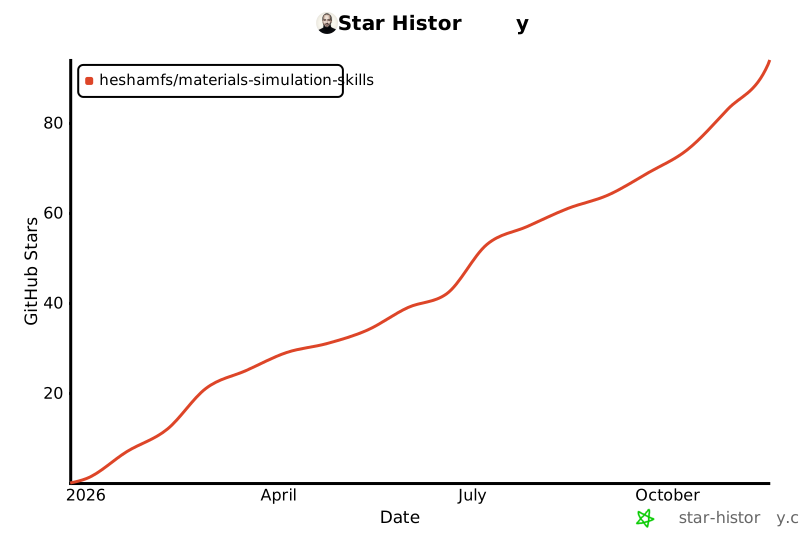
Star History
License
Acknowledgements
- Agent Skills standard — open specification for portable agent capabilities
- Anthropic — original developer of the Agent Skills format
- agentskills/agentskills — reference implementation and validation library
1 maintainer

Metadata
1 maintainer
Release files for materials-simulation-skills 1.0.0
For a detailed explanation of source distributions (sdists) and built distributions (wheels), please see the package formats documentation.
Source distribution (sdist)
| File | Size | Uploaded | Provenance | Actions |
|---|---|---|---|---|
| materials_simulation_skills-1.0.0.tar.gz | 558.4 kB | With provenance | Details for materials_simulation_skills-1.0.0.tar.gz |
Built distribution (wheel)
| File | Interpreter | ABI | Platform | Actions Reset |
|---|---|---|---|---|
| materials_simulation_skills-1.0.0-py3-none-any.whl | Python 3 | none | any | Details for materials_simulation_skills-1.0.0-py3-none-any.whl |
Total release size: 1.3 MB
Release files / materials_simulation_skills-1.0.0.tar.gz
| Download URL | materials_simulation_skills-1.0.0.tar.gz |
|---|---|
| Size | 558.4 kB |
| Tags | Source |
|
SHA-256 checksum How to use checksums |
2ed15ca0ee8b323ddef0dc9b245f54334047cd7ffc9ff2085985de579bf2c157
|
|
BLAKE2b-256 checksum How to use checksums |
50e6d5510598fa1dc44c6d377ace870392422afddf73ceaf98b66e8dc4aa4ea5
|
| Upload date | |
|
Uploaded using Trusted Publishing? What is trusted publishing? |
Yes |
| Uploaded via |
twine/7.0.0 CPython/3.13.16
|
Provenance
Provenance describes where a file came from. On PyPI, provenance is shared via attestations, which provide a verifiable record of the build or publishing details. View details, limitations and caveats.


PyPI Publish Attestation
PyPI verified that this artifact, at this checksum, originated from the publisher listed below.
Signed by GitHub Actions, verified by PyPI on Nov 15, 2026.
Transparency logRelease files / materials_simulation_skills-1.0.0-py3-none-any.whl
| Download URL | materials_simulation_skills-1.0.0-py3-none-any.whl |
|---|---|
| Size | 700.9 kB |
| Tags | Python 3 |
|
SHA-256 checksum How to use checksums |
c7d9ecd9e53607013b68ac09e9e554067dd57040b0085738f4a750fba57a0f2e
|
|
BLAKE2b-256 checksum How to use checksums |
a7ad47a8d514f10cca36a5421d20c5090f6aa253d3bac82b03e179d8452fecd4
|
| Upload date | |
|
Uploaded using Trusted Publishing? What is trusted publishing? |
Yes |
| Uploaded via |
twine/7.0.0 CPython/3.13.16
|
Provenance
Provenance describes where a file came from. On PyPI, provenance is shared via attestations, which provide a verifiable record of the build or publishing details. View details, limitations and caveats.
PyPI Publish Attestation
PyPI verified that this artifact, at this checksum, originated from the publisher listed below.
Signed by GitHub Actions, verified by PyPI on Nov 15, 2026.
Transparency logSecurity for materials-simulation-skills 1.0.0
Provenance
Provenance describes where a file came from. On PyPI, provenance is shared via attestations, which provide a verifiable record of the build or publishing details. View details, limitations and caveats.
Full provenance
Both files in this release have been uploaded with provenance metadata.
Attestation for materials_simulation_skills-1.0.0.tar.gz
PyPI Publish Attestation
PyPI verified that this artifact, at this checksum, originated from the publisher listed below.
Signed by GitHub Actions, verified by PyPI on Nov 15, 2026.
Transparency logA note on package security
PyPI is a repository for distributing packages, not a service for auditing them. While third-party security researchers and our staff do their best to detect and remove malicious packages, PyPI cannot guarantee the quality, security or suitability of any given package.
To learn more about protecting yourself from malicious actors, visit our package security documentation.













