
mathema
Proofs and counterexamples for Python functions, kept as records bound to the exact code they were checked against.





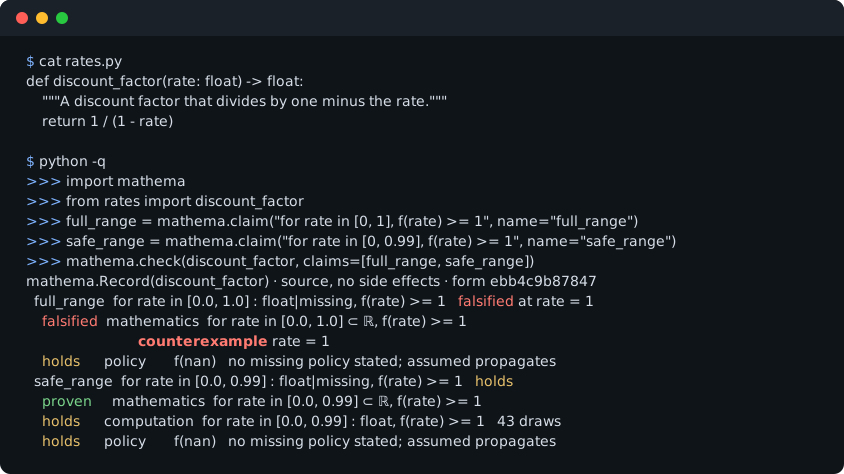
mathema checks Python functions against claims, short mathematical statements of what a function is meant to do, and keeps each result as a record bound to the code. It proves the mathematics of a claim over its whole domain where the body reads as mathematics, and checks the computation by running the real function on inputs chosen to break it, keeping proof and evidence apart. The name is Greek, μάθημα, that which is learned.
Highlights
- Proofs of the mathematics over a whole domain, not a sample of it: the function body is lifted to a symbolic expression and the claim decided in exact real arithmetic, with an opt-in z3 step for nonlinear inequalities.
- Inputs that break code are searched for directly (poles, domain corners, the largest double, empty and degenerate containers), and every falsification carries a counterexample that was executed against the real function.
- A bare
mathema.check(fn)runs built-in claims of both kinds with no claim written: mathematical ones about the formula (where it is defined, its poles, monotonicity, convexity, symmetry) and computational ones about the code as it runs (side effects, determinism, overflow, numerical stability). - Each claim is judged twice: its mathematics exactly over the reals, and its computation as the code runs in float64. When the computation misses, the record names the condition number and says whether the inputs or the code lost the precision.
- Functions that call numpy, pandas or polars are checked through bundled claims about those libraries, and parameters annotated as a
SeriesorDataFrameare run on real ones. - Records are bound to the code by a hash of its form, so
mathema verifyre-checks a function when it or anything it calls changes, and a claim that held before and fails now is reported asinvalidated. - CI gets distinct exit codes, GitHub Actions and JUnit output, a claim-level diff of a pull request (
mathema review) and a population report over a package (mathema audit). - Coding agents connect through an MCP server and agent skills, and can propose and check claims while accepting a verdict stays with a person.
- Claims about strings and structured records take their domains from the mathema-language package.
When mathema cannot settle a claim it says unknown and records why, rather than reporting a pass.
Install
pip install "mathema[all]"
pip install mathema
The first adds numpy, z3, the MCP server, the coverage reader and mathema-language; the second is the core alone, which needs only sympy and pyyaml. mathema supports Python 3.10 to 3.14 and runs offline, with no account or API key.
Quick start
import mathema

def discounted(price: float, rate: float) -> float:
    """The price after applying a discount rate."""
    return price * (1 - rate)

print(mathema.check(discounted, claims=[
    mathema.claim("for rate in [0, 1], f(price, rate) <= price",
                  name="at_most_price"),
    mathema.claim("for price in [0, 1e6], rate in [0, 1], f(price, rate) <= price",
                  name="at_most_price_when_positive"),
]))
mathema.Record(discounted) · source, no side effects · form d2ab6eef1b84
  at_most_price  for rate in [0.0, 1.0] : float|missing, f(price, rate) <= price
      falsified at price = -1, rate = 1
    falsified  mathematics  for rate in [0.0, 1.0] ⊂ ℝ, f(price, rate) <= price
        counterexample price = -1, rate = 1
                            [mathematics unsound, blame claim]
  at_most_price_when_positive  for price in [0.0, 1000000.0] : float|missing, rate in
      [0.0, 1.0] : float|missing, f(price, rate) <= price   holds
    proven     mathematics  for price in [0.0, 1000000.0] ⊂ ℝ, rate in [0.0, 1.0] ⊂ ℝ,
        f(price, rate) <= price
    holds      computation  for price in [0.0, 1000000.0] : float, rate in [0.0, 1.0] :
        float, f(price, rate) <= price   49 draws
The first claim never said prices are positive, and a negative price discounted by the whole rate breaks it. The second states the domain, and its mathematics line is proven for every price and rate in range. The computation line runs the same claim through float64 and holds on every draw, which is evidence rather than proof, so the headline reports holds.
A tour
Proving
import math

def put_call_parity_gap(s: float, k: float, r: float, t: float,
                        sigma: float) -> float:
    """A European call minus a European put on the same strike."""
    root_t = math.sqrt(t)
    d1 = (math.log(s / k) + (r + 0.5 * sigma * sigma) * t) / (sigma * root_t)
    d2 = d1 - sigma * root_t
    phi = lambda z: 0.5 * (1.0 + math.erf(z / math.sqrt(2.0)))
    call = s * phi(d1) - k * math.exp(-r * t) * phi(d2)
    put = k * math.exp(-r * t) * phi(-d2) - s * phi(-d1)
    return call - put
The code prices a call and a put through logarithms, square roots and the normal distribution, yet their difference should always be s - k*exp(-r*t), with volatility dropping out entirely. That is put-call parity, and the claim states it over realistic ranges:
mathema check options.py --claim "for s in [50,150], k in [50,150], \
    r in [0.0,0.1], t in [0.1,2], sigma in [0.05,0.8], \
    f(s,k,r,t,sigma) == s - k*exp(-r*t)"
ok options.put_call_parity_gap: source, no side effects; claims 7/7 checked (1 proven, 6 holds, 0 falsified)
mathema lifted the body to an expression in which both Gaussian terms cancel and sigma drops out, so the identity is proven over the whole region. The six that hold are the same identity run in float64 and five rows recording what the function does with a nan in each parameter. The derive route lists what can be lifted and how each proof is named.
Falsifying
Before any claim is written, mathema already asks the questions that apply to every function: does it have a value for every input it accepts, does it divide by zero anywhere, does it touch anything outside itself? Here is what that finds:
import mathema

def discount_factor(x: float) -> float:
    """A discount factor that divides by one minus the rate."""
    return 1 / (1 - x)

print(mathema.check(discount_factor))
mathema.Record(discount_factor) · source, no side effects · form ebb4c9b87847
  proven    is_defined: 1 - x != 0
  falsified is_pole_safe[x]: is_pole_safe(x)
           counterexample x = 1 is admitted by the declared domain but sits at or beside a pole: the call raised ZeroDivisionError
These are two of fourteen rows. is_defined is a mathematical claim, proven from the formula itself; is_pole_safe is a computational one, falsified by running the code at the point the formula says is dangerous. Uniform sampling over the reals lands on x = 1 with probability zero, so mathema solves the lifted expression for where the denominator vanishes and makes sure that point is tried. See what mathema finds has more.
The mathematics and the computation
The function below is correct on paper, since (x + 1) - x is 1 for every real x. mathema proves that, then runs it in float64, where it is not true:
import mathema

def step(x: float) -> float:
    """The distance from x to x + 1."""
    return (x + 1.0) - x

print(mathema.check(step, claims=[
    mathema.claim("for x in [0, 1e16], f(x) == 1", name="unit_step")]))
mathema.Record(step) · source, no side effects · form 8ca9c721c4cf
  unit_step  for x in [0.0, 1e+16] : float|missing, f(x) = 1   falsified at x = 1e+16
    proven     mathematics  for x in [0.0, 1e+16] ⊂ ℝ, f(x) = 1
    falsified  computation  for x in [0.0, 1e+16] : float, f(x) = 1   counterexample x = 1e+16
                            [mathematics sound, implementation:numerical-instability]
                            f loses more than the conditioning explains (κ ≈ 0, error 1)
                            possible fixes:
                              if the loss is accepted, run: mathema accept step unit_step --as discovery
    holds      policy       f(nan)   no missing policy stated; assumed propagates
At 1e16 the spacing between doubles is 2, so x + 1.0 rounds back to x and the function returns 0.0. A condition number near zero says the exact problem is well conditioned, so the precision was lost by the code and not by the inputs, and the record offers the command that accepts the loss if it is in scope. Guarantees sets out what each line establishes.
Library code
import pandas as pd

def average_return(returns: pd.Series) -> float:
    """The mean of a series of periodic returns."""
    return float(returns.mean())
import mathema
from returns import average_return

record = mathema.check(average_return, claims=[mathema.claim(
    "for returns in [-0.1, 0.1]^n \\ {missing}, assuming dim(returns) >= 1, "
    "min(returns) <= f(returns) <= max(returns)", name="between")])
proof = record.probes[0]
print(proof.verdict, proof.route)
print(proof.sketch.split("; link 2")[0])
proven derive
link 1: min(returns) <= f(returns): taking pandas.Series.mean as mean(a) (axiom, bundled
    with mathema, pandas 2.2 to 3.x); through the pandas.Series.mean definition row,
    read as sums over returns at a symbolic length: the relation holds for every length
    of at least one (min(returns) is at most mean(returns))
The proof covers a series of every length, not the handful a test would build. It reads Series.mean through a claim about pandas that ships with mathema, then confirms the result by running the function on real Series. mathema compendium status lists which library calls in a project have rows and which are a black box, as library claims shows.
Knowledge that goes stale
def rate_for(years: int) -> float:
    """The loyalty discount for a customer of this many years."""
    return 0.05 * years
from rates import rate_for

def discounted(price: float, years: int) -> float:
    """The price after the customer's loyalty discount.

    Claims:
        never_raises: for price in [0, 1e6], years in [0, 10] subset Z, f(price, years) <= price
    """
    return price * (1 - rate_for(years))
import mathema, pricing, rates

mathema.write_spec(rates.rate_for)
mathema.write_spec(pricing.discounted)
A result is only worth keeping while the code still matches it. write_spec records each result against a hash of the function and of everything it calls, so a later change anywhere in that chain is noticed. Here the helper changes:
def rate_for(years: int) -> float:
    """The loyalty discount, counted from the second year."""
    return 0.05 * (years - 1)
$ mathema verify; echo "exit $?"
FAIL pricing.discounted: dependency changed; 1 proven, 1 holds, 0 falsified, 1 invalidated  <- 1 invalidated claim(s)
ok   rates.rate_for: form changed; 1 proven, 0 holds, 0 falsified
0 unchanged since the last run (not run again), 2 checked, 1 problem(s)
grammars detected: mathema; verified by this run: mathema
exit 1
discounted did not change, but a new customer now gets a negative rate and the claim that held is invalidated, so verify exits 1. mathema verify covers the rest.
CI and review
mathema init --ci github           # scaffold the workflow step
mathema verify                     # 0 clean, 1 a finding, 2 could not run
mathema check src --format github  # inline annotations on the pull request
mathema review origin/develop      # what the change did to what is known
mathema audit src                  # every function: claimed, pure, liftable, tested
A reviewer sees what a pull request did to what is known about the code, not only to the code itself. review lists each claim whose verdict moved, and --format json gives a pipeline the same list. Accepting a verdict (mathema accept), locking a function's form and the integrity checksum are covered in governance, and gate a pipeline walks through a first red run.
Coding agents
An agent that writes code can also be asked to state what the code should do, and mathema will check it. The MCP server (mathema mcp serve) gives the agent the same tools a person has, except the ones that settle a disagreement: accepting a verdict and unlocking a function stay with a person. mathema init --agents vendors skills for Claude Code, Codex, Gemini, Cursor, Copilot and other coding agents, and is the one command that fetches anything. See working with coding agents and set up mathema for an agent.
Text and records
With mathema-language installed, a claim can range over strings or structured records as well as numbers. The inputs that break text-handling code are tried first: the empty string, control characters, a byte-order mark, a lone surrogate. Random strings come after:
for s in L[unicode], f(f(s)) == f(s)
for s in L[unicode], len(f(s)) <= len(s)
for s in L[unicode], "<" not in f(s)
Without the package such a claim is unknown and names what it needs. Language domains has the details.
How it compares
mathema sits beside these tools rather than replacing them, and each answers a question it does not.
| Category | What it establishes | Over which inputs | What mathema adds |
|---|---|---|---|
| Unit tests | the outputs for cases someone chose | the chosen cases | a claim over a stated domain, proven or searched |
| Property-based testing | a property survives random and shrunk inputs | a random sample | proof where the body lifts, and poles, corners and degenerate inputs that sampling rarely hits |
| Type checkers | values have the declared types | every input, at the level of types | statements about values, not only their types |
| Linters and static analysis | known bug patterns are absent | every path, by pattern | the function's own intended behaviour, checked by running or proving it |
| Formal verification and proof assistants | a full specification, machine-checked | every input, under a proof someone writes | proofs found automatically for a narrower class of code, and labelled evidence where proof is out of reach |
| LLM code review | a model's reading of the diff | none in particular | verdicts from mathematics or execution with no model in the loop, kept as records |
A type checker and a test suite remain worth running; mathema is narrower than a proof assistant and makes no claim about whole programs.
Documentation
The documentation has a reading order for each job, the quick start, case studies, the claim grammar, verdicts and exit codes and the command reference. mathema is pre-1.0: its claim grammar and record format are fixed by the claim-driven development specification, and its Python API may still change, as stability sets out. Releases are in the CHANGELOG.
Contributing
Issues and pull requests are welcome; CONTRIBUTING.md covers the process and the contributor agreement, SECURITY.md how to report a vulnerability, and SUPPORT.md where to ask a question.
Licence
mathema is source-available under the Business Source License 1.1, and each release converts to AGPL-3.0-or-later four years after it is published. LICENSING.md sets out the grant in plain language.
1 maintainer

Metadata
1 maintainer
Release files for mathema 0.6.2
For a detailed explanation of source distributions (sdists) and built distributions (wheels), please see the package formats documentation.
Source distribution (sdist)
| File | Size | Uploaded | |
|---|---|---|---|
| mathema-0.6.2.tar.gz | 2.4 MB | Details |
Built distribution (wheel)
| File | Interpreter | ABI | Platform | Reset |
|---|---|---|---|---|
| mathema-0.6.2-py3-none-any.whl | Python 3 | none | any | Details |
Total release size: 3.9 MB
Release files / mathema-0.6.2.tar.gz
| Download URL | mathema-0.6.2.tar.gz |
|---|---|
| Size | 2.4 MB |
| Tags | Source |
|
SHA-256 checksum How to use checksums |
76305b75c5eaf6ce02f7cc02c9cf3e3d50b1690c2c177600713a5da1544814b8
|
|
BLAKE2b-256 checksum How to use checksums |
87530d3e822136c06106245b77d8c2bd288a93b69cfa4383fa328c6bea734a00
|
| Upload date | |
|
Uploaded using Trusted Publishing? What is trusted publishing? |
Yes |
| Uploaded via |
twine/7.0.0 CPython/3.13.14
|
Provenance
Provenance describes where a file came from. On PyPI, provenance is shared via attestations, which provide a verifiable record of the build or publishing details. View details, limitations and caveats.


PyPI Publish Attestation
PyPI verified that this artifact, at this checksum, originated from the publisher listed below.
Signed by GitHub Actions, verified by PyPI on Oct 14, 2026.
Transparency logRelease files / mathema-0.6.2-py3-none-any.whl
| Download URL | mathema-0.6.2-py3-none-any.whl |
|---|---|
| Size | 1.5 MB |
| Tags | Python 3 |
|
SHA-256 checksum How to use checksums |
f5da0a9af3f7a5c1c97756e6e12bfb4769e8272ba78d4070c1b4f06301808916
|
|
BLAKE2b-256 checksum How to use checksums |
c985d3665d241f320cc24c4cf20c6c3fd33e218f2b9fe0a0fa655ce7db90732e
|
| Upload date | |
|
Uploaded using Trusted Publishing? What is trusted publishing? |
Yes |
| Uploaded via |
twine/7.0.0 CPython/3.13.14
|
Provenance
Provenance describes where a file came from. On PyPI, provenance is shared via attestations, which provide a verifiable record of the build or publishing details. View details, limitations and caveats.
PyPI Publish Attestation
PyPI verified that this artifact, at this checksum, originated from the publisher listed below.
Signed by GitHub Actions, verified by PyPI on Oct 14, 2026.
Transparency log













