
mathematicskit
| Package |   |
| Quality |     |
| Documentation |  |
| Code style |  |
| Downloads |   |
| Community |     |
| Try it online |    |
See how the algorithms of computational mathematics actually work. mathematicskit is a Python toolkit for learning and teaching numerical methods, dynamical systems, and discrete mathematics. Every iterative method keeps its iterates, every result is an inspectable dataclass, every domain ships plotting helpers, and each domain's docs walk through the field's breakthroughs in historical order, each one linked to runnable code that reproduces it.
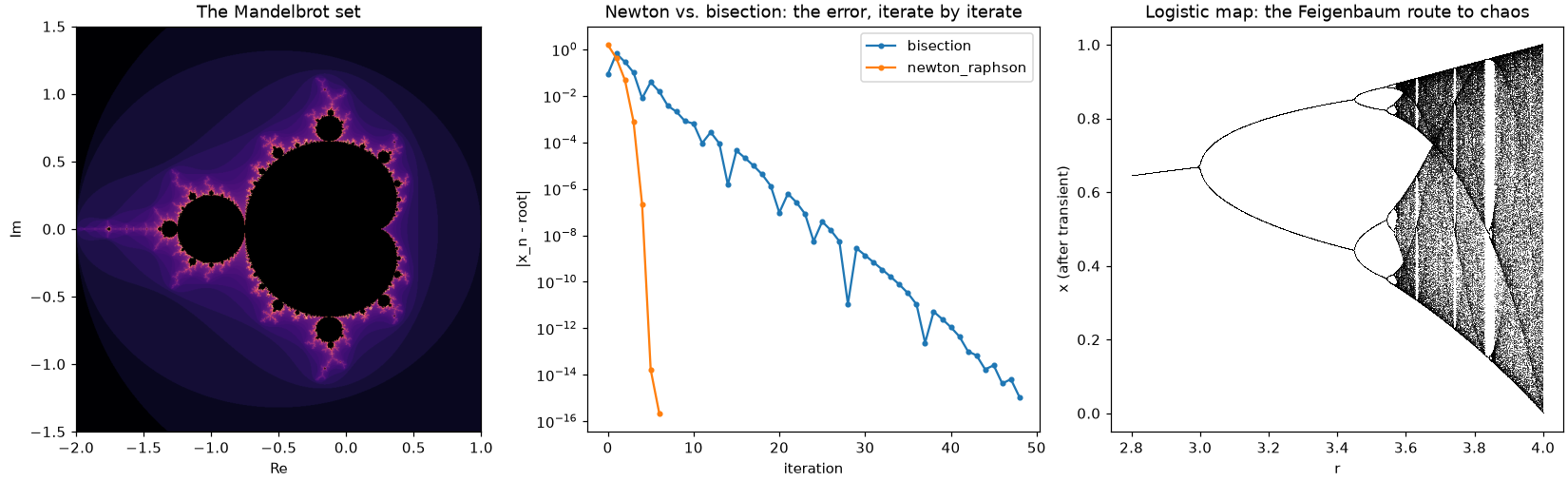
- For students: watch Newton's method converge quadratically while bisection converges linearly, see the Runge phenomenon appear, trace the Feigenbaum route to chaos, all in a few lines each.
- For instructors: 16 domains, one consistent API, and hundreds of gallery examples, each downloadable as a notebook or runnable in the browser, ready to hand out as course material.
- Built on numpy/scipy: production-grade library routines under the hood, with algorithms hand-rolled only where the steps themselves are what you're learning (see Design).
mathematicskit is part of a family of packages -- physicskit, mathematicskit and chemistrykit -- that share the same architecture, API conventions, and history-driven documentation.
Install
pip install "mathematicskit[fast]"   # with numba JIT acceleration (recommended)
pip install mathematicskit           # pure numpy/scipy/matplotlib, e.g. for Pyodide/JupyterLite
Then import mathematicskit as mk. (The shorter name mathkit was
already taken on PyPI by an unrelated package.) The fast extra adds
numba, which compiles the inner loops of
ode_dynamics, fractals_chaos, pde, and integrators. Without it
those kernels run as plain Python: same results, slower.
For development: pip install -e ".[dev]" (see CONTRIBUTING.md).
Quick start
import numpy as np
import mathematicskit as mk
from mathematicskit.numerical_analysis.visualizers import plot_convergence_history

f, fprime = (lambda x: x**2 - 2.0), (lambda x: 2.0 * x)
newton = mk.numerical_analysis.NewtonRaphson(f, fprime, x0=3.0, tol=1e-14).solve()
bisection = mk.numerical_analysis.Bisection(f, 0.0, 3.0, tol=1e-14).solve()
print(len(newton.history), len(bisection.history))  # 8 iterates vs. 49

ax = plot_convergence_history(bisection, root_exact=np.sqrt(2))
plot_convergence_history(newton, root_exact=np.sqrt(2), ax=ax)
ax.legend()
The quickstart notebook tours six domains in ten minutes. Open it in Colab or Binder using the badges above.
Subpackages
Domain subpackages, each with runnable examples linked below:
mathematicskit.numerical_analysis-- root finding (bisection, Newton-Raphson, secant, fixed-point, hand-rolled for their convergence history), Lagrange/Newton (hand-rolled) plus scipy-backed cubic-spline interpolation, numpy-backed Chebyshev nodes,numpy.linalg.lstsq-based polynomial regression, andnumpy.linalg.cond-based error/condition-number analysis.mathematicskit.linalg-- LU/QR/Cholesky decompositions and eigenvalue computation viascipy.linalg/numpy.linalg, power/inverse iteration (hand-rolled), SVD, conjugate gradient and GMRES viascipy.sparse.linalg, and least-squares stability (normal equations vs. QR vs.numpy.linalg.lstsq).mathematicskit.calculus-- finite-difference derivatives with Richardson extrapolation (hand-rolled),scipy.integrate-backed trapezoidal/Simpson/Gauss-Legendre/adaptive quadrature, forward-mode (dual numbers) and reverse-mode (backpropagation) automatic differentiation (hand-rolled), and Taylor/Maclaurin series.mathematicskit.ode_dynamics-- Jacobian-linearization fixed-point stability (node/saddle/spiral/center), phase portraits, the logistic map's Feigenbaum route to chaos, saddle-node/pitchfork/Hopf bifurcation normal forms, the Van der Pol limit cycle, and Poincare sections of the driven Duffing oscillator.mathematicskit.pde-- the heat equation in 1D and 2D by the method of lines onmathematicskit.integratorsand by the theta-method family (FTCS, Crank-Nicolson, backward Euler viascipy.sparse.linalg.splu); the wave equation with symplectic leapfrog stepping against d'Alembert's solution; upwind, Lax-Friedrichs and Lax-Wendroff advection; Poisson/Laplace problems solved withscipy.sparse.linalg.spsolveormathematicskit.linalg's CG/Jacobi/Gauss-Seidel/SOR; CFL checks and von Neumann amplification factors; and Fourier (numpy.fft) and Chebyshev spectral methods.mathematicskit.fractals_chaos-- Lyapunov exponent estimation, box-counting fractal dimension, Numba-accelerated Mandelbrot/Julia set generation, iterated function systems (Barnsley fern, Sierpinski triangle/carpet), and cellular automata (Wolfram rules, Conway's Game of Life).mathematicskit.optimization-- gradient descent and nonlinear conjugate gradient (hand-rolled, iterate-path-exposing), Newton's method and BFGS viascipy.optimize.minimize, Lagrange multipliers and KKT-condition verification, a quadratic-penalty method, and linear programming viascipy.optimize.linprog.mathematicskit.probability-- binomial/Poisson/geometric/uniform/exponential/normal/gamma distributions viascipy.stats(plus mathematicskit's own MGFs), Monte Carlo integration with variance reduction (importance sampling, control variates), Law of Large Numbers/Central Limit Theorem simulation, and discrete-time Markov chains.mathematicskit.statistics-- descriptive statistics, z/t/chi-square hypothesis tests and one-way ANOVA, confidence intervals for means/proportions/variances, OLS linear regression with residual diagnostics, and bootstrap resampling viascipy.stats.bootstrap.mathematicskit.number_theory-- the extended Euclidean algorithm and modular inverses, fast modular exponentiation, primality testing (trial division, Miller-Rabin) and prime generation, the Chinese Remainder Theorem, continued fractions and best rational approximations, Euler's totient/Mobius/divisor-sum functions, and linear/Pell Diophantine equation solvers (hand-rolled -- exact-integer number theory has nonumpy/scipyequivalent).mathematicskit.combinatorics-- permutation/combination counting viascipy.special.perm/comb(sequence generation viaitertools), a hand-rolled Pascal's triangle, integer partitions and Young/Ferrers diagrams, the inclusion-exclusion principle and derangements, and Stirling/Catalan/Bell numbers (hand-rolled -- no scipy/numpy equivalent).mathematicskit.complex_analysis-- the Cauchy-Riemann equations, contour integrals viascipy.integrate.quad(complex_func=True), winding numbers and Cauchy's integral formula, residues (periodic trapezoidal rule), the residue theorem and the argument principle, conformal maps (Möbius transformations, Joukowski airfoils), and domain coloring.mathematicskit.graph_theory-- a lightweight own graph container (nonetworkx); shortest paths (Dijkstra/Bellman-Ford/Floyd-Warshall) and minimum spanning tree (Kruskal) viascipy.sparse.csgraph, with a hand-rolled Prim's kept for comparison; maximum flow/minimum cut viascipy.sparse.csgraph.maximum_flow; hand-rolled graph coloring (greedy, exact backtracking); and spectral graph theory (Laplacian via scipy, eigendecomposition vianumpy.linalg.eigh).mathematicskit.abstract_algebra-- cyclic and permutation groups with Cayley tables and group-property checks, subgroup/coset enumeration, finite field arithmetic (GF(p)/GF(p^n)via irreducible polynomials), and polynomial ring arithmetic over Z/Q/finite fields (hand-rolled throughout -- no scipy/numpy equivalent).mathematicskit.geometry-- convex hull viascipy.spatial.ConvexHull(with a hand-rolled Graham scan comparison), Delaunay triangulation/Voronoi diagrams viascipy.spatial, hand-rolled segment intersection and point-in-polygon tests, polygon area/centroid via the shoelace formula, and curvature/arc-length/the Frenet-Serret frame for parametric curves.mathematicskit.special_functions-- the gamma/beta functions and Bessel functions viascipy.special, orthogonal polynomial families (Legendre/Chebyshev/Hermite/Laguerre) vianumpy.polynomialwith numerically-verified orthogonality, the discrete Fourier transform vianumpy.fftalongside a hand-rolled naive-DFT-vs-radix-2-FFT pedagogical speed comparison, and signal processing: direct/FFT convolution and Butterworth/Chebyshev/window-FIR filters viascipy.signal, the Z-transform with partial-fraction inversion, the Laplace transform with hand-rolled Talbot/Gaver-Stehfest numerical inversion, and hand-rolled Daubechies wavelets, the discrete wavelet transform, and the Morlet continuous wavelet transform (no numpy/scipy equivalent since scipy 1.15).
Shared infrastructure, used across the subpackages above rather than standalone toolkits:
mathematicskit.constants-- mathematical constants and default numerical tolerances shared across subpackages.mathematicskit.integrators-- shared numerical ODE integrators (RK4, leapfrog, Yoshida4, adaptive Dormand-Prince), used bymathematicskit.ode_dynamics.
Design
mathematicskit calls numpy/scipy directly for anything they already
implement (decompositions, eigensolvers, quadrature, statistical
distributions, optimization routines, and more), and hand-rolls an
algorithm only where no numpy/scipy equivalent exists (e.g. graph
algorithms, finite fields, modular arithmetic) or where the
algorithm's own iterate behavior is the pedagogical subject (e.g.
root-finder convergence history, autodiff). No hard dependency on
networkx, cvxpy, or SageMath. The ODE integrators are shared across
domains.
The public API follows the stability and deprecation policy.
Test
Tests live alongside each subpackage, at mathematicskit/<name>/tests/.
pytest                                              # everything
pytest mathematicskit/numerical_analysis/tests             # a single subpackage

# docstring examples, across every subpackage:
MPLBACKEND=Agg pytest --doctest-modules mathematicskit --ignore-glob="*/tests/*"
Both commands, plus ruff check/ruff format --check, run in CI on
every PR (.github/workflows/ci.yml) across Python 3.10-3.14 on Linux and
macOS. See CONTRIBUTING.md before opening a PR.
Coverage
MPLBACKEND=Agg pytest -q --cov=mathematicskit --cov-report=term
1568 tests, 96% line coverage overall (94% excluding the test files themselves). Per-subpackage coverage, excluding tests:
| Subpackage | Coverage | Subpackage | Coverage | |
|---|---|---|---|---|
abstract_algebra |
97% | numerical_analysis |
95% | |
calculus |
93% | ode_dynamics |
85% | |
combinatorics |
96% | optimization |
99% | |
complex_analysis |
99% | pde |
94% | |
fractals_chaos |
83% | probability |
98% | |
geometry |
99% | special_functions |
99% | |
graph_theory |
99% | statistics |
99% | |
linalg |
94% | integrators |
41% | |
number_theory |
97% | constants |
100% |
visualizers/ modules are smoke-tested only (correct return type/shape,
or that anim.save() succeeds) rather than covered line-by-line, per the
testing convention in CLAUDE.md. integrators looks low
only because its bodies are @njit-compiled, and coverage cannot trace
compiled code; every integrator is tested directly, and with the JIT
disabled the subpackage is fully covered:
NUMBA_DISABLE_JIT=1 MPLBACKEND=Agg pytest -q mathematicskit/integrators --cov=mathematicskit.integrators
Docs
Built docs are hosted at https://cpoli.github.io/mathematicskit/, served from
the gh-pages branch. To build locally:
pip install -e ".[docs]"
cd docs && make html
See docs/source/history/ for a chronology of each domain's foundational
results, linked to the corresponding implementation at each step.
Citation
If you use mathematicskit in your research, please cite it — see CITATION.cff.
Contributing
See CONTRIBUTING.md. Please note that this project follows the Contributor Covenant.
License
MIT -- see LICENSE.
1 maintainer

Metadata
1 maintainer
Release files for mathematicskit 0.4.0
For a detailed explanation of source distributions (sdists) and built distributions (wheels), please see the package formats documentation.
Source distribution (sdist)
| File | Size | Uploaded | |
|---|---|---|---|
| mathematicskit-0.4.0.tar.gz | 453.2 kB | Details |
Built distribution (wheel)
| File | Interpreter | ABI | Platform | Reset |
|---|---|---|---|---|
| mathematicskit-0.4.0-py3-none-any.whl | Python 3 | none | any | Details |
Total release size: 939.5 kB
Release files / mathematicskit-0.4.0.tar.gz
| Download URL | mathematicskit-0.4.0.tar.gz |
|---|---|
| Size | 453.2 kB |
| Tags | Source |
|
SHA-256 checksum How to use checksums |
ee5ee0b2ea892d3b8600b58d0f1f75da5b514be9078f6486a8f58f0f030aeeab
|
|
BLAKE2b-256 checksum How to use checksums |
bf3827d1db620274be5ceb5be9ee7d8ac8b62b065f0912d93be92ba7f7b47887
|
| Upload date | |
|
Uploaded using Trusted Publishing? What is trusted publishing? |
No |
| Uploaded via |
twine/7.0.0 CPython/3.14.7
|
Release files / mathematicskit-0.4.0-py3-none-any.whl
| Download URL | mathematicskit-0.4.0-py3-none-any.whl |
|---|---|
| Size | 486.3 kB |
| Tags | Python 3 |
|
SHA-256 checksum How to use checksums |
e5cf7c9b80dd0f1ccb5225a06e6455ef0291d40e72fd45e9b5611e4d6d514753
|
|
BLAKE2b-256 checksum How to use checksums |
30fb5d992fa6c0d17ec1b6ae0d6c71d6c11d0e2aa1171e5bf02459629b227f61
|
| Upload date | |
|
Uploaded using Trusted Publishing? What is trusted publishing? |
No |
| Uploaded via |
twine/7.0.0 CPython/3.14.7
|














