
mc683xx
An emulator for the Motorola MC68331 microcontroller, in Rust, with Python bindings: the CPU32 core, the chip's own modules (SIM, QSM, GPT), and a board layer that wires memories and peripherals around the chip as a board does. It runs real firmware inside a host program: board emulators, firmware test harnesses, fuzzers, debuggers.
Licensed MIT OR Apache-2.0.
Crates
One repository and one version; this README is every crate's on crates.io.
| Crate | What it is |
|---|---|
mc683xx-target |
A CPU32 under debug control: the Cpu32Target trait and its registers, entry sources, addresses, operand sizes and function codes, no_std, shared with a BDM pod on silicon. |
mc683xx-cpu32 |
The CPU32 core, and a bare CPU on flat memory (flat). |
mc683xx-modules |
The SIM and the QSM, and the interfaces host peripherals plug into. |
mc683xx-mc68331 |
The GPT, and the MC68331 chip built from the core and the modules. |
mc683xx-board |
Board files: memories, peripherals from a registry, decoders and nets around the chip, on board time. |
mc683xx-peripherals |
Stock peripherals for board files, each from its datasheet. |
mc683xx-gdb |
A GDB remote stub over the bare CPU, the chip or a board, and over any Cpu32Target, a BDM pod's among them. |
mc683xx-debug |
Loading S-records, ELF and raw binary, and running init scripts, over any Cpu32Target: a BDM pod's or the chip's. |
mc683xx-run |
The runner: runs a board file from the command line. |
mc683xx (PyPI) |
The Python package. |
Status
- CPU32 core: every instruction family (data movement, integer
arithmetic and logic, shifts and rotates, bit operations, BCD,
multiply and divide,
chk2/cmp2,tbl*, program and system control,movec/moves,stop/lpstop/bkpt), exception processing with the CPU32's frames, interrupts, trace, and table-based cycle estimates. Checked against the manuals, SingleStepTests' 68000 cases, Musashi and a firmware function corpus. - Chip: the SIM (clock synthesizer, chip selects, bus monitor, PIT, watchdog, ports, resets), the QSM (QSPI and SCI) and the GPT, on next-event timing, deterministic run to run.
- Host interface: peripherals on chip-select pins, QSPI peripherals, module pins, code, block and memory hooks, page permissions, tracing, and save/restore.
- Boards: board files in TOML (memories, peripherals from a registry,
decoders and nets on picosecond board time), and
mc683xx-run, a command that runs one. - Stock peripherals: 74x373/374 latches, 74x244 buffer, 74x164 shift register, AD569 DAC, ADC0838 ADC, AT28C64B EEPROM, MC144110 DAC, MC6850 ACIA, MC68681 and SCC68692 DUARTs, each modeled from its datasheet.
- gdb: a GDB remote stub over the bare CPU, the chip or a board, or a CPU32 under BDM control.
- Loading: S-records, ELF and raw binary loaded, verified and started, and init scripts run, on a CPU32 under BDM control or the emulated chip.
- Python: the chip, boards and a bare CPU, with Python objects as peripherals and callables as hooks, and type stubs.
- WebAssembly: a board from JavaScript (
crates/wasm, the npm packagemc683xx), and the demo board in a web page (examples/web): try it in your browser.
Early: 0.x, and the API may change between minor versions.
Install
cargo add mc683xx-board      # boards, with the chip and core below it
cargo install mc683xx-run    # the runner
pip install mc683xx          # the Python package
Rust: a board (mc683xx-board)
Load a board file with the stock peripherals and run it for a second of board time (from the repository's root):
use std::error::Error;
use std::path::Path;
use mc683xx_board::board::Board;
use mc683xx_board::description::Options;
use mc683xx_board::registry::Environment;
use mc683xx_board::time::Time;
use mc683xx_mc68331::chip::Mc68331;
fn main() -> Result<(), Box<dyn Error>> {
let registry = mc683xx_peripherals::registry();
let mut board = Board::<Mc68331>::read(
Path::new("examples/boards/echo.toml"),
&Options::default(),
®istry,
&Environment::default(),
)?;
let run = board.run_until(Time::from_seconds(1))?;
println!("{:?} at {:?}", run.stop, run.now);
Ok(())
}
mc683xx_peripherals::registry() holds the built-in peripheral types
(Registry::with_builtins()) and the stock ones, and a host registers
its own peripheral models in a registry with Registry::register. A
host can also build the chip directly, without a board file, with
mc683xx_mc68331::chip::Builder (the host guide, below).
Python: a board (mc683xx)
The same board, with bytes sent to its console and echoed back:
import mc683xx

board = mc683xx.Board("examples/boards/echo.toml")
board.run_for(seconds=0.001)
for byte in b"hello":
    board.send("console", byte)
run = board.run_for(seconds=0.01)
print(run.stop, [frame for _, frame in board.take_received("console")])
The runner (mc683xx-run)
cargo run --release -p mc683xx-run -- examples/boards/echo.toml --bind console=stdio --seconds 5
runs the board the file describes for five seconds of board time, its
external.console on standard input and output, and says on standard
error why it stopped. --trace bus-cycles,exceptions,pins,qspi traces
the run; --stop-on-fault stops it at a bus or address error, before
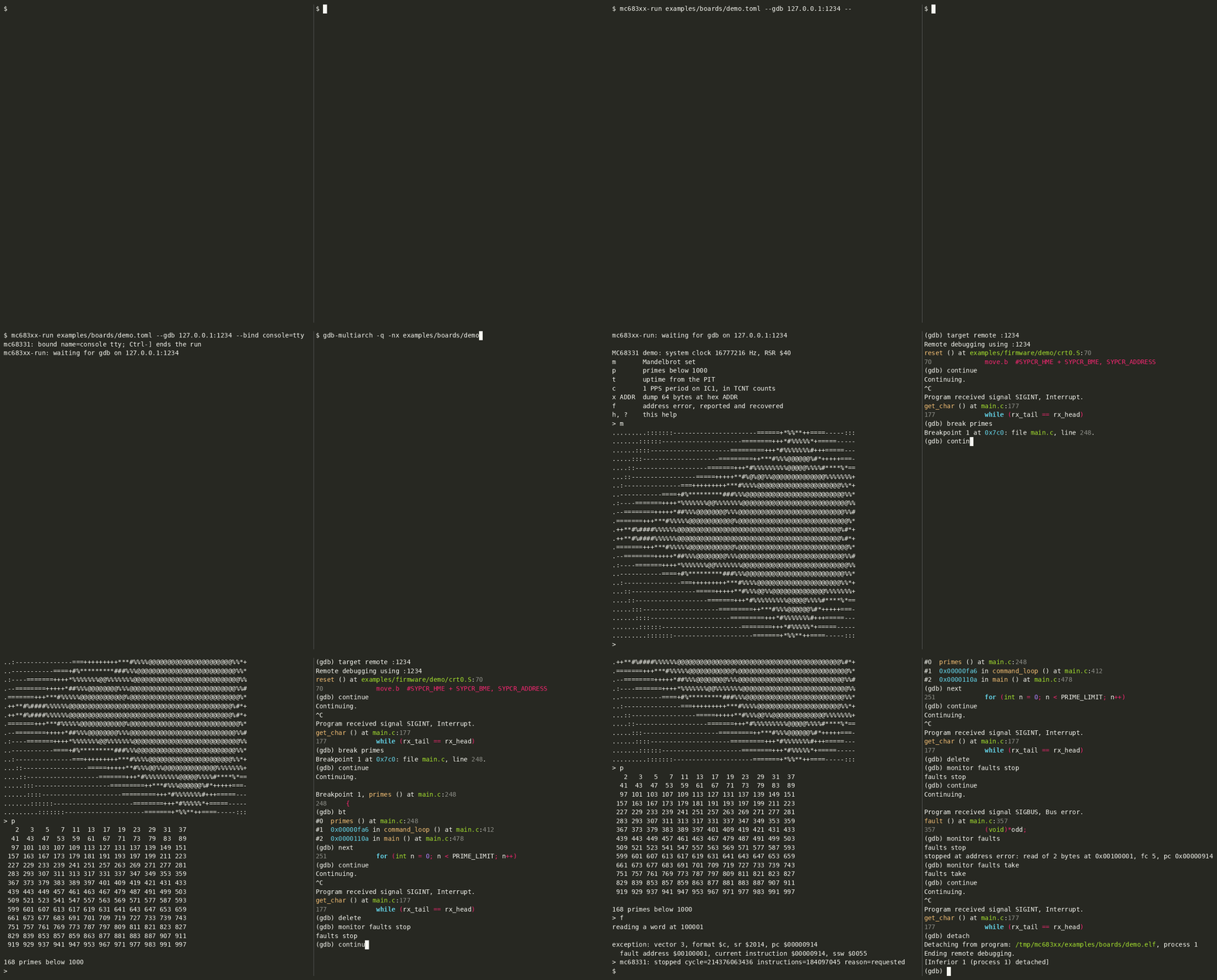
the firmware takes it, and says which; and --gdb 127.0.0.1:1234 waits at reset for gdb to run it.
Standard input that is a file or a pipe is read to its end when input
first goes in and fed a byte a turn, so the run is the same each time;
a terminal's is live. --bind console=tty makes the terminal a
serial console: keys go in raw as typed, Ctrl-C included, and Ctrl-]
ends the run. --bind NAME=stdout writes an endpoint's
output as stdio does and reads nothing, for an endpoint that only
listens or to leave standard input to another binding.
mc683xx-run --help gives the rest; --firmware gives a board
another image. examples/README.md describes the example
boards and their firmware.
Documentation
- Host guide: embedding the chip in a Rust host: building a chip, running, peripherals, pins, hooks, save/restore, errors.
- Board files: the format, the built-in peripheral types and the Rust API for peripheral models.
- Stock peripherals: the peripherals a board file names by part number, their parameters and ports.
- Python: the same from Python.
- gdb: debugging firmware with gdb.
- Firmware under gdb: a recipe: the demo board's C firmware under gdb, source level.
- Tracing: the run trace's format.
- Performance: measurements and the benchmarks.
- PLAN.md: the architecture and the decisions behind it.
- Releasing: versions and the release procedure.
Workspace
The crates above are in crates/: target (mc683xx-target),
cpu32 (mc683xx-cpu32),
mc683xx (mc683xx-modules), mc68331 (mc683xx-mc68331),
mc68331-board (mc683xx-board), peripherals
(mc683xx-peripherals), gdb (mc683xx-gdb), debug
(mc683xx-debug) and mc68331-run
(mc683xx-run). The other members are not on crates.io:
cpu32-py(crates/cpu32-py): the Python packagemc683xx, on PyPI.mc683xx-wasm(crates/wasm): JavaScript bindings for boards, through WebAssembly, the npm packagemc683xx(crates/wasm/README.md).examples: the example boards and their firmware, and the documentation's examples run as tests (examples/README.md).benches: the criterion benchmarks.cpu32-harness,cpu32-oracle: test-only checks of the core against SingleStepTests' 68000 cases, Musashi, Unicorn and the firmware functions of smartclock (HP's firmware images, not in this repository).snapshot-golden: test-only golden files of the snapshot formats.
Building
make hooks   # once per clone
make ci      # fmt check, license copies, commit-msg hook, clippy, tests, rustdoc
make python      # the Python module in .venv, with its tests
make wasm        # the JavaScript bindings (wasm32, wasm-bindgen), linted, as the npm package
make npm-test    # the npm package packed and installed, in Node and headless Chrome
make npm-types   # the npm package's TypeScript declarations compiled (fetches TypeScript)
make web-test    # the demo board's web page (examples/web) in headless Chrome
make pages       # the web page as a static site, for GitHub Pages
make pages-test  # that site in headless Chrome, under its subpath
make singlestep  # SingleStepTests m68000 (fetches about 140 MB once)
make oracle      # differential runs against Musashi (fetches it once)
make corpus SMARTCLOCK_FIRMWARE=...  # smartclock firmware functions
make boot-smoke SMARTCLOCK_FIRMWARE=...  # whole images from reset
make boot-diff SMARTCLOCK_FIRMWARE=... BOOT_DIFF_REFERENCE=...  # against smartclock-emu's trace
make bench       # benchmarks (docs/performance.md)
make deny        # dependencies' licenses and advisories (cargo-deny)
make smartclock-boards SMARTCLOCK_BOARDS=...  # smartclock's board files, stock peripherals real
make corpus-musashi SMARTCLOCK_FIRMWARE=...  # their results against Musashi
make corpus-unicorn SMARTCLOCK_FIRMWARE=...  # against Unicorn
make corpus-oracles SMARTCLOCK_FIRMWARE=...  # against both
make unicorn     # the Unicorn oracle's own tests and clippy
make gdb         # gdb-multiarch against the runner's --gdb, the demo board too
make python creates .venv with maturin, pytest and mypy the first
time; after it, .venv/bin/python imports mc683xx.
The Unicorn targets build Unicorn and QEMU's m68k from C through the
unicorn-engine crate the first time, which takes some minutes and
needs cmake, a C compiler (cc or clang) and pkg-config.
Unicorn is GPL-2.0; it is a test-only oracle, off by default and never
part of the shipped crates (third_party/NOTICE).
The manuals in third_party/ are kept in Git LFS; git lfs install
before cloning, or git lfs pull after.
Contributing
See CONTRIBUTING.md: changes follow the manuals and
datasheets in third_party/, cite them, and come with tests.
Releases
One version for the crates, the Python package and the npm package, semver from 0.1.0; what it covers is in docs/releasing.md, Semver scope. Release notes are on GitHub's releases.
Specification
The vendor manuals in third_party/motorola/ are the specification;
see third_party/NOTICE.
1 maintainer

Metadata
1 maintainer
Release files for mc683xx 0.8.0
For a detailed explanation of source distributions (sdists) and built distributions (wheels), please see the package formats documentation.
Source distribution (sdist)
| File | Size | Uploaded | Provenance | Actions |
|---|---|---|---|---|
| mc683xx-0.8.0.tar.gz | 846.0 kB | With provenance | Details for mc683xx-0.8.0.tar.gz |
Built distributions (wheels)
| File | Actions Reset | |||
|---|---|---|---|---|
| mc683xx-0.8.0-cp312-abi3-win_amd64.whl | CPython 3.12 | abi3 | Windows x86-64 | Details for mc683xx-0.8.0-cp312-abi3-win_amd64.whl |
| mc683xx-0.8.0-cp312-abi3-manylinux_2_17_x86_64.manylinux2014_x86_64.whl | CPython 3.12 | abi3 | Linux glibc 2.17+ x86-64 | Details for mc683xx-0.8.0-cp312-abi3-manylinux_2_17_x86_64.manylinux2014_x86_64.whl |
| mc683xx-0.8.0-cp312-abi3-manylinux_2_17_aarch64.manylinux2014_aarch64.whl | CPython 3.12 | abi3 | Linux glibc 2.17+ ARM64 | Details for mc683xx-0.8.0-cp312-abi3-manylinux_2_17_aarch64.manylinux2014_aarch64.whl |
| mc683xx-0.8.0-cp312-abi3-macosx_11_0_arm64.whl | CPython 3.12 | abi3 | macOS 11.0+ ARM64 | Details for mc683xx-0.8.0-cp312-abi3-macosx_11_0_arm64.whl |
| mc683xx-0.8.0-cp312-abi3-macosx_10_12_x86_64.whl | CPython 3.12 | abi3 | macOS 10.12+ x86-64 | Details for mc683xx-0.8.0-cp312-abi3-macosx_10_12_x86_64.whl |
Total release size: 10.7 MB
Release files / mc683xx-0.8.0.tar.gz
| Download URL | mc683xx-0.8.0.tar.gz |
|---|---|
| Size | 846.0 kB |
| Tags | Source |
|
SHA-256 checksum How to use checksums |
3a9accb1555fa92962e75fe1b00d6338ff4e8a3b53fd853e769427193607c9c7
|
|
BLAKE2b-256 checksum How to use checksums |
ad548e093ab0535b7de1277380964ab71678ee9237da7b36ebd85cfe69141129
|
| Upload date | |
|
Uploaded using Trusted Publishing? What is trusted publishing? |
Yes |
| Uploaded via |
twine/7.0.0 CPython/3.13.16
|
Provenance
Provenance describes where a file came from. On PyPI, provenance is shared via attestations, which provide a verifiable record of the build or publishing details. View details, limitations and caveats.


PyPI Publish Attestation
PyPI verified that this artifact, at this checksum, originated from the publisher listed below.
Signed by GitHub Actions, verified by PyPI on Nov 22, 2026.
Transparency logRelease files / mc683xx-0.8.0-cp312-abi3-win_amd64.whl
| Download URL | mc683xx-0.8.0-cp312-abi3-win_amd64.whl |
|---|---|
| Size | 1.7 MB |
| Tags | CPython 3.12 Windows x86-64 abi3 |
|
SHA-256 checksum How to use checksums |
5e85f956553e6b21457808b2fc492956fe3993c8bec9079ebca2cabbb33f6310
|
|
BLAKE2b-256 checksum How to use checksums |
c993e95eb693c2482b4a9b55f1c5a6e3394324186a1fd4e17b41ff75b7cb7208
|
| Upload date | |
|
Uploaded using Trusted Publishing? What is trusted publishing? |
Yes |
| Uploaded via |
twine/7.0.0 CPython/3.13.16
|
Provenance
Provenance describes where a file came from. On PyPI, provenance is shared via attestations, which provide a verifiable record of the build or publishing details. View details, limitations and caveats.
PyPI Publish Attestation
PyPI verified that this artifact, at this checksum, originated from the publisher listed below.
Signed by GitHub Actions, verified by PyPI on Nov 22, 2026.
Transparency logRelease files / mc683xx-0.8.0-cp312-abi3-manylinux_2_17_x86_64.manylinux2014_x86_64.whl
| Download URL | mc683xx-0.8.0-cp312-abi3-manylinux_2_17_x86_64.manylinux2014_x86_64.whl |
|---|---|
| Size | 2.1 MB |
| Tags | CPython 3.12 Linux glibc 2.17+ x86-64 abi3 |
|
SHA-256 checksum How to use checksums |
cea0a0e63c4c274487587f843d463c9ff494676f4202058fe9adf4991539bbaa
|
|
BLAKE2b-256 checksum How to use checksums |
ed3c22fde2e1934fee7dbe4d17dc08f5fe70abbd2a03571feea784823f67063a
|
| Upload date | |
|
Uploaded using Trusted Publishing? What is trusted publishing? |
Yes |
| Uploaded via |
twine/7.0.0 CPython/3.13.16
|
Provenance
Provenance describes where a file came from. On PyPI, provenance is shared via attestations, which provide a verifiable record of the build or publishing details. View details, limitations and caveats.
PyPI Publish Attestation
PyPI verified that this artifact, at this checksum, originated from the publisher listed below.
Signed by GitHub Actions, verified by PyPI on Nov 22, 2026.
Transparency logRelease files / mc683xx-0.8.0-cp312-abi3-manylinux_2_17_aarch64.manylinux2014_aarch64.whl
| Download URL | mc683xx-0.8.0-cp312-abi3-manylinux_2_17_aarch64.manylinux2014_aarch64.whl |
|---|---|
| Size | 2.1 MB |
| Tags | CPython 3.12 Linux glibc 2.17+ ARM64 abi3 |
|
SHA-256 checksum How to use checksums |
7ffb4cec4457470f65e64504d059e4261f85e72e9e6ae4ffac0ddcd650e919f3
|
|
BLAKE2b-256 checksum How to use checksums |
46201097e891ef6051a070ca2542aba36ed5b93ea52cd864b42a9b8dea60d7aa
|
| Upload date | |
|
Uploaded using Trusted Publishing? What is trusted publishing? |
Yes |
| Uploaded via |
twine/7.0.0 CPython/3.13.16
|
Provenance
Provenance describes where a file came from. On PyPI, provenance is shared via attestations, which provide a verifiable record of the build or publishing details. View details, limitations and caveats.
PyPI Publish Attestation
PyPI verified that this artifact, at this checksum, originated from the publisher listed below.
Signed by GitHub Actions, verified by PyPI on Nov 22, 2026.
Transparency logRelease files / mc683xx-0.8.0-cp312-abi3-macosx_11_0_arm64.whl
| Download URL | mc683xx-0.8.0-cp312-abi3-macosx_11_0_arm64.whl |
|---|---|
| Size | 1.9 MB |
| Tags | CPython 3.12 abi3 macOS 11.0+ ARM64 |
|
SHA-256 checksum How to use checksums |
b0330c021fdfbb770ec112ca62d7af3360c35f128d89f425334427c15a0abfb5
|
|
BLAKE2b-256 checksum How to use checksums |
cc744037a21931d4bcc5979e8f19470dc689ebd7f9236eacc1a00274664bf77b
|
| Upload date | |
|
Uploaded using Trusted Publishing? What is trusted publishing? |
Yes |
| Uploaded via |
twine/7.0.0 CPython/3.13.16
|
Provenance
Provenance describes where a file came from. On PyPI, provenance is shared via attestations, which provide a verifiable record of the build or publishing details. View details, limitations and caveats.
PyPI Publish Attestation
PyPI verified that this artifact, at this checksum, originated from the publisher listed below.
Signed by GitHub Actions, verified by PyPI on Nov 22, 2026.
Transparency logRelease files / mc683xx-0.8.0-cp312-abi3-macosx_10_12_x86_64.whl
| Download URL | mc683xx-0.8.0-cp312-abi3-macosx_10_12_x86_64.whl |
|---|---|
| Size | 2.0 MB |
| Tags | CPython 3.12 abi3 macOS 10.12+ x86-64 |
|
SHA-256 checksum How to use checksums |
d1b0d6f033561e8f668338f70b780e140eca3b1dbd1176d8e02d2971071965e4
|
|
BLAKE2b-256 checksum How to use checksums |
282e146c1f93a7c7e160bbea5b9c98b02eaf634a6bc33865be829d42bf153fab
|
| Upload date | |
|
Uploaded using Trusted Publishing? What is trusted publishing? |
Yes |
| Uploaded via |
twine/7.0.0 CPython/3.13.16
|
Provenance
Provenance describes where a file came from. On PyPI, provenance is shared via attestations, which provide a verifiable record of the build or publishing details. View details, limitations and caveats.
PyPI Publish Attestation
PyPI verified that this artifact, at this checksum, originated from the publisher listed below.
Signed by GitHub Actions, verified by PyPI on Nov 22, 2026.
Transparency logSecurity for mc683xx 0.8.0
Provenance
Provenance describes where a file came from. On PyPI, provenance is shared via attestations, which provide a verifiable record of the build or publishing details. View details, limitations and caveats.
Full provenance
All 6 files in this release have been uploaded with provenance metadata.
Attestation for mc683xx-0.8.0.tar.gz
PyPI Publish Attestation
PyPI verified that this artifact, at this checksum, originated from the publisher listed below.
Signed by GitHub Actions, verified by PyPI on Nov 22, 2026.
Transparency logA note on package security
PyPI is a repository for distributing packages, not a service for auditing them. While third-party security researchers and our staff do their best to detect and remove malicious packages, PyPI cannot guarantee the quality, security or suitability of any given package.
To learn more about protecting yourself from malicious actors, visit our package security documentation.














