
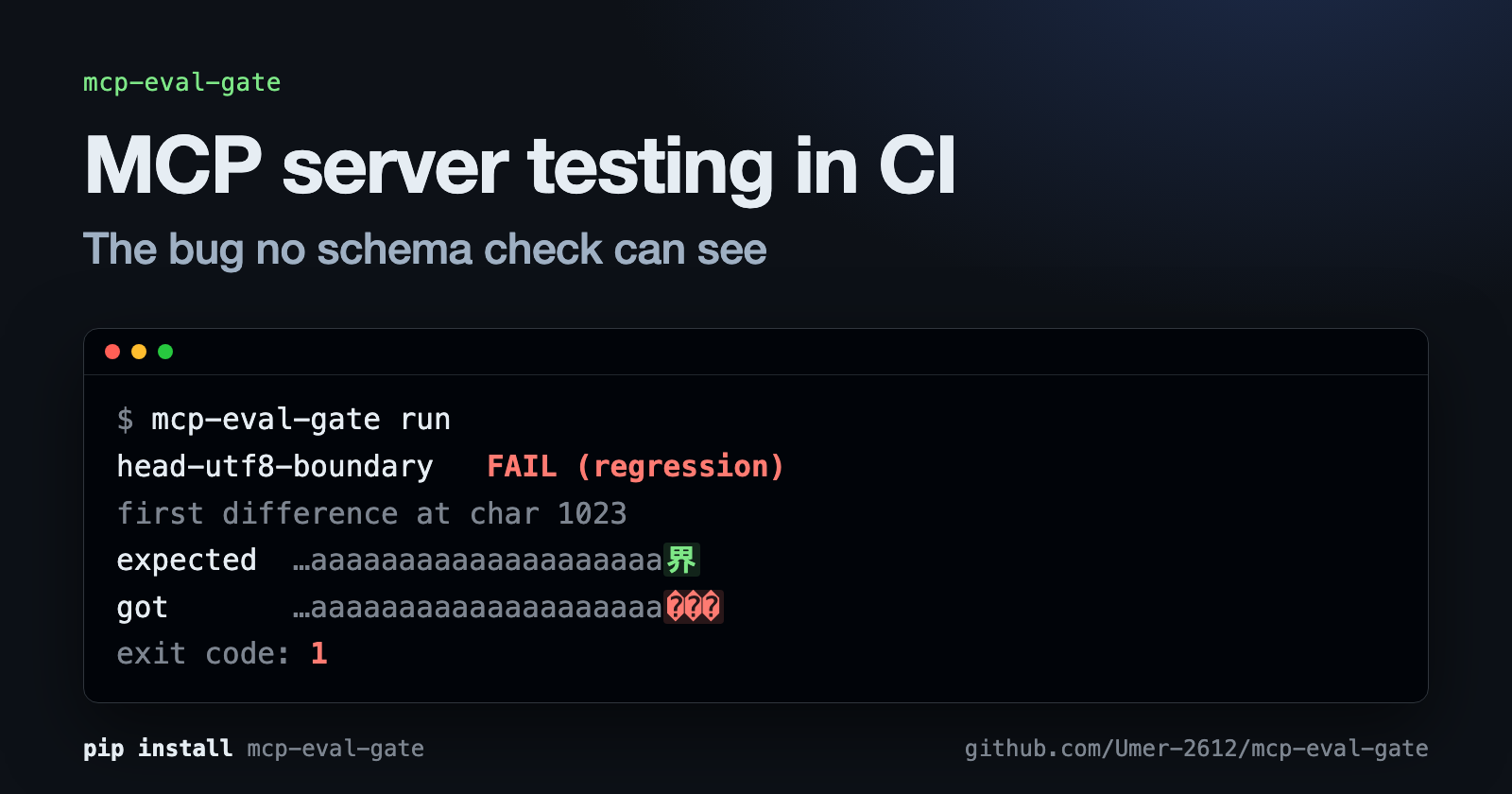
mcp-eval-gate
A CI regression gate for MCP servers. It calls your server's tools, compares the results to a saved baseline, and fails the build when the output gets worse, even if the schema did not change.






Read the write-up: MCP server testing in CI: the bug no schema check can see.
Why
An MCP server's tool names and input schemas can stay identical while what a tool returns quietly gets worse: a refactor breaks a code path, a dependency bump changes behavior. Nothing crashes, the agent using it just gets worse answers. The same goes for the contract a server declares: a schema dialect some clients reject, a tool a client silently drops, an error message that stopped explaining what went wrong.
Other tools cover parts of this. The official Inspector's CLI runs scripted single-run
assertions. mcp-server-diff compares declared schemas and says it does not test output
correctness. A few other early tools record golden outputs and diff them too, for example
vexyo and
cisco-open/mcptoolkit-test.
mcp-eval-gate is another take on golden-output regression, with the server's declared
contract checked next to it.
How it works
init --command "<how you start your server>"lists the server's tools and writes agolden_set.yaml. Tools the server marks read-only and that need no arguments become cases. Every other tool is a commented stub, since a case calls the tool for real.run --update-baselinecalls every tool and records what came back, once, while everything is known to be good. The baseline keeps the raw output, the structured content, whether it was an error, and the server's contract.runcalls the same tools again and compares against the baseline. It prints a table and a diff, and exits1if anything failed or changed, so any CI job can gate on it.
Install
Requires Python 3.12+.
pip install mcp-eval-gate

# only if you use match_type: judge
pip install "mcp-eval-gate[judge]"

# or run it without installing
uvx mcp-eval-gate --help
Quickstart
mcp-eval-gate init --command "node dist/index.js"   # writes golden_set.yaml from the live tool list
mcp-eval-gate run --update-baseline                 # first run: record the baseline
mcp-eval-gate run                                   # later runs: gate on changes
init with no server writes a sample that runs as is against the official MCP reference
server (needs Node.js). --update-baseline refuses to record while any case fails, since a
baseline should hold known-good output. Commit golden_set.yaml and baseline.json.
Golden set
server:
  command: node
  args: ["dist/index.js"]
  # or, for an HTTP server instead of stdio:
  # url: http://localhost:3000/mcp

cases:
  # compare against whatever was recorded in the baseline
  - id: list-projects
    tool_name: list_projects
    match_type: snapshot

  # substring match
  - id: get-weather-nyc
    tool_name: get_weather
    tool_args:
      city: "New York"
    match_type: contains
    expected_output: "New York"

  # exact match
  - id: cancel-subscription
    tool_name: cancel_subscription
    tool_args:
      immediate: true
    match_type: exact
    expected_output: "cancelled"

  # the tool is supposed to fail, and say why
  - id: unknown-user
    tool_name: get_user
    tool_args:
      id: "does-not-exist"
    match_type: contains
    expected_output: "not found"
    expect_error: true

  # scored by an LLM against a rubric (needs ANTHROPIC_API_KEY)
  - id: retention-policy-answer
    tool_name: search_docs
    tool_args:
      query: "data retention policy"
    match_type: judge
    judge_criteria: "Answer must state data is retained for 90 days"
    min_judge_score: 0.8
examples/golden_set.yaml is a copy you can edit.
Case fields
| Field | Required | Default | Meaning |
|---|---|---|---|
id |
yes | Unique name for the case | |
tool_name |
yes | The MCP tool to call | |
tool_args |
no | {} |
Arguments passed to the tool |
match_type |
no | contains |
snapshot, exact, contains, or judge |
expected_output |
for exact and contains |
The text to compare against | |
judge_criteria |
for judge |
The rubric the LLM scores against | |
min_judge_score |
no | 0.8 |
Lowest judge score that passes |
expect_error |
no | false |
The case passes only if the tool returns an error, and the error still has to match |
normalize |
no | Normalizers for this case, on top of the file level ones | |
timeout_seconds |
no | 30 |
A case that takes longer fails on its own, so one hung tool does not stall the run |
A tool call that returns an error fails its case, unless the case sets expect_error.
exact compares character for character, so a trailing newline is a difference and the
failure shows it.
Normalizers
Output that changes on every run, like timestamps and generated ids, can't be compared as is. List normalizers at the top of the golden set to apply them to every case, or under a case to apply them to that one. They run on both sides of a comparison, so the baseline keeps the raw output.
normalize:
  - trim                                   # strip surrounding whitespace
  - tmp_paths                              # /tmp/tmpab12/x becomes <tmp>/x
  - regex: '\d{4}-\d{2}-\d{2}T[\d:.]+Z'    # replace anything that matches
    replace: "<timestamp>"
  - ignore_keys: [id, created_at]          # drop these keys at any depth of JSON output
Exit codes
| Code | Meaning |
|---|---|
0 |
Every case passed and nothing regressed against the baseline |
1 |
A case failed or regressed, --update-baseline was refused because a case failed, compare found a difference, or lint found a problem |
2 |
The golden set or baseline is invalid, or the server could not be started or reached |
Contract
Each recorded baseline also holds the server's contract: protocol version, server info,
capabilities, and every tool as listed by tools/list. On a later run the gate diffs the
current contract against it and prints what changed, for example a tool's inputSchema, a
renamed server, a different tool order.
Contract changes are warnings by default. run --strict-contract fails the build on them.
To silence a path that is expected to move, such as a version string, list it in the golden set:
contract_ignore: [serverInfo.version]
The same run also lints the contract and each call's result for things that make clients drop
or reject tools: a $schema other than 2020-12, a root-level allOf or if in an
inputSchema, an inputSchema that is not an object, and structured content that is missing
or does not match the tool's outputSchema.
lint does only the contract check, and needs no golden set or baseline:
mcp-eval-gate lint --command "uvx some-mcp-server"
mcp-eval-gate lint --url http://localhost:3000/mcp
Compare two servers
compare runs your golden set against two servers and reports where their behavior differs.
Server A is the server block of the golden set, server B is passed on the command line.
Every case is treated as a snapshot, A's output is the reference, so cases need no expected
values. A case that can't run on A counts as a failure. Use it for an old and a new SDK version, or a release and its candidate.
mcp-eval-gate compare --config golden_set.yaml --against "node dist-next/index.js"
mcp-eval-gate compare --config golden_set.yaml --against-url http://localhost:4000/mcp
It also diffs the two contracts, and exits 1 if anything differs.
GitHub Action
- uses: actions/checkout@v4
- uses: Umer-2612/mcp-eval-gate@main
  with:
    config: golden_set.yaml
    baseline: baseline.json
It installs the package, runs the gate, and writes the results table to the job summary.
strict-contract: "true" also fails on contract changes, and package takes a pinned
requirement such as mcp-eval-gate==0.4.0. This repository's CI runs the action against a
real server, once expecting a pass and once expecting a failure.
Run as an MCP tool
The package also installs mcp-eval-gate-mcp, an MCP server over stdio with one tool,
run_eval_gate(config_path, baseline_path, update_baseline, strict_contract). Add it to an MCP
client's config:
{
  "mcpServers": {
    "mcp-eval-gate": { "command": "mcp-eval-gate-mcp" }
  }
}
Without installing, use uvx:
{
  "mcpServers": {
    "mcp-eval-gate": { "command": "uvx", "args": ["--from", "mcp-eval-gate", "mcp-eval-gate-mcp"] }
  }
}
The tool declares its annotations: not read-only (update_baseline rewrites a file), it reaches
whatever server the golden set names, and running it twice gives the same result.
Validation
validation/ has runs against real servers, each with the actual command
output committed and steps to reproduce it. No paid API calls.
- A one-line regression planted in the official MCP reference server, caught with exit
code
1and a real diff. - A real bug the official filesystem server shipped (garbled text when a multi-byte character straddled a read boundary), caught by running the commit before its upstream fix against a baseline from the fixed commit. The write-up walks through it.
- The same three tools on mcp 1.30.0 and mcp 2.2.0.
comparefound that 2.x hides the exception message on a failing tool (the text goes fromError executing tool boom: kaboom...toError executing tool boom), and that the server version string is reported differently. Everything else matched. Upgrading the SDK is a one-line change that a schema check never sees.
These are small. They show the gate works end to end on real code, not how often this class of bug occurs.
Limitations
- Output that varies between runs needs a normalizer, and you write it. There is no automatic detection of timestamps or ids.
snapshotcompares the text and the structured content a tool returns.exactandcontainscompare the text only. There is no check of resources or prompts.- The contract check reads what the server declares. It can't see how a particular client reacts to it beyond the lint rules above.
match_type: judgehas only been tested against a stub client, not the live Anthropic API.
Feedback
If you maintain an MCP server, I'd like to know what you would want to test and what got in the way. Open an issue with the feedback form.
Development
uv sync --extra judge --dev
uv run pytest --cov=src --cov-report=term-missing
uv run ruff check src tests
License
MIT
1 maintainer

Metadata
1 maintainer
Release files for mcp-eval-gate 0.4.0
For a detailed explanation of source distributions (sdists) and built distributions (wheels), please see the package formats documentation.
Source distribution (sdist)
| File | Size | Uploaded | Provenance | Actions |
|---|---|---|---|---|
| mcp_eval_gate-0.4.0.tar.gz | 24.1 kB | Without provenance | Details for mcp_eval_gate-0.4.0.tar.gz |
Built distribution (wheel)
| File | Interpreter | ABI | Platform | Actions Reset |
|---|---|---|---|---|
| mcp_eval_gate-0.4.0-py3-none-any.whl | Python 3 | none | any | Details for mcp_eval_gate-0.4.0-py3-none-any.whl |
Total release size: 55.9 kB
Release files / mcp_eval_gate-0.4.0.tar.gz
| Download URL | mcp_eval_gate-0.4.0.tar.gz |
|---|---|
| Size | 24.1 kB |
| Tags | Source |
|
SHA-256 checksum How to use checksums |
9026ca44f90cee73b117584bfff275400b1c9b99a22a1882d5c0ad3a0627968a
|
|
BLAKE2b-256 checksum How to use checksums |
3a4382bbc0cdd7671c0480dddff1a63e8541a57600719b842fbe76aeb4593dd3
|
| Upload date | |
|
Uploaded using Trusted Publishing? What is trusted publishing? |
No |
| Uploaded via |
uv/0.12.17 {"installer":{"name":"uv","version":"0.12.17","subcommand":["publish"]},"python":null,"implementation":{"name":null,"version":null},"distro":{"name":"macOS","version":null,"id":null,"libc":null},"system":{"name":null,"release":null},"cpu":null,"openssl_version":null,"setuptools_version":null,"rustc_version":null,"ci":null}
|
Release files / mcp_eval_gate-0.4.0-py3-none-any.whl
| Download URL | mcp_eval_gate-0.4.0-py3-none-any.whl |
|---|---|
| Size | 31.8 kB |
| Tags | Python 3 |
|
SHA-256 checksum How to use checksums |
437914ddaf5e47b451a6e52b938f6d4c3a6e280cfd7d38de2e80c65adfafcd9b
|
|
BLAKE2b-256 checksum How to use checksums |
2133eeec73866da880f5b34b23872d64376c925cde7dd374a2828e6c230215d2
|
| Upload date | |
|
Uploaded using Trusted Publishing? What is trusted publishing? |
No |
| Uploaded via |
uv/0.12.17 {"installer":{"name":"uv","version":"0.12.17","subcommand":["publish"]},"python":null,"implementation":{"name":null,"version":null},"distro":{"name":"macOS","version":null,"id":null,"libc":null},"system":{"name":null,"release":null},"cpu":null,"openssl_version":null,"setuptools_version":null,"rustc_version":null,"ci":null}
|
Security for mcp-eval-gate 0.4.0
Provenance
Provenance describes where a file came from. On PyPI, provenance is shared via attestations, which provide a verifiable record of the build or publishing details. View details, limitations and caveats.
No provenance found
None of the files in this release were uploaded with provenance metadata.
A note on package security
PyPI is a repository for distributing packages, not a service for auditing them. While third-party security researchers and our staff do their best to detect and remove malicious packages, PyPI cannot guarantee the quality, security or suitability of any given package.
To learn more about protecting yourself from malicious actors, visit our package security documentation.














