
MCP KQL Server
mcp-name: io.github.4R9UN/mcp-kql-server
AI-Powered KQL Query Execution with Natural Language to KQL (NL2KQL) Conversion and Execution
A Model Context Protocol (MCP) server that transforms natural language questions into optimized KQL queries with intelligent schema discovery, AI-powered caching, and seamless Azure Data Explorer integration. Simply ask questions in plain English and get instant, accurate KQL queries with context-aware results.
Latest Version: v2.1.5 - Policy compliant Azure CLI login and migration to the official MCP Python SDK.












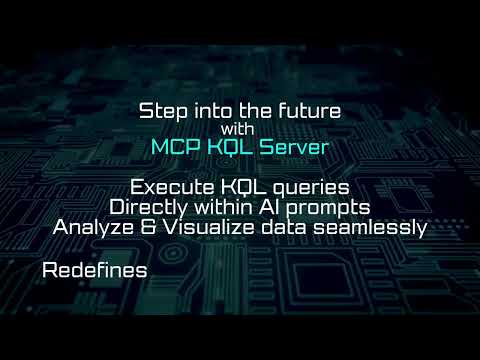
🎬 Demo
Watch a quick demo of the MCP KQL Server in action:
🚀 Features
-
execute_kql_query:- Natural Language to KQL: Generate KQL queries from natural language descriptions.
- Direct KQL Execution: Execute raw KQL queries.
- Multiple Output Formats: Supports JSON, CSV, and table formats.
- Strict Schema Validation: Uses discovered schema memory and validation before execution.
- Schema-Grounded Repair: Repairs invalid columns only when a valid table schema can prove the replacement.
-
kql_schema_memory:- Schema Discovery: Discover and cache schemas for tables.
- Database Exploration: List all tables within a database.
- AI Context: Get ranked CAG context for tables, with optional table-scoped strict schema output.
- Analysis Reports: Generate reports with visualizations.
- Cache Management: Clear or refresh the schema cache.
- Memory Statistics: Get statistics about the memory usage.
📊 MCP Tools Execution Flow
graph TD
    A[👤 User Submits KQL Query] --> B{🔍 Query Validation}
    B -->|❌ Invalid| C[📝 Syntax Error Response]
    B -->|✅ Valid| D[🧠 Load Schema Context]

    D --> E{💾 Schema Cache Available?}
    E -->|✅ Yes| F[⚡ Load from Memory]
    E -->|❌ No| G[🔍 Discover Schema]

    F --> H[🎯 Execute Query]
    G --> I[💾 Cache Schema + AI Context]
    I --> H

    H --> J{🎯 Query Success?}
    J -->|❌ Error| K[🚨 Enhanced Error Message]
    J -->|✅ Success| L[📊 Process Results]

    L --> M[🎨 Generate Visualization]
    M --> N[📤 Return Results + Context]

    K --> O[💡 AI Suggestions]
    O --> N

    style A fill:#4a90e2,stroke:#2c5282,stroke-width:2px,color:#ffffff
    style B fill:#7c7c7c,stroke:#4a4a4a,stroke-width:2px,color:#ffffff
    style C fill:#e74c3c,stroke:#c0392b,stroke-width:2px,color:#ffffff
    style D fill:#8e44ad,stroke:#6a1b99,stroke-width:2px,color:#ffffff
    style E fill:#7c7c7c,stroke:#4a4a4a,stroke-width:2px,color:#ffffff
    style F fill:#27ae60,stroke:#1e8449,stroke-width:2px,color:#ffffff
    style G fill:#f39c12,stroke:#d68910,stroke-width:2px,color:#ffffff
    style H fill:#2980b9,stroke:#1f618d,stroke-width:2px,color:#ffffff
    style I fill:#f39c12,stroke:#d68910,stroke-width:2px,color:#ffffff
    style J fill:#7c7c7c,stroke:#4a4a4a,stroke-width:2px,color:#ffffff
    style K fill:#e74c3c,stroke:#c0392b,stroke-width:2px,color:#ffffff
    style L fill:#27ae60,stroke:#1e8449,stroke-width:2px,color:#ffffff
    style M fill:#8e44ad,stroke:#6a1b99,stroke-width:2px,color:#ffffff
    style N fill:#27ae60,stroke:#1e8449,stroke-width:2px,color:#ffffff
    style O fill:#f39c12,stroke:#d68910,stroke-width:2px,color:#ffffff
Schema Memory Discovery Flow
The schema memory flow is integrated into query execution, but it now reuses existing cached schema before attempting live discovery. If a table schema is already available in CAG/schema memory, the server will use that cached schema instead of re-indexing it.
graph TD
    A[👤 User Requests Schema Discovery] --> B[🔗 Connect to Cluster]
    B --> C[📂 Enumerate Databases]
    C --> D[📋 Discover Tables]

    D --> E[🔍 Get Table Schemas]
    E --> F[🤖 AI Analysis]
    F --> G[📝 Generate Descriptions]

    G --> H[💾 Store in Memory]
    H --> I[📊 Update Statistics]
    I --> J[✅ Return Summary]

    style A fill:#4a90e2,stroke:#2c5282,stroke-width:2px,color:#ffffff
    style B fill:#8e44ad,stroke:#6a1b99,stroke-width:2px,color:#ffffff
    style C fill:#f39c12,stroke:#d68910,stroke-width:2px,color:#ffffff
    style D fill:#2980b9,stroke:#1f618d,stroke-width:2px,color:#ffffff
    style E fill:#7c7c7c,stroke:#4a4a4a,stroke-width:2px,color:#ffffff
    style F fill:#e67e22,stroke:#bf6516,stroke-width:2px,color:#ffffff
    style G fill:#8e44ad,stroke:#6a1b99,stroke-width:2px,color:#ffffff
    style H fill:#f39c12,stroke:#d68910,stroke-width:2px,color:#ffffff
    style I fill:#2980b9,stroke:#1f618d,stroke-width:2px,color:#ffffff
    style J fill:#27ae60,stroke:#1e8449,stroke-width:2px,color:#ffffff
📋 Prerequisites
- Python 3.10 or higher
- Azure CLI installed. Server startup checks the current token and runs plain interactive
az loginonly when needed. - Access to Azure Data Explorer cluster(s)
🚀 One-Command Installation
Quick Install (Recommended)
From Source
git clone https://github.com/4R9UN/mcp-kql-server.git && cd mcp-kql-server && pip install -e .
Alternative Installation Methods
pip install mcp-kql-server
That's it! The server automatically:
- ✅ Sets up memory directories in
%APPDATA%\KQL_MCP(Windows) or~/.local/share/KQL_MCP(Linux/Mac) - ✅ Configures optimal defaults for production use
- ✅ Suppresses verbose Azure SDK logs
- ✅ No environment variables required
📱 MCP Client Configuration
One-time install (any platform):
pip install --upgrade mcp-kql-serverAfter install, configure your MCP client to launch the server via the Python module entry point:
python -m mcp_kql_server. This works on every platform where Python is onPATHand does not depend on the location of themcp-kql-serverconsole script. (The console script is still installed bypipand remains supported for backward compatibility — see the alternative snippets below.)
Claude Desktop
Add to your Claude Desktop MCP settings file (mcp_settings.json):
Location:
- Windows:
%APPDATA%\Claude\mcp_settings.json - macOS:
~/Library/Application Support/Claude/mcp_settings.json - Linux:
~/.config/Claude/mcp_settings.json
{
  "mcpServers": {
    "mcpKqlServer": {
      "type": "stdio",
      "command": "python",
      "args": ["-m", "mcp_kql_server"]
    }
  }
}
Alternatives: platform-stable launchers or the installed console script
Windows (the py launcher is commonly available as py; use Get-Command py if you need its full path):
{
  "mcpServers": {
    "mcpKqlServer": {
      "type": "stdio",
      "command": "py",
      "args": ["-3", "-m", "mcp_kql_server"]
    }
  }
}
On macOS / Linux replace "py" with "python3" and drop the "-3" arg.
VSCode (with MCP Extension)
Add to your VSCode MCP configuration:
Settings.json location:
- Windows:
%APPDATA%\Code\User\mcp.json - macOS:
~/Library/Application Support/Code/User/mcp.json - Linux:
~/.config/Code/User/mcp.json
{
  "servers": {
    "mcpKqlServer": {
      "type": "stdio",
      "command": "py",
      "args": ["-3", "-m", "mcp_kql_server", "--transport", "stdio"],
      "timeout": 300000,
      "env": {
        "FASTMCP_TRANSPORT": "stdio",
        "MCP_KQL_AUTH_ON_STARTUP": "true",
        "MCP_KQL_CHECK_FOR_UPDATES": "false",
        "MCP_KQL_SKIP_STARTUP_VERSION_CHECK": "1",
        "MCP_KQL_AUTH_CHECK_TIMEOUT_SECONDS": "10",
        "MCP_KQL_AUTH_LOGIN_TIMEOUT_SECONDS": "120",
        "MCP_KQL_SQLITE_BUSY_TIMEOUT_MS": "30000"
      }
    }
  }
}
If VS Code logs
spawn ...PythonNNN/python.exe ENOENT, the Python extension is substituting a cached interpreter path for"python". Switch to"py"(Windows) /"python3"(macOS/Linux), or to the"mcp-kql-server"console script thatpip installdrops onPATH. See docs/troubleshooting.md for full details.
Windows tip: use
py -3 -m mcp_kql_serverso VS Code does not need a user-specific Python path. If you must use a full path locally, keep it in your privatemcp.json, not in shared documentation.
If the server starts but VS Code still shows no tools, run
MCP: Reset Cached Tools, thenMCP: Reset Trust, and restart the server fromMCP: List Servers. VS Code stores trust and cached tools separately frommcp.json, so a previous failed launch can keep the old empty state until you reset it.
Shared HTTP Mode for Multiple MCP Clients
Use shared HTTP when VS Code, GitHub Copilot CLI, agents, or other MCP clients should connect to one persistent MCP KQL server process.
HTTP binds are restricted to loopback by default because tool calls execute with the operator's Azure CLI identity. Put authentication and TLS in a trusted reverse proxy before remote exposure. Non-loopback binding requires the explicit MCP_KQL_ALLOW_UNAUTHENTICATED_REMOTE_HTTP=true acknowledgement.
Start the server:
python -m mcp_kql_server --transport http --host 127.0.0.1 --port 8000 --http-path /mcp --stateless-http
Client configuration:
{
  "servers": {
    "mcpKqlServer": {
      "type": "http",
      "url": "http://127.0.0.1:8000/mcp"
    }
  }
}
Runtime Settings
| Option or environment variable | Purpose | Default |
|---|---|---|
--transport, FASTMCP_TRANSPORT |
stdio, http, streamable-http, or sse |
stdio |
--host, FASTMCP_HOST |
HTTP bind host | 127.0.0.1 |
--port, FASTMCP_PORT |
HTTP bind port | 8000 |
--http-path, FASTMCP_STREAMABLE_HTTP_PATH |
Streamable HTTP endpoint path | /mcp |
--stateless-http, FASTMCP_STATELESS_HTTP |
Stateless HTTP mode for shared deployments | false |
--auth-on-startup / --no-auth-on-startup, MCP_KQL_AUTH_ON_STARTUP |
Initialize authentication when the server starts | true |
--check-updates, MCP_KQL_CHECK_FOR_UPDATES |
Check PyPI for package updates before startup | false |
MCP_KQL_AUTH_CHECK_TIMEOUT_SECONDS |
Azure CLI auth check timeout | 10 |
MCP_KQL_AUTH_LOGIN_TIMEOUT_SECONDS |
Interactive Azure login timeout | 120 |
MCP_KQL_AUTH_MODE |
Kusto authentication mode: azure-cli or managed-identity |
azure-cli |
AZURE_CLIENT_ID |
Optional user-assigned managed identity client ID | unset |
MCP_KQL_SQLITE_BUSY_TIMEOUT_MS |
SQLite busy timeout for concurrent local MCP instances | 30000 |
MCP_KQL_MAX_CONCURRENT_QUERIES |
Maximum simultaneous Kusto requests per process | 5 |
MCP_KQL_MAX_RESULT_ROWS |
Maximum rows returned in one MCP response | 10000 |
MCP_KQL_MAX_RESULT_BYTES |
Maximum default JSON response size | 2000000 |
MCP_KQL_MAX_CACHE_ENTRIES |
Maximum persisted query-result cache entries | 1000 |
MCP_KQL_MAX_CACHED_RESULT_BYTES |
Maximum size of one cached result | 2000000 |
MCP_KQL_CACHE_RESULTS |
Persist bounded query results in local SQLite | true |
MCP_KQL_EMBEDDING_MODEL |
Sentence Transformers model used for semantic retrieval | all-MiniLM-L6-v2 |
MCP_KQL_LOG_LEVEL |
Server log level written to stderr | INFO |
MCP_KQL_ALLOW_UNAUTHENTICATED_REMOTE_HTTP |
Explicitly permit a non-loopback HTTP bind | false |
The embedding model is lazy loaded. Changing it causes schemas to be re-embedded on refresh, and vectors produced by other models are ignored rather than mixed.
Roo-code Or Cline (VS-code Extentions)
Ask or Add to your Roo-code Or Cline MCP settings:
MCP Settings location:
- All platforms: Through Roo-code extension settings or
mcp_settings.json
{
  "mcp-kql-server": {
    "type": "stdio",
    "command": "python",
    "args": ["-m", "mcp_kql_server"],
    "alwaysAllow": []
  }
}
Generic MCP Client
For any MCP-compatible application:
# Preferred: invoke as a Python module (cross-platform)
python -m mcp_kql_server

# Platform-stable launchers (recommended if `python` is ambiguous on PATH)
py -3 -m mcp_kql_server     # Windows
python3 -m mcp_kql_server   # macOS / Linux

# Equivalent console script installed by pip
mcp-kql-server

# Shared HTTP mode for multiple clients
python -m mcp_kql_server --transport http --host 127.0.0.1 --port 8000 --http-path /mcp --stateless-http

# Server provides these tools:
# - execute_kql_query: Execute KQL or generate KQL from natural language
# - kql_schema_memory: Discover, cache, and inspect cluster schemas
🔧 Quick Start
1. Start the MCP Server (Zero configuration)
python -m mcp_kql_server
Server startup begins an Azure CLI token check in the background and runs plain interactive az login only when needed. Kusto tool calls never launch login; they wait for that startup task before executing. To authenticate manually before starting the server, run:
az login
To inspect the installed server version and runtime defaults:
python -m mcp_kql_server --info --json
The server starts immediately with:
- 📁 Auto-created memory path:
%APPDATA%\KQL_MCP\cluster_memory - 🔧 Optimized defaults: No configuration files needed
- 🔐 Secure setup: Uses your existing Azure CLI credentials
- ⚡ Responsive startup: MCP discovery starts immediately while authentication initializes in the background
3. Use via MCP Client
The server provides two main tools:
execute_kql_query- Execute KQL queries or generate KQL from natural language
kql_schema_memory- Discover, refresh, and inspect cached cluster schemas
💡 Usage Examples
Basic Query Execution
Ask your MCP client (like Claude):
"Execute this KQL query against the help cluster:
cluster('help.kusto.windows.net').database('Samples').StormEvents | take 10and summarize the result and give me high level insights "
Complex Analytics Query
Ask your MCP client:
"Query the Samples database in the help cluster to show me the top 10 states by storm event count, include visualization"
Schema Discovery
Ask your MCP client:
"Discover and cache the schema for the help.kusto.windows.net cluster, then tell me what databases and tables are available"
Data Exploration with Context
Ask your MCP client:
"Using the StormEvents table in the Samples database on help cluster, show me all tornado events from 2007 with damage estimates over $1M"
Time-based Analysis
Ask your MCP client:
"Analyze storm events by month for the year 2007 in the StormEvents table, group by event type and show as a visualization"
🎯 Key Benefits
For Data Analysts
- ⚡ Faster Query Development: AI-powered autocomplete and suggestions
- 🎨 Rich Visualizations: Instant markdown tables for data exploration
- 🧠 Context Awareness: Understand your data structure without documentation
For DevOps Teams
- 🔄 Automated Schema Discovery: Keep schema information up-to-date
- 💾 Smart Caching: Reduce API calls and improve performance
- 🔐 Secure Authentication: Leverage existing Azure CLI credentials
For AI Applications
- 🤖 Intelligent Query Assistance: AI-generated table descriptions and suggestions
- 📊 Structured Data Access: Clean, typed responses for downstream processing
- 🎯 Context-Aware Responses: Rich metadata for better AI decision making
🏗️ Architecture
%%{init: {'theme':'dark', 'themeVariables': {
  'primaryColor':'#1a1a2e',
  'primaryTextColor':'#00d9ff',
  'primaryBorderColor':'#00d9ff',
  'secondaryColor':'#16213e',
  'secondaryTextColor':'#c77dff',
  'secondaryBorderColor':'#c77dff',
  'tertiaryColor':'#0f3460',
  'tertiaryTextColor':'#ffaa00',
  'tertiaryBorderColor':'#ffaa00',
  'lineColor':'#00d9ff',
  'textColor':'#ffffff',
  'mainBkg':'#0a0e27',
  'nodeBorder':'#00d9ff',
  'clusterBkg':'#16213e',
  'clusterBorder':'#9d4edd',
  'titleColor':'#00ffff',
  'edgeLabelBackground':'#1a1a2e',
  'fontFamily':'Inter, Segoe UI, sans-serif',
  'fontSize':'16px',
  'flowchart':{'nodeSpacing':60, 'rankSpacing':80, 'curve':'basis', 'padding':20}
}}}%%
graph LR
    Client["🖥️ MCP Client<br/><b>Claude / AI / Custom</b><br/>─────────<br/>Natural Language<br/>Interface"]

    subgraph Server["🚀 MCP KQL Server"]
        direction TB
        FastMCP["⚡ FastMCP<br/>Framework<br/>─────────<br/>MCP Protocol<br/>Handler"]
        NL2KQL["🧠 NL2KQL<br/>Engine<br/>─────────<br/>AI Query<br/>Generation"]
        Executor["⚙️ Query<br/>Executor<br/>─────────<br/>Validation &<br/>Execution"]
        Memory["💾 Schema<br/>Memory<br/>─────────<br/>AI Cache"]

        FastMCP --> NL2KQL
        NL2KQL --> Executor
        Executor --> Memory
        Memory --> Executor
    end

    subgraph Azure["☁️ Azure Services"]
        direction TB
        ADX["📊 Azure Data<br/>Explorer<br/>─────────<br/><b>Kusto Cluster</b><br/>KQL Engine"]
        Auth["🔐 Azure<br/>Identity<br/>─────────<br/>Interactive<br/>CLI Auth"]
    end

    %% Client to Server
    Client ==>|"📡 MCP Protocol<br/>stdio or streamable HTTP"| FastMCP

    %% Server to Azure
    Executor ==>|"🔍 Execute KQL<br/>Query & Analyze"| ADX
    Executor -->|"🔐 Authenticate"| Auth
    Memory -.->|"📥 Fetch Schema<br/>On Demand"| ADX

    %% Styling - Using cyberpunk palette
    style Client fill:#1a1a2e,stroke:#00d9ff,stroke-width:4px,color:#00ffff
    style FastMCP fill:#16213e,stroke:#c77dff,stroke-width:3px,color:#c77dff
    style NL2KQL fill:#1a1a40,stroke:#ffaa00,stroke-width:3px,color:#ffaa00
    style Executor fill:#16213e,stroke:#9d4edd,stroke-width:3px,color:#9d4edd
    style Memory fill:#0f3460,stroke:#00d9ff,stroke-width:3px,color:#00d9ff
    style ADX fill:#1a1a2e,stroke:#ff6600,stroke-width:4px,color:#ff6600
    style Auth fill:#16213e,stroke:#00ffff,stroke-width:2px,color:#00ffff

    style Server fill:#0a0e27,stroke:#9d4edd,stroke-width:3px,stroke-dasharray: 5 5
    style Azure fill:#0a0e27,stroke:#ff6600,stroke-width:3px,stroke-dasharray: 5 5
Report Generated by MCP-KQL-Server | ⭐ Star this repo on GitHub
🚀 Production Deployment
Ready to deploy MCP KQL Server to Azure for production use? We provide comprehensive deployment automation for Azure Container Apps with enterprise-grade security and scalability.
🌟 Features
- ✅ Serverless Compute: Azure Container Apps with auto-scaling
- ✅ Managed Identity: Passwordless authentication with Azure AD
- ✅ Infrastructure as Code: Bicep templates for reproducible deployments
- ✅ Monitoring: Integrated Log Analytics and Application Insights
- ✅ Secure by Default: Network isolation, RBAC, and least-privilege access
- ✅ One-Command Deploy: Automated PowerShell and Bash scripts
📖 Deployment Guide
For complete deployment instructions, architecture details, and troubleshooting:
👉 View Production Deployment Guide
The guide includes:
- 🏗️ Detailed architecture diagrams
- ⚙️ Step-by-step deployment instructions (PowerShell & Bash)
- 🔒 Security configuration best practices
- 🐛 Troubleshooting common issues
- 📦 Docker containerization details
Quick Deploy
# PowerShell (Windows)
cd deployment
.\deploy.ps1 -SubscriptionId "YOUR_SUB_ID" -ResourceGroupName "mcp-kql-prod-rg" -ClusterUrl "https://yourcluster.region.kusto.windows.net"

# Bash (Linux/Mac/WSL)
cd deployment
./deploy.sh --subscription "YOUR_SUB_ID" --resource-group "mcp-kql-prod-rg" --cluster-url "https://yourcluster.region.kusto.windows.net"
📁 Project Structure
mcp-kql-server/
├── mcp_kql_server/
│   ├── __init__.py          # Package initialization
│   ├── mcp_server.py        # Main MCP server implementation
│   ├── execute_kql.py       # KQL query execution logic
│   ├── memory.py            # Advanced memory management
│   ├── kql_auth.py          # Azure authentication
│   ├── utils.py             # Utility functions
│   └── constants.py         # Configuration constants
├── docs/                    # Documentation
├── Example/                 # Usage examples
├── pyproject.toml          # Project configuration
└── README.md               # This file
🔒 Security
- Azure CLI Authentication: Reuses an existing token or starts interactive browser login
- No Credential Storage: Server doesn't store authentication tokens
- Local Memory: Schema cache stored locally, not transmitted
🐛 Troubleshooting
Common Issues
-
Authentication Errors
# Re-authenticate with Azure CLI
az login --tenant your-tenant-id
-
Memory Issues
# The memory cache is now managed automatically. If you suspect issues,
# you can clear the cache directory, and it will be rebuilt on the next query.
# Windows:
rmdir /s /q "%APPDATA%\KQL_MCP\unified_memory.json"

# macOS/Linux:
rm -rf ~/.local/share/KQL_MCP/cluster_memory
-
Connection Timeouts
- Check cluster URI format
- Verify network connectivity
- Confirm Azure permissions
🤝 Contributing
We welcome contributions! Please do.
📞 Support
- Issues: GitHub Issues
- PyPI Package: PyPI Project Page
- Author: Arjun Trivedi
- Certified : MCPHub
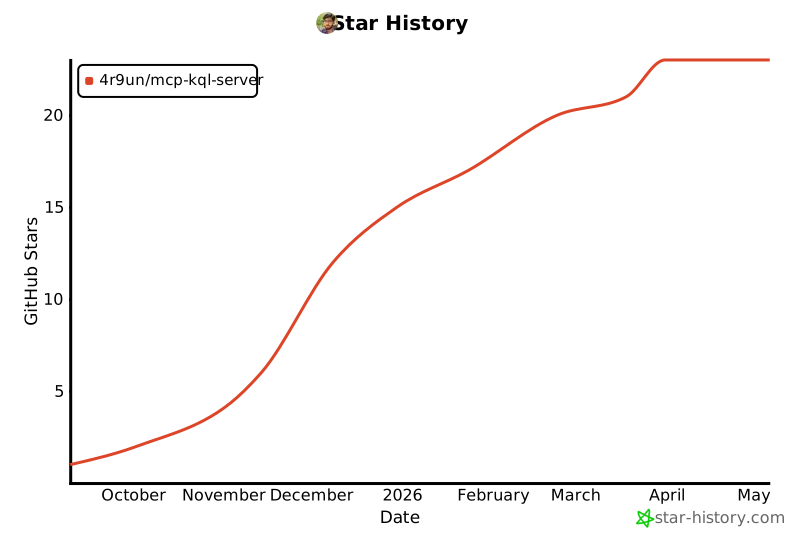
🌟 Star History
mcp-name: io.github.4R9UN/mcp-kql-server
Happy Querying! 🎉
1 maintainer

Metadata
1 maintainer
Release files for mcp-kql-server 2.1.5
For a detailed explanation of source distributions (sdists) and built distributions (wheels), please see the package formats documentation.
Source distribution (sdist)
| File | Size | Uploaded | |
|---|---|---|---|
| mcp_kql_server-2.1.5.tar.gz | 469.8 kB | Details |
Built distribution (wheel)
| File | Interpreter | ABI | Platform | Reset |
|---|---|---|---|---|
| mcp_kql_server-2.1.5-py3-none-any.whl | Python 3 | none | any | Details |
Total release size: 577.6 kB
Release files / mcp_kql_server-2.1.5.tar.gz
| Download URL | mcp_kql_server-2.1.5.tar.gz |
|---|---|
| Size | 469.8 kB |
| Tags | Source |
|
SHA-256 checksum How to use checksums |
a2d4d7558a4b29c5324e0c3a12d8f2946d95e53666d9ef144622ed4844616525
|
|
BLAKE2b-256 checksum How to use checksums |
277b6aa2b0e33fc0800851f6d03bf391ca4ae42b35b37df6c8818d3d89eca705
|
| Upload date | |
|
Uploaded using Trusted Publishing? What is trusted publishing? |
No |
| Uploaded via |
twine/7.0.0 CPython/3.13.14
|
Release files / mcp_kql_server-2.1.5-py3-none-any.whl
| Download URL | mcp_kql_server-2.1.5-py3-none-any.whl |
|---|---|
| Size | 107.8 kB |
| Tags | Python 3 |
|
SHA-256 checksum How to use checksums |
f6eac66f7ea0e114637d64aeeccf8433274b14496998f84d741fadfaba300d39
|
|
BLAKE2b-256 checksum How to use checksums |
743f1ff1c04701f868c6d1cfb287c713231e7037472b26b8a287727d7e4f4ec4
|
| Upload date | |
|
Uploaded using Trusted Publishing? What is trusted publishing? |
No |
| Uploaded via |
twine/7.0.0 CPython/3.13.14
|














