
MCP server for SQLite files. Supports Datasette-compatible metadata!
Verified details
These details have been verified by PyPIProject links
GitHub Statistics
Maintainers

Project description
mcp-sqlite
Provide useful data to AI agents without giving them access to external systems. Compatible with Datasette for human users!
Features
- AI agents can get the structure of all tables and columns in the SQLite database in one command -
sqlite_get_catalog.- The catalog can be enriched with descriptions for the tables and columns using a simple YAML or JSON metadata file.
- The same metadata file can contain canned queries to the AI to use.
Each canned query will be turned into a separate MCP tool
sqlite_execute_main_{tool name}. - AI agents can execute arbitrary SQL queries with
sqlite_execute.
Quickstart
- Install uv.
- Download the sample SQLite database titanic.db.
- Create a metadata file
titanic.ymlfor your dataset:databases: titanic: tables: Observation: description: Main table connecting passenger attributes to observed outcomes. columns: survived: "0/1 indicator whether the passenger survived." age: The passenger's age at the time of the crash. # Other columns are not documented but are still visible to the AI agent queries: get_survivors_of_age: title: Count survivors of a specific age description: Returns the total counts of passengers and survivors, both for all ages and for a specific provided age. sql: |- select count(*) as total_passengers, sum(survived) as survived_passengers, sum(case when age = :age then 1 else 0 end) as total_specific_age, sum(case when age = :age and survived = 1 then 1 else 0 end) as survived_specific_age from Observation
- Create an entry in your MCP client for your database and metadata
{
    "mcpServers": {
        "sqlite": {
            "command": "uvx",
            "args": [
                "mcp-sqlite",
                "/absolute/path/to/titanic.db",
                "--metadata",
                "/absolute/path/to/titanic.yml"
            ]
        }
    }
}
Your AI agent should now be able to use mcp-sqlite tools sqlite_get_catalog, sqlite_execute, and get_survivors_of_age!
Interactive exploration with MCP Inspector and Datasette
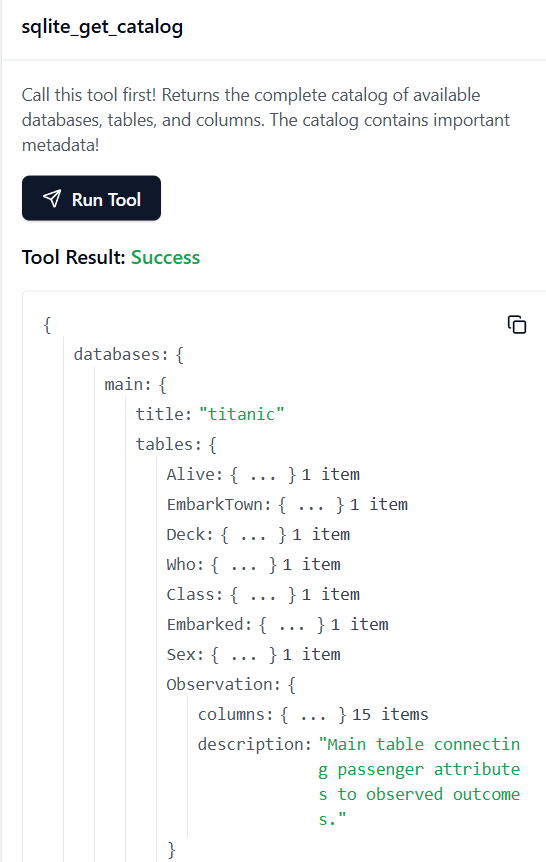
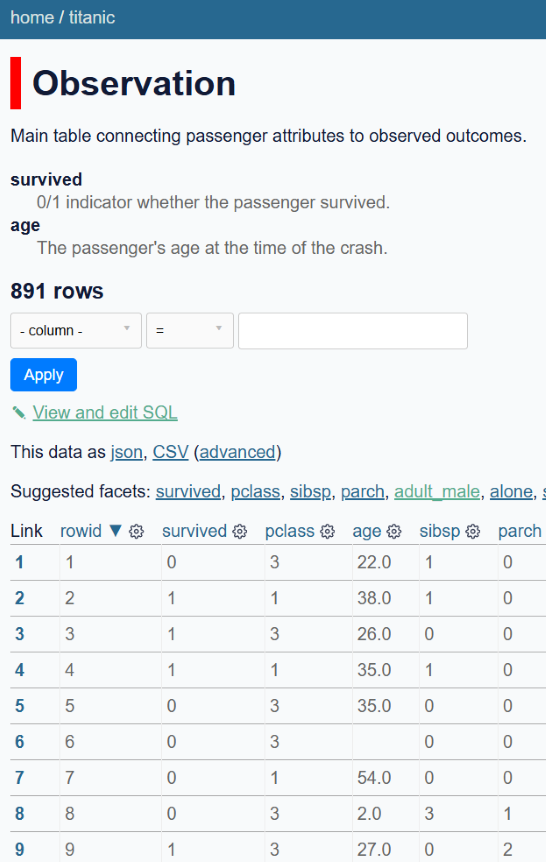
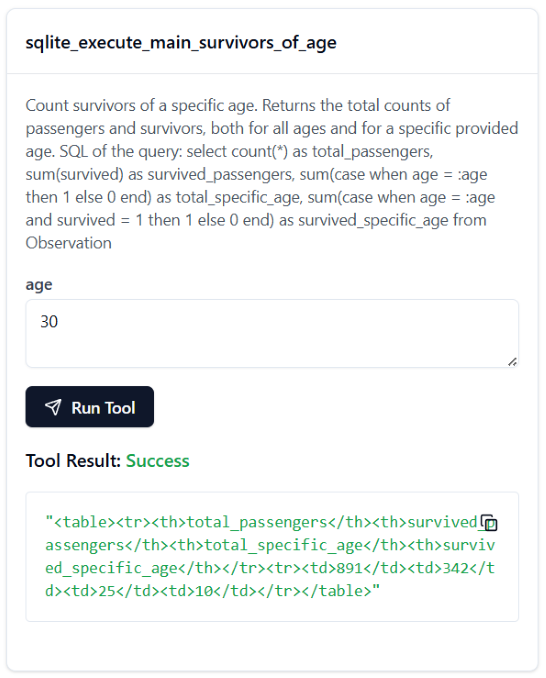
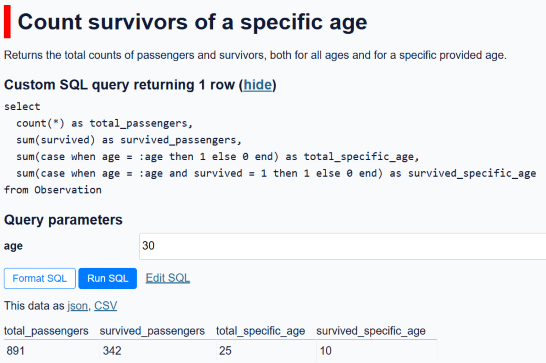
The same database and metadata files can be used to explore the data interactively with MCP Inspector and Datasette.
| MCP Inspector | Datasette |
|---|---|
 |
 |
 |
 |
MCP Inspector
Use the MCP Inspector dashboard to interact with the SQLite database the same way that an AI agent would:
- Install npm.
- Run:
npx @modelcontextprotocol/inspector uvx mcp-sqlite path/to/titanic.db --metadata path/to/titanic.yml
Datasette
Since mcp-sqlite metadata is compatible with the Datasette metadata file, you can also explore your data with Datasette:
uvx datasette serve path/to/titanic.db --metadata path/to/titanic.yml
Compatibility with Datasette allows both AI agents and humans to easily explore the same local data!
MCP Tools provided by mcp-sqlite
- sqlite_get_catalog(): Tool the agent can call to get the complete catalog of the databases, tables, and columns in the data, combined with metadata from the metadata file.
In an earlier iteration of
mcp-sqlite, this was a resource instead of a tool, but resources are not as widely supported, so it got turned into a tool. If you have a usecase for the catalog as a resource, open an issue and we'll bring it back! - sqlite_execute(sql): Tool the agent can call to execute arbitrary SQL. The table results are returned as HTML. For more information about why HTML is the best format for LLMs to process, see Siu et al.
- {canned query name}({canned query args}): A tool is created for each canned query in the metadata, allowing the agent to run predefined queries without writing any SQL.
Usage
Command-line options
usage: mcp-sqlite [-h] -m METADATA [-p PREFIX] [-v] sqlite_file

CLI command to start an MCP server for interacting with SQLite data.

positional arguments:
  sqlite_file           Path to SQLite file to serve the MCP server for.

options:
  -h, --help            show this help message and exit
  -m METADATA, --metadata METADATA
                        Path to Datasette-compatible metadata YAML or JSON file.
  -p PREFIX, --prefix PREFIX
                        Prefix for MCP tools. Defaults to no prefix.
  -v, --verbose         Be verbose. Include once for INFO output, twice for DEBUG output.
Metadata
Hidden tables
Hiding a table with hidden: true will hide it from the catalog returned by the MCP tool sqlite_get_catalog().
However, note that the table will still be accessible by the AI agent!
Never rely on hiding a table from the catalog as a security feature.
Canned queries
Canned queries are each turned into a separate callable MCP tool by mcp-sqlite.
For example, a query named my_canned_query will become a tool my_canned_query.
The canned queries functionality is still in active development with more features planned for development soon:
Roadmap
| Datasette query feature | Supported in mcp-sqlite? |
|---|---|
| Displayed in catalog | ✅ |
| Executable | ✅ |
| Titles | ✅ |
| Descriptions | ✅ |
| Parameters | ✅ |
| Explicit parameters | ❌ (planned) |
| Hide SQL | ✅ |
| Write restrictions on canned queries | ✅ |
| Pagination | ❌ (planned) |
| Cross-database queries | ❌ (planned) |
| Fragments | ❌ (not planned) |
| Magic parameters | ❌ (not planned) |
Project details
Verified details
These details have been verified by PyPIProject links
GitHub Statistics
Maintainers


Download files
Download the file for your platform. If you're not sure which to choose, learn more about installing packages.
Source Distribution
Built Distribution
Filter files by name, interpreter, ABI, and platform.
If you're not sure about the file name format, learn more about wheel file names.
Copy a direct link to the current filters
File details
Details for the file mcp_sqlite-0.3.1.tar.gz.
File metadata
- Download URL: mcp_sqlite-0.3.1.tar.gz
- Upload date:
- Size: 12.8 kB
- Tags: Source
- Uploaded using Trusted Publishing? Yes
- Uploaded via: twine/6.1.0 CPython/3.12.9
File hashes
| Algorithm | Hash digest | |
|---|---|---|
| SHA256 |
3fca8590bef4716b984de18cdd22c4e7e20ccff3b189cc9b1bd84a5dda84106f
|
|
| MD5 |
2e677ee643bccc2303c77ddce91b1034
|
|
| BLAKE2b-256 |
f8063628950c94d53afca75d234cc33e5e9d703c95a15ff19aa0375a0f72e7e2
|
Provenance
The following attestation bundles were made for mcp_sqlite-0.3.1.tar.gz:
Publisher:
publish-to-test-pypi.yml on panasenco/mcp-sqlite
-
Statement:
-
Statement type:
https://in-toto.io/Statement/v1 -
Predicate type:
https://docs.pypi.org/attestations/publish/v1 -
Subject name:
mcp_sqlite-0.3.1.tar.gz -
Subject digest:
3fca8590bef4716b984de18cdd22c4e7e20ccff3b189cc9b1bd84a5dda84106f - Sigstore transparency entry: 260122204
- Sigstore integration time:
-
Permalink:
panasenco/mcp-sqlite@b43cbf38099fed88e03a7c532f036194fe665321 -
Branch / Tag:
refs/tags/0.3.1 - Owner: https://github.com/panasenco
-
Access:
public
-
Token Issuer:
https://token.actions.githubusercontent.com -
Runner Environment:
github-hosted -
Publication workflow:
publish-to-test-pypi.yml@b43cbf38099fed88e03a7c532f036194fe665321 -
Trigger Event:
push
-
Statement type:
File details
Details for the file mcp_sqlite-0.3.1-py3-none-any.whl.
File metadata
- Download URL: mcp_sqlite-0.3.1-py3-none-any.whl
- Upload date:
- Size: 11.4 kB
- Tags: Python 3
- Uploaded using Trusted Publishing? Yes
- Uploaded via: twine/6.1.0 CPython/3.12.9
File hashes
| Algorithm | Hash digest | |
|---|---|---|
| SHA256 |
cb68e9c8931287b5c50bf0b3ae2a0e3065e038411ddd18bf787ff84a51973f5f
|
|
| MD5 |
d95f6348e0a352b7aa13ac5456ca9db2
|
|
| BLAKE2b-256 |
f980c2d50560b6d38363d27ef437b2c4829a5ebe777ceff66462a13a7d3c3067
|
Provenance
The following attestation bundles were made for mcp_sqlite-0.3.1-py3-none-any.whl:
Publisher:
publish-to-test-pypi.yml on panasenco/mcp-sqlite
-
Statement:
-
Statement type:
https://in-toto.io/Statement/v1 -
Predicate type:
https://docs.pypi.org/attestations/publish/v1 -
Subject name:
mcp_sqlite-0.3.1-py3-none-any.whl -
Subject digest:
cb68e9c8931287b5c50bf0b3ae2a0e3065e038411ddd18bf787ff84a51973f5f - Sigstore transparency entry: 260122224
- Sigstore integration time:
-
Permalink:
panasenco/mcp-sqlite@b43cbf38099fed88e03a7c532f036194fe665321 -
Branch / Tag:
refs/tags/0.3.1 - Owner: https://github.com/panasenco
-
Access:
public
-
Token Issuer:
https://token.actions.githubusercontent.com -
Runner Environment:
github-hosted -
Publication workflow:
publish-to-test-pypi.yml@b43cbf38099fed88e03a7c532f036194fe665321 -
Trigger Event:
push
-
Statement type:






