
md2star





🇫🇷 Version française : LISEZMOI.md.
Convert Markdown into professional DOCX, PPTX and PDF documents using Pandoc, branded templates, and practical automation.
md2star is a cross-platform command-line tool that wraps Pandoc
with a curated styling layer. It handles the parts Pandoc alone gets
wrong — list spacing, bibliography injection, LaTeX math, Mermaid
diagrams, image embedding, table widths, PPTX slide isolation — so
you stay in Markdown and never open Word to fix layout.
The Promise
Local-first by design. md2star runs entirely on your machine — Markdown is converted to DOCX/PPTX/PDF locally via Pandoc/LibreOffice; your documents are never uploaded to a third-party service, no telemetry, no account, no cloud lock-in. Part of the AI Helpers suite: sovereignty over your data through local-first Open Source.
The one honest caveat: the content of your document stays local. Two
optional, clearly-flagged conveniences may touch the network — and only when you
let them: the bundled default template is fetched once from deraison.ai if you
have no local --reference-doc (pass --offline to force the vendored template
and never reach out), and remote  images are embedded only when
you pass --allow-remote-images. Neither ever sends your Markdown anywhere.
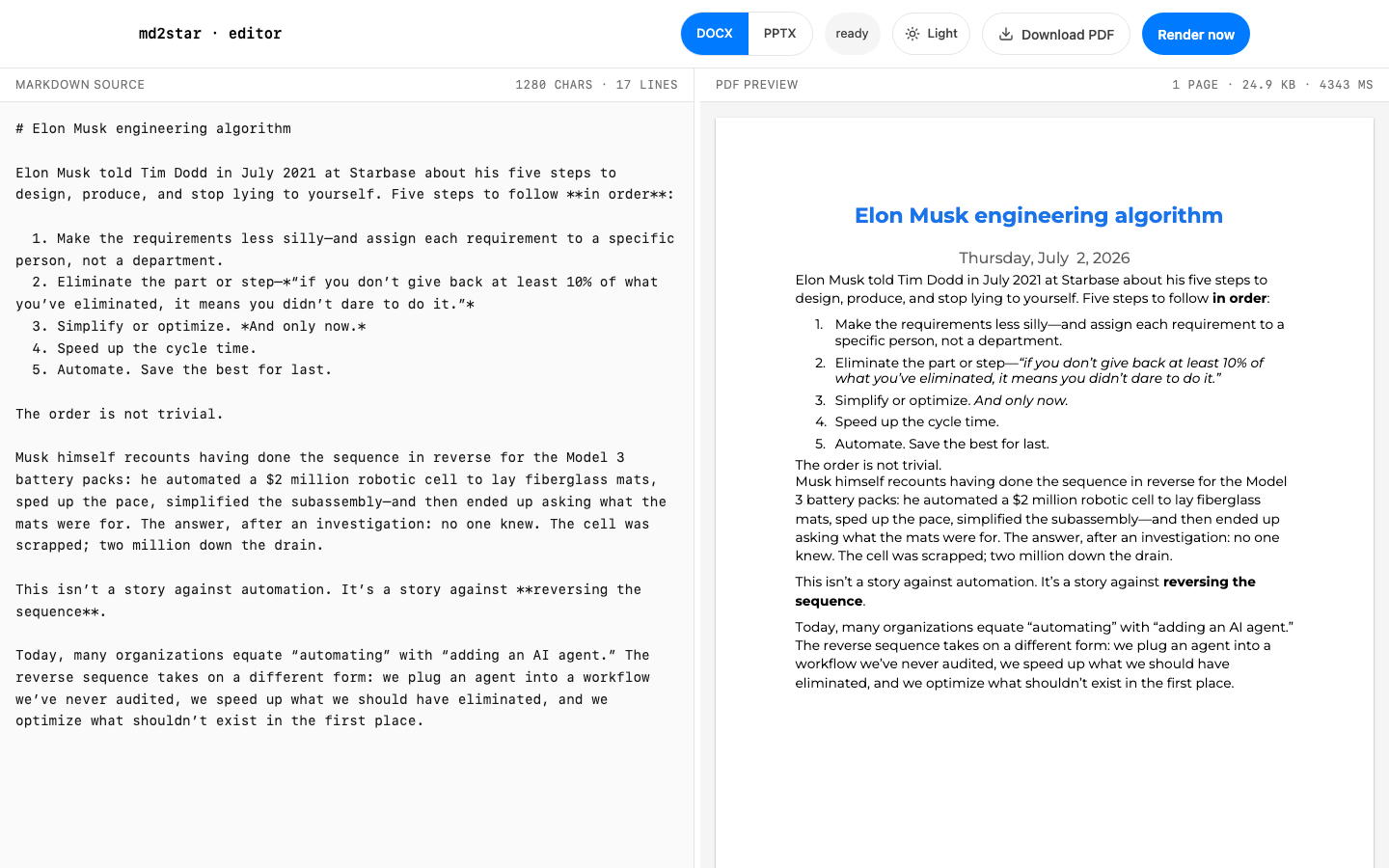
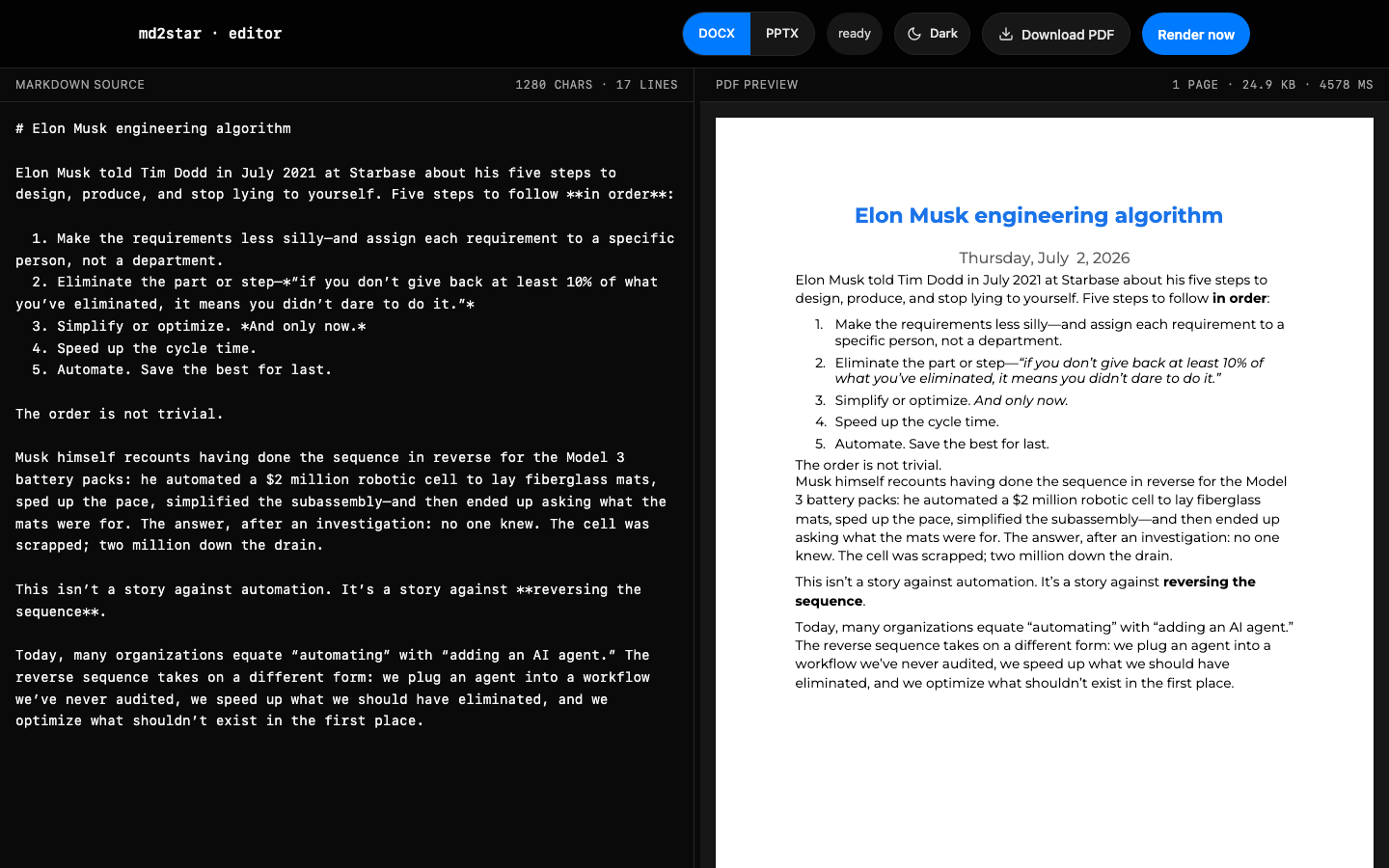
DOCX mode — Musk's five-step engineering algorithm rendered live:
| Light | Dark |
|---|---|
 |
 |
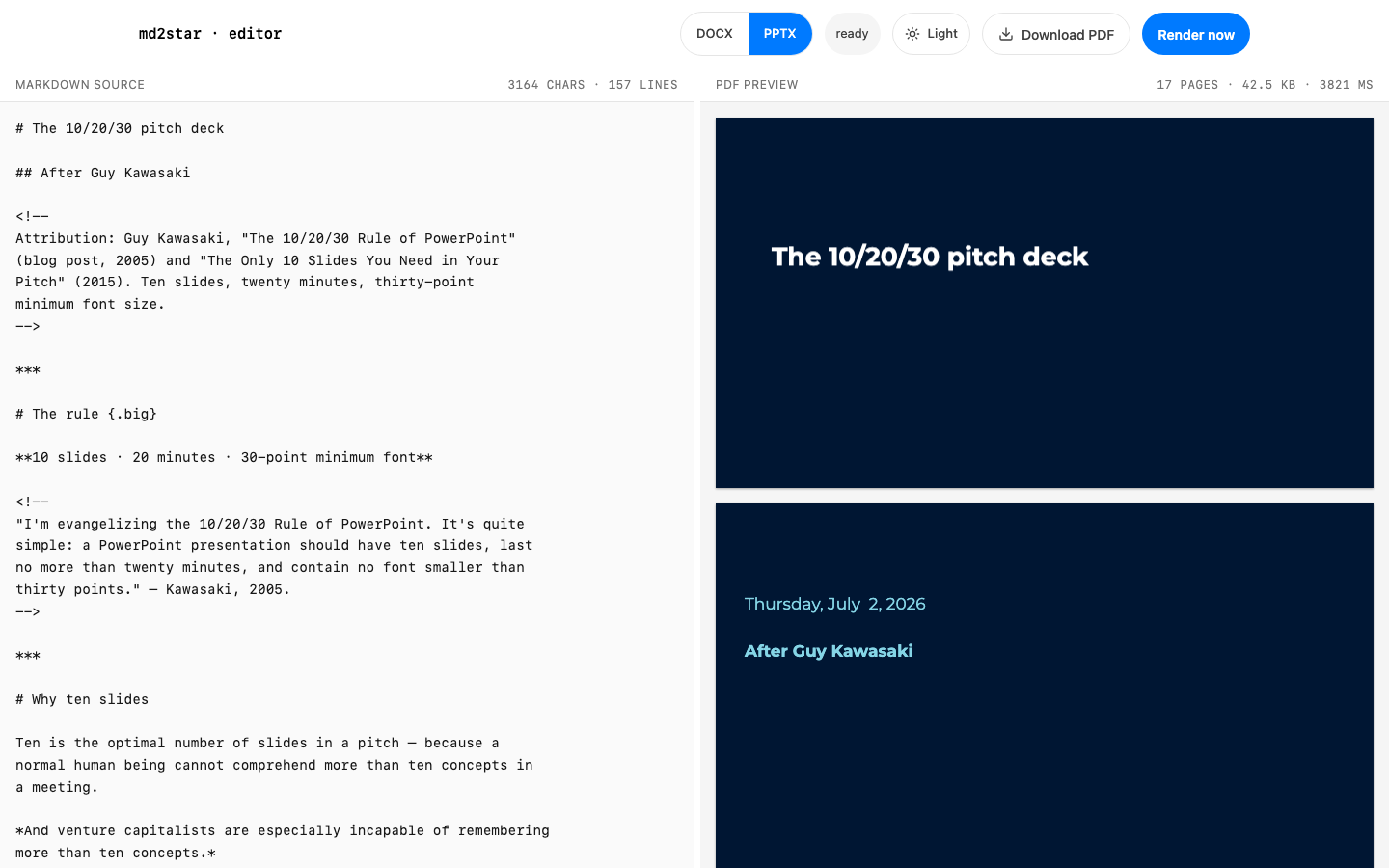
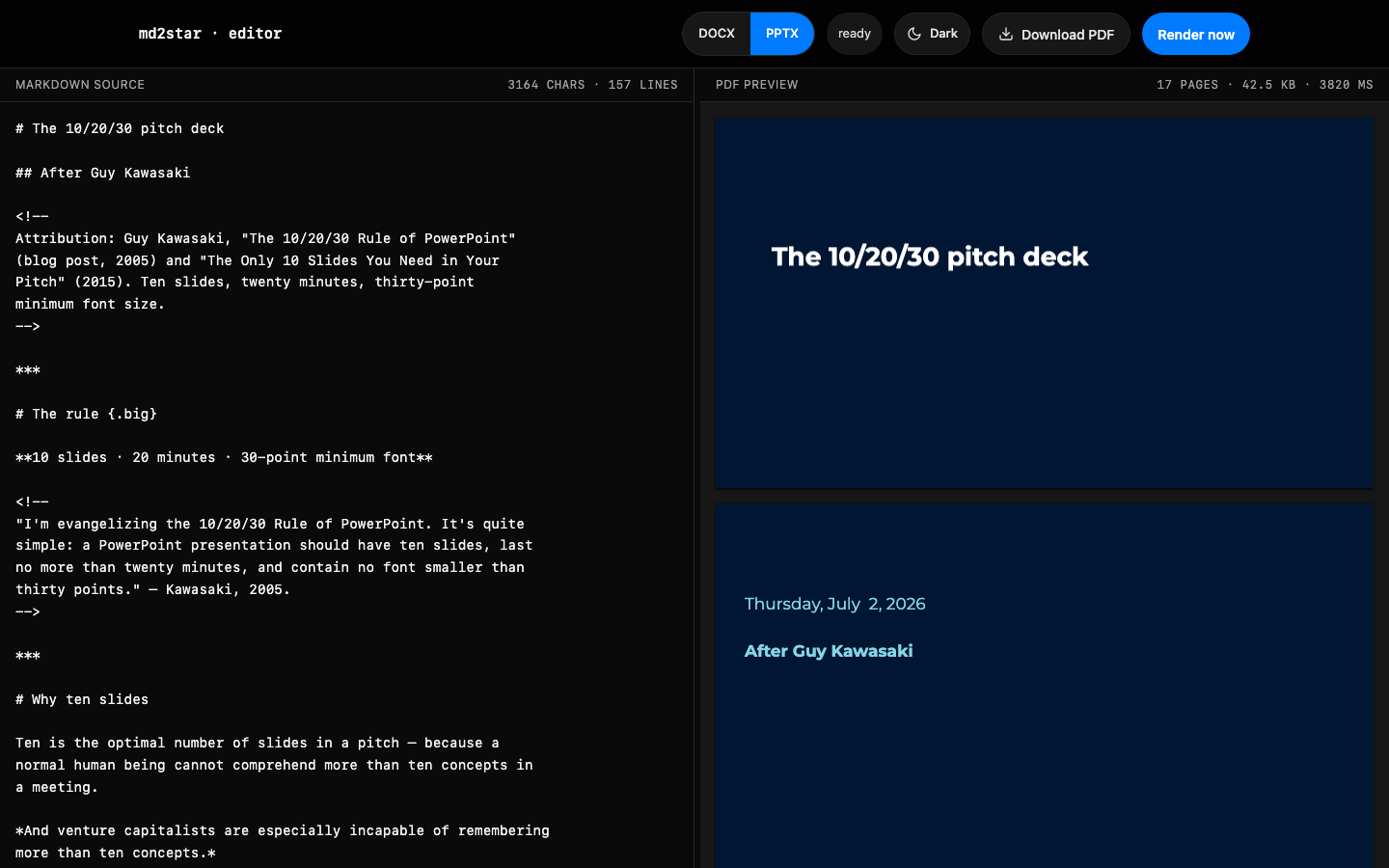
PPTX mode — Kawasaki's 10/20/30 pitch deck rendered live:
| Light | Dark |
|---|---|
 |
 |
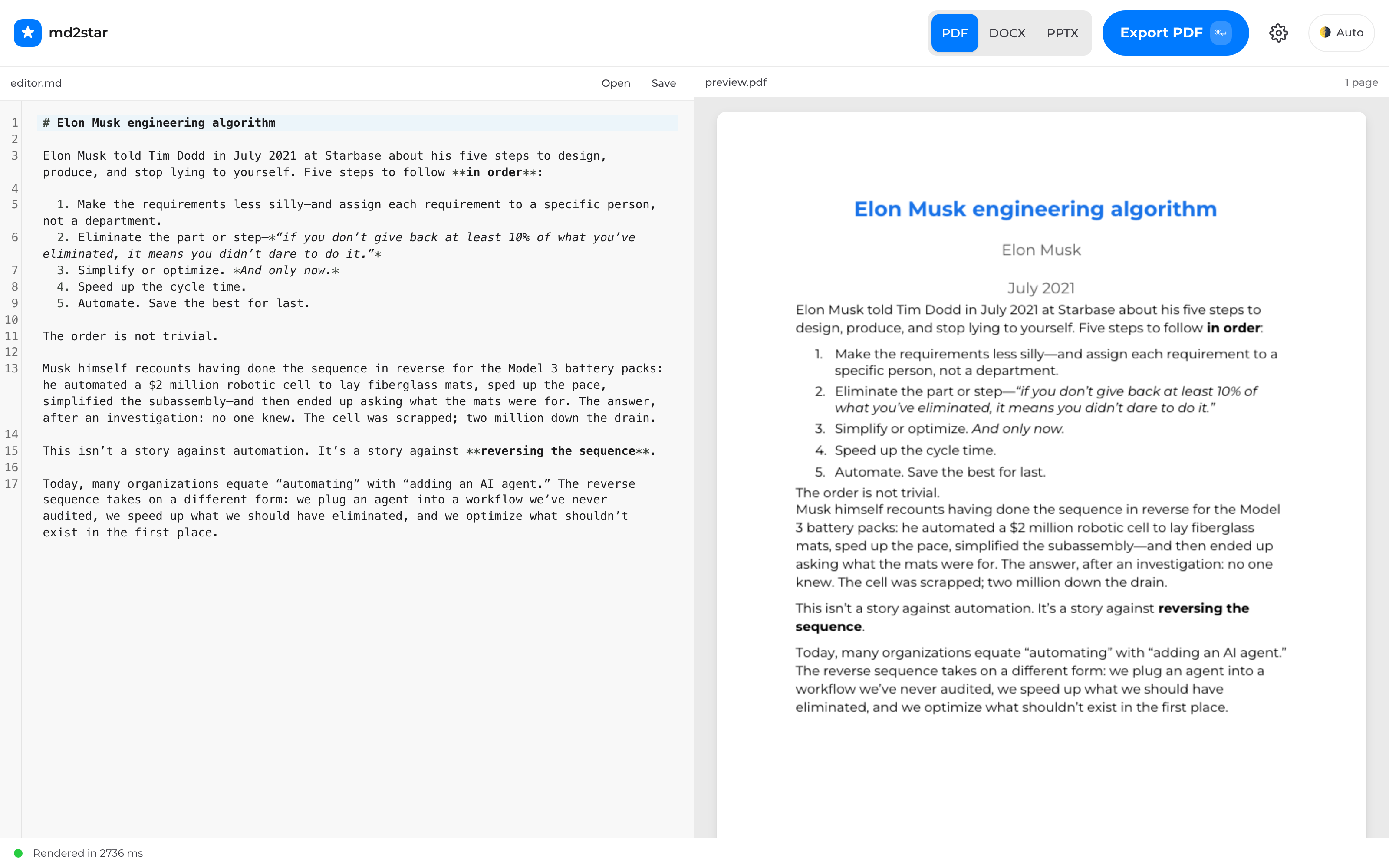
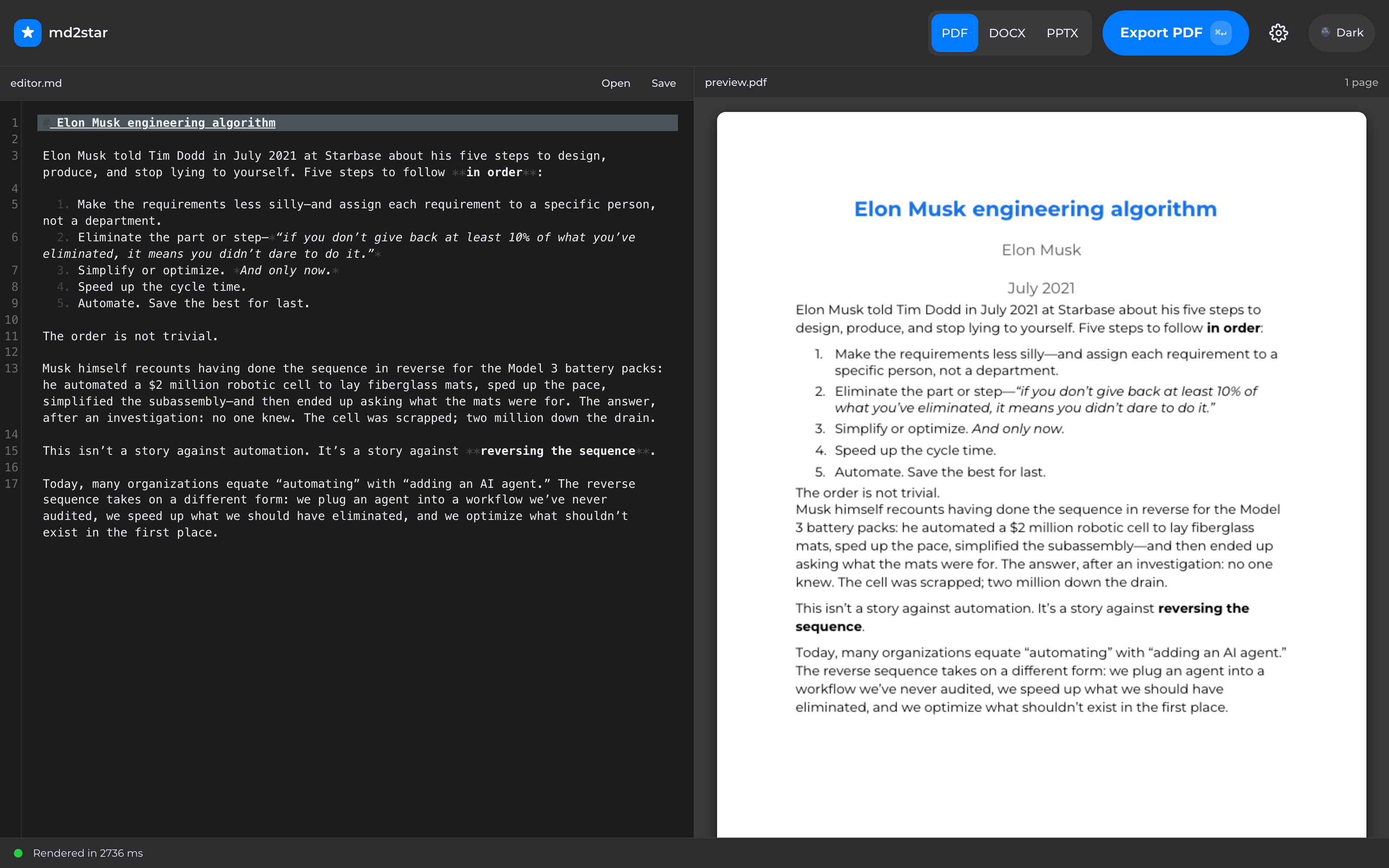
GUI mode — the local Overleaf-style editor with live PDF preview
(md2star gui):
| Light | Dark |
|---|---|
 |
 |
Documentation
Why md2star? (the honest "just use Pandoc" answer)
Pandoc is a converter; md2star is a deliverable. Pandoc turns
Markdown into a valid .docx; md2star turns Markdown into a .docx you can
send to a client without opening Word — and reads it back into editable
Markdown when it comes home. md2star does not out-Pandoc Pandoc; it calls
Pandoc and adds the curated template, the Mermaid/image/PDF glue, the reverse
md2star twin path, and a CI-enforced round-trip that raw Pandoc makes you
build yourself. It sits on top of Pandoc — it never asks you to give Pandoc up.
The full case — the styling gaps raw pandoc report.md -o report.docx leaves on
your desk, the one place "just use Pandoc" has no answer (the reverse path +
round-trip guarantee), and where Pandoc really is the right tool — is in
WHY_MD2STAR_OVER_PANDOC.md.
Quick start
pipx install md2star          # one line, gets you the four CLIs + GUI
md2star doctor                # confirm the environment is healthy
md2docx report.md             # markdown → DOCX
md2pptx slides.md             # markdown → PPTX
md2pdf  paper.md              # markdown → PDF (needs LibreOffice)
md2star gui                   # local browser editor with live PDF preview
Prefer plain pip? Two requirements files mirror the install profiles:
pip install -r requirements.txt for the CLI, pip install -r requirements-gui.txt for the CLI + GUI (same wheel — the GUI adds no
extra Python dependencies).
Prefer HTTP or MCP? md2star also ships a FastAPI surface and an MCP server:
pip install 'md2star[api,mcp]'

md2star-api                    # FastAPI: /gui, /health, /doctor, /convert — docs at /docs
curl -F 'file=@report.md' 'http://localhost:8000/convert?fmt=docx' -o report.docx
# open http://localhost:8000/gui for a minimal drop-a-file browser bench

md2star-mcp                    # same tools (doctor / convert) over MCP
The
md2star-apiserver also serves a minimal browser bench atGET /gui— drop a.md, pick a format, download the result. It is the lightweight sibling of the fullmd2star guieditor (live PDF preview).
Prefer click? md2star-x docx|pptx|pdf|gui|doctor is a click front-end over
the same pipeline (ships with the core install). And md2star packages itself as
a Claude Skill / OpenCode skill so an agent can drive it — see
skills/md2star/ and skills/README.md.
The full catalogue of what should invoke md2star (phrasings, commands, file
situations) lives in TRIGGERS.md.
See docs/installation.md for the full per-OS matrix (macOS / Ubuntu / Fedora / Arch / Windows), feature- by-feature dependency table, verification recipe, and the troubleshooting guide.
Supported outputs
| Format | Status | Requires | CLI |
|---|---|---|---|
| DOCX | Beta | Pandoc | md2docx file.md |
| PPTX | Beta | Pandoc | md2pptx file.md |
| Beta | Pandoc + LibreOffice (soffice) |
md2pdf file.md |
"Beta" means: the format works for the common cases, has automated test coverage, and has been used to ship real documents. The table-render bug that haunted v1.x's PDF pipeline (cells leaking out of the table as a vertical paragraph dump) is fixed in v2.0.0 — the bundled template was rebuilt from a Pandoc-clean baseline.
Examples (the punchy ones)
1. Plain markdown → branded DOCX
md2docx report.md --author "Ada Lovelace"
Gives you report.docx with the bundled template's fonts /
margins / heading styles, the first # Heading lifted to the
document title, today's date localized to the document language,
and the author rendered in the subtitle.
2. Scientific paper with bibliography
md2docx paper.md --author "Dr. Renegade Researcher" \
                 --bib references.bib \
                 --bibliography-name "References"
Pandoc's citeproc resolves [@einstein1905] references against the
BibTeX file and appends a "References" section at the end.
3. PDF that matches the DOCX 1:1
md2pdf paper.md --author "Dr. Renegade Researcher" --bib references.bib
Renders the DOCX through headless LibreOffice so the PDF inherits every md2star polish — branded template, Mermaid PNGs, table styles, localized dates.
A self-contained cookbook with more recipes lives at EXAMPLES.md.
Local GUI (md2star gui)
Prefer a browser to a terminal? md2star gui launches an
Overleaf-style local editor: Markdown on the left, a live PDF
preview on the right, and one-click DOCX / PPTX / PDF downloads.
pip install 'md2star[gui]'    # self-documenting "I want the GUI" install
md2star gui                   # opens http://127.0.0.1:8765 in your browser
md2star gui --port 9000       # pick a port (auto-falls-back if taken)
md2star gui --no-browser      # just print the URL, don't auto-open
md2star[gui]resolves to the same wheel as plainmd2star— the GUI is bundled and needs no extra Python packages, sopip install md2staralready includes it. The[gui]form is just a clearer way to say "I'm here for the editor".
What it gives you:
- Live PDF preview rendered in-page with PDF.js — no round trip through Word or a PDF viewer.
- Folder browser confined to a single folder you open, so you can
edit a whole project's
.mdfiles (open / read / save / create / delete) without leaving the page. - In-session reference template — drag a
template.docx/template.pptxin and this session brands its output with it. - Draft auto-save to the cache dir, so a browser crash or a restart never loses your text.
It is local-first and offline: the server binds to 127.0.0.1
only, the entire frontend (PDF.js, CodeMirror, Tailwind, fonts) is
vendored inside the package, and it fronts the exact same converter as
the CLI — no data ever leaves your machine. Since v2.6.0 the GUI ships
in the core wheel; there is nothing extra to install (the
pip install 'md2star[gui]' command is a self-documenting alias for the
same wheel, not a separate download).
Features
- Frictionless Conversion: Write in Markdown with your favorite editor (
emacs,vim,Sublime Text,Obsidian, …) and produce styled.docx,.pptx, and.pdffiles. - Local GUI (
md2star gui): an offline, localhost-only browser editor with a live PDF preview, a root-confined folder browser, in-session template upload, and draft auto-save. Bundled in the core wheel — nothing extra to install. See Local GUI. - LaTeX Math Support: Robust rendering of complex formulas in both documents and slides.
- Mermaid Diagrams:
```mermaidblocks are rendered locally to PNG via the official Mermaid CLI and embedded automatically (requires Node.js ≥16). - Intelligent Metadata:
- Automatic Title Extraction from your first
# Heading. - Smart Subtitle Injection combining Author and localized Date.
- Language Detection via
langdetect: date formats ship for 10 languages (English, French, Spanish, German, Italian, Portuguese, Dutch, Russian, Japanese, Chinese), with translated weekday/month names in 7 (fr, es, de, it, pt, nl, ru).
- Automatic Title Extraction from your first
- Scientific-Ready: Native BibTeX integration via Pandoc's
citeproc, for documents with managed reference libraries. - Native Footnotes: Markdown footnotes (
text[^1]+[^1]: …) pass straight through Pandoc'sfootnotesextension to real Word footnotes — DOCX gets true bottom-of-page footnotes, PPTX collects them into per-slide notes. No special syntax, no preprocessing. See EXAMPLES.md §10. - Automatic Cleanups (quiet quality-of-life): remote
http(s)://images downloaded for embedding (opt-in), HTML<table>blocks converted to Pandoc pipe-tables, and standalone images split off PPTX slides that contain a table (Pandoc otherwise drops them). - Reversible by Design: md2star's output is a faithful, recoverable rendering, not a one-way dead end. Read the DOCX back with Pandoc and your headings,
**bold**/*italic*/`code`emphasis, tables, and lists come back intact; render all the way to PDF and read it back with kreuzberg and themd → docx → pdf → textround-trip is the exact identityg(f(x)) = xfor prose, bullet lists, multi-page docs, and footnotes (CI-enforced). Repeated conversions converge to a stable fixed point rather than drifting. See Round-trip fidelity. - Markdown twin (reverse direction):
md2star twin <file>reads any PDF — or anything LibreOffice can convert to one — back into an editable<stem>.mdplus anassets/folder. Tables return as GFM pipe tables and every embedded image is scraped out and re-linked. Add--diagrams(opt-in, needs[ai]+ a local Ollama) and node-and-edge figures are re-authored as Mermaid via a target-matching eyeball loop — render a candidate with the samemmdcthe forward path uses, compare it against the scraped original with a local vision model, and iterate until it matches; the scraped PNG is kept as a fallback so nothing is ever lost. Everything degrades gracefully: without the AI stack, images simply stay as scraped PNGs. Needspip install 'md2star[ocr]'. - Graceful Image Path Resolution: URLs, absolute paths, and relative paths all "just work". Relative
references resolve against the input file's directory — somd2docx subdir/file.mdfrom any cwd still finds the image. No need tocdinto the source folder first. - Zero-Config Branding: drop a
template.docx/template.pptxnext to your Markdown and md2star will pick it up automatically as--reference-doc. If neither exists, md2star fetches thederaison.aidefault template by default (since v2.5.0) and caches it; pass--no-remote-templates/--offlineto use the bundled template instead. - Discoverable CLI: every wrapper supports
--help/-hand prints the md2star-specific flags followed bypandoc --help, so the full conversion surface is one command away. Trymd2docx --help,md2pptx --help, ormd2star --help. - Opt-in LLM Linter: a local Ollama pass fixes syntax-level mistakes (broken image links, unclosed fences, malformed pipes) before Pandoc parses the file. Off by default so conversions stay deterministic; pass
--lintto opt in. The wrapper then spawnsollama serveandollama pulls the default model on demand —gemma4:e2b-mlxon macOS (Apple-Silicon-optimized MLX build) orgemma4:e2bon Linux/Windows. The pass works with zero Python dependencies (stdliburllib); installing the optionalmd2star[ai]extra swaps in the officialollamaclient for a nicer API with no change in behaviour. - AI-Drafted Alt-Text: with
--lint, every emptyreference gets a vision-model-drafted alt text (samegemma4:e2bmodel, cached per image). Override the model withMD2STAR_ALT_TEXT_MODEL. - Companion: AI Template Adapter: when you need to brand a corporate PPTX template that doesn't follow Pandoc's standard layout names, use the sibling md2star-adapt tool to build a compatible reference doc from the template + its PDF export.
Installation
md2star is a Python package distributed on PyPI. Installation via
pipx is recommended — it isolates the
package in its own venv and puts the four CLIs (md2star,
md2docx, md2pptx, md2pdf) on your PATH. Pandoc is the only
hard system dependency; LibreOffice is needed for md2pdf; Node.js
is needed for Mermaid; Ollama is needed for --lint.
-
macOS 🍎 :
brew install pandoc pipx(installbrewthanks to brew.sh) — or run the one-shot idempotent bootstrapbash scripts/brew.sh --with-pdfpipx ensurepath # one-time: add ~/.local/bin to PATH pipx install md2star # (install `brew` itself via https://brew.sh/) # Optional: PDF output needs LibreOffice brew install --cask libreoffice # Optional: Mermaid diagrams need Node.js brew install node # Optional: --lint and AI alt-text need Ollama brew install ollama # Optional: nicer AI transport (official ollama client) — pipx-friendly pipx inject md2star ollama # equivalent to the md2star[ai] extra
-
Ubuntu 🐧 :
sudo apt-get install pandoc pipxpipx ensurepath pipx install md2star # Optional dependencies sudo apt-get install libreoffice nodejs curl -fsSL https://ollama.com/install.sh | sh # ollama
-
Windows 🪟 :
winget install --id JohnMacFarlane.Pandocpython -m pip install --user pipx python -m pipx ensurepath pipx install md2star # Optional dependencies winget install --id TheDocumentFoundation.LibreOffice winget install --id OpenJS.NodeJS winget install --id Ollama.Ollama
Install from source (development path)
git clone https://github.com/warith-harchaoui/md2star.git
cd md2star
make install            # checks deps, runs `pipx install .`
Prefer plain pip into a venv? Two requirement files at the repo root
point straight at pyproject.toml (which stays the single source of
truth for version pins):
requirements.txt— runtime (-e .: langdetect + Pillow), enough to runmd2docx/md2pptx/md2pdf.requirements-dev.txt— dev + test (-e .[dev]: pytest, ruff, pytest-cov, pypdf, the api/mcp deps, and kreuzberg).
python -m venv .venv && source .venv/bin/activate
pip install -r requirements.txt        # runtime only
# or
pip install -r requirements-dev.txt    # runtime + test/lint stack
Updating
| Platform | Command |
|---|---|
| Any (PyPI install) | pipx upgrade md2star |
| macOS / Linux from source | make update (git pull + pipx install --force .) |
| Windows from source | powershell -ExecutionPolicy Bypass -File scripts\update.ps1 |
For development
make dev                # creates .venv/ with `pip install -e .[dev]`
source .venv/bin/activate
python -m pytest tests/ -v
Usage Guide
1. Simple Export
md2docx myfile.md
Generates myfile.docx.
2. Scientific Paper (with Citations and Math Formulas)
md2docx work.md --author "Dr. Renegade Researcher" --bib references.bib --bibliography-name "References" --lang en-US
Generates work.docx.
3. Presentation Slides
md2pptx slides.md --author "Speaker Name"
Generates slides.pptx.
4. Branded Slides with Custom Template
md2pptx slides.md --reference-doc my_branded_template.pptx
5. PDF Output
md2pdf paper.md --author "Dr. Renegade Researcher" --bib references.bib
Generates paper.pdf (via headless LibreOffice; requires soffice on PATH).
6. Opt-in LLM Syntax Lint
# default: lint is OFF, conversions are deterministic
md2docx draft.md

# opt in (spawns `ollama serve` and pulls the default model on demand)
md2docx draft.md --lint

# explicit no-op (same as the default; kept for unambiguous scripting)
md2docx draft.md --no-lint
When you pass --lint, a local Ollama pass (text-only gemma4:e2b-mlx on macOS, gemma4:e2b on Linux/Windows) fixes broken image links, unclosed code fences, and malformed table pipes before Pandoc sees the file. The same --lint flag also fills empty  alt text via a local vision model (override the model with MD2STAR_ALT_TEXT_MODEL). The wrapper starts the daemon on demand (ollama serve) and pulls the default model on first use (ollama pull gemma4:e2b…) — a one-time download, narrated on stderr. If --lint is passed but Ollama isn't installed, md2star prints a one-line warning on stderr and falls back to the original Markdown so the conversion still succeeds.
The request reaches the daemon over stdlib urllib by default (no Python dependency). Install the optional md2star[ai] extra — pip install 'md2star[ai]', or pipx inject md2star ollama for a pipx install — to route through the official ollama client instead. It is a pure transport upgrade: same models, same output, same fallback guarantees; the extra only buys the typed client API.
Template Adapter (separate repo)
For branded PPTX templates whose layout names don't follow Pandoc's
defaults, use the companion tool
md2star-adapt. It runs
a three-phase pipeline — extract theme/logo/shapes from the PPTX, classify
each layout with a local VLM (Ollama) against the matching PDF, then
assemble a Pandoc-compatible reference doc — and produces a
branded_ref.pptx you feed back to md2star via --reference-doc.
It lives in its own repo because its dependencies (PyMuPDF, lxml, python-pptx, requests + a running Ollama VLM) are much heavier than the core conversion pipeline needs, and the correctness profile (VLM-driven) is different in kind from md2star's deterministic core.
Examples
A self-contained cookbook lives at EXAMPLES.md — covering titles, Mermaid, lists, multi-column slides, LaTeX math, bibliographies, branded templates, language detection, page breaks, and footnotes.
You can also find more complex examples inside the tests/examples/ directory. To natively batch-compile all documents inside the folder, execute the bash runner:
cd tests/examples
./run.sh
Below are basic .docx and .pptx files generated dynamically during our test suite from sample Markdown files:
Word Documents Examples
- Basic Title assets/docx/basic.docx (from basic.md)
md2docx assets/docx/basic.md - Author Injected assets/docx/with_author.docx (from with_author.md)
md2docx assets/docx/with_author.md --author "Tester"
- Bibliography assets/docx/with_bib.docx (from with_bib.md)
md2docx assets/docx/with_bib.md --bib "assets/references.bib" --bibliography-name "References"
- Language & Date (French) assets/docx/with_lang.docx (from with_lang.md)
md2docx assets/docx/with_lang.md --author "User"
- Math Formulas assets/docx/math.docx (from math.md)
md2docx assets/docx/math.md
PowerPoint Slides Examples
- Extensive Example assets/pptx/example.pptx (from example.md)
md2pptx assets/pptx/example.md - Branded Template tests/examples/branded_slides.pptx (from branded_slides.md + Presentation1.pptx)
md2pptx tests/examples/branded_slides.md --reference-doc tests/examples/Presentation1.pptx
Quality & Reliability
md2star is built for reliability. Our automated test suite covers:
- Metadata accuracy: title extraction, author injection, and subtitle composition.
- Bibliography rendering: citeproc pipeline against the curated references.bib snapshot.
- Date localization: French weekday/month rendering and date-format injection.
- Preprocessor invariants: list spacing, code-block preservation, HTML-table conversion, pipe-table separator normalization, image width injection, language detection, mermaid fallback, math-in-code unwrapping, PPTX slide isolation.
- Offline-mode enforcement: every network-touching phase refuses to run with
--offline.
Integration tests (shell)
Requires Pandoc installed:
make test
Unit tests (Python)
Requires pytest and your generated virtual environment:
python -m pytest tests/ -v
For more details, see tests/README.md.
Round-trip fidelity
Converting to .docx doesn't trap your content in a binary format. md2star's
output is a faithful, reversible rendering of your Markdown: read the
.docx back with any DOCX reader and the source content comes home.
What survives md → docx → md:
| Construct | Recovered? |
|---|---|
| Headings (section levels) | ✅ |
**bold** / *italic* |
✅ |
Inline `code` spans |
✅ (via Pandoc) |
| Pipe tables (every cell) | ✅ |
| Bullet & numbered lists | ✅ |
| Paragraph text | ✅ |
It reaches a fixed point. The round-trip is idempotent in the
mathematical sense — running it twice yields the same document as running it
once (g(g(x)) == g(x)), so repeated conversions converge instead of
accumulating cruft. This is enforced in CI by
tests/test_roundtrip.py, which converts a fixture
to DOCX, reads it back with Pandoc's native reader, and asserts both content
survival and the fixed-point property.
The one thing md2star adds on each run — by design — is a localized date subtitle re-stamped with today's date; that (and cosmetic details like line wrapping and the exact dash count in a table separator, which carry no meaning) is normalized out before the idempotence check. Nothing else drifts.
Reproduce it yourself (any DOCX reader works; the built-in Pandoc path needs no extra install):
md2docx report.md --offline            # report.md → report.docx
pandoc report.docx -t gfm --wrap=none  # report.docx → Markdown on stdout
The pdf → md direction is exact too — and CI-enforced. Rendered all the way
to a PDF and read back with kreuzberg
(extract_file_sync(path, config=ExtractionConfig(output_format=OutputFormat.PLAIN))),
the round-trip md → docx → pdf → text is the identity g(f(x)) = x — proven
by exact, whole-document string equality under an explicit normal form in
tests/test_roundtrip_ocr.py, run for real in CI on a
full LibreOffice + kreuzberg toolchain. It holds for:
- paragraphs of any length (line wrapping is reflowed back);
- bullet lists;
- multi-page documents (page-number footers are normalized out);
- footnotes — numeric
[^1]and named[^aa]alike: the footnote text is recovered even though the renderer renumbers the label.
What a PDF cannot give back is markup it never stored: inline emphasis, heading levels, and table structure render to plain text — their words survive, their markup does not. That structured markup is exactly what the DOCX reader above recovers, so the two directions together cover the whole document.
Customization
Metadata Defaults
Adjust your global defaults in md2star/data/metadata.yaml:
author: "Your Default Name"
date_format: "%A, %e %B %Y"
lang: "en-US"
Chosen conventions:
-
date_formatuses anstrftime()-style format string. See C/POSIX date-time formatting documentation for more information. -
languses a BCP 47 language tag (e.g.,en-US,fr-FR). See RFC 5646 documentation for more information.
Styling Templates
Two levels of customization, from project-local to global:
Per-project (recommended): drop a template.docx or template.pptx next to your Markdown file. Every md2star wrapper auto-detects it and passes it as --reference-doc. Commit it alongside your source so collaborators and CI produce identical branded output.
If neither template.docx (preferred) nor the legacy .pandoc-reference.docx (still honored with a deprecation notice) exists, md2star fetches the default deraison.ai template by default (since v2.5.0) and caches it under XDG:
https://deraison.ai/template.docx
https://deraison.ai/template.pptx
Pass --no-remote-templates (or the hard --offline switch) to skip that fetch and use the bundled template shipped inside the wheel. A failed download (no network, 404, timeout) also falls back to the bundled template, so a conversion never breaks just because deraison.ai is unreachable. You then edit the local/cached copy in Word / PowerPoint / LibreOffice and commit it whenever you're happy with the styling.
Global (changes the bundled default for every project that hasn't pinned its own): modify the master templates in md2star/data/ to change fonts, margins, or logos:
md2star/data/template.docxmd2star/data/template.pptx
These are shipped inside the wheel and used as the offline fallback when no
template.{docx,pptx} is found next to your Markdown. After editing, run
make reinstall so the changes take effect for already-installed CLIs.
Developer Documentation
For contributors and advanced users interested in the inner workings of our Python logic and AST parsing hooks, check our internal API guides:
Related Projects
- Pandoc: The engine that makes document conversion universal.
- MarkItDown: A utility by Microsoft that performs the reverse operation, converting Office documents and other formats into Markdown.
- Obsidian: Our recommended environment for writing high-fidelity Markdown.
- Zotero: The ideal research companion for managing your
.bibbibliographies.
Troubleshooting
| Issue | Solution |
|---|---|
md2docx: command not found |
Add ~/.local/bin to your PATH (pipx ensurepath) and restart your shell. |
pandoc: command not found |
Install Pandoc. |
mmdc errors / mermaid blocks left as code |
Install Node.js ≥16 so npx can fetch @mermaid-js/mermaid-cli. |
| Want the LLM linter to run | Pass --lint. It is off by default; with --lint, the wrapper starts the Ollama daemon and pulls the model on demand. Requires ollama on PATH; otherwise it silently no-ops. |
--lint printed a model-pull error |
The first run downloads gemma4:e2b-mlx (macOS) or gemma4:e2b (Linux/Windows). If the pull failed (e.g. offline), md2star falls back to the original Markdown silently — fix your network and re-run. |
md2pdf: LibreOffice not found |
Install LibreOffice (brew install --cask libreoffice / apt-get install libreoffice / winget). |
| PPTX template layout warnings | Normal if a template lacks standard slide-layout names; output is still valid. |
| Remote image not embedded | Pass --allow-remote-images to opt into the download (md2star is offline-by-default). |
Security model & offline mode
No .md file you process can make a network call on its own. Remote
images stay opt-in via --allow-remote-images. Since v2.5.0 the
deraison.ai reference template is fetched by default when no local
template.{docx,pptx} exists (cached under XDG, bundled fallback on
failure); use --no-remote-templates to skip it. The --offline
switch is the hard kill-switch that forbids every network touch and
makes the refusal explicit in scripts. Full security model:
SECURITY.md.
Roadmap & status
- See ROADMAP.md for what's coming and what's explicitly NOT in scope.
- See CHANGELOG.md for the per-release diff.
- See docs/audit.md for the latest honest engineering audit (forces, risks, priorities).
Contributing
See CONTRIBUTING.md for the quickstart,
project layout, and PR checklist. The TL;DR is make dev +
python -m pytest tests/ + ruff check md2star/ tests/.
License
Distributed under the BSD 3-Clause License — the same permissive license used by scikit-learn and other major scientific Python projects.
Author: Warith HARCHAOUI
1 maintainer

Download files
Download the file for your platform. If you're not sure which to choose, learn more about installing packages.
Source Distribution
Built Distribution
Filter files by name, interpreter, ABI, and platform.
If you're not sure about the file name format, learn more about wheel file names.
Copy a direct link to the current filters
File details
Details for the file md2star-3.0.0.tar.gz.
File metadata
- Download URL: md2star-3.0.0.tar.gz
- Upload date:
- Size: 6.9 MB
- Tags: Source
- Uploaded using Trusted Publishing? No
- Uploaded via:
twine/7.0.0 CPython/3.13.13
File hashes
| Algorithm | Hash digest | |
|---|---|---|
| SHA256 |
a6d6bcac3b9e4e407d40acda8096f3aa3353829c8bb791995be48383e9482636
|
|
| MD5 |
e31d29f5076bc3726c7c719915fed422
|
|
| BLAKE2b-256 |
4754a33aa299b18e05e367c4cc3ef8b9b41f2a3d7d2bfff0f53c883890c8dd82
|
File details
Details for the file md2star-3.0.0-py3-none-any.whl.
File metadata
- Download URL: md2star-3.0.0-py3-none-any.whl
- Upload date:
- Size: 1.4 MB
- Tags: Python 3
- Uploaded using Trusted Publishing? No
- Uploaded via:
twine/7.0.0 CPython/3.13.13
File hashes
| Algorithm | Hash digest | |
|---|---|---|
| SHA256 |
6b786e057d2998aa72deee011fdd91cc730a8cd8c52bfbffca9c61ad7debb01c
|
|
| MD5 |
6e52e481a571de487e359470d9b9ff58
|
|
| BLAKE2b-256 |
8f26f09afabdcf1fc4168a7cf07962e73b80eca3ae650780beaa07547e726146
|














