







mdapy-v2 is a maintained fork of
IHCantabria/mdapy, developed by the
original author. It keeps the legacy mdapy Python import while evolving the
public API, correctness checks, examples, and performance of the algorithm.
Installation
mdapy-v2 requires Python 3.12 or newer.
pip install mdapy-v2
The distribution name changed, but the import remains short and familiar:
from mdapy import DataColumn, max_diss_alg
Quick start
Each DataColumn represents one variable. Mark angular variables as
directional so that, for example, the distance between 350° and 10° is 20°
rather than 340°.
from mdapy import DataColumn, max_diss_alg

tp = [14.93, 10.42, 7.46, 7.63, 12.20, 12.05, 14.49, 8.62]
hs = [1.82, 1.45, 0.26, 0.90, 1.30, 5.71, 1.40, 2.18]
direction = [268, 272, 289, 293, 276, 273, 276, 292]

points, indices = max_diss_alg(
    DataColumn(tp),
    DataColumn(hs),
    DataColumn(direction, directional=True),
    n_clusters=3,
)
points contains the selected observations in selection order and indices
contains their positions in the original input. Use seed_index to choose a
different initial observation:
points, indices = max_diss_alg(
    DataColumn(tp),
    DataColumn(hs),
    n_clusters=3,
    seed_index=4,
)
How it works
The implementation follows the formulation described in Appendix 1 of Guanche et al. (2013).
The Maximum Dissimilarity Algorithm builds a diverse subset iteratively:
- Start with the observation at
seed_index(position0by default). - Measure every unselected observation against its nearest selected one.
- Select the observation whose nearest distance is greatest.
- Repeat until
n_clustersobservations have been selected.
Distances are Euclidean after normalizing each variable by its standard deviation. Directional variables use the shortest angular distance and a circular standard deviation. Exact ties preserve input order.
Examples
Start with the minimal selection, a one-dimensional case small enough to follow in a debugger. The next example animates how the algorithm expands a diverse subset through a two-dimensional sample.
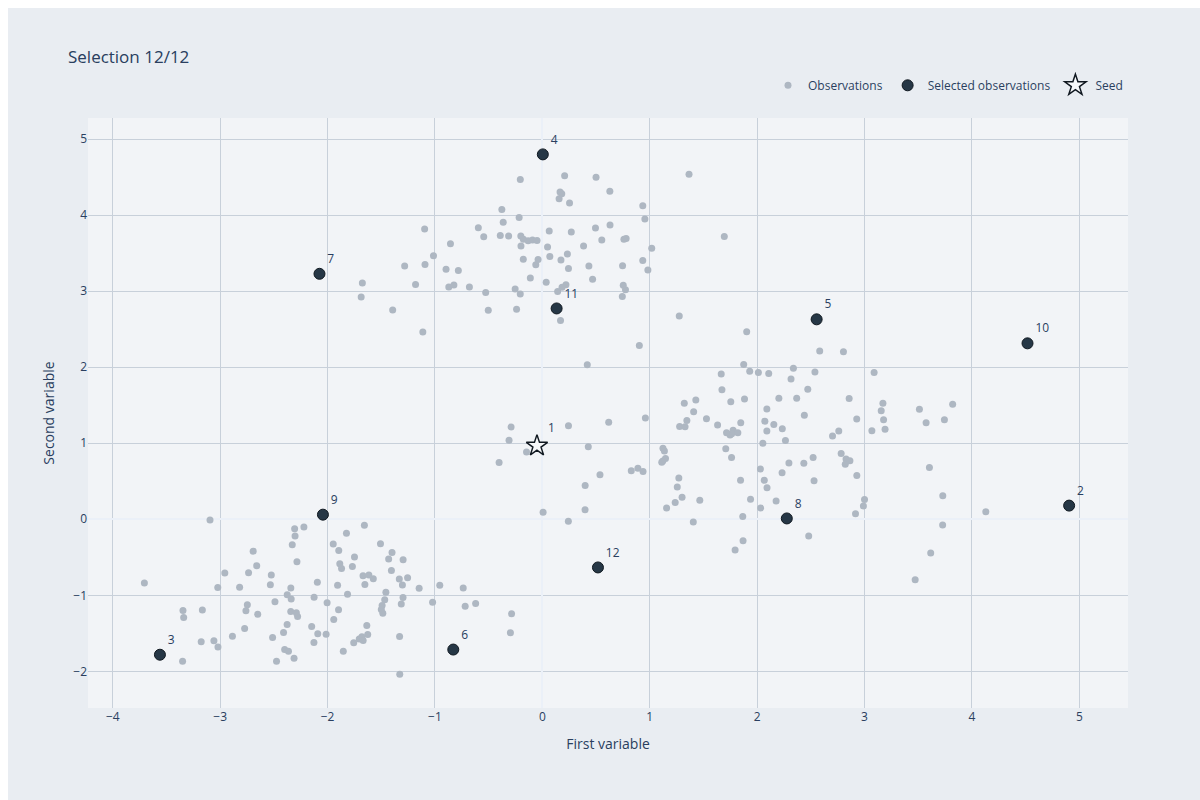
For a focused explanation of circular distances, see the directional variables example. The final example applies the algorithm to select representative sea states from 10,000 directional observations.
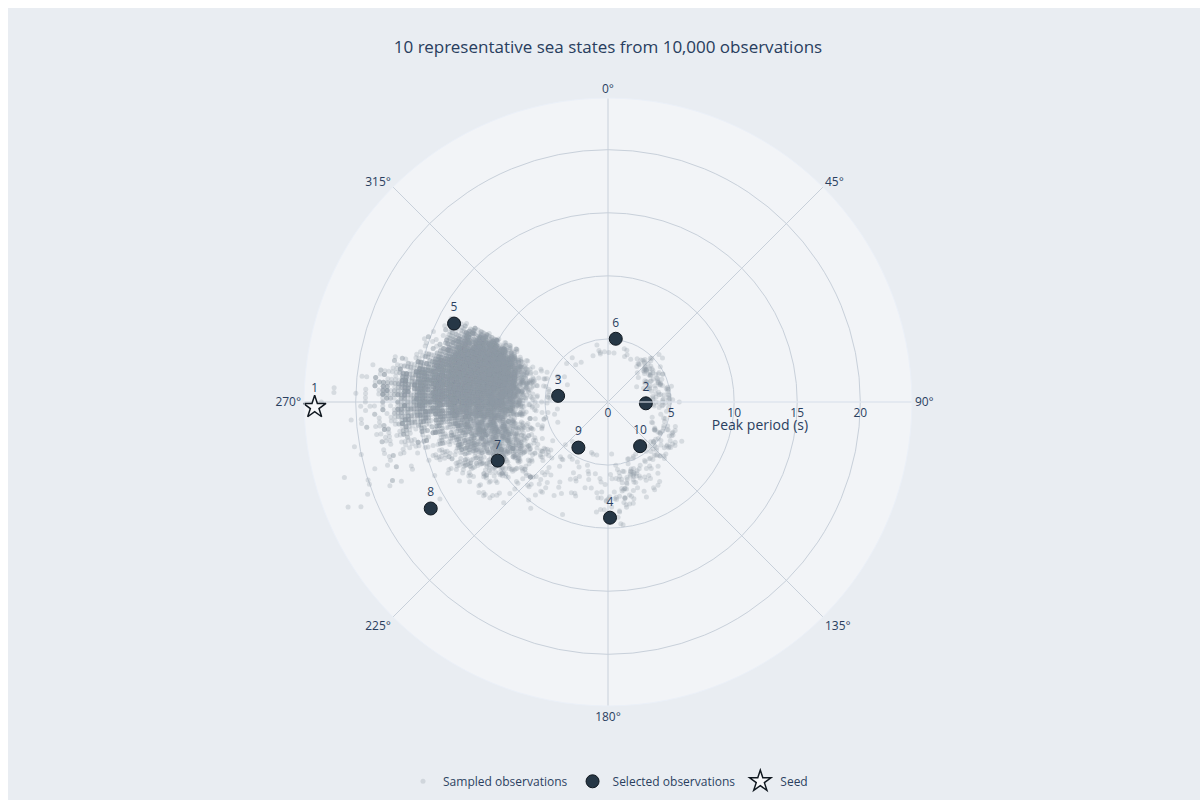
Clone the repository and run any example in the project environment:
uv run python examples/1_mda_minimal.py
Legacy tuple API
Projects migrating from the original tuple-based API can use an explicit compatibility import:
from mdapy.legacy import max_diss_alg

points, indices = max_diss_alg(
    (tp, hs, direction),
    3,
    seed_index=0,
    dir_indices=[2],
)
Passing a tuple to mdapy.max_diss_alg raises an error that points to this
compatibility module. The published ihc-mdapy==0.1.0 package uses the legacy
API; its unpublished v0.1.1 fix remains available in this repository's Git
history.
Development
Install the locked development environment and run the project checks:
make install
make format
make lint
make test
Credits and license
Originally developed by Pablo Garcia at
IHCantabria and now maintained as the
personal mdapy-v2 fork. The historical v0.1.1 fix was contributed by
Álvaro Rodríguez, but was never included
in the published ihc-mdapy package.
The original IHCantabria copyright notice and MIT terms are preserved in LICENSE.
Reference
Guanche, Y., Guanche, R., Camus, P., Mendez, F. J., & Medina, R. (2013). “A multivariate approach to estimate design loads for offshore wind turbines.” Wind Energy, 16(7), 1091–1106. https://doi.org/10.1002/we.1542
1 maintainer

Metadata
1 maintainer
Release files for mdapy-v2 2.1.0
For a detailed explanation of source distributions (sdists) and built distributions (wheels), please see the package formats documentation.
Source distribution (sdist)
| File | Size | Uploaded | |
|---|---|---|---|
| mdapy_v2-2.1.0.tar.gz | 6.9 kB | Details |
Built distribution (wheel)
| File | Interpreter | ABI | Platform | Reset |
|---|---|---|---|---|
| mdapy_v2-2.1.0-py3-none-any.whl | Python 3 | none | any | Details |
Total release size: 15.2 kB
Release files / mdapy_v2-2.1.0.tar.gz
| Download URL | mdapy_v2-2.1.0.tar.gz |
|---|---|
| Size | 6.9 kB |
| Tags | Source |
|
SHA-256 checksum How to use checksums |
a4dad5b1863bcad53ee1617b03ac90b6e5ad98d5d10f4f2cda7d35edffdab5df
|
|
BLAKE2b-256 checksum How to use checksums |
7af234568e8bde3b090570ffcfdcc3cd6d585323d4d2e10dc9a72d0d2a3cee92
|
| Upload date | |
|
Uploaded using Trusted Publishing? What is trusted publishing? |
Yes |
| Uploaded via |
uv/0.13.1 {"installer":{"name":"uv","version":"0.13.1","subcommand":["publish"]},"python":null,"implementation":{"name":null,"version":null},"distro":{"name":"Ubuntu","version":"24.04","id":"noble","libc":null},"system":{"name":null,"release":null},"cpu":null,"openssl_version":null,"setuptools_version":null,"rustc_version":null,"ci":true}
|
Release files / mdapy_v2-2.1.0-py3-none-any.whl
| Download URL | mdapy_v2-2.1.0-py3-none-any.whl |
|---|---|
| Size | 8.3 kB |
| Tags | Python 3 |
|
SHA-256 checksum How to use checksums |
8c660e07cd6cf0a5f21993519aae735670cbb19404ee83fd74ace5c5f09d54a7
|
|
BLAKE2b-256 checksum How to use checksums |
29dbdda127916018a14ed55cddea64049ff55abb7c4065cc18290e12ee6bd425
|
| Upload date | |
|
Uploaded using Trusted Publishing? What is trusted publishing? |
Yes |
| Uploaded via |
uv/0.13.1 {"installer":{"name":"uv","version":"0.13.1","subcommand":["publish"]},"python":null,"implementation":{"name":null,"version":null},"distro":{"name":"Ubuntu","version":"24.04","id":"noble","libc":null},"system":{"name":null,"release":null},"cpu":null,"openssl_version":null,"setuptools_version":null,"rustc_version":null,"ci":true}
|














