



MEG-SPIKES
This repository contains functions for detecting, analyzing and evaluating epileptic spikes in MEG recording.
Installation
Optionally create a fresh virtual environment:
conda create -n megspikes pip python=3.7
The easiest way to install the package is using pip:
pip install megspikes
To install the latest version of the package, you should clone the repository and install all dependencies:
git clone https://github.com/MEG-SPIKES/megspikes.git
cd megspikes/
pip install .
Examples
Examples of how to use this package are prepared in the Jupyter Notebooks.
- 0_simulation.ipynb: simulation used to test this package and in other examples.
- 1_manual_pipeline.ipynb: localization of the irritative area for already detected (simulated) spikes.
- 2_aspire_alphacsc_pipepline.ipynb: full spikes detection pipeline and visualization of each step.
Documentation
ASPIRE AlphaCSC pipeline
Full detection pipeline is presented on the figure below. The image was created using Scikit-learn Pipeline module.
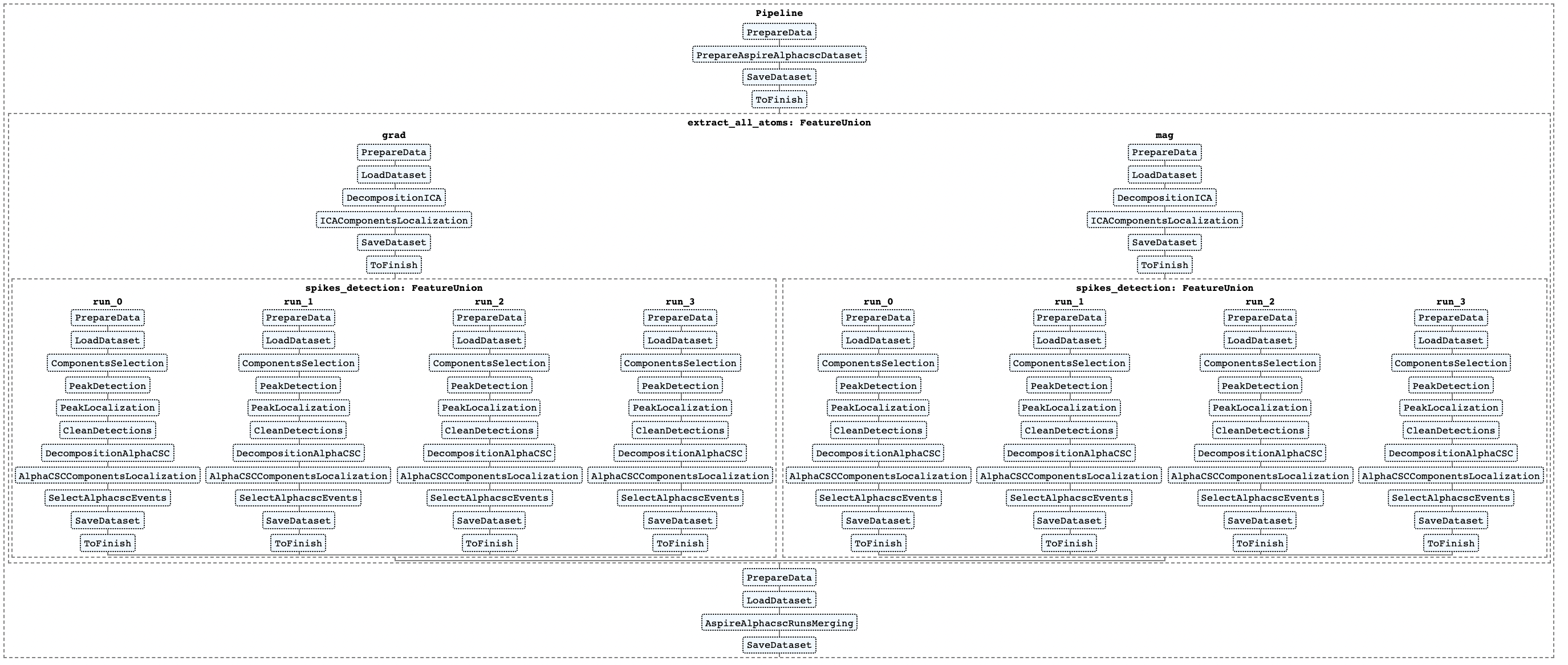
To reproduce this picture see 2_aspire_alphacsc_pipepline.ipynb.
As is it depicted on the figure, ASPIRE-AlphaCSC pipeline includes the following main steps:
- ICA decomposition
- ICA components localization
- ICA components selection
- ICA peaks localization
- ICA peaks cleaning
- AlphaCSC decomposition
- AlphaCSC atoms localization
- AlphaCSC events selection
- AlphaCSC atoms merging
- AlphaCSC atoms goodness evaluation
- AlphaCSC atoms selection
Clusters localization and the irritative area prediction
Irritative zone prediction pipeline is presented on the figure below. The image was created using Scikit-learn Pipeline module.
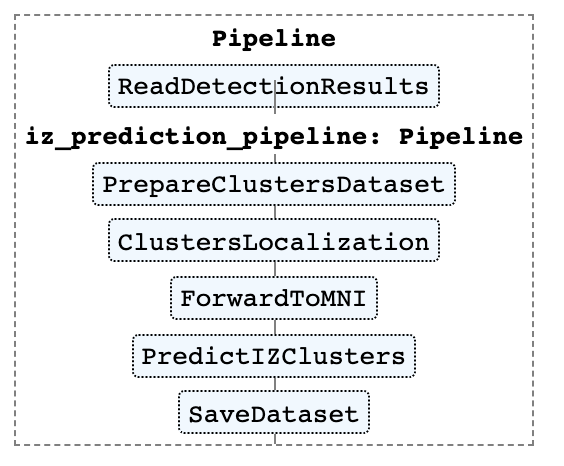
To reproduce this picture see 2_aspire_alphacsc_pipepline.ipynb and 1_manual_pipeline.ipynb.
Parameters
aspire_alphacsc_default_params.yml includes all default parameters that were used to run spike detection using combination of ASPIRE [2] and AlphaCSC [1].
clusters_default_params.yml describes all the parameters that were used for the irritative area prediction based on the detected events and their clustering.
Dependencies
Analysis
Data storing
Visualization
Testing
Contributing
All contributors are expected to follow the code of conduct.
References
[1] La Tour, T. D., Moreau, T., Jas, M., & Gramfort, A. (2018). Multivariate Convolutional Sparse Coding for Electromagnetic Brain Signals. ArXiv:1805.09654 [Cs, Eess, Stat]. http://arxiv.org/abs/1805.09654
[2] Ossadtchi, A., Baillet, S., Mosher, J. C., Thyerlei, D., Sutherling, W., & Leahy, R. M. (2004). Automated interictal spike detection and source localization in magnetoencephalography using independent components analysis and spatio-temporal clustering. Clinical Neurophysiology, 115(3), 508–522. https://doi.org/10.1016/j.clinph.2003.10.036
1 maintainer

Metadata
1 maintainer
Release files for megspikes 0.1.5
For a detailed explanation of source distributions (sdists) and built distributions (wheels), please see the package formats documentation.
Source distribution (sdist)
| File | Size | Uploaded | |
|---|---|---|---|
| megspikes-0.1.5.tar.gz | 65.5 kB | Details |
Release files / megspikes-0.1.5.tar.gz
| Download URL | megspikes-0.1.5.tar.gz |
|---|---|
| Size | 65.5 kB |
| Tags | Source |
|
SHA-256 checksum How to use checksums |
d1012ef73e6a319f3820c443fd19568c7e8cb56a5efe40c33f9ae7f1ff55b3dd
|
|
BLAKE2b-256 checksum How to use checksums |
a8c704cc319fade18f471b47dc1a6d6e3dbd1fdb789604a8f96395a8168b9393
|
| Upload date | |
|
Uploaded using Trusted Publishing? What is trusted publishing? |
No |
| Uploaded via |
twine/4.0.0 CPython/3.7.13
|













