

Inverse design of crystalline materials from target properties, with your own data and rules.
MEIDNet Prism: learn, build and benchmark multimodal AI for materials discovery, with MEIDNet as the reference implementation.
home · learn · architectures · build (Studio) · datasets · benchmarks · community





Documentation · Try it in your browser · Paper · v1.0 code as published
▶ MEIDNet: from concept to demonstration, the live 3D tour on the home page (video version)
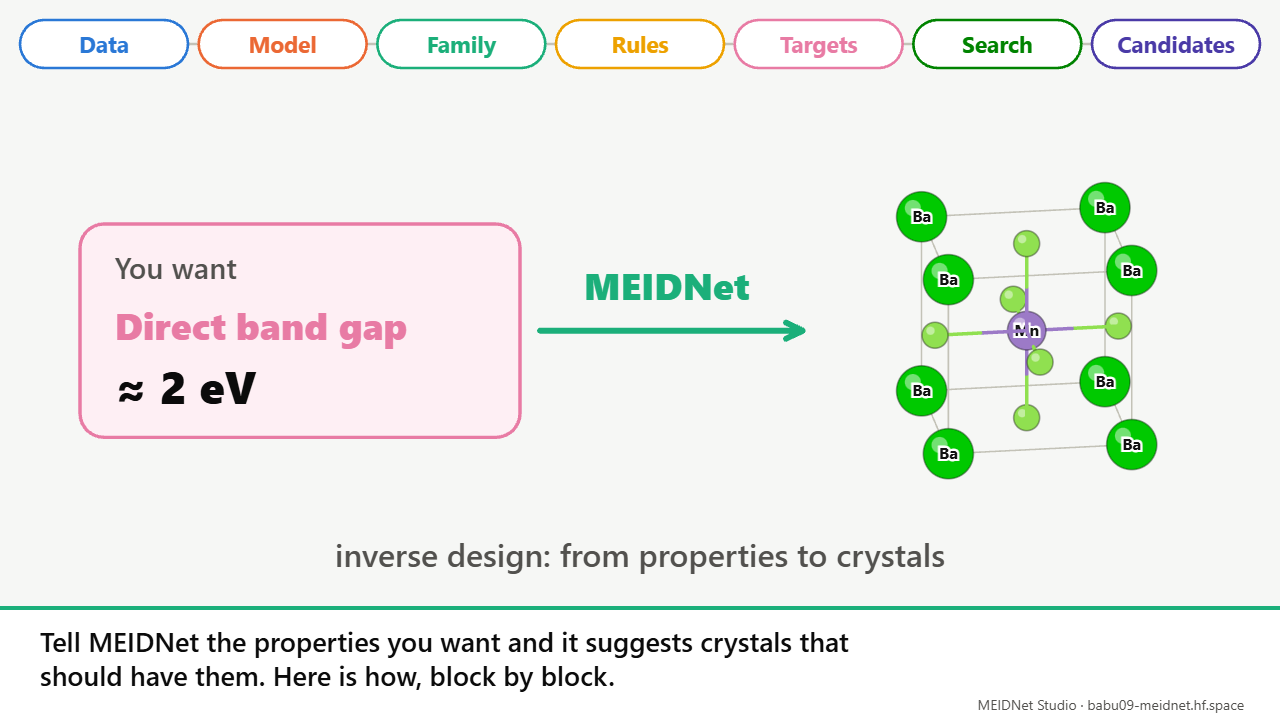
MEIDNet learns one latent space shared by crystal structures and their properties (contrastive alignment of an equivariant graph encoder and a property encoder), then searches that space for new materials that hit property targets while obeying the chemical and structural rules of a material family.
MEIDNet 2.0 turns the published perovskite code into a framework:
| You want to… | You do… |
|---|---|
| try it | meidnet demo or the browser demo |
| use your structures + properties | put them in a table, run meidnet init / check / train / generate |
| change targets, elements, rules | edit meidnet.yaml — or move sliders in MEIDNet Studio and export it |
| a different material family | copy a family .yaml (prototype + site groups + rules) |
| your own rule | a 5-line Python function registered as a constraint |
| understand every decision | each step writes a plain-language HTML report (data check, training, generation) |
The published cubic-ABX₃ perovskite model (band gap + formation enthalpy, Perov-5) is example application #1; it runs unchanged and bit-identically (tests prove it).
Install
pip install meidnet            # core (PyTorch CPU wheels work; CUDA optional)
pip install "meidnet[stability]"   # + MACE stability screening
From source: git clone https://github.com/ABnano/MEIDNet && cd MEIDNet && pip install -e ".[dev]".
Try it (2 minutes, CPU is fine)
meidnet demo                      # halide perovskites, band gap 2.0 eV → CIFs + report
meidnet studio                    # interactive workbench with the published model
Use your own data (the main path)
Your data is a table with one row per material plus the structures as CIF text (a cif
column) or files (structures/<id>.cif):
material_id   cif                         band_gap   dielectric
mat_001       data_mat_001 ...            1.42       18.3
mat_002       data_mat_001 ...            2.16       11.7
meidnet init --table materials.csv --properties band_gap dielectric --family perovskite_abx3 --variant oxide
meidnet check meidnet.yaml      # → check_report.html: what is usable, what was skipped and why
meidnet train meidnet.yaml      # → model.pt + training_report.html: how accurate, did modalities align
meidnet generate meidnet.yaml   # → CIFs + generation_report.html: every candidate and why it passed
Everything you can change is in meidnet.yaml, with a one-line explanation per setting
(reference). No Python needed.
MEIDNet Studio — see the effect of every change
meidnet studio meidnet.yaml
A local web page shows the workflow as a strip of colour-coded blocks Data → Model → Family → Rules → Targets → Search → Candidates. Move a rule's limit or a target and watch the change flow through every later block, with a short explanation: how many compositions still pass, which are predicted closest, which of your earlier candidates would now be rejected. Beginner mode shows the input, logic and output of each block, and Behind the scenes shows the YAML and Python that do the same thing.
- Your data in the browser: upload a table (CSV / Excel / JSON) with CIF structures, map the columns, check it and train a model — every block then uses your properties.
- Edit as text: the configuration as YAML; errors name the exact setting.
- Explore in 3D: the design space, your data or the candidates as a property map linked to a crystal viewer (chemiscope).
- "Run search" runs the paper's latent optimisation live; every candidate comes with its
checklist and a rotatable cell. Export
meidnet.yamlto repeat the run from the command line.
No installation needed to try it: the hosted Studio runs on Hugging Face (direct link).
What is in the box
meidnet/
  config.py       the meidnet.yaml schema (pydantic) — single source of truth for CLI, docs, Studio
  data.py         tables + CIFs → prototype-aligned feature vectors, with a skip report
  model.py        SE(3)-equivariant crystal autoencoder + property autoencoder, shared latent
  train.py        the five-term objective of the paper, validation metrics in physical units
  family.py       material families from YAML: prototype, site groups, charges, lattice rule, variants
  constraints.py  hard rules (charge balance, tolerance factor, …) — each returns value, window, sentence
  terms.py        soft search terms and logit transforms used during the latent optimisation
  generate.py     the inverse-design loop (latent search → decode → rules → rank → save), with a funnel log
  designspace.py  every composition a family can make, with rule descriptors and model predictions
  report.py       plain-language HTML reports; svg.py: dependency-free charts
  studio/         the interactive workbench (stdlib HTTP server + one HTML page)
  families/       perovskite_abx3.yaml, double_perovskite_a2bbx6.yaml
tests/            incl. byte-level regression against the published v1 code (tests/legacy_v1/)
examples/         Perov-5 reproduction, custom-rule plugin, the paper's generated CIFs
docs/             the website (MkDocs)   notebooks/  Colab tutorials   app/  Hugging Face demo
Scope
- Generation works for prototype families: a fixed arrangement of sites whose
occupants and cell size are chosen (ABX₃, A₂BB′X₆, and anything you describe the same
way, up to
max_sitesatoms). It does not invent new atomic arrangements. - Properties: any number of scalar columns. Spectra/images as modalities are on the roadmap, not in this release.
- Predicted properties are model estimates. Confirm candidates with DFT or experiment;
meidnet screen(MACE) is a first filter.
Reproducing the paper
meidnet download-data                       # Perov-5 (CDVAE split) → data/perov5/
meidnet init --template perov5 -o examples/perov5/meidnet.yaml
meidnet train examples/perov5/meidnet.yaml  # ~1 h on a laptop GPU for 200 epochs
meidnet generate examples/perov5/meidnet.yaml --model checkpoints/dual_autoencoder_clip_earlyfusion_propertyaware_2k.pth
pytest -m slow re-runs the frozen v1 generation code (tests/legacy_v1/) and checks that
MEIDNet 2 produces the same CIFs, predictions and file names.
Citation
@article{meidnet2026,
  title   = {MEIDNet: Multimodal generative AI framework for inverse materials design},
  author  = {Anand Babu and Rog{\'e}rio Almeida Gouv{\^e}a and Pierre Vandergheynst and Gian-Marco Rignanese},
  journal = {npj Computational Materials},
  year    = {2026},
  doi     = {10.1038/s41524-026-02153-3}
}
MIT licence. Perov-5 data: Xie et al., CDVAE (ICLR 2022); Castelli et al. (2012).
Further reading
- A. Babu, R. Almeida Gouvêa, G.-M. Rignanese, Toward automated discovery with generative models multimodal learning and closed loop workflows in inverse materials design, Cell Reports Physical Science 7, 103561 (2026). doi:10.1016/j.xcrp.2026.103561
- A. Babu, N. M. A. Krishnan, Multimodal and cross-modal learning techniques, APL Machine Learning 4, 030901 (2026). doi:10.1063/5.0346744
1 maintainer

Metadata
1 maintainer
Release files for meidnet 2.2.0
For a detailed explanation of source distributions (sdists) and built distributions (wheels), please see the package formats documentation.
Source distribution (sdist)
| File | Size | Uploaded | |
|---|---|---|---|
| meidnet-2.2.0.tar.gz | 216.0 kB | Details |
Built distribution (wheel)
| File | Interpreter | ABI | Platform | Reset |
|---|---|---|---|---|
| meidnet-2.2.0-py3-none-any.whl | Python 3 | none | any | Details |
Total release size: 411.6 kB
Release files / meidnet-2.2.0.tar.gz
| Download URL | meidnet-2.2.0.tar.gz |
|---|---|
| Size | 216.0 kB |
| Tags | Source |
|
SHA-256 checksum How to use checksums |
63a631902731442a0e6739369436b3debb6ba2a282db6baa1464e94893726eca
|
|
BLAKE2b-256 checksum How to use checksums |
242d0e3357730b7127d54a1537fcf5e5e2e653ee49b1e32e989b2510148b6118
|
| Upload date | |
|
Uploaded using Trusted Publishing? What is trusted publishing? |
No |
| Uploaded via |
uv/0.12.13 {"installer":{"name":"uv","version":"0.12.13","subcommand":["publish"]},"python":null,"implementation":{"name":null,"version":null},"distro":null,"system":{"name":null,"release":null},"cpu":null,"openssl_version":null,"setuptools_version":null,"rustc_version":null,"ci":null}
|
Release files / meidnet-2.2.0-py3-none-any.whl
| Download URL | meidnet-2.2.0-py3-none-any.whl |
|---|---|
| Size | 195.6 kB |
| Tags | Python 3 |
|
SHA-256 checksum How to use checksums |
775c88dccb1ef32764c4388925a04ec8b9e4bb7eabc307f4cae5b0f64426a603
|
|
BLAKE2b-256 checksum How to use checksums |
48ba57f07b9bbcb6ef679dc4bc9fce038f1a80444783808271c9662cef6cb1c8
|
| Upload date | |
|
Uploaded using Trusted Publishing? What is trusted publishing? |
No |
| Uploaded via |
uv/0.12.13 {"installer":{"name":"uv","version":"0.12.13","subcommand":["publish"]},"python":null,"implementation":{"name":null,"version":null},"distro":null,"system":{"name":null,"release":null},"cpu":null,"openssl_version":null,"setuptools_version":null,"rustc_version":null,"ci":null}
|














