
MemBrain-Stats
Membrain-Stats1 is a Python project developed by the CellArchLab for computing membrane protein statistics in 3D for cryo-electron tomography (cryo-ET). It is part of the larger MemBrain v2 package, which also includes MemBrain-pick for membrane protein detection and MemBrain-seg for membrane segmentation.
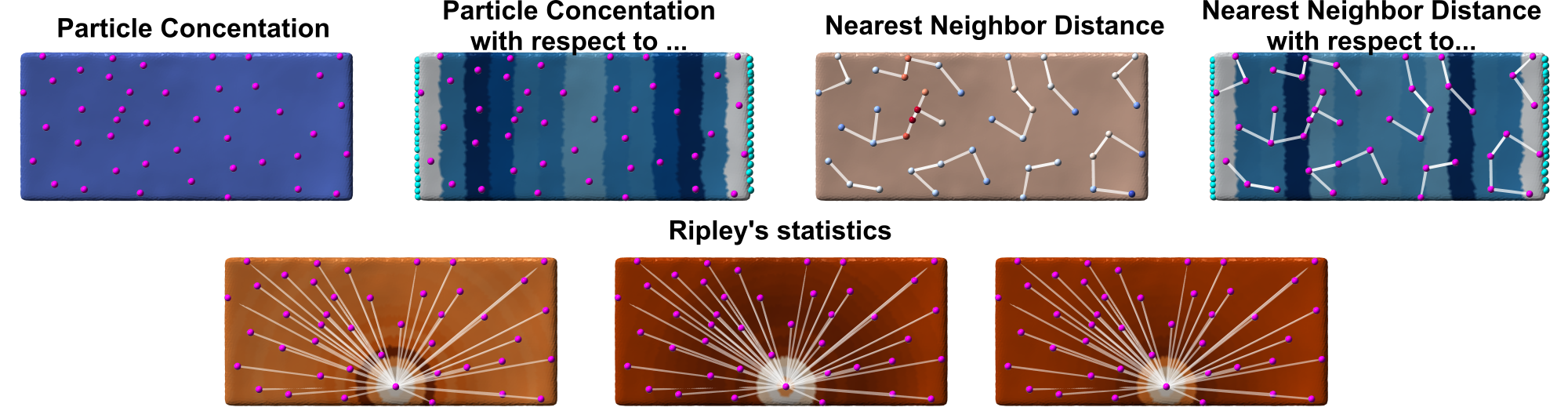
The goal of the package is to provide easy-to-use tools to analyze the distribution of membrane proteins in relation to the underlying membrane geometry. To this end, we provide the following functionalities:
- Protein concentration computation
- Protein concentration with respect to another point class (e.g., membrane edge)
- Protein concentration with respect to a membrane property (e.g., morphometrics property)
- (Geodesic) Nearest Neighbor distances (and orientations of neighbors to each other)
- (Geodesic) Nearest Neighbor distances with respect to another point class (e.g., membrane edge)
- (Geodesic) Ripley's statistics
Publication:
Membrain-stats's functionalities are described in more detail in our preprint [1].
[1] Lamm, L., Zufferey, S., Righetto, R.D., Wietrzynski, W., Yamauchi, K.A., Burt, A., Liu, Y., Zhang, H., Martinez-Sanchez, A., Ziegler, S., Isensee, F., Schnabel, J.A., Engel, B.D., and Peng, T, 2024. MemBrain v2: an end-to-end tool for the analysis of membranes in cryo-electron tomography. bioRxiv, https://doi.org/10.1101/2024.01.05.574336
Usage:
For more details about how to use MemBrain-stats, refer to our User Instructions document.
Example Notebooks:
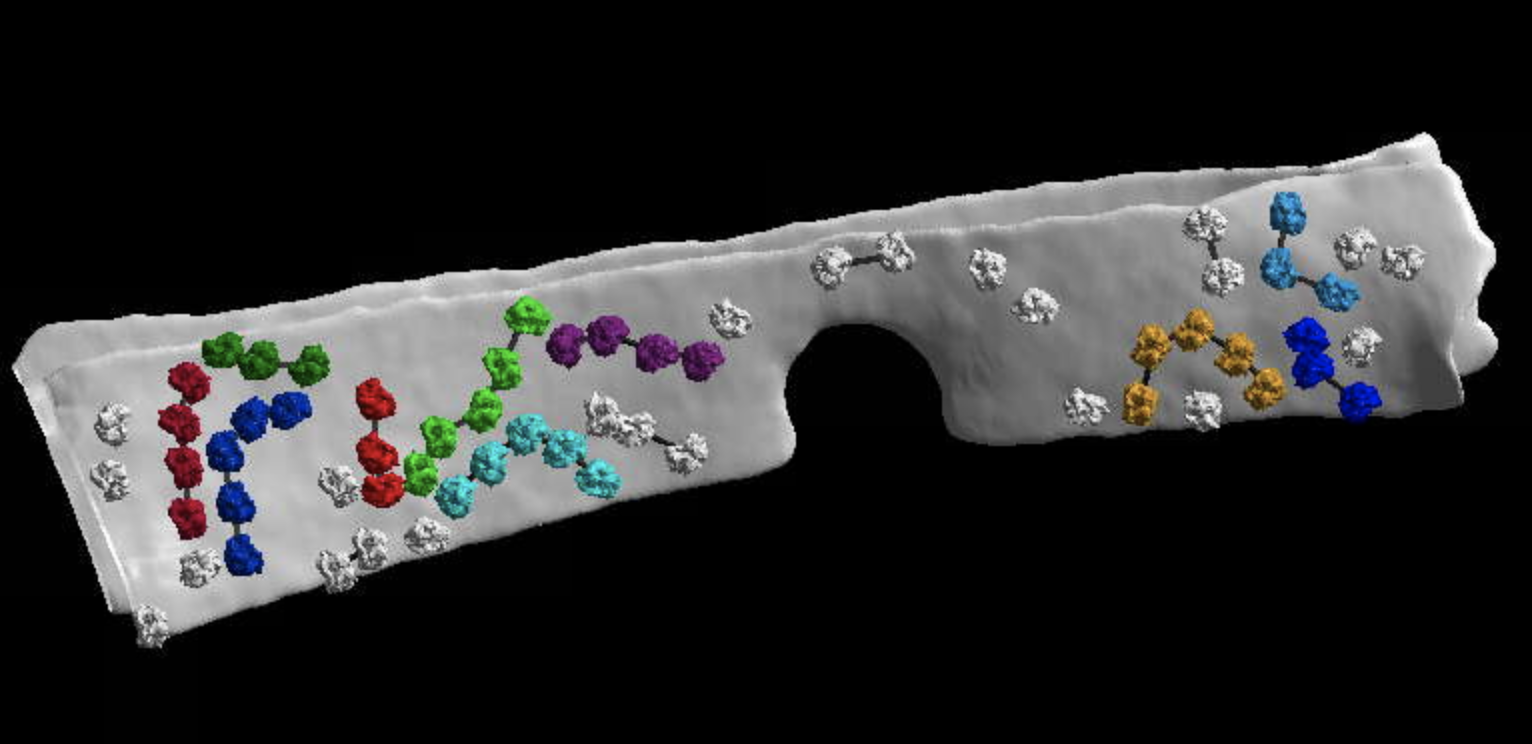
We provide an example jupyter notebook highlighting what can be done with MemBrain-stats here. This is an advanced example, using outputs from template matching and analyzing ribosome chains (this example was also shown in our preprint). We did not wrap this functionality into a single command in MemBrain-stats due to its complexity and need for user input. But if you are interested in analyzing similar data, this notebook can serve as a guide.
An example notebook (Colab tutorial) showcasing the pure functionalities of MemBrain-stats can be found here (
1 maintainer

Metadata
1 maintainer
Release files for membrain-stats 0.0.3
For a detailed explanation of source distributions (sdists) and built distributions (wheels), please see the package formats documentation.
Source distribution (sdist)
| File | Size | Uploaded | |
|---|---|---|---|
| membrain_stats-0.0.3.tar.gz | 83.9 kB | Details |
Built distribution (wheel)
| File | Interpreter | ABI | Platform | Reset |
|---|---|---|---|---|
| membrain_stats-0.0.3-py3-none-any.whl | Python 3 | none | any | Details |
Total release size: 119.6 kB
Release files / membrain_stats-0.0.3.tar.gz
| Download URL | membrain_stats-0.0.3.tar.gz |
|---|---|
| Size | 83.9 kB |
| Tags | Source |
|
SHA-256 checksum How to use checksums |
1161f178da52b221cf465e2018879a2d891ed972306dbb185ce17c20b7a66d86
|
|
BLAKE2b-256 checksum How to use checksums |
ca76aae731c01508feb294ade474fdbbeb667e61584bf18763bc2a2df43c90f4
|
| Upload date | |
|
Uploaded using Trusted Publishing? What is trusted publishing? |
No |
| Uploaded via |
twine/6.2.0 CPython/3.10.19
|
Release files / membrain_stats-0.0.3-py3-none-any.whl
| Download URL | membrain_stats-0.0.3-py3-none-any.whl |
|---|---|
| Size | 35.7 kB |
| Tags | Python 3 |
|
SHA-256 checksum How to use checksums |
170cd20b5fe52e2395f31d20d6c6d55c07a1ebc5282d7ed54a565be99103a520
|
|
BLAKE2b-256 checksum How to use checksums |
1398acc5dbaeb72009c04d5fccc8c3a540ce4e28dfe05c1875e9d2d935bed713
|
| Upload date | |
|
Uploaded using Trusted Publishing? What is trusted publishing? |
No |
| Uploaded via |
twine/6.2.0 CPython/3.10.19
|














