
Add your description here

Project description

MemoryAgent: An Open, Modular Memory Framework for Agents (Beta)
MemoryAgent is a reusable memory framework for LLM-based agent systems. It provides tiered memory (working, episodic, semantic, perceptual), hot/cold storage, archive indexing, confidence-based retrieval escalation, and optional local vector search via sqlite-vec.
Highlights
- Tiered memory: working (TTL), episodic, semantic, perceptual
- Storage tiers: hot metadata (SQLite + sqlite-vec), cold archive (filesystem), archive index (vector index)
- Memory retrieval pipeline: hot -> archive -> cold hydration with rerank + context packaging
- Local mode: SQLite + sqlite-vec (optional) + filesystem
- Async-friendly with sync convenience methods
Project Layout
memoryagent/
  config.py            # Default system settings and retrieval thresholds
  models.py            # Pydantic data models for memory items, queries, bundles
  system.py            # MemorySystem entry point and wiring
  retrieval.py         # Retrieval orchestration and reranking
  confidence.py        # Confidence scoring components
  policy.py            # Conversation + routing policies
  indexers.py          # Episodic/semantic/perceptual indexers
  workers.py           # Consolidation, archiving, rehydration, compaction
  storage/
    base.py            # Storage adapter interfaces
    in_memory.py       # Simple in-memory vector + graph stores
    local_disk.py      # SQLite metadata/features + sqlite-vec + file object store
  examples/
    minimal.py         # Basic usage example
    openai_agent.py    # CLI OpenAI agent with memory retrieval
    memory_api_server.py # Local API for memory + chat
    memory_viz.html    # Web UI for chat + memory visualization
Installation
Python 3.10+ required.
Development (sync deps from uv.lock):
uv sync
Use as a dependency:
uv add memoryagent-lib
# or
pip install memoryagent-lib
Optional extras:
uv add openai sqlite-vec
# or
pip install openai sqlite-vec
Quick Start
from memoryagent import MemoryEvent, MemorySystem

memory = MemorySystem()
owner = "user-001"

memory.write(
    MemoryEvent(
        content="User prefers concise summaries about climate policy.",
        type="semantic",
        owner=owner,
        tags=["preference", "summary"],
        confidence=0.7,
        stability=0.8,
    )
)

bundle = memory.retrieve("What policy topics did we cover?", owner=owner)
print(bundle.confidence.total)
for block in bundle.blocks:
    print(block.text)

memory.flush(owner)
Enable sqlite-vec (Local Vector Search)
from memoryagent import MemorySystem, MemorySystemConfig

config = MemorySystemConfig(
    use_sqlite_vec=True,
    vector_dim=1536,  # match your embedding model
)

memory = MemorySystem(config=config)
If sqlite-vec cannot be auto-loaded, set an explicit path:
from pathlib import Path
from memoryagent import MemorySystemConfig

config = MemorySystemConfig(
    use_sqlite_vec=True,
    vector_dim=1536,
    sqlite_vec_extension_path=Path("/path/to/sqlite_vec.dylib"),
)
Examples
OpenAI Agent (CLI)
python -m memoryagent.examples.openai_agent
- Uses OpenAI responses + embeddings.
- Stores session transcript as a single working memory item.
Memory Visualization + API
Start the API server:
python -m memoryagent.examples.memory_api_server
Open in browser:
http://127.0.0.1:8000/memory_viz.html
An example (System records semantic memory and updating working memory):
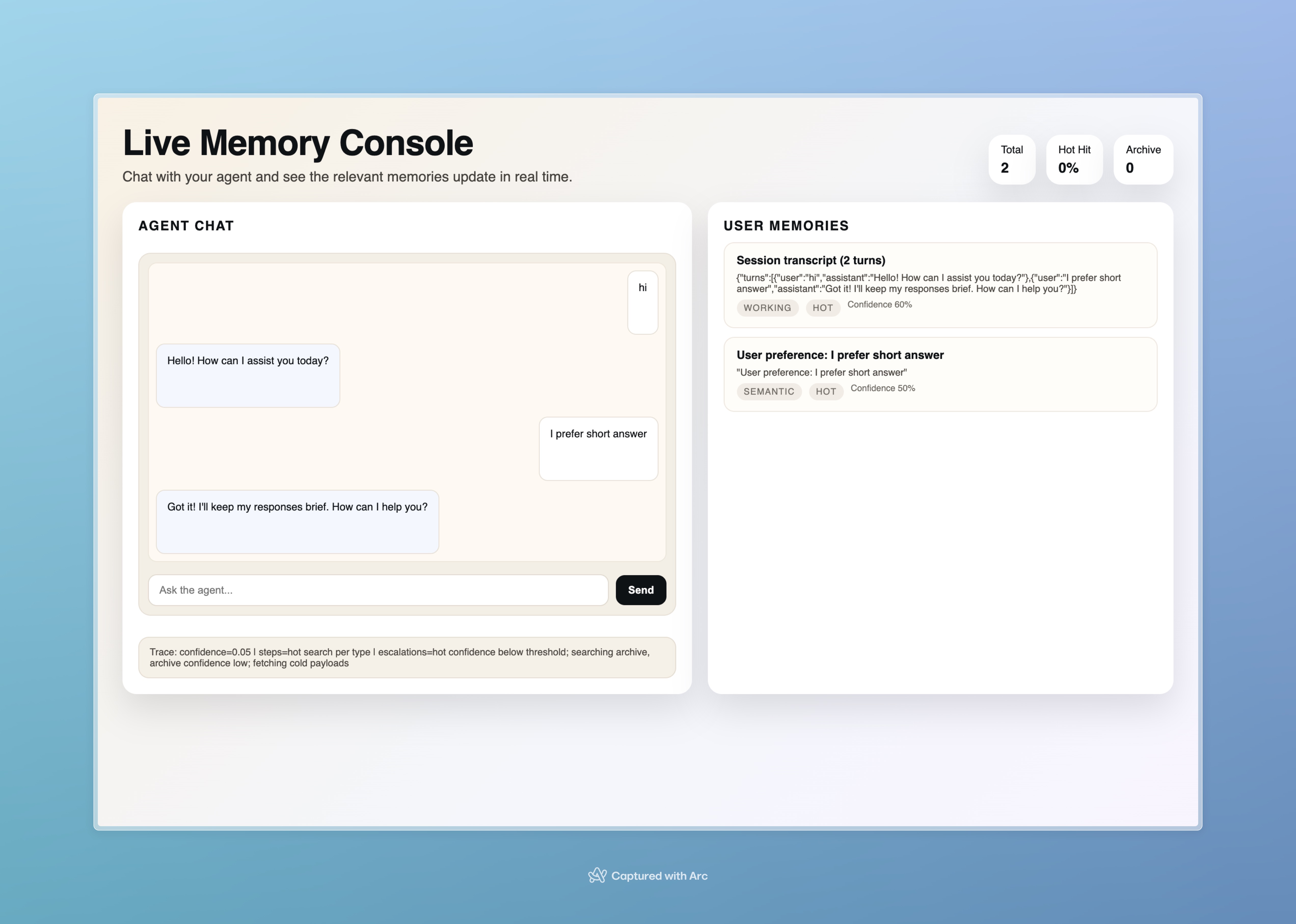
The page calls:
GET /api/memory?owner=user-001POST /api/chat
Policies
Conversation storage policy
HeuristicMemoryPolicy decides whether a turn should be stored and whether it becomes episodic or semantic memory.
Routing policy
MemoryRoutingPolicy decides where a memory should be written:
- Hot metadata store
- Vector index
- Feature store (perceptual)
- Cold archive (via workers)
Background Workers
ConsolidationWorker: working -> episodic/semanticArchiverWorker: hot -> cold + archive indexRehydratorWorker: cold -> hot (based on access)Compactor: cleanup/TTL
Data Stores
- Hot metadata:
.memoryagent_hot.sqlite - Vector index:
.memoryagent_vectors.sqlite(sqlite-vec) - Features:
.memoryagent_features.sqlite - Cold archive:
.memoryagent_cold/records/<owner>/YYYY/MM/DD/daily_notes.json
Data Root (Installed Usage)
The system auto-detects a project root by walking up from the current working directory and looking for pyproject.toml or .git. If it can’t find one, it uses the current directory.
Configuration
See memoryagent/config.py for defaults:
working_ttl_secondsretrieval_planthresholds and budgetsuse_sqlite_vec,vector_dim,sqlite_vec_extension_path
Notes
- Working memory is stored as a single session transcript (updated each turn).
- Episodic/semantic memories are candidates for cold archive.
License
MIT License
Release history Release notifications | RSS feed


Download files
Download the file for your platform. If you're not sure which to choose, learn more about installing packages.
Source Distribution
Built Distribution
Filter files by name, interpreter, ABI, and platform.
If you're not sure about the file name format, learn more about wheel file names.
Copy a direct link to the current filters
File details
Details for the file memoryagent_lib-0.1.3.tar.gz.
File metadata
- Download URL: memoryagent_lib-0.1.3.tar.gz
- Upload date:
- Size: 23.0 kB
- Tags: Source
- Uploaded using Trusted Publishing? No
- Uploaded via: twine/6.2.0 CPython/3.12.9
File hashes
| Algorithm | Hash digest | |
|---|---|---|
| SHA256 |
1e7fa1518019ec732732860426eba5d47612b203622ffd8af60416ac32d3e7c1
|
|
| MD5 |
53429ae8246dfcf952f6bad552a6402e
|
|
| BLAKE2b-256 |
cfaa46e69c2c3ae2bf720e2e88f84cc4258946fc442f9ae49ef186a23b966b6e
|
File details
Details for the file memoryagent_lib-0.1.3-py3-none-any.whl.
File metadata
- Download URL: memoryagent_lib-0.1.3-py3-none-any.whl
- Upload date:
- Size: 28.2 kB
- Tags: Python 3
- Uploaded using Trusted Publishing? No
- Uploaded via: twine/6.2.0 CPython/3.12.9
File hashes
| Algorithm | Hash digest | |
|---|---|---|
| SHA256 |
26d5d0e47ff0300bacfa48602fc7018cc8a51724388cfdd4023c95f869460740
|
|
| MD5 |
4150212e09c3f34f69a9f7b6fc043ad1
|
|
| BLAKE2b-256 |
e6f99a54a134af99ce846a285111611240b9cfa47c717d6b9eccfa6225aece26
|






