
memproc
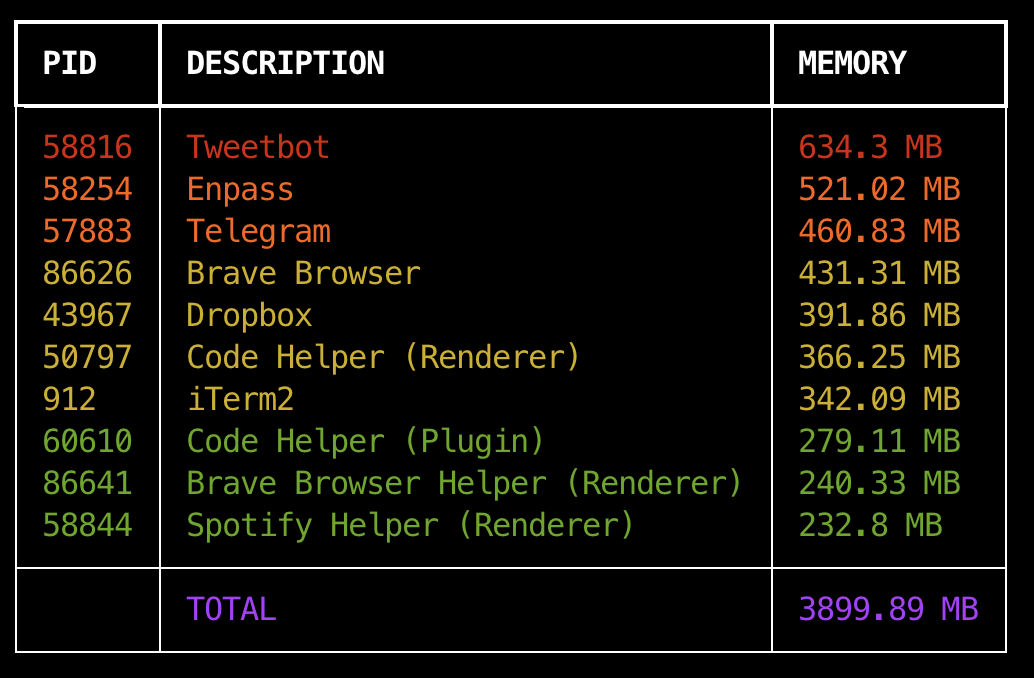
✨ Fancy display of memory usage.
Aim
This tool lets you show all processes in your system (like ps aux) including memory usage with a fancy display and a bunch of command line options. RSS is the chosen memory metric.
Installation
$ pip install memproc
Usage
Usage: memproc [OPTIONS]

 --version                            Show installed version.
 --update                             Update memproc to last version.
 --sort              -s      TEXT     Sort results by criteria (m:mem, p:pid, d:description). [default: m]
 --sort-reverse      -r               Sort reverse by current criteria.
 --description       -d      TEXT     Process description (n:name, e:executable, c:command line). [default: n]
 --show-total        -t               Show total used memory.
 --units             -u      TEXT     Memory units (k:KB, m:MB, g:GB). [default: m]
 --num-processes     -n      INTEGER  Limit the number of processes shown. [default: 0]
 --grouped                            Group process by description.
 --greater-than      -g      FLOAT    Show processes with used memory greater than this value. [default: 0]
 --lower-than        -l      FLOAT    Show processes with used memory lower than this value. [default: 17179869184]
 --find-description  -f      TEXT     Find processes with text by the chosen description criteria.
 --no-color                           Disable output coloring.
 --help                               Show this message and exit.
Get version
$ memproc --version
Update tool
$ memproc --update
Use cases
Show all processes with the total amount of used memory:
$ memproc -t
Sort results by pid with processes greater than 10MB and less than 100MB:
$ memproc -sp -g10 -l100 -um
Show grouped Firefox processes sorted by command line:
$ memproc --grouped -f firefox -sd -dc
Show the top 20 most memory consuming processes with KB units:
$ memproc -n20 -uk
Show processes (sorted reverse memory used) with executable as description and GB units:
$ memproc -de -ug -r
Color
By default, processes are classified in 4 groups with regards to the maximum amount of memory usage. Each group is shown with colors: green, yellow, orange and red.
Output coloring can be disabled as follows:
$ memproc --no-color
Pager
You can use memproc with your favourite pager:
$ memproc | less
1 maintainer

Metadata
1 maintainer
Release files for memproc 0.1.2
For a detailed explanation of source distributions (sdists) and built distributions (wheels), please see the package formats documentation.
Source distribution (sdist)
| File | Size | Uploaded | Provenance | |
|---|---|---|---|---|
| memproc-0.1.2.tar.gz | 129.8 kB | Without provenance | Details |
Built distribution (wheel)
| File | Interpreter | ABI | Platform | Reset |
|---|---|---|---|---|
| memproc-0.1.2-py3-none-any.whl | Python 3 | none | any | Details |
Total release size: 137.2 kB
Release files / memproc-0.1.2.tar.gz
| Download URL | memproc-0.1.2.tar.gz |
|---|---|
| Size | 129.8 kB |
| Tags | Source |
|
SHA-256 checksum How to use checksums |
746c548f93d14de3078f21ceea70a0fe59e7250b256de8fb531f7389f09495c9
|
|
BLAKE2b-256 checksum How to use checksums |
bcec4c19bfbe75c8d00de36f3e71924583da71ce4283300bf97a0d39f7d48e8d
|
| Upload date | |
|
Uploaded using Trusted Publishing? What is trusted publishing? |
No |
| Uploaded via |
twine/4.0.2 CPython/3.11.0
|
Release files / memproc-0.1.2-py3-none-any.whl
| Download URL | memproc-0.1.2-py3-none-any.whl |
|---|---|
| Size | 7.4 kB |
| Tags | Python 3 |
|
SHA-256 checksum How to use checksums |
f8d018d321f1879bbee8d155299f06900fdb7e074dd8cafb90aea17ed6df0d6a
|
|
BLAKE2b-256 checksum How to use checksums |
b242f43a484c7b507120287c69472171e7b4f9e78e0b04c7830429ba19ec4fc1
|
| Upload date | |
|
Uploaded using Trusted Publishing? What is trusted publishing? |
No |
| Uploaded via |
twine/4.0.2 CPython/3.11.0
|
Security for memproc 0.1.2
Provenance
Provenance describes where a file came from. On PyPI, provenance is shared via attestations, which provide a verifiable record of the build or publishing details. View details, limitations and caveats.
No provenance found
None of the files in this release were uploaded with provenance metadata.
A note on package security
PyPI is a repository for distributing packages, not a service for auditing them. While third-party security researchers and our staff do their best to detect and remove malicious packages, PyPI cannot guarantee the quality, security or suitability of any given package.
To learn more about protecting yourself from malicious actors, visit our package security documentation.














