

Memory should be decided, not just extracted.
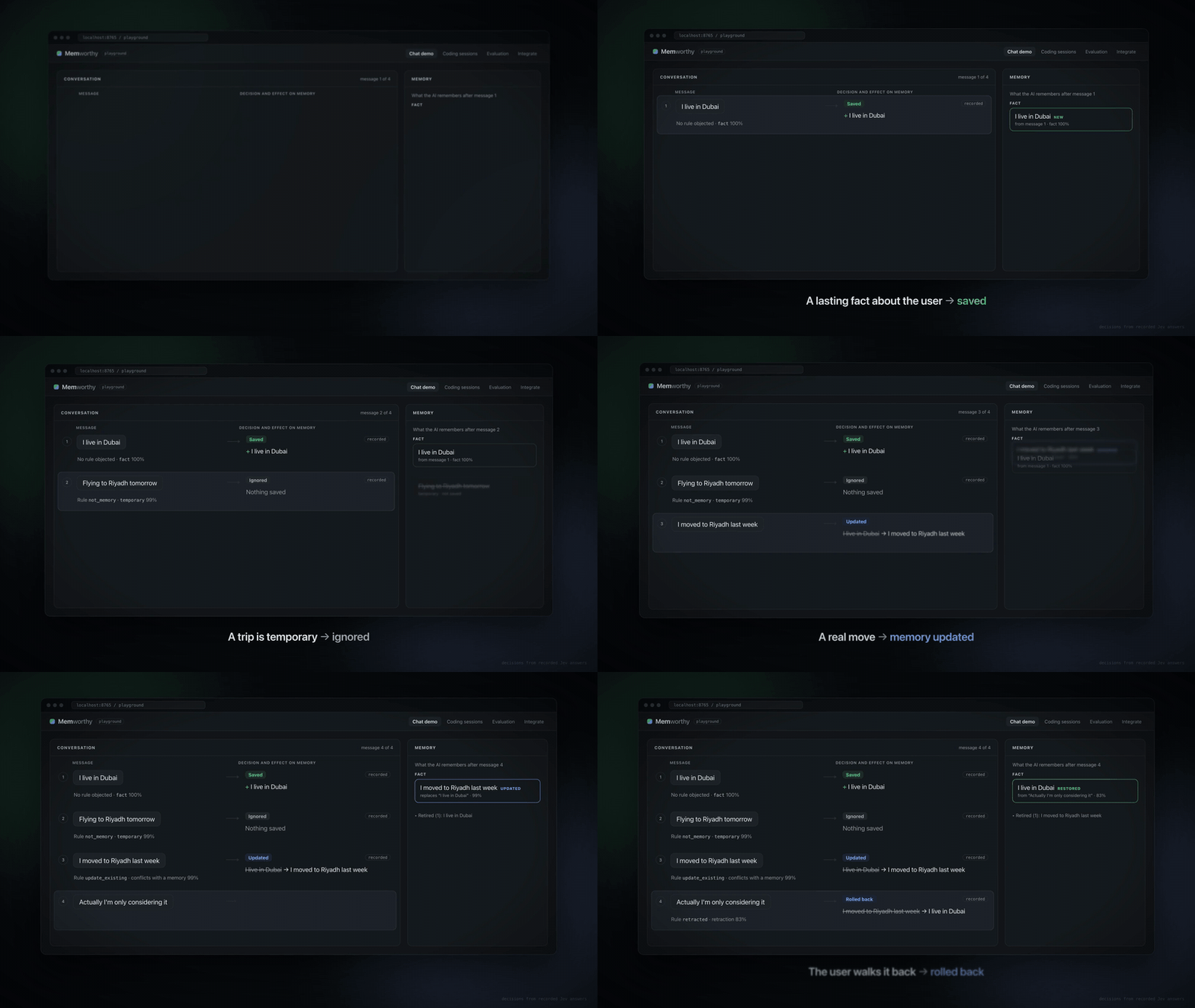
Agent memory usually fails at the decision step, not at retrieval. Extraction pipelines are generous, so memory fills up with errors:
- temporary states stored as permanent facts ("in Dubai this week" becomes "lives in Dubai")
- plans stored as facts
- other people's facts stored as the user's
- stale values and ignored corrections
- the assistant's guesses saved as things the user said
- secrets
- no record of why anything was kept
Memworthy is a small Python library that sits between whatever proposes memories and whatever stores them. For each candidate it:
- runs deterministic code checks
- asks a decision model one batch of typed questions (TypeSafe's Jev by default; OpenAI's Decisions API, Microsoft-Decision-1 on Foundry or your own provider also work)
- applies an ordered, user-editable policy to choose an action:
store,update,merge,supersede,reject,review,redactorstore_labeled
Every decision is written to a ledger you can audit, replay under a changed policy, and review.
Quickstart
pip install "memworthy[jev]"              # Python 3.10+
export TYPESAFE_API_KEY=...             # https://typesafe.ai
from memworthy import Candidate, DictStore, Gate

gate = Gate(policy="personal-memory", store=DictStore())
decisions = gate.ingest_messages([
    {"role": "user", "content": "I live in Dubai"},
    {"role": "user", "content": "Flying to Riyadh tomorrow"},
    {"role": "user", "content": "I moved to Riyadh last week"},
    {"role": "user", "content": "Actually I'm only considering it"},
])
for d in decisions:
    print(f"{d.action:10} {d.rule:16} {d.candidate.text}")
# store      rules[9]         I live in Dubai
# reject     not_memory       Flying to Riyadh tomorrow
# update     update_existing  I moved to Riyadh last week
# supersede  retracted        Actually I'm only considering it   (rolls back to Dubai)
The output above is what the bundled recorded Jev answers give; a live run may differ slightly. You can reproduce it with no API key:
from memworthy import RecordedJudge
from memworthy.judges.recorded import bundled_fixture_path

gate = Gate("personal-memory", DictStore(),
            judge=RecordedJudge(bundled_fixture_path("personal-memory")))
Each decision also lands in memworthy.ledger.jsonl with every signal, its probability, the rule that fired, and the policy and model version.
Other integrations
# Wrap a Mem0 client: only approved content reaches Mem0 (pip install "memworthy[jev,mem0]")
from mem0 import Memory
from memworthy import GatedMemory
memory = GatedMemory(Memory(), policy="personal-memory")          # mode="input" or "candidate"
memory.add([{"role": "user", "content": "I'm in Lisbon this week"}], user_id="alice")  # rejected
# Turn Claude Code / Codex sessions into an Obsidian-compatible Markdown knowledge base
memworthy run dev-sessions ~/.claude/projects --store markdown:~/kb
memworthy run dev-sessions ~/.claude/projects --store markdown:~/kb --extractor llm   # OpenRouter via EXTRACTOR_MODEL
CLI
| Command | What it does |
|---|---|
memworthy test POLICY [--judge recorded|mock|jev|openai|microsoft|PLUGIN] [--pairs FILE] |
Runs the policy's tests; exits 1 on failure (CI-friendly with recorded answers) |
memworthy run POLICY SOURCE [--store dict|markdown:PATH|mem0] [--dry-run] |
Gates a candidate file, chat JSON or session folder |
memworthy replay LEDGER POLICY [--only-changed] |
Shows which past decisions a policy change would flip (no API calls when prompts are unchanged) |
memworthy lint POLICY [--strict] |
Overlapping types, unused signals, unreachable rules, vague prompts |
memworthy review LEDGER [--export-tests FILE] |
Accept, override or skip queued decisions; overrides become tests |
memworthy record POLICY INPUT [--judge jev|openai|microsoft|PLUGIN] |
Records live judge answers as fixtures |
memworthy eval POLICY |
Contrast-pair metrics, calibration and plots into eval/results/ |
Judge providers
The judge answers the typed questions. Pick one with --judge or MEMWORTHY_JUDGE, or pass any object with a name and an async judge(state, questions) method to Gate(judge=...).
| Provider | Configuration |
|---|---|
jev (default) |
TYPESAFE_API_KEY, optional TYPESAFE_BASE_URL, MEMWORTHY_MODEL (default jev-1.13.0) |
openai |
OPENAI_API_KEY, optional OPENAI_BASE_URL, OPENAI_DECISIONS_MODEL (default gpt-6-luna); uses the Decisions API, in public beta |
microsoft |
AZURE_FOUNDRY_ENDPOINT, AZURE_FOUNDRY_API_KEY, optional AZURE_FOUNDRY_DEPLOYMENT (found automatically when unset); Microsoft-Decision-1 deployed in your Foundry resource (API-key auth) |
The bundled templates' thresholds and evaluation results come from Jev. Other providers' probabilities are on a different scale, so run memworthy eval with your judge before you trust a template's cut-offs.
To ship your own provider as a package, implement the memworthy.Judge protocol (see memworthy/judges/openai_decisions.py for a complete HTTP example) and register a zero-argument factory that reads its settings from the environment:
[project.entry-points."memworthy.judges"]
myprovider = "memworthy_myprovider:MyJudge"
If your provider speaks the System One API (the format Jev and Microsoft-Decision-1 use), you don't need to write the request and response mapping: return a configured memworthy.SystemOneJudge(api_key=..., base_url=..., model=..., auth="bearer" or "api-key") from your factory.
After pip install, --judge myprovider and MEMWORTHY_JUDGE=myprovider work. memworthy.available_judges() lists what is installed.
Templates
Both are ordinary YAML files in src/memworthy/templates/; copy one and edit it.
personal-memory (v1.1) is for consumer assistants.
- Types: fact, preference, relationship, temporary, intent, hypothetical, noise.
- Rules, in order:
- Redact secrets.
- Reject anything the user didn't say.
- Roll back retractions.
- Reject temporary states, plans, hypotheticals and noise.
- Reject future or time-bounded statements. Dates are parsed by code, not the judge.
- Review sensitive data (health, finances, religion, precise location).
- Reject low-durability facts.
- Review facts about someone else.
- Update memories the new fact replaces.
- Store the rest.
rules:
  - {name: secrets, when: "secret", then: redact}
  - {name: not_user, when: "not from_user", then: reject}
  - {name: retracted, when: "retraction > 0.7 and conflict", then: supersede, restore: true}
  - {name: not_memory, when: "type in ['temporary', 'intent', 'hypothetical', 'noise']", then: reject}
  - {name: bounded_time, when: "timing == 'bounded' or timing == 'future'", then: reject}
  - {name: sensitive, when: "sensitivity >= 1.5", then: review}
  - {name: low_durability, when: "durable < 0.6 or explicit < 0.5", then: reject}
  - {name: wrong_subject, when: "about_subject < 0.5", then: review}
  - {name: update_existing, when: "conflict and conflict.p > 0.6", then: update}
  - {else: store}
dev-sessions (v1.1) turns coding-agent sessions into a knowledge base.
- Pipeline:
- Sessions are split into episodes.
- Each episode is classified with one Jev call, and noise is dropped.
- Candidates are extracted.
- Each candidate is gated.
- Types: task, fix, decision, discussion, explanation, concept, convention, noise.
- What happens to each kind:
- Unverified fixes and tasks are labeled
unverified, meaning no passing tests, build, commit or user sign-off. - Explanations not grounded in files read are labeled.
- Unfinished discussions become open questions.
- Proposals the user did not endorse go to review.
- Abandoned approaches and generic textbook content are rejected.
- Later decisions supersede earlier ones, and the old entry moves to
_archive/. - Secrets are redacted before the judge sees them.
- Unverified fixes and tasks are labeled
Policies use a small, safe expression language (a hand-written parser, never eval). For anything it can't express, register Python checks and rules with @memworthy.check and @memworthy.rule.
Evaluation results
All numbers come from real jev-1.13.0 answers, regenerated with memworthy eval <policy>. Full reports, including every failure, are in eval/results/.
Contrast pairs are held out: one changed word flips the correct action, labels come from the template, and the policies were frozen before the pairs were recorded.
| Template | Cases | Action accuracy | Pair consistency | Target |
|---|---|---|---|---|
personal-memory v1.1 |
272 | 97.4% | 94.4% | ≥90% / ≥85%: met |
dev-sessions v1.1 |
236 | 91.5% | 83.9% | pair consistency misses 85% |
- First run. Three pair templates had labeling or wording errors and were corrected after the first run. That run scored 94.5% / 88.1% and 87.3% / 75.4%; it is kept in the repo, and the corrections are listed in
eval/results/README.md. - Remaining failures (genuine):
- A question that embeds a fact ("Since I live in Vienna, what…") is read as an intent.
- Failed fixes are rejected as noise instead of being labeled unverified.
- Some project-specific facts are typed as explanations and labeled ungrounded.
- Latency and cost. The median Jev round trip was about 1 s from the author's machine, which misses the 500 ms target. The median cost is about $0.00003 per candidate.
- Calibration. Raw ECE is 0.05–0.29 on small samples. See the reports for what the temperature-scaled numbers do and do not mean.
- Built-in tests are not evidence. The template tests (124 and 105) pass 100%, but they were used to tune the prompts.
- LongMemEval knowledge-update, with vs without Memworthy: pending real run. Run it with
python eval/longmemeval.py longmemeval_s_cleaned.json --limit 78; details are ineval/results/longmemeval/README.md.
Playground
playground/ has a FastAPI backend that imports this library and a React front end:
- a guided Dubai → Riyadh demo, one timeline row per message: message → verdict → effect on memory, with "Why?" showing the rule, judge answers and thresholds
- free play with example messages
- a policy panel with one-click experiments, rule switches and a YAML editor; edits replay the conversation and mark changed decisions
- the recorded coding-session demo
- the evaluation page
pip install -e ".[dev,jev]"
uvicorn playground.backend.app:app --port 8765     # open http://localhost:8765
The built front end is committed in playground/web/. To change it, edit playground/ui/ and rebuild:
cd playground/ui && npm ci
npm run dev        # http://localhost:5173, proxies /api to the backend on :8765
npm run build      # typechecks, then writes ../web
Replay mode uses the bundled recorded answers and needs no key. Live mode needs TYPESAFE_API_KEY. It is rate-limited per IP (40 calls per hour) and globally (600 per hour), and has a daily spend cap (PLAYGROUND_DAILY_CAP_USD, default $0.50). Every decision is labeled recorded, live or needs-live.
Development
pyenv install -s 3.12 && python -m venv .venv
.venv/bin/pip install -e ".[dev,jev,mem0]"
.venv/bin/pytest -q && .venv/bin/mypy src && .venv/bin/ruff check .
Tests never call live APIs; pytest -m live runs a few real Jev calls when TYPESAFE_API_KEY is set, and OpenAI Decisions calls when OPENAI_API_KEY is set. Design decisions are in docs/decisions.md and build status is in PROGRESS.md.
License
Apache 2.0.
1 maintainer

Metadata
1 maintainer
Release files for memworthy 0.3.0
For a detailed explanation of source distributions (sdists) and built distributions (wheels), please see the package formats documentation.
Source distribution (sdist)
| File | Size | Uploaded | Provenance | Actions |
|---|---|---|---|---|
| memworthy-0.3.0.tar.gz | 281.9 kB | Without provenance | Details for memworthy-0.3.0.tar.gz |
Built distribution (wheel)
| File | Interpreter | ABI | Platform | Actions Reset |
|---|---|---|---|---|
| memworthy-0.3.0-py3-none-any.whl | Python 3 | none | any | Details for memworthy-0.3.0-py3-none-any.whl |
Total release size: 612.8 kB
Release files / memworthy-0.3.0.tar.gz
| Download URL | memworthy-0.3.0.tar.gz |
|---|---|
| Size | 281.9 kB |
| Tags | Source |
|
SHA-256 checksum How to use checksums |
bbc508326a0ac17dd11648ab8fafa020f265c92eca2facaf0138d661093f3545
|
|
BLAKE2b-256 checksum How to use checksums |
ba13d97820f83bea27f59ee2f93acf24a8bbf4efacfd11fe5be7806841334b48
|
| Upload date | |
|
Uploaded using Trusted Publishing? What is trusted publishing? |
No |
| Uploaded via |
twine/7.0.0 CPython/3.12.13
|
Release files / memworthy-0.3.0-py3-none-any.whl
| Download URL | memworthy-0.3.0-py3-none-any.whl |
|---|---|
| Size | 330.9 kB |
| Tags | Python 3 |
|
SHA-256 checksum How to use checksums |
50945dcc8091d08b8944e398450d4423a45f56bd0fef94a3d97dba87649e133f
|
|
BLAKE2b-256 checksum How to use checksums |
b54fcf40bd226c40fc65651b54b10fe274630b8ba69f2beda8a851e39738d156
|
| Upload date | |
|
Uploaded using Trusted Publishing? What is trusted publishing? |
No |
| Uploaded via |
twine/7.0.0 CPython/3.12.13
|
Security for memworthy 0.3.0
Provenance
Provenance describes where a file came from. On PyPI, provenance is shared via attestations, which provide a verifiable record of the build or publishing details. View details, limitations and caveats.
No provenance found
None of the files in this release were uploaded with provenance metadata.
A note on package security
PyPI is a repository for distributing packages, not a service for auditing them. While third-party security researchers and our staff do their best to detect and remove malicious packages, PyPI cannot guarantee the quality, security or suitability of any given package.
To learn more about protecting yourself from malicious actors, visit our package security documentation.














