
Measures of Encoding and Decoding of Videos.
![[license GPL]](https://pypi-camo.freetls.fastly.net/c79ada62a45bcb5a7f5efa7966c4e5f27b174743/68747470733a2f2f696d672e736869656c64732e696f2f62616467652f4c6963656e73652d47504c2d677265656e2e737667)
![[linting: ruff]](https://pypi-camo.freetls.fastly.net/4ab8c9e233e52ae9678db9e8397b779a97882cd9/68747470733a2f2f696d672e736869656c64732e696f2f62616467652f6c696e74696e672d727566662d677265656e)
![[versions]](https://pypi-camo.freetls.fastly.net/6c92a7980be012a8b7773c629cd025794a76f532/68747470733a2f2f696d672e736869656c64732e696f2f62616467652f707974686f6e2d332e3132253230253743253230332e3133253230253743253230332e31342d626c7565)
![[downloads]](https://pypi-camo.freetls.fastly.net/138f6b0f189dbe5b9128c1b6773a0ad2689850bf/68747470733a2f2f7374617469632e706570792e746563682f62616467652f6d656e64657669)
![[documentation]](https://pypi-camo.freetls.fastly.net/ea01db449a8ea4728a15df2cfa58fef515445155/68747470733a2f2f72656164746865646f63732e6f72672f70726f6a656374732f6d656e646576692f62616467652f3f76657273696f6e3d312e332e36)
Useful links: Binary Installers | Source Repository | Online Documentation |
Description
Context
This module is developed by the INRIA COMPACT team, as part of the VideoImpact project.
Project
This Python module performs energy consumption and video metrics measurements for both video encoding and decoding workflows. It includes comprehensive ready-to-use datasets, available as exhaustive SQL databases and lightweight JSON representations, as well as pretrained predictive models for energy and quality estimation. The framework provides advanced visualization tools for generating complex matplotlib figures, executable from a single command-line interface.
It manages the following parameters:
It supports the libx264, libopenh264, libx265, libvpx-vp9, libaom-av1, libsvtav1, librav1e and vvc cpu encoders.
It supports the h264_nvenc, hevc_nvenc, av1_nvenc and *_vaapi gpu encoders.
Distortions are measured using the lpips, psnr, ssim, vif and vmaf metrics.
Complexity metrics are measured using the rms_sobel, rms_time_diff, spatial_dct and temporal_dct metrics.
Encoding efforts are fast, medium and slow.
It handles color-related parameters, including color range, transfer characteristics, and color primaries (range, transfer and primaries).
Iterate over different effort, encoder, mode, quality, threads, fps, resolution and pix_fmt.
Energy measurements are captured with RAPL and an external wattmeter on grid'5000.
Get the cpu, gpu, ram and temperature activity.
Get a full environment context, including hardware and software version.
It supports the mode (constant bitrate) cbr and (constant quality) vbr.
Ability to modify ffmpeg commands on the fly to perform specific tests, giving your own defined callback function.
It takes care to transfer files to RAM if possible to avoid biases related to storage space access.
Provides a guide to compile ffmpeg with all optimizations in order to compare encoders/decoders at their limits.
Pipeline
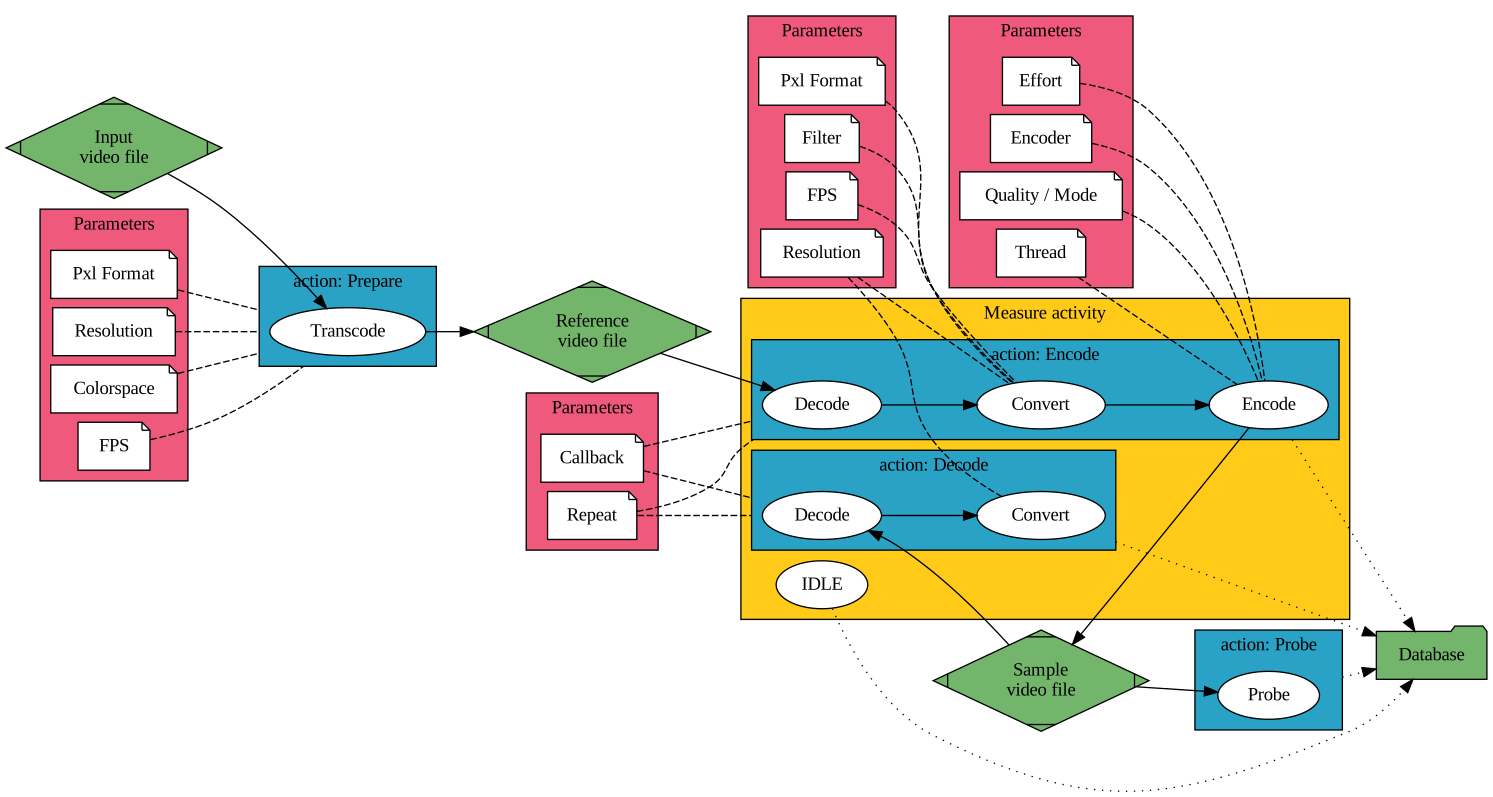
This is the pipeline used for measurements:
Example of result
Download and merge two datasets with this bash command:
mendevi merge svtav1_vs_rav1e_vs_aom.db x264_vs_openh264.db -o /tmp/av1_h264.dbExample of energy and rate distortion video encoding, on a single video for several profiles:
mendevi plot /tmp/av1_h264.db -x rate -x energy -y vmaf -c encoder -m effort -wy profile -f "ref_stem=='park_joy'"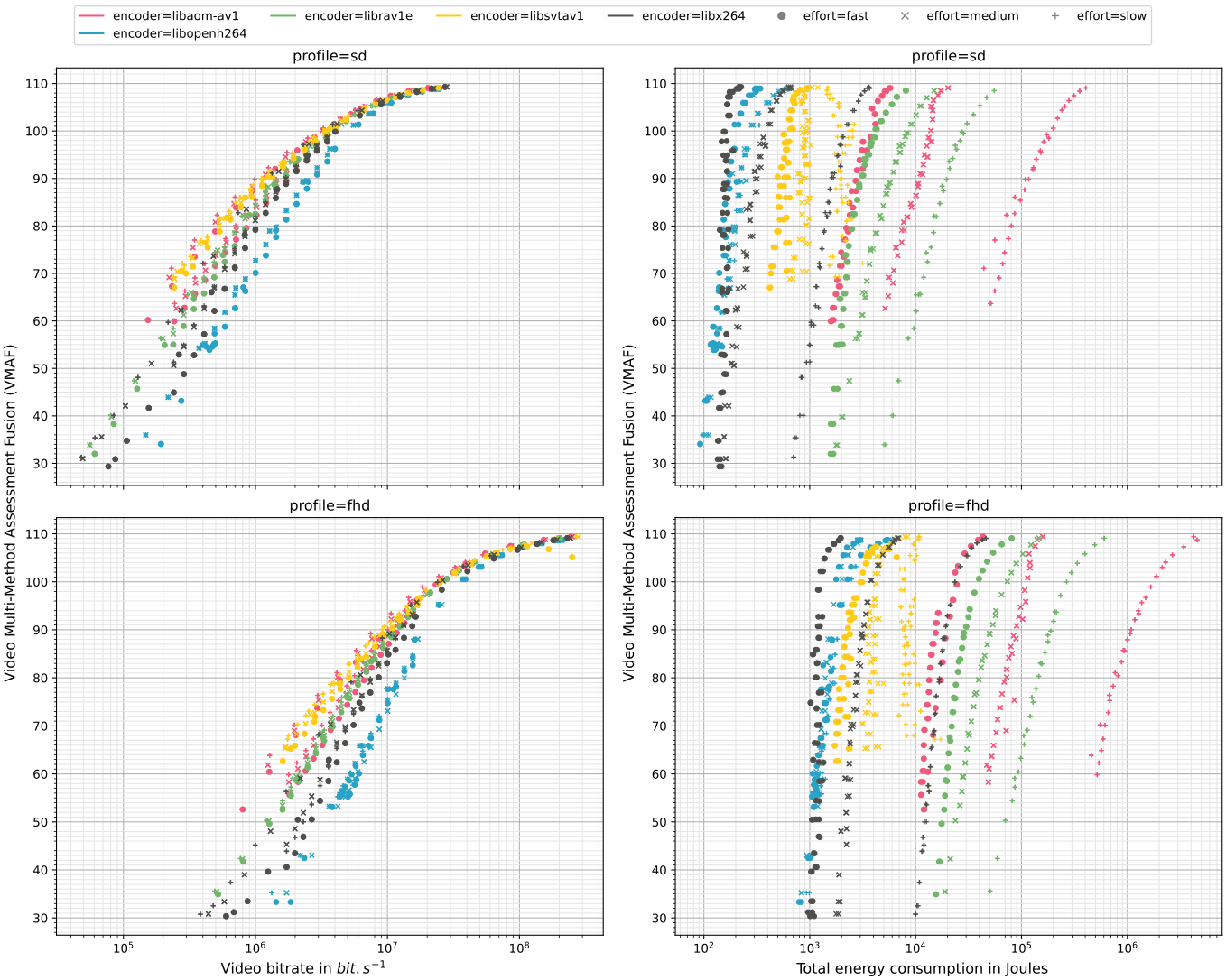
Alternatives
The GREEM video encoding measurement tool.
The MVCD database also includes video encoding and decoding energy measurements.
The COCONUT database also includes video decoding measurements.
The SEED and VEED dataset offers a comprehensive LCA and GPU measurements.
Citation
If this work is helpful for your research, please consider citing it.
@software{mendevi,
    author = {Robin Richard and Thomas Maugey and Anne-Cecile Orgerie},
    title = {{Mendevi}: Measures of Encoding and Decoding of Videos},
    date = {2026-09-12},
    url = {https://gitlab.inria.fr/rrichard/mendevi},
    version = {1.3.6},
    license = {GPLv3},
    note = {Python software and dataset for measuring video encoding and decoding},
    keywords = {video encoding, decoding, energy, complexity, quality, dataset},
    organization = {Inria},
    location = {Rennes, France},
}1 maintainer

Metadata
1 maintainer
Release files for mendevi 1.3.6
For a detailed explanation of source distributions (sdists) and built distributions (wheels), please see the package formats documentation.
Source distribution (sdist)
| File | Size | Uploaded | |
|---|---|---|---|
| mendevi-1.3.6.tar.gz | 4.1 MB | Details |
Release files / mendevi-1.3.6.tar.gz
| Download URL | mendevi-1.3.6.tar.gz |
|---|---|
| Size | 4.1 MB |
| Tags | Source |
|
SHA-256 checksum How to use checksums |
497ace5435c5e05534e400e7da7f6cb76c2f9eebf591467c0fb7ef2964435aae
|
|
BLAKE2b-256 checksum How to use checksums |
f58c0c58c2cc4879f3a6f4248980c6130de312cd535da44b646e497da1a9dbec
|
| Upload date | |
|
Uploaded using Trusted Publishing? What is trusted publishing? |
No |
| Uploaded via |
twine/7.0.0 CPython/3.14.2
|














