
mesh2cad


Turn 3D meshes (STL/OBJ/PLY) into real, editable CAD (STEP) — fitted planes, cylinders, spheres, and cones instead of triangle soup. CLI + MCP server for AI agents. MIT, pure Python on top of OpenCascade.
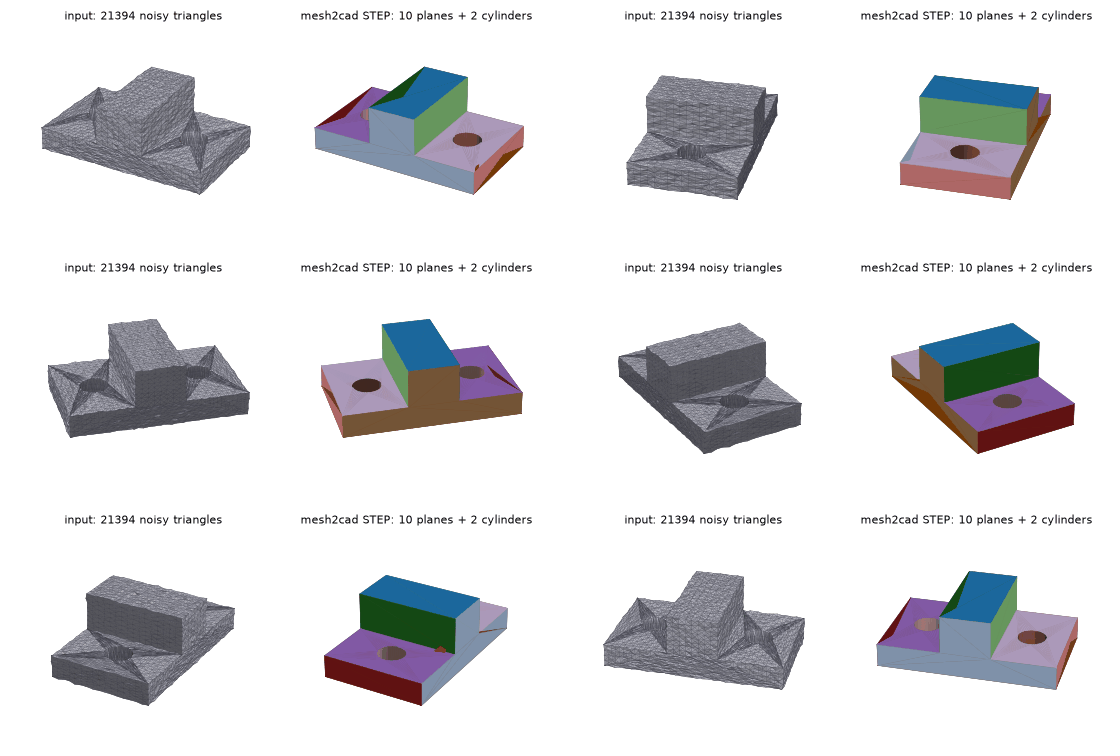
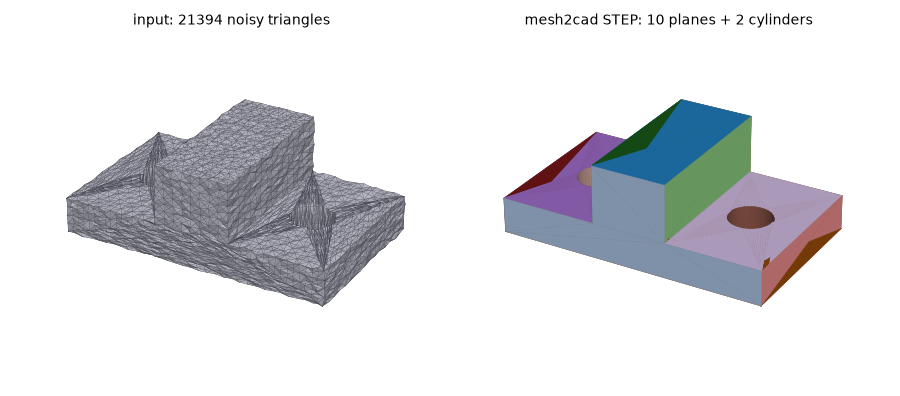
Left: 21k-triangle mesh with 0.1 mm noise. Right: the STEP mesh2cad writes — 10 planes + 2 cylinders, max deviation 0.05 mm from the true part.
Install
pip install mesh2cad              # CLI + STEP
pip install "mesh2cad[mcp]"       # + MCP server
pip install "mesh2cad[cadquery]"  # + run/verify generated CadQuery scripts
Use
mesh2cad convert part.stl -o part.step --tol 0.1 --report report.md
mesh2cad report part.stl --json
--tol ≈ the noise / accuracy of your mesh in model units (default 0.1 % of the bounding-box diagonal).
Output: STEP + fidelity report — method (exact / faceted-hybrid / faceted), face types, solid validity, two-sided Hausdorff / RMS deviation, volume error, % area per surface type.
Editable parametric CadQuery script
For simple prismatic parts mesh2cad can also write a CadQuery Python script where every dimension is a named parameter, so you change a number and re-run instead of editing B-rep faces:
mesh2cad convert bracket.stl --cadquery bracket.py   # add -o bracket.step to also write STEP
python bracket.py                                    # -> bracket.step
# --- parameters ---
base_x           = 40.0  # base length (X)
base_y           = 30.0  # base width (Y)
base_t           = 6.0  # base thickness (Z)
...
hole_1_d         = 6.0  # diameter
hole_1_x         = 0.0
hole_1_y         = 0.0
hole_1_csk_d     = 12.0  # countersink diameter
hole_1_csk_angle = 90.0  # countersink angle
Make the hole 2 mm bigger: set hole_1_d = 8.0 and run it again.
Supported: Z-up box/plate base, rectangular pads on the top face, vertical holes (through, blind, countersunk) and vertical bosses (straight, drafted, chamfered). Values are rounded to clean numbers (5.997 → 6.0) when that stays within --tol. Before writing, the script is executed and compared with the mesh (needs cadquery installed); if the part is outside this vocabulary or the script deviates, nothing is written and the command exits with code 2 and the reason. Use STEP output for everything else.
MCP server (Claude Desktop, Cursor, …)
{ "mcpServers": { "mesh2cad": { "command": "mesh2cad", "args": ["mcp"] } } }
Tools: convert(input_path, output_path?, tol?, cylinders?, spheres?, cones?), analyze(input_path, tol?, cylinders?, spheres?, cones?), report(input_path, tol?, cylinders?, spheres?, cones?), to_cadquery(input_path, output_path?, tol?) (returns the parameters and measured deviation). spheres and cones default on.
Listed on Glama and the TensorBlock MCP catalog.
How it works
- Load + clean mesh (trimesh); Taubin-smoothed copy for normals.
- Region growing into planes; strip chains and leftovers are fitted as cylinders, spheres, or cones (normal-ray / algebraic / constant-normal-angle fits, robust nonlinear refinement). A coaxial cylinder + cone component (countersink, chamfered pin) is split by normal-to-axis angle first. Small noisy patches that tile a sphere are merged into one spherical region. Split/redundant regions are merged and absorbed.
- Exact B-rep (OCP / OpenCascade): plane polygons from triple-plane intersections, circles from plane ∩ cylinder and plane ∩ sphere, plane ∩ cone, cylindrical faces, spherical caps and zones, conical frustums, sewn into a solid and validated.
- Fallbacks: hybrid faceted solid (vertices snapped to fitted surfaces, coplanar triangles merged), then raw faceted solid.
- Fidelity report against the input mesh.
Self-test benchmark
Ground-truth cadquery parts → tessellated + subdivided (≤ 2 mm edges) → Gaussian vertex noise → mesh2cad → compared with the truth. 3 seeds, worst case shown (python benchmarks/run.py); the same cases run in CI.
| part | noise σ (mm) | exact | faces (plane/cyl[/sph[/cone]]) | Hausdorff (mm) | RMS (mm) | vol err % | time s |
|---|---|---|---|---|---|---|---|
| cube | 0.0 | 3/3 | 6/0 | 0.000 | 0.000 | 0.00 | 0.7 |
| cube | 0.05 | 3/3 | 6/0 | 0.019 | 0.006 | 0.07 | 0.6 |
| cube | 0.2 | 3/3 | 6/0 | 0.075 | 0.026 | 0.34 | 0.6 |
| l_bracket | 0.0 | 3/3 | 8/0 | 0.000 | 0.000 | 0.00 | 0.9 |
| l_bracket | 0.05 | 3/3 | 8/0 | 0.040 | 0.006 | 0.03 | 1.0 |
| l_bracket | 0.2 | 3/3 | 8/0 | 0.216 | 0.026 | 0.15 | 1.0 |
| stepped_block | 0.0 | 3/3 | 11/0 | 0.000 | 0.000 | 0.00 | 2.1 |
| stepped_block | 0.05 | 3/3 | 11/0 | 0.032 | 0.006 | 0.02 | 2.3 |
| stepped_block | 0.2 | 3/3 | 11/0 | 0.136 | 0.022 | 0.07 | 2.1 |
| plate_with_hole | 0.0 | 3/3 | 6/1 | 0.015 | 0.002 | 0.00 | 1.9 |
| plate_with_hole | 0.05 | 3/3 | 6/1 | 0.028 | 0.006 | 0.05 | 1.9 |
| plate_with_hole | 0.2 | 3/3 | 6/1 | 0.078 | 0.023 | 0.18 | 1.9 |
| boss | 0.0 | 3/3 | 7/1 | 0.027 | 0.006 | 0.01 | 1.9 |
| boss | 0.05 | 3/3 | 7/1 | 0.031 | 0.007 | 0.04 | 2.5 |
| boss | 0.2 | 3/3 | 7/1 | 0.090 | 0.016 | 0.07 | 3.5 |
| ribbed_plate | 0.0 | 3/3 | 10/2 | 0.013 | 0.002 | 0.00 | 2.3 |
| ribbed_plate | 0.05 | 3/3 | 10/2 | 0.028 | 0.005 | 0.03 | 2.4 |
| ribbed_plate | 0.2 | 3/3 | 10/2 | 0.108 | 0.020 | 0.12 | 2.3 |
| spherical_dome | 0.0 | 3/3 | 6/0/1 | 0.065 | 0.007 | 0.04 | 1.9 |
| spherical_dome | 0.05 | 3/3 | 6/0/1 | 0.067 | 0.008 | 0.06 | 2.0 |
| spherical_dome | 0.2 | 3/3 | 6/0/1 | 0.241 | 0.028 | 0.25 | 1.9 |
| spherical_pocket | 0.0 | 3/3 | 6/0/1 | 0.046 | 0.004 | 0.02 | 2.2 |
| spherical_pocket | 0.05 | 3/3 | 6/0/1 | 0.057 | 0.005 | 0.03 | 2.1 |
| spherical_pocket | 0.2 | 3/3 | 6/0/1 | 0.075 | 0.015 | 0.13 | 2.1 |
| countersunk_plate | 0.0 | 3/3 | 6/1/0/1 | 0.039 | 0.003 | 0.01 | 2.2 |
| countersunk_plate | 0.05 | 3/3 | 6/1/0/1 | 0.055 | 0.009 | 0.07 | 2.1 |
| countersunk_plate | 0.2 | 0/3 | 16322/0, 16324/0 | 0.745 | 0.130 | 0.17 | 41.6 |
| tapered_boss | 0.0 | 3/3 | 7/0/0/1 | 0.086 | 0.011 | 0.05 | 1.8 |
| tapered_boss | 0.05 | 3/3 | 7/0/0/1 | 0.095 | 0.012 | 0.05 | 1.7 |
| tapered_boss | 0.2 | 3/3 | 7/0/0/1 | 0.123 | 0.025 | 0.22 | 1.7 |
| chamfered_boss | 0.0 | 3/3 | 7/1/0/1 | 0.053 | 0.005 | 0.02 | 2.9 |
| chamfered_boss | 0.05 | 1/3 | 16461/0, 16473/0, 7/1/0/1 | 0.160 | 0.035 | 0.08 | 31.6 |
| chamfered_boss | 0.2 | 0/3 | 16565/0, 16569/0, 16570/0 | 0.703 | 0.133 | 0.26 | 34.8 |
"exact" = valid B-rep with the true face count. All rows are the worst of 3 seeds from python benchmarks/run.py (v0.3.0). Rows with fewer than 3/3 exact fell back to a faceted solid (face count = triangles): noisy narrow countersink/chamfer bands don't constrain a cone yet, so CI checks those parts only where they are exact.
Limits (v0.4)
Planes, cylinders, spheres, and cones. Cylinders must end on planes perpendicular to their axis (through-holes, bosses, pins). Spheres are exact when each boundary loop is a single plane ∩ sphere circle (domes, spherical bosses, spherical pockets, and zones between two parallel planes). A sphere that runs into an edge or a cylinder falls back to the hybrid solid — vertices are still snapped onto the fitted sphere, but the face stays faceted. Cones are exact when they run between two planes perpendicular to their axis: countersinks, chamfered holes and bosses, drafted/tapered bosses. Cones may also meet a coaxial cylinder (countersunk hole, chamfered pin). A cone that ends in its apex falls back to the hybrid solid, and countersinks are reliable up to ~0.05 mm noise, narrow chamfers on clean meshes only for now (wide drafted walls up to 0.2 mm). No fillets or free-form yet.
Development
pip install -e .[dev]
pytest
python docs/make_demo.py   # regenerate images (needs matplotlib, pillow)
License: MIT
1 maintainer

Metadata
1 maintainer
Release files for mesh2cad 0.4.1
For a detailed explanation of source distributions (sdists) and built distributions (wheels), please see the package formats documentation.
Source distribution (sdist)
| File | Size | Uploaded | |
|---|---|---|---|
| mesh2cad-0.4.1.tar.gz | 768.9 kB | Details |
Built distribution (wheel)
| File | Interpreter | ABI | Platform | Reset |
|---|---|---|---|---|
| mesh2cad-0.4.1-py3-none-any.whl | Python 3 | none | any | Details |
Total release size: 802.1 kB
Release files / mesh2cad-0.4.1.tar.gz
| Download URL | mesh2cad-0.4.1.tar.gz |
|---|---|
| Size | 768.9 kB |
| Tags | Source |
|
SHA-256 checksum How to use checksums |
4903abdacfea6fda5fe48019120416bdba69b902d94bb4b44f376456c84b6430
|
|
BLAKE2b-256 checksum How to use checksums |
91c5b1c370083194919dcff3113ffd2f7f8cf01f4d7f69591ab6f9fb406fa738
|
| Upload date | |
|
Uploaded using Trusted Publishing? What is trusted publishing? |
Yes |
| Uploaded via |
twine/7.0.0 CPython/3.13.14
|
Provenance
Provenance describes where a file came from. On PyPI, provenance is shared via attestations, which provide a verifiable record of the build or publishing details. View details, limitations and caveats.


PyPI Publish Attestation
PyPI verified that this artifact, at this checksum, originated from the publisher listed below.
Signed by GitHub Actions, verified by PyPI on Oct 16, 2026.
Transparency logRelease files / mesh2cad-0.4.1-py3-none-any.whl
| Download URL | mesh2cad-0.4.1-py3-none-any.whl |
|---|---|
| Size | 33.2 kB |
| Tags | Python 3 |
|
SHA-256 checksum How to use checksums |
79e40c4ee052bf8f1bc0845e191df41f2898390836cd83a19542f17c02851378
|
|
BLAKE2b-256 checksum How to use checksums |
aa8bd3ba9646cde97c50f89ab28f5d8718b836c00eeed4b0aa51e00e185a066a
|
| Upload date | |
|
Uploaded using Trusted Publishing? What is trusted publishing? |
Yes |
| Uploaded via |
twine/7.0.0 CPython/3.13.14
|
Provenance
Provenance describes where a file came from. On PyPI, provenance is shared via attestations, which provide a verifiable record of the build or publishing details. View details, limitations and caveats.
PyPI Publish Attestation
PyPI verified that this artifact, at this checksum, originated from the publisher listed below.
Signed by GitHub Actions, verified by PyPI on Oct 16, 2026.
Transparency log













