
metamath-py
A python interface to Metamath
install
$ pip install --user metamath-py
basic usage
Loading a .mm file (may take a minute for large databases):
>>> import metamathpy.database as md
>>> import os
>>> db = md.parse(os.path.join(os.environ["HOME"], "metamath", "set.mm"))
Change the path depending on where you installed metamath or downloaded set.mm, which you can quickly do with
wget https://raw.githubusercontent.com/metamath/set.mm/refs/heads/develop/set.mm
Access any statement by its label, for example the major premise of the modus ponens axiom:
>>> db.statements['maj'] # uses a named tuple data structure
Statement(label='maj', tag='$e', tokens=['|-', '(', 'ph', '->', 'ps', ')'], proof=[])
>>> " ".join(db.statements['maj'].tokens) # more human readable
|- ( ph -> ps )
Access any inference rule by the label of its consequent:
>>> db.rules['ax-mp']
<metamathpy.database.Rule object at 0x7fe21f099370>
>>> print(db.rules['ax-mp']) # more human readable
ax-mp $a |- ps $.
disjoint variable sets: set()
  wph $f wff ph $.
  wps $f wff ps $.
  min $e |- ph $.
  maj $e |- ( ph -> ps ) $.
It has fields for the consequent and hypotheses
>>> db.rules['ax-mp'].consequent
Statement(label='ax-mp', tag='$a', tokens=['|-', 'ps'], proof=[])
>>> db.rules['ax-mp'].essentials
[Statement(label='min', tag='$e', tokens=['|-', 'ph'], proof=[]), Statement(label='maj', tag='$e', tokens=['|-', '(', 'ph', '->', 'ps', ')'], proof=[])]
Verify a proof to construct the proof tree in memory:
>>> import metamathpy.proof as mp
>>> root, steps = mp.verify_proof(db, db.rules['a1i'])
root is a ProofStep object representing the final step of the proof; it is the root of a proof tree. The nodes of that tree are other ProofStep objects and the values in the steps dictionary; the corresponding key is the step's conclusion. ProofSteps display like strings but have the following attributes:
>>> root
ax-mp |- ( ps -> ph )
>>> root.conclusion # the conclusion of this step of the proof
('|-', '(', 'ps', '->', 'ph', ')')
>>> root.rule # the rule used to justify this step
<metamathpy.database.Rule object at 0x7fe21f099370>
>>> root.rule.consequent # in this case it is ax-mp
Statement(label='ax-mp', tag='$a', tokens=['|-', 'ps'], proof=[])
>>> root.substitution # the variable substitution that unified ax-mp with this step
{'ph': ('ph',), 'ps': ('(', 'ps', '->', 'ph', ')')}
>>> root.dependencies # the other steps on which this one was justified
{'wph': ProofStep(conclusion=[wph] wff ph), 'wps': ProofStep(conclusion=[wi] wff ( ps -> ph )), 'min': ProofStep(conclusion=[a1i.1] |- ph), 'maj': ProofStep(conclusion=[ax-1] |- ( ph -> ( ps -> ph ) ))}
The dependencies are a dictionary where keys are the labels of the rule's hypotheses, and values are the other proof steps that satisfied those hypotheses. These can be thought of as the children of the root in the proof tree.
You can instantiate a gym-like environment that operates similarly to metamath solitaire. Initialize it with a database and reset to a blank proof state, optionally with a claim you want to prove:
>>> from metamathpy.environment import Environment
>>> env = Environment(db)
>>> env.reset(claim=db.rules['mpd'])
(<metamathpy.database.Rule object at 0x74ad291f37c0>, [], [])
It returns a state tuple (claim, proof, stack). Rule applications are treated like actions and their labels are saved in the proof list. The stack is updated according to the metamath proof verification algorithm. To apply a rule, provide it as an action at the current step:
>>> env.step("wph")
((<metamathpy.database.Rule object at 0x74ad291f37c0>, [], [ProofStep(conclusion=[wph] wff ph)]), '')
>>> env.step("wps")
((<metamathpy.database.Rule object at 0x74ad291f37c0>, [], [ProofStep(conclusion=[wph] wff ph), ProofStep(conclusion=[wps] wff ps)]), '')
>>> env.step("wi")
((<metamathpy.database.Rule object at 0x74ad291f37c0>, [], [ProofStep(conclusion=[wi] wff ( ph -> ps ))]), '')
>>> env.step("wi")
((<metamathpy.database.Rule object at 0x74ad291f37c0>, [], [None]), '2 hypotheses != 1 dependences')
The step returns a (state, msg) tuple. msg is empty if the rule was valid, otherwise it contains an error message and the top of stack is None.
Environments can be deep-copied if you want to use them in a branching tree search:
>>> env.reset()
(None, [], [])
>>> env.step("wph")
((None, ['wph'], [ProofStep(conclusion=[wph] wff ph)]), '')
>>> env2 = env.copy()
>>> env.step("wi")
((None, ['wph', 'wi'], [None]), '2 hypotheses != 1 dependences')
>>> env2.step("wps")
((None, ['wph', 'wps'], [ProofStep(conclusion=[wph] wff ph), ProofStep(conclusion=[wps] wff ps)]), '')
user interface (in-progress)
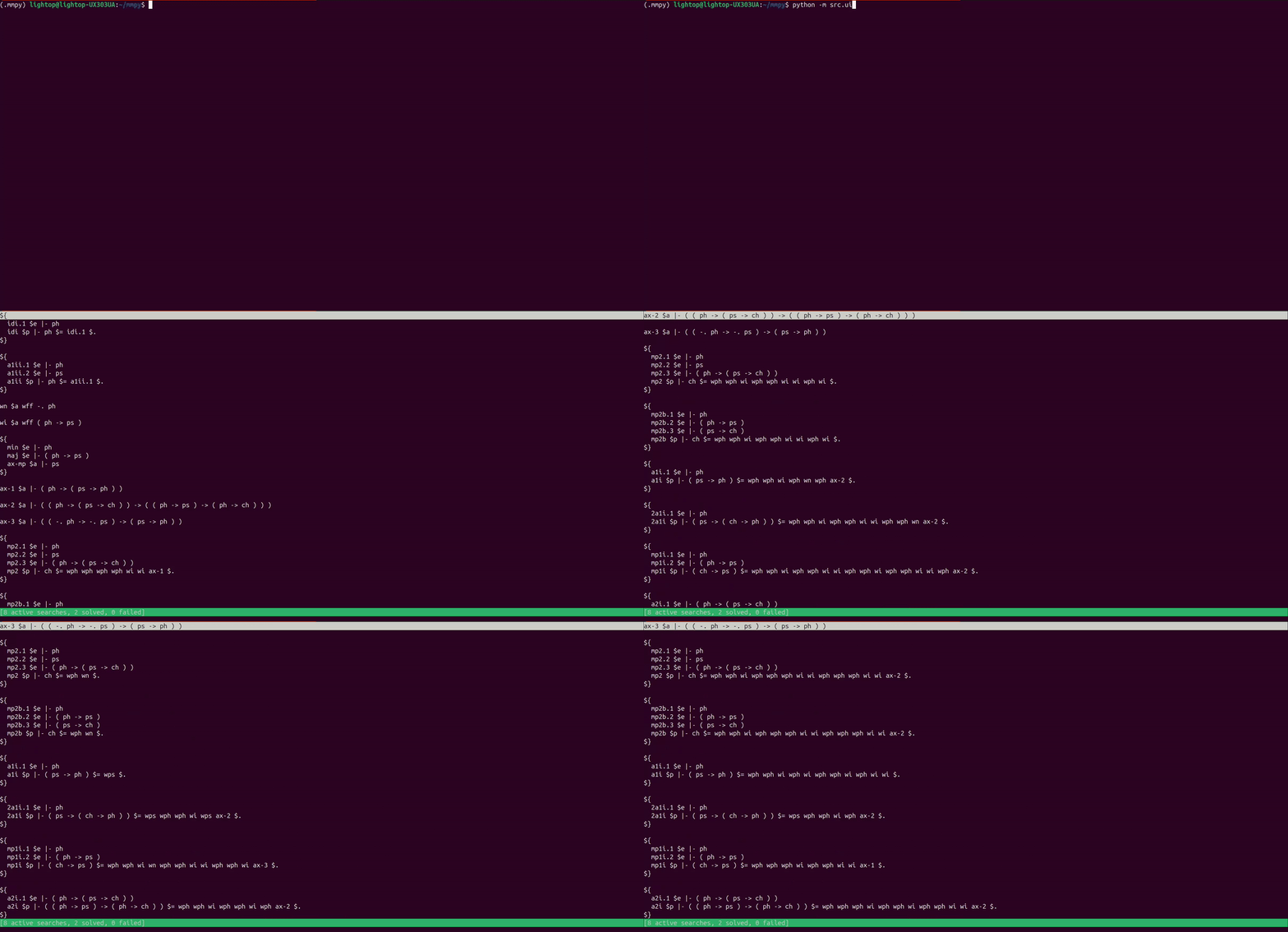
A TUI (requires blessed) that shows live proof searches in a Metamath database:
1 maintainer

Metadata
1 maintainer
Release files for metamath-py 0.1.0
For a detailed explanation of source distributions (sdists) and built distributions (wheels), please see the package formats documentation.
Source distribution (sdist)
| File | Size | Uploaded | |
|---|---|---|---|
| metamath_py-0.1.0.tar.gz | 39.0 kB | Details |
Built distribution (wheel)
| File | Interpreter | ABI | Platform | Reset |
|---|---|---|---|---|
| metamath_py-0.1.0-py3-none-any.whl | Python 3 | none | any | Details |
Total release size: 89.7 kB
Release files / metamath_py-0.1.0.tar.gz
| Download URL | metamath_py-0.1.0.tar.gz |
|---|---|
| Size | 39.0 kB |
| Tags | Source |
|
SHA-256 checksum How to use checksums |
a2be36bc9d33d03fc5bd84ee02d16f6d8101afd3684f24bf0224c0faf2c105da
|
|
BLAKE2b-256 checksum How to use checksums |
5a36f1c87cb633824602278fb949da513ab0f7e21075c3f5b2bbfe02a38fedaf
|
| Upload date | |
|
Uploaded using Trusted Publishing? What is trusted publishing? |
No |
| Uploaded via |
twine/6.2.0 CPython/3.12.3
|
Release files / metamath_py-0.1.0-py3-none-any.whl
| Download URL | metamath_py-0.1.0-py3-none-any.whl |
|---|---|
| Size | 50.8 kB |
| Tags | Python 3 |
|
SHA-256 checksum How to use checksums |
9809314cd2b4e539d3f91d4fc292fa82949453acdef1bbb4226b3fdbbc14da85
|
|
BLAKE2b-256 checksum How to use checksums |
af98cf58781508e69f0ed21073c3a13f6ba7f66f479ae4c9d68faa34784bdfed
|
| Upload date | |
|
Uploaded using Trusted Publishing? What is trusted publishing? |
No |
| Uploaded via |
twine/6.2.0 CPython/3.12.3
|














