
MGP-Imputer: Missing Value Imputation with Deep Gaussian Processes


A PyTorch-based implementation of Missing Gaussian Processes (MGP) for missing value imputation, wrapped in a user-friendly scikit-learn compatible API.
This package allows you to seamlessly integrate Deep Gaussian Process models into your data preprocessing pipelines for robust and uncertainty-aware imputation. It is based on the paper "Gaussian processes for missing value imputation".
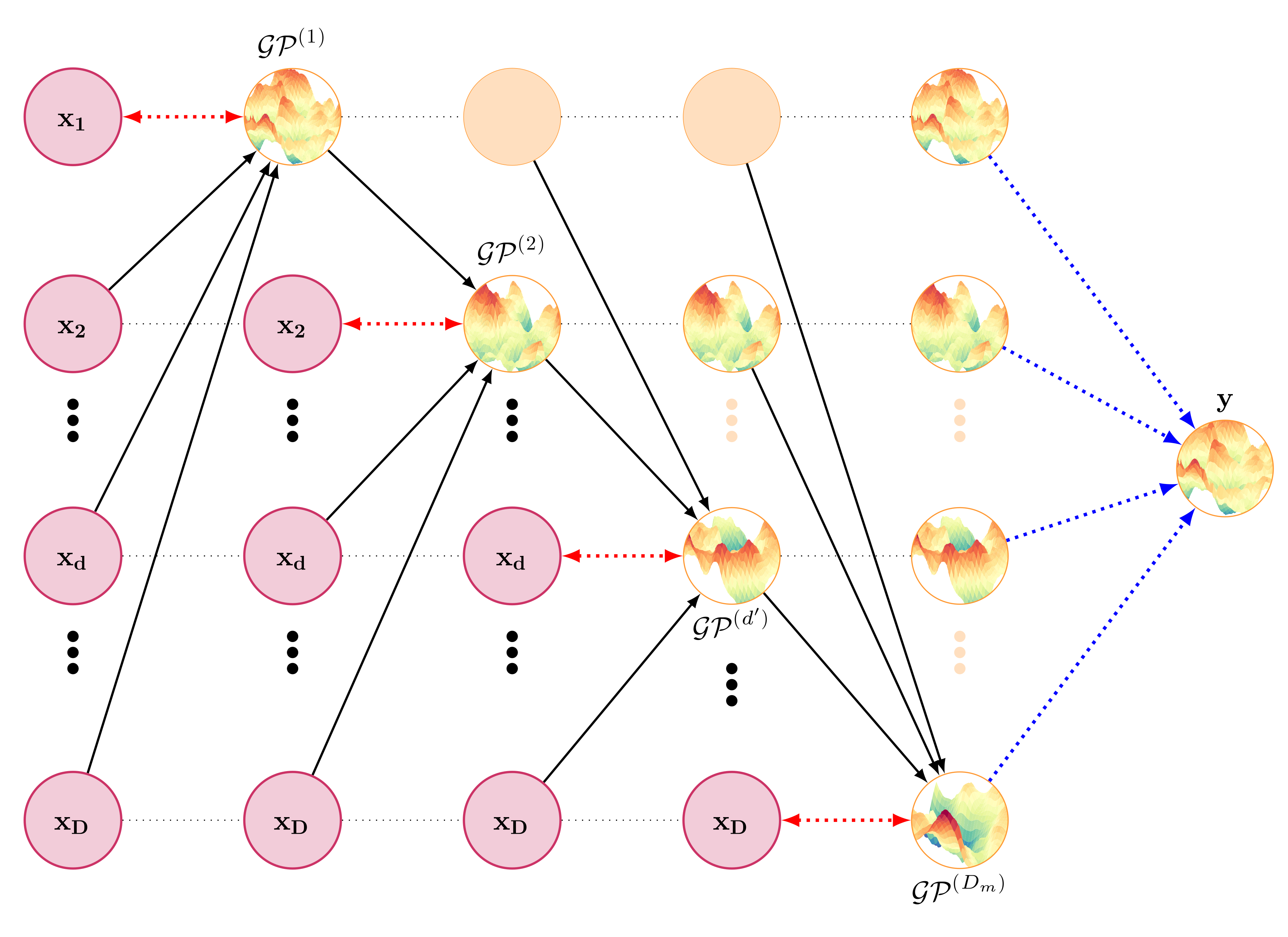
Chained Deep Gaussian Processes for Missing Value Imputation
Features
- Scikit-learn Compatible: Use
fit,predict, andfit_transformmethods just like any other scikit-learn transformer. - Two Imputation Strategies:
chained(Default): Builds a separate GP layer for each feature with missing values, modeling dependencies in a chained fashion (MGP).holistic: Builds a single, multi-output Deep GP to model all features simultaneously.
- Probabilistic Imputation: Returns both the imputed values and the standard deviation, giving you a measure of uncertainty for each imputed value.
- GPU Accelerated: Leverages PyTorch to run on CUDA devices for significant speedups.
Installation
You can install mgp-imputer directly from PyPI:
pip install mgp-imputer
Quick Start
Here's how to use MGPImputer to fill in missing values (np.nan) in your dataset.
import numpy as np
import pandas as pd
from mgp import MGPImputer

# 1. Create a synthetic dataset with 20% missing values
np.random.seed(42)
n_samples, n_features = 200, 5
X_true = np.random.rand(n_samples, n_features) * 10
X_missing = X_true.copy()
missing_mask = np.random.rand(n_samples, n_features) < 0.2
X_missing[missing_mask] = np.nan

print(f"Created a dataset with {np.sum(missing_mask)} missing values.")

# 2. Initialize the MGPImputer
# Strategies can be 'chained' (default) or 'holistic'
imputer = MGPImputer(
    imputation_strategy='chained',
    n_inducing_points=100,
    n_iterations=1000, # Use more iterations for real data
    learning_rate=0.01,
    batch_size=64,
    verbose=True,
    seed=42
)

# 3. Fit on the data and transform it to get imputed values
# The imputer returns the imputed data and the standard deviation of the predictions
X_imputed, X_std = imputer.fit_transform(X_missing)

# 4. Evaluate the imputation quality
rmse = np.sqrt(np.mean((X_imputed[missing_mask] - X_true[missing_mask])**2))
print(f"\nImputation complete.")
print(f"RMSE on missing values: {rmse:.4f}")

# The result is a complete numpy array
print("\nImputed data shape:", X_imputed.shape)
print("Number of NaNs in imputed data:", np.isnan(X_imputed).sum())
Configuration Options
You can customize the behavior of MGPImputer by passing parameters during initialization. Here are the available options:
| Parameter | Description | Type | Options | Default |
|---|---|---|---|---|
imputation_strategy |
The core method for building the GP model. | str |
'chained', 'holistic' |
'chained' |
imp_init |
The standard imputation method used to create an initial complete dataset before training the GP. | str |
'mean', 'median', 'knn', 'mice', 'constant' |
'mean' |
kernel |
The covariance function for the Gaussian Process layers. | str |
'matern', 'rbf' |
'matern' |
n_layers |
The number of layers in the Deep GP. Only used when imputation_strategy is 'holistic'. |
int |
> 0 |
2 |
n_inducing_points |
The number of inducing points for the sparse GP approximation. A higher number is more accurate but computationally slower. | int |
> 0 |
100 |
n_iterations |
The total number of optimization iterations to run during training. | int |
> 0 |
10000 |
n_samples |
The number of Monte Carlo samples drawn to approximate the model's posterior distribution. | int |
> 0 |
20 |
learning_rate |
The learning rate for the Adam optimizer. | float |
> 0 |
0.01 |
batch_size |
The number of data points in each mini-batch during training. | int |
> 0 |
128 |
likelihood_var |
The initial variance of the Gaussian likelihood function. | float |
> 0 |
0.01 |
var_noise |
The initial variance of the white noise added to the kernel. | float |
> 0 |
0.0001 |
verbose |
If True, prints training progress and other information. |
bool |
True, False |
True |
use_cuda |
If True, the model will run on a GPU if one is available. |
bool |
True, False |
True |
seed |
A random seed for reproducibility of results. | int |
≥ 0 |
0 |
Citation
If you use this work in your research, please cite the original paper:
Jafrasteh, B., Hernández-Lobato, D., Lubián-López, S. P., & Benavente-Fernández, I. (2023). Gaussian processes for missing value imputation. Knowledge-Based Systems, 273, 110603. Missing GPs
License
This project is licensed under the MIT License.
1 maintainer

Download files
Download the file for your platform. If you're not sure which to choose, learn more about installing packages.
Source Distribution
Built Distribution
Filter files by name, interpreter, ABI, and platform.
If you're not sure about the file name format, learn more about wheel file names.
Copy a direct link to the current filters
File details
Details for the file mgp_imputer-0.1.2.tar.gz.
File metadata
- Download URL: mgp_imputer-0.1.2.tar.gz
- Upload date:
- Size: 35.5 kB
- Tags: Source
- Uploaded using Trusted Publishing? No
- Uploaded via:
twine/6.1.0 CPython/3.10.12
File hashes
| Algorithm | Hash digest | |
|---|---|---|
| SHA256 |
168c87b5eb013eca1648ec3a8400ff6dca0ff609972f33b75dce35da8a69895b
|
|
| MD5 |
00e0975944fa97b0b6c17a655a801967
|
|
| BLAKE2b-256 |
0d0c6ea3f98f3cbd947ce614064fd908593dcaa3f7eccec0bc2fb5f9380096c3
|
File details
Details for the file mgp_imputer-0.1.2-py3-none-any.whl.
File metadata
- Download URL: mgp_imputer-0.1.2-py3-none-any.whl
- Upload date:
- Size: 38.4 kB
- Tags: Python 3
- Uploaded using Trusted Publishing? No
- Uploaded via:
twine/6.1.0 CPython/3.10.12
File hashes
| Algorithm | Hash digest | |
|---|---|---|
| SHA256 |
786fa3e9e1eb7ba80ac4380421da864cba81014fad350b7154e6455fc14d3780
|
|
| MD5 |
0856f7697726c6d6a54f16535e35f4dd
|
|
| BLAKE2b-256 |
fd8d4e8b2220573edca1a353791e4a10a361513c37757794d4c09faf802be476
|














